Andrés Caicedo, Jacqueline Gordón (2022). Evaluation of usability and accesibility of the interactive tool for psychopedagogical recovery "Titiapp". In: Human Interaction & Emerging Technologies (IHIET 2022): Artificial Intelligence & Future Applications. AHFE Open Access, vol. 68, pp. 113–119. https://doi.org/10.54941/ahfe1002720
The present study aims to establish an evaluation of the interactive tool for psychopedagogical recovery “Titiapp” based on usability and accessibility metrics, as well as to collect impressions from the user's point of view in order to establish their experience in the process of interaction with the tool. For this purpose, a methodology that consists of a series of techniques is applied; starting with the analysis of similarities to determine differentiating elements, accessibility and usability evaluations that present a first approach to the tool, and finally, the collection of the user's experience in their interaction with the application, triangulated with other techniques such as the interview and the evaluative focus group. This allows extracting valuable information to establish recommendations that promote the improvement of the tool from the perspectives of efficiency, effectiveness and satisfaction.
To address this study, it is necessary to understand that technological tools have become an influential element in educational environments. From this, the educational system has been reconfigured with the insertion of digi- tal platforms as learning enhancing resources, as established by Roig-Vila (2016). Traditional paradigms have been affected by the transformation of pedagogical dynamics that see information and communication technologies as a potential support to improve the teaching-learning processes.
One of the possible limitations in this context is the level of digital “lite- racy” of the users, as well as others related to technology, such as access to resources, connections, performance of the hardware and software used for the training process. This is where interactive tools must be able to adapt to the needs of users and their context.
Barroso & Cabero (2010), agree that technologies within the spectrum of education have generated a strong impact, since, from the discipline of design, these platforms can obey endless categories and uses. The support to educational processes with means of information transmission such as text,
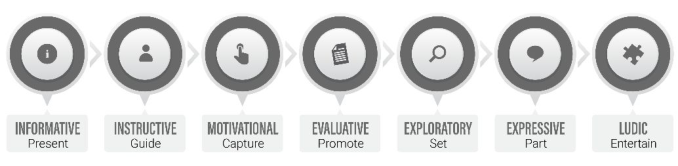
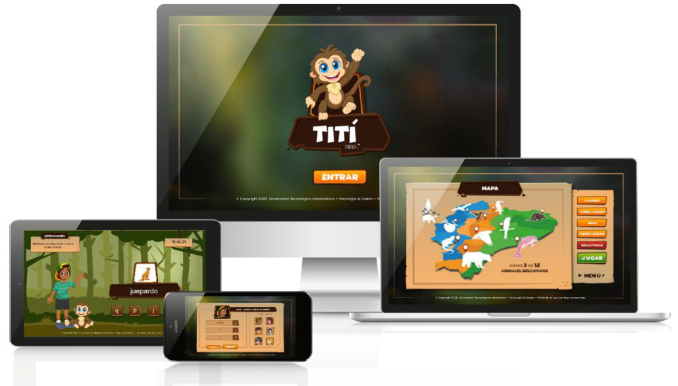
Figure 1: Functions of interactive platforms in education. (Adapted from Ochoa, 2014).Figure 2: TitíApp application user interface.
animation, video, sound and, exponentially, interaction, ensure that the lear- ning process has motivational factors, which makes teaching a dynamic and effective space.
In this sense, interactive platforms fulfill various functions in the teaching exercise as detailed by Ochoa (2014), from an informative approach to a playful learning context (see Figure 1).
The User-Centered Design philosophy served as the basis for the develo- pment of “Titíapp” (Caicedo et al., 2019), understood as a methodology directed towards the design of products governed by the characteristics and needs of the user and its context. Thus, it is of utmost importance to deeply know those who will use the tool, how they react to the narrative, design, inte- raction and other elements in order to take permanent actions to improve the platform and consequently the user experience, as established by Montero, Fernández and Iazza (2004).
“TitíApp” is an interactive tool that contributes to the process of psycho- pedagogical recovery, focused on children who are attending a basic level of education. This application, which is supported by the inclusion of new tech- nologies, contains a series of exercises that serve as support in reading-writing training (see Figure 2). The development of the exercises is contextuali- zed from a specific theme in order to generate motivational factors that accompany the learning process.
Evaluation of Usability and Accessibility of the Interactive Tool 115
The User-Centered Design as a differentiating factor in its construction, based on the in-depth study of the user, needs and context, results in a narra- tive line addressed throughout the exercise of interaction with the tool that starts from a local theme such as the rescue of endangered animal species in Ecuadorian territory.
According to Rosenblat (2017), it is important to consider and recognize the regional diversity of language, historical influence, cultural and geogra- phical contexts, and other aspects that renew and enrich language. On the contrary, the pedagogy of experience points to the development of narrative- driven thinking that, from the point of view of empathy, facilitates the linkage of learning processes with the user’s experiences in their environment, as concluded by Domingo & Ferré (2010).
On the other hand, conceiving a platform that meets the standards of access and use is necessary to become a contribution to education. Puyu- elo, M., Val, M., Merino, L., & Gual, J. (2018). mention that, “Only through a correct interaction with the devices and the experience of a correct feed- back, the user gets to participate in the content and enrich their knowledge.” (p. 104). In training spaces, the use of interactive technological resources cannot be subject to accessibility limitations, be they cultural, contextual or functional. On this basis, it is practically impossible to conceive the design outside the needs of the people to whom the developed product or service is addressed (Montero, 2017, p. 15).
A study conducted by Lanna & Oró (2016, p. 79) shows that the main barriers of technology in the service of education are focused on problems regarding access, visual design, interaction, adaptability and navigation; which shows that these were not conceived under the needs of users and the characteristics of the context. Thus, the need arises to evaluate the “Titiapp” tool so that it is consistent with the reality of children, since this promotes motivational experiences and reinforces the learning process.
Focusing on the user, his experiences and context, according to Domingo & de Larra Ferré (2010), is of vital importance for the construction of what is known as the pedagogy of experience, which requires a common thread that starts from the empathy to the connection of learning with the user’s experiences.
In order for the interactive tools and the user interface to meet the obje- ctive of being easy to use and navigate, it is important to establish permanent studies that allow evaluating the standards met both in access and use. More- over, it is necessary to evaluate to detect problems in the tasks performed by the user, which can affect the achievement of objectives and consequently the user experience.
Frequently, the failure of interactive platforms is generated as a result of “classic” errors (Fernández, 2019, p. 40) that occur in the 3 moments of creation of an interactive product: during the process, when the product is conceived or in the development phase. Additionally, the publication of the application or versions without iteration processes that allow detecting errors and opportunities to constantly improve and enhance the tool, aggravate the failure in the market. In this sense, since “Titiapp” is at a stage prior to its launch on the market, it demands a study to strengthen the tool.
116 Caicedo and Gordón
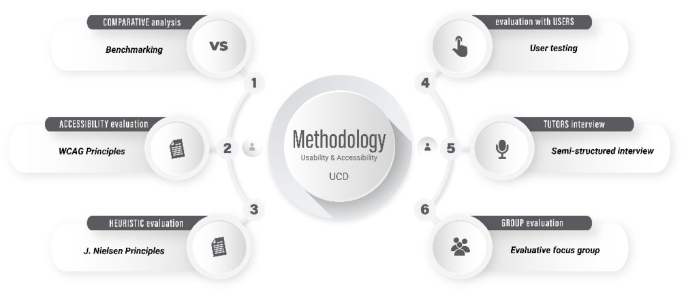
Figure 3: Methodology for usability and accessibility evaluation.
Both accessibility and usability play an important role in the development of interfaces, encompassing contexts beyond the limitations of people. This promotes standards that present appropriate conditions for interaction and thus, equate the possibilities of users with respect to products and/or services (Fernández, 2019, p. 173). Under this background, it is important to esta- blish accessibility evaluations throughout the design process of interactive platforms to identify problems.
METHODOLOGY
It consists of carrying out an evaluation of the interactive tool “Titíapp”, to determine accessibility and usability problems in order to establish recom- mendations that contribute to the improvement of the user experience through the application of qualitative techniques that allow obtaining infor- mation on the current state of the tool and the users’ points of view in relation to the interaction with the application (See Figure 3).
Techniques: Comparative analysis (Benchmarking), to recognize platforms with similar characteristics: their attributes, strengths, weaknesses and differentiating ele- ments that generate a favorable user experience. In this way, improvement considerations can be established to enhance the tool with a view to its launch on the market.
Accessibility evaluation, to identify access barriers that the user may encounter in the process of interacting with the platform and the contents in general. For this purpose, a manual evaluation is carried out with the sup- port of specialized software, based on the principles established in the Web Content Accessibility Guidelines (WCAG), which allows the identification of errors that limit the construction of the “Universal Design” principle around the tool.
Heuristic usability evaluation, to subject the application to a usability inspection against a set of heuristic principles (Nielsen, 1994) that allow dete- cting problems and barriers in the application. This as a starting point prior
Evaluation of Usability and Accessibility of the Interactive Tool 117
to contact with real users of the tool. Since “Titíapp” is an interactive appli- cation that is shallow in its extension, a high-level evaluation is carried out to study the entire application.
User testing (Nielsen, 2012), as an evaluative technique that involves the user in a real use scenario and allows detecting usage errors and inconsi- stencies in the design and interaction based on the execution of a series of tasks. This is to establish a contrast with the results obtained in the heuristic evaluation Semi-structured interview, as a qualitative technique based on conver- sation, in this case of study, applied to the moderators of the interaction process (accompanying tutors in the sessions) to collect information about the experience that is evident in the children at the time they work with the application.
Evaluative focus group (Joyce, 2019), to obtain evaluations of the tool from the user’s perspective, in this case, the children who previously worked with the application. This technique is considered particularly for its chara- cteristic of application under a group dynamic, since the target user is part of an age group between 6 and 12 years old, the interaction is estimated to be more effective in contrast to a system of individual interviews.
CONCLUSION
Starting from the perspective that the use of technologies within the field of education is in growing demand, and that these technological tools must meet requirements that cover the needs of users, generating favorable experie- nces that promote and complement learning, the present study was proposed, where the tool for psychopedagogical recovery “Titíapp” was analyzed from the point of view of access and use, prior to its launch on the education market.
For this purpose, a series of analyses were carried out to identify attributes and shortcomings of the tool with respect to its market peers, as well as acces- sibility and use barriers that could be found in its interface and navigation. In this sense, the application was studied using techniques that directly involved the user, as well as expert evaluations. This whole process allowed to glimpse the problems that should be corrected in the application to improve its per- formance and consequently the user’s experience during the interaction from the perspectives of attraction, functionality and reflection.
In general terms, the studies with users showed that the experience with the application is favorable, and the level of acceptance of the platform is high, as a result of the simple navigation structure, the visual resources and narrative that are adjusted to the regional diversity of language and cultural contexts, which becomes a motivating element in the interaction. This connects directly with the concepts of the pedagogy of experience that goes from empathy to the linkage with learning from the user’s experiences. It is here where the importance of designing with a focus on the needs and contexts where the user develops on a daily basis is marked.
Accessibility barriers must be eliminated in all senses when it comes to inte- ractive platforms for education, since this promotes motivating experiences
118 Caicedo and Gordón
for the user and, consequently, contributes to a simple and intuitive intera- ction dynamic. Therefore, it is essential to focus on the debugging of errors that could generate interaction problems in children with different characte- ristics, whether cognitive, functional, motor or contextual. Thus, possible accessibility barriers will be minimized when faced with an interactive tool that provides all the facilities for a fluid, intuitive and satisfactory interaction.
Enhancing the experience throughout the user’s journey in the process of reading and writing correction becomes one of the qualities that the “Titíapp” tool should offer as a differentiating element, based on an assessment of the child’s current situation in an automated way and connected to the entire Titiapp.ec platform. Accordingly, at the end of the sessions with the tool, the results obtained will allow to contrast and analyze the level of improvement in the child and, consequently, the efficiency and effectiveness of the “Titíapp” platform in the educational context.
Finally, it is of utmost importance to establish a periodic follow-up of the application based on constant measurements that allow to continue identif- ying possible errors that may reduce user satisfaction levels, as well as to identify new implementations that enrich the user experience.
REFERENCES
Barroso, J., & Cabero, J. (2010). La investigación educativa en TIC. España: Síntesis S.A. Caicedo, A., Gordón, J., Gordillo E., Quintero J., Cajas N., Narváez S., Ron G.,
Ediciones Morata. Fernández, P. (2019). Usabilidad web: teoría y uso. Ediciones de la U. https://bv.uni r.net:2769/es/ereader/unir/127064?page=41 Initiative, W. W. A. (2021). Visión general sobre la evaluación de la accesibilidad
web. Web Accessibility Initiative (WAI). https://www.w3.org/WAI/test-evaluate/ es#intro Joyce, A. (2019). Usability Testing with Minors: 16 Tips. Nielsen Norman Group.
https://www.nngroup.com/articles/usability-testing-minors/ Lanna, L. C., & i Oró, M. G. (2016). Análisis del diseño interactivo de las mejores apps educativas para niños de cero a ocho años. Comunicar: Revista científica iberoamericana de comunicación y educación, (46), 77-85. Montero, Y., Martín Fernández, F. J., & Iazza, G. (2004). Diseño web centrado en el
usuario: usabilidad y arquitectura de la información. Hipertext. net, (2). Montero, H. Y., & Martín, F. (2005, 7 septiembre). La Experiencia del Usuario. No solo usabilidad. http://www.nosolousabilidad.com/articulos/experiencia_del_usu ario.htm Montero, Y. H. (2017). Experiencia de Usuario: Principios y Métodos. Independently
Published. Nielsen, J. (2012). How Many Test Users in a Usability Study? Nielsen Norman Group. https://www.nngroup.com/articles/how-many-test-users/ Nielsen, J. (1994). Heuristic Evaluation: How-To: Article by Jakob Nielsen. Nielsen
Norman Group. https://www.nngroup.com/articles/how-to-conduct-a-heuristic- evaluation/
Evaluation of Usability and Accessibility of the Interactive Tool 119
Ochoa, I. (2014). Trabajo colaborativo docente-estudiante para la producción de materiales educativos computarizados (MEC) en la asignatura Multimedia de la mención informática de la Facultad Ciencias de la Educación de la Universi- dad de Carabobo. ARJE. Revista de Postgrado FACE-UC, 6(15). Recuperado de http://servicio.bc.uc.edu.ve/educacion/arje/arj15/art04.pdf Puyuelo, M., Val, M., Merino, L., & Gual, J. (2018). Diseño inclusivo accesibilidad
a la cultura (1.a ed., Vol. 1). Universitat Politécnica de Valencia. Rello, L., Bayarri, C., & Gorríz, A. (2013). Nuevas Ideas en Informática Educativa TISE 2013. Nuevas Ideas en Informática Educativa TISE 2013. https://blog.changedyslexia.org/wp-content/uploads/2017/03/tise2013.pdf Roig-Vila, R. (2016). Tecnología, innovación e investigación en los procesos de
enseñanza-aprendizaje. Barcelona: Editorial Octaedro. Rosenblat, Á. (2017). Estudios sobre el español de América 2. Athenaica Ediciones Universitarias.
Read this individual research paper free through the original publisher, or explore the full digital proceedings book.
ISBN 978-1-958651-44-5
Explore this ISBN in the AHFE Bookstore ↗Listed in the July 2026 bookstore catalogue; search by ISBN to confirm current availability · Digital book purchase optional