A Virtual Reality (VR) system is introduced in a modified Observe, Orient, Decide and Act (OODA) model for supporting information sharing and situational awareness in a complex environment. At the same time the cooperation and interaction with technical systems provided organizational process support, guidance, and monitoring of system critical functions.The OODA-VR combination enabled bringing together theoretical discussion and practicality responses in dyadic interactions. With the integration of simulation and reality metaphors the reasoning process takes advantage of environmental and cognitive knowledge constructed from complexity tasks. From an interaction viewpoint a more holistic view has been performed in relation to the problem space to articulate the thinking and decision-making process.The provision of the VR interaction capability has been extended to reshape quantum formalism and reality and complement the measurement collapse theory. This baseline has been explored through the Theory of Decoherence and Everettian quantum mechanics representing different measurements outcomes on a system.
“So far as the laws of mathematics refer to reality, they are not certain. And so far, as they are certain, they do not refer to reality” (Einstein, 1921).
This definition drawn from history is reported to introduce the contex- tual human performance subject in dynamic situations where problems are constantly changing and require a flow of actions or decisions to reach a target or a goal (Brehmer, 1990). In addition, decisions need to be taken in real time to establish common and coordinated actions. This objective requi- res enhanced abilities to work and communicate technical solutions about a task at hand. In situations where decision makers require sharing the same information, successful communication is the most important facet among cooperation in different working environments. In reality interpretation cle- arly shape the expectations of a situation where meaning is either negotiated or constructed (Clark, 1996). The concept of Human Machine Interaction (HMI) begins with Fitts list of statements citing a comparison table with spe- cific functions performed by human or a machine (Fitts, 1954). The allocation of tasks to the human and machine are continuously represented within the
Quantum Reality Perspectives in Dyadic Interactions 511
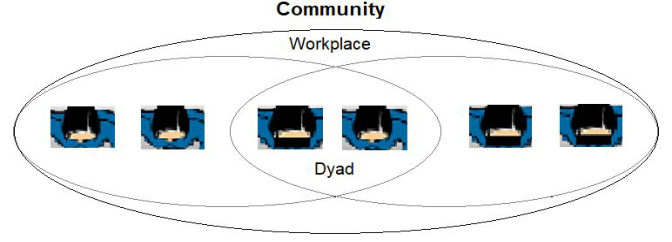
Figure 1: Analysis of different interactions.
science of Human Factors and recognized through contiguous layers of inter- pretation and knowledge. In a time-critical environment, the introduction of a VR technology solution allowed new ways of collaboration as well refi- ning the context of interaction in Human-Virtual Reality Interaction (HVRI), that could also be integrated between the distinct HMI to Human-Robot Interaction (HRI). Interaction can take place between a team of people, VR users and probably the most common between one person and one VR user. This combination displayed in Figure 1 is made of units primarily defined as “…dyad if its units are two…” (Peirce: CP 1.447, 1931-60).
How does exactly the sharing take place requires more in-depth apprecia- tion and awareness of the fundamental parts of the Human VR relationship. The introduction of the VR technological capability enabled new possibilities to support information sharing elements represented through the command, control, communication, and information or C3I system hierarchies of con- trol and development time (Howell, Lane, Laux, Anderson, Holden, 1993). In formulating the relationship between the human and the VR technological capability a broad definition of VR is presented: “Inducing targeted behavior in an organism by using artificial sensory sti- mulation, while the organism has little or no awareness of the interference” (La Valle, 2019).
The definition introduces keywords as: organism, artificial and sensory, in addition through computation user’s inputs are received and rendered to displays. The computational model alone does not represent a complete VR system without the organic interaction experienced with artificial sti- muli transmitted from standard hardware and software engineering parts. As a result, the stimulation of human’s senses extends the VR engineering capability through a commonly known reverse engineering to the human physiological and perceptual activity. It can be added that information gained from the real world contemplate itself a physical process where information inputs are perceived through the VR carrier. Through this transformation the configuration space is always transformed or configured through the chan- ging position in the space and time domain, one important feature of this operation is the number of the Degrees of Freedom (DoF) of the sense organ, corresponding to the following motions: side-to-side motion, vertical motion, and closer-further, with yaw, pitch, and roll rotations (La Valle, 2019). An
512 Compierchio and Tretten
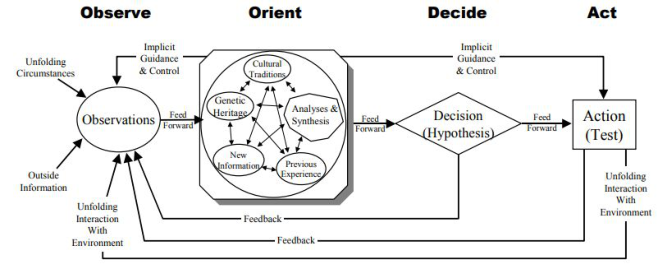
Figure 2: Modified OODA loop.
intuitive approximation of such a numerical relation classifies a VR system as a measuring apparatus and the organism as an observer taking measurements.
AUGMENTING THE OODA LOOP Specifically, in problematic situations “…complexity cannot in principle be without reference to the change in the world that are both produced by the system’s responses and responded to…” (Brandon, 2009). This resolution flares dealing with complexity since involves constructing feedback loops rea- ching the observer and the environment. This definition also emphasizes the “human interpretation capability” (Lee, 1999). in meeting demanding tasks. In this context, the OODA loop or Boyd Cycle (Boyd, 1987) has been intro- duced in recognition of the looping role in decision making. Figure 2 presents a modified OODA-Loop showing four feed forward stages with direct feed- back (Brehmer, 2005). In principle, Boyd described how the organization gathers information of a situational event, understanding the basic, decide the action and then execute the action.
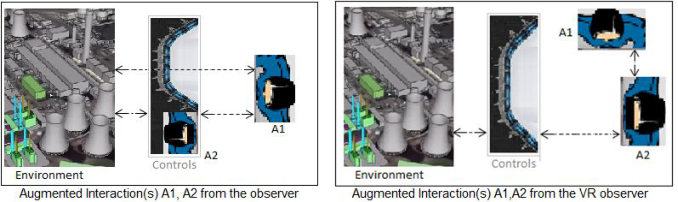
Here, the mind is constantly adapting to the environment while capturing and interpreting information. The orient stage itself contains ten intercon- nections clearly demonstrating the dubious simplicity of the loop structure. The decision-making process is laid sequentially instead of parallel proces- sing that ties with the multiple activation of brain areas when responding to multiple stimuli from the real and virtual world. The most important feature refers to implicit and control that enhances a deep and intuitive under- standing of the situation at hand in a fast-paced environment. Furthermore, the loop does not mention time, in light to Boyd’s emphasis “we should operate at a faster tempo… or, better get inside the adversary’s Observation- Orientation-Decision-Action loop” (Boyd, 1987). In this context, VR is positioned to enhance interaction, productivity and improve the relationship between models and data with the distinguished “simulative model-based reasoning” approach (Nersessian et al., 2002). The interaction dyad consi- sts of two members working together or individually to perform a task. The team executing a complex activity in a plant environment, needs to consider safety constraints imposed by the process. The time dimension is extremely
Quantum Reality Perspectives in Dyadic Interactions 513
Figure 3: Augmented prospects of dyadic interactions.
relevant as the OODA development is not only random and subjected to con- straints that could slender the decision process (Figure 3). As for the context of the dyadic interaction the behavioral and cognitive aspects of each mem- ber are captured in different ways, especially mental models sharing reality characteristics and reasoning practices.
An important aspect of reasoning in all their complexity can be distingui- shed according to Peirce deductive reasoning: “Deduction is that mode of reasoning which examines the state of things …” (Peirce: CP 1.66, 1931-60). A VR system ensures that the OODA loop information is constantly upda- ted in supporting the decision-making process and control potential actions triggered by reality that is uncertain.
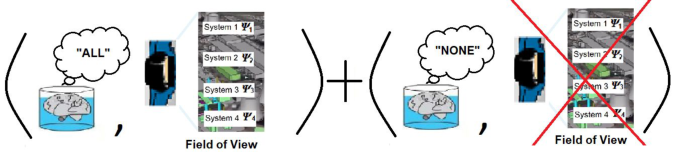
VIRTUAL AND QUANTUM REALITY “The full mind alone is not clear, and truth dwells in the deeps” (Heisenberg, 1971). During a VR experience the brain deeply may form neural structures for unreal places within environments that do not exist, this conception holds the principle that the cause-and-effect approach are not always valid since coming to light chaotic conditions. In addition, to amplify this conception from a microscopic to a macroscopic condition since humans are made of atoms, atoms are parts of the quantum world. This Everettian viewpoint stands out while invoking through the biological influence of fields as perce- ption and physiology the influence of quantum physics into the science of quantum biology. Furthermore, in a virtual world an observer can look at multiple systems simultaneously while taking notes, just as pictured:
“All elements of a superposition must be regarded as simultaneously exi- sting” (Everett, 1957) in other words identified with reality. From these viewpoints, the VR composite system can be treated according to Quantum rules from von Neumann dynamics principles: (von Neumann, 1955)
1. When no measurements are made, systems are described by wave functions obeying the Schrödinger equation.
2. When measurements are made the wave function collapses, the system instantaneously and randomly jumps (within realities) to a state that has or has no a determinately measured property. The probability of each post- measurement outcome is the wave function square of the initial projection
514 Compierchio and Tretten
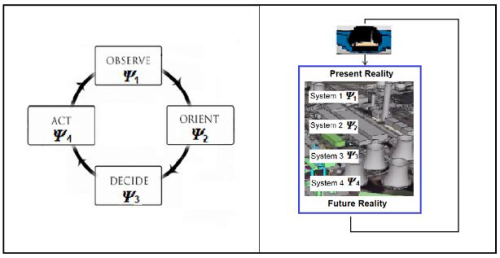
Figure 4: OODA measurements and observer reality association.
state to the final state. In this view the physical systems within the acting envi- ronments are described by the state function ψ in a Hilbert space providing information of the probabilities of the observational results. This informa- tion is made within a characterized OODA loop systems where the dyadic interaction takes place (Fig. 4).
The scenario of association with the wave function represents the behavior of the system, in this case it represents each of the four system states as indica- ted with the OODA loop, while the reality decision loop represents the state of discovery of every system’s observable. When such a holistic approach of the decision making is put to work the VR observer follows the representation of each system in a state of superposition that means the system observable are at each step or stages of the OODA-loop with a value of x′x′… x′′′x′′′′ in ψ′ψ′…ψ′′′ψ′′′with a probability 1/4. The decision follows four possible outcomes: status on, status off, standby or tripped.
In the classical case, when the VR observer (vro) is performing a measure- ment on a system there are four possibilities: [vro] = [S1, ON]; [vro] = [S2, OFF]; [vro] = [S3, standby];
[vro] = [S4, tripped] The observer freely performs periodical measurements to build up an OODA picture of the situation, however since the system state can be virtually measured simultaneously quantum mechanically allows for superpositions:
In practice the observer’s mind is either viewing the state of all systems or no systems at all (Figure 5).
This relationship initiated on the Everittan quantum formulation describes the physical system’s interaction without modeling the observers as servo- mechanisms and memory devices. In this case, the former is replaced by the mechanisms of a VR system and the latter by human memory. The decision-making process is further supported by decoherence, an environ- mental entanglement operation in quantum mechanics relevant to both micro
Quantum Reality Perspectives in Dyadic Interactions 515
Figure 5: Superposition of virtual observed system states.Figure 6: Virtual induced-decoherence.
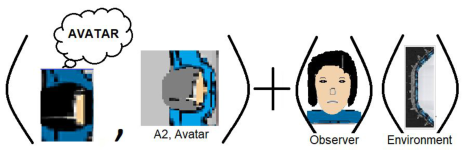
and macro systems. Decoherence states that any system is influenced by the environment as well the measurement and associated interpretation. A VR system allows a wide spectrum of visual interactions from an anonymous avatar to a 3D representation, all depends on how a VR observer decide to be seen. An illustration of a decoherence (Figure 6) of a VR composite system may be located in a control room for real or as an avatar.
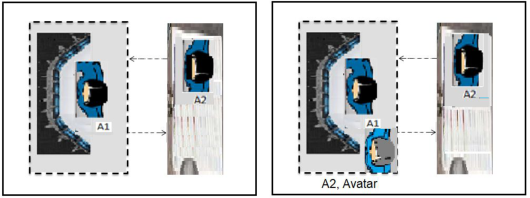
A VR observer positioned in an environment has decided to change his appearance, while another observer is looking to meet. Although, sharing the same environment, before entering the control room the observer will not know whether he will find a real person or an avatar. In either case the VR observer becomes entangled to the environment and interacting accor- ding to the Schrödinger equation with the observer. Since the VR observer does not maintain two separate entities, on a decoherence basis two possi- bilities would exist in superposition splitting the wave function. Having two observers allows to replicate the Wigner Friends experiment reported by Eve- rett where the laboratory in this case is a control room. In the control room the observer A1 is making some measurements on system S1, and record the results in a logbook, he knows the state function of S1 based on previous mea- surements and believes that the results would be undetermined. At the same time observer A2 who’s knowledgeable of the entire control room and A1 as composite system (A1 + S1) computes the state function weekly. Since A2 believes the state function calculation of what is going to be in the logbook implies that A1 is incorrect in assuming the indeterminacy of his measure- ments. When A2 enters the control room to view the logbook he already knows the logbook contents based on past memory of what occurred a week ago, however the results should have been decided when A2 entered the room (Figure 7).
But here there is an alteration to Wigner’s story. What A1 does not know is that A2 is also represented through an avatar that is already in the control
516 Compierchio and Tretten
Figure 7: Virtual presentation of the Wigner Friends experiment.
room, who’s looking what is being recorded on the logbook. Therefore, A2 does not need to enter the room at all, since he’s already aware of the results.
CONCLUSION
The exploration of the Human-Human VR dyadic interaction through the standardized OODA ideology, provided the possibility to widen the inte- raction context. A VR composite system allows many forms of interaction according to the universal simulation principle (La Valle, 2019) while advo- cating the “loopability” of the thinking process in a stepwise reality context. This scrutiny advocated Peirce’s figurative expressions of reasoning were devoted to both imaginative and actual mode of reality: “The mind has not as yet eaten of the fruit of the Tree of Knowledge of Truth and Falsity” (Pei- rce: CP 3.488, 1931-60). The virtual world has transformed social interaction through targeted activities allowing a virtual presence through a VR interface instead of a real one. In effect the VR interaction evolved in a superposi- tion of different reality, like a networked one through video capture and a real through some sort of social interaction. This representation could also correspond to neural (0,1) codes and as a superposition in the brain. This pos- sibility proved extremely useful in the implementation of the OODA loop as the observer performing the measurement could simultaneously access infor- mation covering system performance variable at each stage of the loop. This interpretation was assessed in a purely quantum sense without excluding the macroscopic size of the VR composite system. The consequences of the virtual phenomena are far beyond the simple contact, the most important argument made is the direct intervention drawn into it from the “fooled”to the felt pre- sence. Unsurprisingly, in virtue to von Neumann: “…it must be possible so to describe the extra-physical process of the subjective perception as if it were in reality in the physical world…”(von Neumann, 1955). This view was further substantiated by the observer physically interacting in a world that has been altered, just as Bohr noted “the observer cannot remain an unaffected and independent watcher” (Bohr, 1938). The exposed Everett assertion of mode- ling the observers within pure wave mechanics was confronted with a created reality where both the observer memory and the fully determinate measure- ment records existed. The nature of this phenomena implies a refinement to the standard Bohr’s interpretation:
Quantum Reality Perspectives in Dyadic Interactions 517
That is the state change of the observable is not due by the observation act (the wave function collapse) but by the fact that the reality has been altered by the observer reality (while performing the measurement).
REFERENCES
Acta Psychologica, Bohr, N. (1938) Natural Philosophy and Human Cultures, Atomic Physics and Human Knowledge 29-30. Boyd, J. (1987). A discourse on winning and losing. Maxwell Air Force Base, AL:
Air University Library Document No. M-U43947 (Briefing slides) Brandon, P. (2009) Seeking innovation: The construction enlightenment. Spon Press Brehmer, B. (1990) Dynamic decision making: Human control of complex systems. Brehmer, B. (2005) The Dynamic OODA Loop: Amalgamating Boyd’s OODA Loop and the Cybernetic Approach to Command and Control Assessment, tools and metrics. 10th International Command and Control Research and Technology Symposium the Future of C2. Clark, H. H. (1996) Using Language. Cambridge University Press Einstein, A. (1921) Theoretical Physicist and Nobel laureate, “Geometrie und
Erfahrung,” Lecture to Prussian Academy. Everett, H. (1957) Relative State’ Formulation of Quantum Mechanics, Reviews of Modern Physics, 29(3): 454–462. doi:10.1103/RevModPhys.29.454 Fitts, P. (1954). The information capacity of the human motor system in controlling
the amplitude of movement. Journal of Experimental Psychology, 47:381–391. Heisenberg, W. (1971). Physics and Beyond: Encounters and Conversations. World Perspectives vol. 42. Translated by Pomerans, Arnold J. New York: Harper & Row. Howell, W. C., Lane D. M., Laux L.F., Anderson L.A., Holden K.L., (1993) Visual
Display Principles for C3I System Tasks. ARI Research Note 93-19 La Valle, S. M. (2019) Virtual Reality. Cambridge University Press Lee, R. (1999) Technical Keynote Address, HUMAN FACTORS DIGEST NO.
14 Proceedings of the Fourth ICAO Global Flight Safety and Human Factors Symposium Nersessian, N. J. (2002) The cognitive basis of model-based reasoning in science In S. S. P. Carruthers & M. Siegal (Eds.). Cambridge: Cambridge University Press Peirce, C. S. (1931-60) Collected papers of Charles Sanders Peirce. Hartshorne Char-
les,. Weiss Paul,. Burks Arthur W,. (eds.). Cambridge, MA: Harvard University Von Neumann, J. (1955) Mathematical Foundations of Quantum Mechanics, Princeton: Princeton University Press. (Translated by R. Beyer from Mathematische Grundlagen der Quantenmechanik, Springer: Berlin, 1932.)
Read this individual research paper free through the original publisher, or explore the full digital proceedings book.
ISBN 978-1-958651-44-5
Explore this ISBN in the AHFE Bookstore ↗Listed in the July 2026 bookstore catalogue; search by ISBN to confirm current availability · Digital book purchase optional