Sarah Mandl, Jennifer Brade, Maximilian Bretschneider, Anabel Skripcak, Frank Asbrock, Bertolt Meyer, Georg Jahn, Philipp Klimant, Anja Strobel (2023). Social perception of Embodied Digital Technologies interacting with humans. In: Intelligent Human Systems Integration (IHSI 2023): Integrating People and Intelligent Systems. AHFE Open Access, vol. 69, pp. 186–196. https://doi.org/10.54941/ahfe1002836
Social perception of Embodied Digital Technologies (EDTs) governs their successful adoption. However, prior findings on processes governing the social perception of EDTs and corresponding attributions are inconclusive. With the present study, we investigate social perception and trustworthiness of robots and Telepresence Systems (TPS). 293 Participants rated five different EDTs after watching a short video sequence of a space sharing conflict between the EDT and a human in terms of anthropomorphism, sociability/morality, activity/cooperation, competence, and trustworthiness. We found differences between the robots for all four social dimensions. TPS were perceived differently only in terms of anthropomorphism. Trustworthiness was not attributed differently to the EDTs. We found associations between social perception of EDTs and personality traits. With our findings, we add to the growing body of research on social perception of EDTs and show that EDTs are indeed perceived differently in dependence of their design.
Interactions between humans and Embodied Digital Technologies (EDTs), that is, artificial agents physically represented in areas previously only clai- med by humans, are becoming more and more common. EDTs encompass, among others, robots and telepresence systems. Robots are physically embo- died artificial agents that have features to communicate with human beings via social interfaces (Meyer et al. 2022). Telepresence systems (TPS) enable people to perform actions in a distant or virtual location, for example to explore or communicate, as if they were physically present (Merriam-Webster
Social Perception of Embodied Digital Technologies Interacting With Humans 187
n.d.). Both systems have, especially under COVID-19 regulations, obvious advantages (Ruiz-del-Solar et al. 2021) that emphasize the importance of research in this area. However, apart from technical requirements, for exam- ple in terms of security and safety, perceptions of EDTs by users determine smooth integration of artificial agents in our society to construct viable hybrid societies. Social perception influences social interactions (Cuddy, Fiske, and Glick 2008). Prior research has identified two (warmth and com- petence) or three (sociability, morality, and competence) main dimensions of human social perception (Fiske et al. 2002, Kervyn, Fiske, and Yzerbyt 2015). Importantly, these perceptions govern behaviour towards others (Cuddy, Fiske, and Glick 2008).
In the case of social robots, which can be perceived as social partners under certain circumstances, social perception is especially important: Pre- vious studies showed that competence, warmth, sociability, and morality are attributed to EDTs to varying degrees (Carpinella et al. 2017, Bretschneider et al. 2022, Mandl et al. 2022c, McKee, Bai, and Fiske 2022). However, rese- arch has also shown that these dimensions might not be ideally suited for EDTs (Bretschneider et al. 2022, Mandl et al. 2022c). In the present study, we apply the Social Perception of Robots Scale (SPRS; Mandl et al. 2022b) instead in order to assess anthropomorphism, sociability/morality, and acti- vity/cooperation. Prior findings of static images showed that industrial robots were perceived as more competent than humanlike robots, e.g., Pepper (Soft- Bank Robotic), probably because of the clearly defined application area the industrial robot was shown in (Mandl et al. 2022c, Bretschneider et al. 2022). Social perception, precisely sociability, of EDTs is positively associa- ted with individual differences such as Need for Cognition (NFC) or affinity for technology interaction (ATI) (Mandl et al. 2022c). Tendency to anthro- pomorphize is positively associated with moral care and concern afforded to non-human agents (Waytz, Cacioppo, and Epley 2010). Attitudes tow- ard robots affect how people interact with robots (Nomura et al. 2008), and hence, should also be associated with social perception.
Trust, or trustworthiness, is another aspect of social robots required for responsible action and social interactions (Meyer et al. 2022). Humans need to trust robots, otherwise they will not be used as intended (Malle et al. 2020). Three factors, human, robot, and environmental ones, are associated with trust in a robotic teammate (Hancock et al. 2011). Both social perception and trust are associated with robotic design. However, evidence for or against a specific design (anthropomorphic, zoomorphic, or mechanical) is not yet clear.
THE PRESENT STUDY We will investigate the following hypotheses (H) and research questions (RQ): H1: The more morphologically humanlike a robot is designed, the more perceived (a) anthropomorphism, (b) sociability/morality, (c) activity/coope- ration is attributed to it. H2: The more morphologically humanlike a robot is designed, the less percei- ved competence is attributed to it.
H3: People identifying as female attribute less anthropomorphism to robots than people identifying as male. RQ1: Are different telepresence systems perceived differently in terms of perceived (a) anthropomorphism, (b) sociability/morality, (c) activity/coope- ration, and (d) competence? RQ2: Is there an association between (I) age and/or (II) gender of the users and attributions of (a) anthropomorphism, (b) sociability/morality, (c) acti- vity/cooperation, and (d) competence? RQ3: Is there an association between (I) negative attitudes toward robots and/or (II) tendency to anthropomorphize and/or (III) NFC and/or (IV) ATI of users and the perceived (a) anthropomorphism, (b) sociability/morality, (c) activity/cooperation, and (d) competence of different telepresence systems? RQ4: Is there an association between (I) negative attitudes toward robots and/or (II) tendency to anthropomorphize of users and the attributions of (a) anthropomorphism, (b) sociability/morality, (c) activity/cooperation, and (d) competence to robots? RQ5: Are there differences between various EDTs in terms of perceived trustworthiness?
METHODS
We pre-registered the study prior to data collection on OSF (https://osf.io /gzcx9/). In addition to the variables used in the present study, attributions of gender to the EDTs were collected and used for subsequent studies. All procedures were determined by the applicably body (Ethics committee of Chemnitz University of Technology) not to require in-depth ethics evalua- tion (#101552377). We report how we determined our sample size, all data exclusions (if any), all manipulations, and all measures in the study (Simmons, Nelson, and Simonsohn 2012).
Participants We conducted an a-priori-power analysis with G*Power (version 3.1.9.6; Faul et al. 2007) with the following parameters for ANOVA (fixed effects, omnibus, one-way): medium effect size f = 0.25; alpha-error probability: 0.05; power: 0.95; number of groups = 5, resulting in a total sample size of N = 305. The sample was composed of N1 = 100 participants acquired via Prolific Academic (www.prolific.co) and N2 = 250 participants acquired via social networks and university circulars. The total sample size was N = 350. 57 participants failed the attention check, resulting in a final sample size of N = 293. The mean age of the sample was M = 28.55 years (SD = 9.33). The sample consisted of 184 female, 106 male, and 2 non-binary participants and was mostly highly-educated, with 57.34% having obtained an university degree (high-school diploma: 31.40%, other degrees: 11.26%). None of the participants indicated that they did not obtain any degree. We tested for mul- tivariate outliers and did not find any. Thus, the final sample was used for subsequent analyses.
Social Perception of Embodied Digital Technologies Interacting With Humans 189
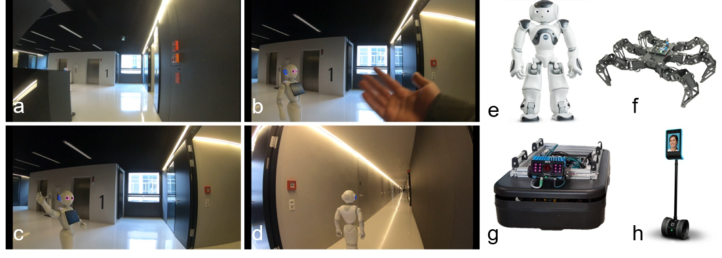
Figure 1: Screenshots of the stimulus material and pictures of the different robots.
Stimulus Material The stimulus material consisted of five videos of a space sharing conflict between a human being and five different EDTs with differing levels of humanlikeness (Figure 1): two anthropomorphic robots (Pepper (SoftBank Robotic; Figure 1a-d), Nao (SoftBank Robotic; Figure 1e)), one zoomorphic robot (PhantomX AX Metal hexapod MK-III (Interbotix Labs; Figure 1f)), and two telepresence robots (Automated Guided Vehicle (AGV) “Hubert” (developed by the Institute for Machine Tools and Production Processes, Che- mnitz University of Technology; Figure 1g), and Double 3 (Double robotics; Figure 1h)). The following interaction was shown from a first-person view (see Figure 1): the person walks down a corridor in a building (Figure 1a) and arrives at a location where two corridors cross. The person meets one of the robots, which approaches the person from the left. Both stop at the point where their paths cross. The human signals the robot via a hand gesture that it is granted right of way (Figure 1b). The robot reacts with either a wave (Pepper, Nao), a circular motion (PhantomX), or a wave by the person visi- ble on the tablet of the TPS (Figure 1c), and continues to drive away while the human briefly looks after it (Figure 1d). The videos are on average 20 seconds long with a deviation of +/−3 seconds due to different movement speeds of the robots. Videos were filmed using a GoPro camera (HERO6) and a gimbal stick. Due to the significantly lower speed of the Nao robot, the video was speeded by 1.5x.
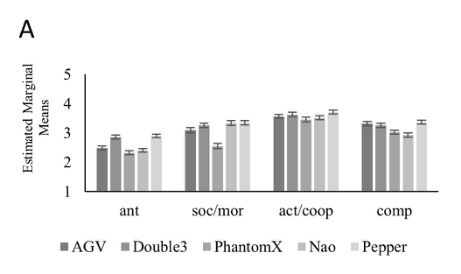
Items Social Perception. We used the Social Perception of Robots Scale (SPRS; (Mandl et al. 2022b) to assess three factors of social perception: anthropo- morphism (Cronbach’s α = .81), sociability/morality (Cronbach’s α = .86), and activity/cooperation (Cronbach’s α = .54). In total, 18 items were pre- sented on a semantic differential to be rated on a five-point Likert-scale, with the additional option to indicate that the attribution is not fitting for this robot/robots in general. We averaged the items of each factor scale (Figure 2A).
Competence. We used one item (competent-incompetent) rated on a semantic differential on a five-point Likert scale with the additional option
to indicate that the attribution is not fitting for this robot/robots in general (Figure 2A).
Trustworthiness. We used the short version of the MDMTv2 (Ullman and Malle 2019) comprising of one item that we translated into German in con- sultation with one author of the scale, B. Malle (personal communication, July 20, 2021). Participants were asked to rate how trustworthy they perceive the robot in question on a seven-point scale. If participants did not think that the attribute of trustworthiness is fitting for a robot, we provided an option to indicate this (Figure 2B).
Affinity for Technology Interaction. We used the German version of the Affinity for Technology Interaction (ATI) Scale (Franke, Attig, and Wessel 2019). Nine items were rated on a six-point scale to indicate whether peo- ple tend to interact with technological systems and averaged into a scale (Table 1).
Need for Cognition. We used the German short version of the Need for Cognition (NFC) scale (Bless et al. 1994), comprising of sixteen items to assess NFC. The items were rated on a seven-point scale. We calculated a sum score (Table 1).
Attitudes Toward Robots. To assess the attitude toward robots we used the German version (Bartneck et al. 2005) of the Negative Attitudes Toward Robots Scale (NARS; Nomura et al. 2008), comprising of fourteen items, rated on a five-point scale. We averaged the fourteen items, with higher scores indicating more negative attitudes toward robots (Table 1).
Tendency to anthropomorphize. To assess the tendency to anthropomor- phize, we used the German version of the Individual Differences in Anth- ropomorphism Questionnaire (IDAQ; Waytz, Cacioppo, and Epley 2010). Participants rated their agreement to fifteen statements on a 10-point scale. We calculated an average score (Table 1).
Social Perception of Embodied Digital Technologies Interacting With Humans 191
Table 1. Reliability analyses and descriptives.
Table available in the original PDF paper.
Scale Mean SD Cronbach’s α Min. Max.
ATI 3.68 1.04 .92 1.11 6.00 NFC 10.86 14.56 .89 −39.00 45.00 NARS 2.84 0.59 .79 1.36 4.71 IDAQ 3.20 1.32 .83 0.13 7.67 Notes. N = 293; ATI, potential range = 1 to 6; NFC, potential range = −48 to +48; NARS, poten- tial range = 1 to 5; IDAQ = Individual Differences in Anthropomorphism Questionnaire, potential range = 1–15.
RESULTS
We examined the data and found that the data was nested. This was the case for competence (ICC(1) = 0.21, F(280, 1016) = 2.56, p < .001, ICC(2) = 0.56), for anthropomorphism (ICC(1) = 0.18, F(179, 478) = 1.82, p < .001, ICC(2) = 0.45), for morality/sociability (ICC(1) = 0.35, F(126, 307) = 2.86, p < .001, ICC(2) = 0.65), for activity/cooperation (ICC(1) = 0.41, F(168, 369) = 3.41, p < .001, ICC(2) = 0.71), and for trustworthiness (ICC(1) = 0.20, F(259, 913) = 2.12, p < .001, ICC(2) = 0.53). We thus employed Mixed Models and, if applicable, post-hoc Tukey tests. The data showed a non-normal distribution, we therefore used bootstrapping with 10,000 iterations. We analyzed the data with R (Version 4.1.1.; R Core Team 2021).
H1 predicted that the more morphologically humanlike a robot is desi- gned, the more perceived (a) anthropomorphism, (b) sociability/morality, (c) activity/cooperation is attributed to it. The robots were perceived diffe- rently in terms of anthropomorphism (b = .29, SE = .04, t = 7.02). The most humanlike robot Pepper was perceived as more anthropomorphic than PhantomX (1M = .58, SE = .08, p < .001) and Nao (1M = .50, SE = .08, p < .001). Nao and PhantomX did not differ from each other in terms of perceived anthropomorphism (p = .603). We therefore partly confirm H1a. In terms of perceived sociability/morality, the robots differed significantly from each other (b = .39, SE = .05, t = 7.25). PhantomX was attributed less sociability/morality than Nao (1M = .80, SE = .10, p < .001) and Pep- per (1M = .80, SE = .10, p < .001). Pepper and Nao were attributed the same amount of sociability/morality (p = .999). We therefore partly confirm H1b. In terms of activity/cooperation, PhantomX and Nao did not differ from each other (p = .770). Pepper, however, was attributed more activit- y/cooperation than PhantomX (1M = .25, SE = .08, p = .011) and Nao (1M = .19, SE = .08, p = .049). We therefore partly confirm H1c.
H2 predicted that the more morphologically humanlike a robot is desi- gned, the less perceived competence is attributed to it. The robots were perceived differently in terms of attributed competence (b = .18, SE = .04, t = 4.14). Nao and PhantomX were attributed the same amount of compe- tence (p = .494). Pepper was attributed more competence than PhantomX (1M = .34, SE = .08, p = .000) and Nao (1M = .44, SE = .08, p < .001). We therefore reject H2.
Table 2. Correlations between social dimensions and personality variables for TPS.
Notes. N = 293. anthro = anthropomorphism, soc/mor = sociability/morality, act/coop = activity/coope- ration, comp = competence. * p < .05, ** p < .001.
H3 predicted that people identifying as female attribute less anthropomor- phism to robots than people identifying as male. Attributions of anthropo- morphism were not correlated with gender (r = −.02, p = .750). Thus, we reject H3.
RQ1 was concerned with whether different TPS are perceived differently in terms of (a) anthropomorphism, (b) sociability/morality, (c) activity/coo- peration, and (d) competence. The TPS were perceived differently in terms of anthropomorphism (b = .39, SE = .09, t = 4.54): AGV Hubert was attribu- ted less anthropomorphism than Double3 (1M = .37, SE = .09, p < .001). They were not perceived differently in terms of attributed sociability/mora- lity (b = .15, SE = .10, t = 1.59), activity/cooperation (b = .06, SE = .06, t = 0.94), or competence (b = −.06, SE = .08, t = −0.77).
RQ2 was concerned with whether there is an association between (I) age and/or (II) gender of the users and attributions of (a) anthropomorphism, (b) sociability/morality, (c) activity/cooperation, and (d) competence. Age was uncorrelated to attributions of anthropomorphism (r = −.12, p = .059), sociability/morality (r = .13, p = .099), activity/cooperation (r = .07, p = .339), or competence (r = .01, p = .841). Gender was uncorrelated to attributions of anthropomorphism (r = −.01, p = .876), sociability/mo- rality (r = −.07, p = .333), activity/cooperation (r = −.06, p = .422), or competence (r = −.08, p = .076).
RQ3 was concerned with whether there is an association between (I) nega- tive attitudes toward robots and/or (II) tendency to anthropomorphize and/or (III) NFC and/or (IV) ATI of users and the perceived (a) anthropomorph- ism, (b) sociability/morality, (c) activity/cooperation, and (d) competence of different telepresence systems. We found that only NFC was associated with attributions of sociability/morality and activity/cooperation. None of the other variables were correlated with attributions of social dimensions (Table 2).
RQ4 was concerned with whether there is an association between (I) nega- tive attitudes toward robots and/or (II) tendency to anthropomorphize of users and the attributions of (a) anthropomorphism, (b) sociability/morality, (c) activity/cooperation, and (d) competence to robots. Negative attitudes
Social Perception of Embodied Digital Technologies Interacting With Humans 193
Table 3. Correlations between social dimensions and personality variables for robots.
Notes. N = 293. anthro = anthropomorphism, soc/mor = sociability/morality, act/coop = activity/coope- ration, comp = competence. * p < .05, ** p < .001.
toward robots were not correlated with social perception. Tendency to anth- ropomorphize was correlated with attributions of all four social dimensions (Table 3).
RQ5 was concerned with whether there are differences between various robots, including telepresence systems, in terms of perceived trustworthi- ness. The robots and telepresence systems did not differ in terms of perceived trustworthiness (b = .05, SE = .03, t = 1.61).
DISCUSSION
We evaluated attributions of anthropomorphism, sociability/morality, acti- vity/cooperation, competence, and trustworthiness to EDTs. We provided participants with the option to indicate that a specific attribution might not be feasible for robots to avoid random clicking or a central tendency. For robots, we found that the most humanlike robot, Pepper, was attributed more anthropomorphism, activity/cooperation, and competence than Nao and PhantomX. In terms of perceived anthropomorphism, this is surprising insofar as that Nao is also designed as a humanlike robot, whereas Phan- tomX is rather zoomorphic. This further indicates that anthropomorphism is, as stated by Epley, Waytz, and Cacioppo (2007), multiply determined and not restricted to design choices. Contrary to prior works (Mandl et al. 2022c, Bretschneider et al. 2022), where static images of robots were shown, competence was associated with humanlikeness. This might be due to the fact that the robot in the present study was shown in a social interaction situation, for which competence was attributed. If the robot reacts more humanlike, i.e., by waving, it is attributed more competence. Nao, howe- ver, is smaller and might be perceived as a children’s toy, hence it is attributed less competence and activity/cooperation. However, in terms of sociabilit- y/morality, both humanlike robots were perceived as more sociable/moral than the zoomorphic robot. It is noteworthy that this is only partly in line with previous findings, where Nao was perceived as less sociable than Pepper (Mandl et al. 2022a). Gender was not associated with attributed anthropo- morphism in the present study, further indicating that the association between gender and attributed anthropomorphism is still inconclusive (Mandl et al. 2022a, but see Scopelliti, Giuliani, and Fornara 2005, Mandl et al. 2022b).
For telepresence systems, we found differences in terms of perceived anth- ropomorphism, but not in terms of sociability/morality, activity/cooperation, or competence. We could thus strengthen previous findings for anthropomor- phism, activity/cooperation, and competence, but not for sociability/morality (Mandl et al. 2022a). As was the case for robots in the present study, corre- lations between social attributions to TPS and age and gender did not yield any significant results. For TPS, we found small positive correlations betw- een NFC and sociability/morality and activity/cooperation, but not between attitude toward robots and ATI, which contrasts previous research (Mandl et al. 2022a). For robots, we found small correlations between tendency to anthropomorphize and all four social dimensions. Attitudes toward robots was not associated with social attributions. This contradicts previous resea- rch (Mandl et al. 2022a). This shows the volatility of social perception and highlights that there is need to further investigate if associations between per- sonality traits and social perception prevail. Finally, robots were, contrary to previous research (Mandl et al., 2022a), not perceived differently in terms of trustworthiness. This is surprising insofar as that robots and TPS were perceived differently in terms of anthropomorphism, which indicates diffe- rences in perceived trustworthiness in autonomous vehicles (Waytz, Heafner, and Epley 2014).
CONCLUSION
By attempting to replicate prior findings, we add to the body of research on social perception of EDTs. We present additional evidence that robots are perceived differently in terms of social dimensions. Additionally, we investigated social perception of TPS and found that, apart from attributed anthropomorphism, TPS are attributed the same amount of sociability/mo- rality, activity/cooperation, and competence. Trustworthiness, however, was attributed equally to robots and TPS. Whether attributions to robots and TPS are associated with personality traits is still inconclusive and requires further research.
ACKNOWLEDGMENT
The research was funded by the Deutsche Forschungsgemeinschaft (DFG, German Research Foundation – [Project-ID 416228727 – SFB 1410]). We thank Franziska Klimant for the critical review.
REFERENCES
Bartneck, C., Nomura, T., Suzuki, T., Kato, K., and Kanda, T. (2005) ‘A Cross- Cultural Study on Attitudes towards Robots’. in Proceedings of the HCI Interna- tional 2005, ‘HCI International 2005, 22–27 July, 2005’. held 2005 at Las Vegas, NV, USA. doi: 10.13140/RG.2.2.35929.11367. Bless, H., Wänke, M., Bohner, G., Fellhauer, R.F., and Schwarz, N. (1994) ‘Need for
Cognition: A Scale Measuring Engagement and Happiness in Cognitive Tasks’. Zeitschrift Für Sozialpsychologie 25, 147–154
Social Perception of Embodied Digital Technologies Interacting With Humans 195
Bretschneider, M., Mandl, S., Strobel, A., Asbrock, F., & Meyer, B. (2022).
Social perception of embodied digital technologies—A closer look at bio- nics and social robotics. Gruppe. Interaktion. Organisation 53(3), 343–358. doi: 10.1007/s11612-022-00644-7 Carpinella, C.M., Wyman, A.B., Perez, M.A., and Stroessner, S.J. (2017) ‘The Robotic Social Attributes Scale (RoSAS): Development and Validation’. in Proceedings of the 2017 ACM/IEEE International Conference on Human-Robot Interaction, March 6, 2017, Vienna Austria. ACM, 254–262. doi: 10.1145/2909824.3020208 Cuddy, A.J.C., Fiske, S.T., and Glick, P. (2008) ‘Warmth and Competence as
Universal Dimensions of Social Perception: The Stereotype Content Model and the BIAS Map’. Advances in Experimental Social Psychology 40, 61–149. doi: 10.1016/S0065-2601(07)00002-0 Epley, N., Waytz, A., and Cacioppo, J.T. (2007) ‘On Seeing Human: A Three- Factor Theory of Anthropomorphism.’ Psychological Review 114 (4), 864–886. doi: 10.1037/0033-295X.114.4.864 Faul, F., Erdfelder, E., Lang, A.-G., and Buchner, A. (2007) ‘G*Power 3: A Flexible
Statistical Power Analysis Program for the Social, Behavioral, and Biomedical Sci- ences’. Behavior Research Methods 39 (2), 175–191. doi: 10.3758/BF03193146 Fiske, S.T., Cuddy, A.J.C., Glick, P., and Xu, J. (2002) ‘A Model of (Often Mixed) Stereotype Content: Competence and Warmth Respectively Follow from Percei- ved Status and Competition.’ Journal of Personality and Social Psychology 82 (6), 878–902. doi: 10.1037/0022-3514.82.6.878 Franke, T., Attig, C., and Wessel, D. (2019) ‘A Personal Resource for Technology
Interaction: Development and Validation of the Affinity for Technology Intera- ction (ATI) Scale’. International Journal of Human–Computer Interaction 35 (6), 456–467. doi: 10.1080/10447318.2018.1456150 Hancock, P.A., Billings, D.R., Schaefer, K.E., Chen, J.Y.C., de Visser, E.J., and Parasuraman, R. (2011) ‘A Meta-Analysis of Factors Affecting Trust in Human-Robot Interaction’. Human Factors: The Journal of the Human Factors and Ergonomics Society 53 (5), 517–527. doi: 10.1177/0018720811417254 Kervyn, N., Fiske, S., and Yzerbyt, V. (2015) ‘Forecasting the Primary Dimension of
Social Perception: Symbolic and Realistic Threats Together Predict Warmth in the Stereotype Content Model’. Social Psychology 46 (1), 36–45. doi: 10.1027/1864- 9335/a000219 Malle, B.F., Fischer, K., Young, J.E., Moon, A., and Collins, E. (2020) Trust and the Discrepancy between Expectations and Actual Capabilities of Social Robots. ed. by Zhang, D. and Wei, B. Human-robot interaction: Control, analysis, and design. New York, NY: Cambridge Scholars Publishing. Mandl, S., Brade, J., Bretschneider, M., Asbrock, F., Meyer, B., Jahn, G., Kli-
mant, P., and Strobel, A. (2022a) Perception of Embodied Digital Technologies: Robots and Telepresence Systems [OSF Open-Ended Registration]. Available from <https://osf.io/gwkdr> Mandl, S., Bretschneider, M., Asbrock, F., Meyer, B., and Strobel, A. (2022b) ‘The Social Perception of Robots Scale (SPRS): Developing and Testing a Scale for Successful Interaction Between Humans and Robots’. in Collaborative Netw- orks in Digitalization and Society 5.0 ed. by Camarinha-Matos, L.M., Ortiz, A., Boucher, X., and Osório, A.L. IFIP Advances in Information and Communica- tion Technology. vol. 662. Cham: Springer International Publishing, 321–334. doi: 10.1007/978-3-031-14844-6_26
Mandl, S., Bretschneider, M., Meyer, S., Gesmann-Nuissl, D., Asbrock, F., Meyer, B., and Strobel, A. (2022c) ‘Embodied Digital Technologies: First Insights in the Social and Legal Perception of Robots and Users of Prostheses.’ Front. Robot. AI [online] 9:787970. doi: 10.3389/frobt.2022.787970 McKee, K.R., Bai, X., and Fiske, S.T. (2022) ‘Warmth and Competence in Human-
Agent Cooperation’. in Proceedings Of the 21st International Conference on Autonomous Agents and Multiagent Systems (AAMAS 2022), Online, May 9-13, 2022, IFAAMAS, 898–907. doi: 10.5555/3535850.3535951 Merriam-Webster (n.d.) ‘Telepresence’. in Merriam-Webster.Com Dictionary [online] available from <https://www.merriam-webster.com/dictionary/teleprese nce> [12 July 2022] Meyer, S., Mandl, S., Gesmann-Nuissl, D., and Strobel, A. (2022) ‘Responsibility in Hybrid Societies: Concepts and Terms’. AI and Ethics. doi: 10.1007/s43681-022- 00184-2 Nomura, T., Kanda, T., Suzuki, T., and Kato, K. (2008) ‘Prediction of Human
Behavior in Human-Robot Interaction Using Psychological Scales for Anxiety and Negative Attitudes Toward Robots’. IEEE Transactions on Robotics 24 (2), 442–451. doi: 10.1109/TRO.2007.914004 R Core Team (2021) R: A Language and Environment for Statistical Computing. R Foundation for Statistical Computing, Vienna, Austria. available from <https://www.R-project.org/> Ruiz-del-Solar, J., Salazar, M., Vargas-Araya, V., Campodonico, U., Marticorena,
N., Pais, G., Salas, R., Alfessi, P., Contreras Rojas, V., and Urrutia, J. (2021) ‘Mental and Emotional Health Care for COVID-19 Patients: Employing Pudu, a Telepresence Robot’. IEEE Robotics & Automation Magazine 28 (1), 82–89. doi: 10.1109/MRA.2020.3044906 Scopelliti, M., Giuliani, M.V., and Fornara, F. (2005) ‘Robots in a Domestic Setting: A Psychological Approach’. Universal Access in the Information Society 4 (2), 146–155. doi: 10.1007/s10209-005-0118-1 Simmons, J., Nelson, L., and Simonsohn, U. (2012) ‘A 21 Word Solution’. SPSP
Dialogue. doi: 10.2139/ssrn.2160588 Ullman, D. and Malle, B.F. (2019) ‘Measuring Gains and Losses in Human-Robot Trust: Evidence for Differentiable Components of Trust’. in Proceedings of the 14th ACM/IEEE International Conference on Human-Robot Interaction (HRI’19), March 11-14, 2019, Daegu, South Korea (South). ACM, 618–619. doi: 10.1109/HRI.2019/8673154 Waytz, A., Cacioppo, J., and Epley, N. (2010) ‘Who Sees Human?: The Stability
and Importance of Individual Differences in Anthropomorphism’. Perspectives on Psychological Science 5 (3), 219–232. doi: 10.1177/1745691610369336 Waytz, A., Heafner, J., and Epley, N. (2014) ‘The mind in the machine: Anthropomorphism increases trust in an autonomous vehicle’. Journal of Experimental Social Psychology 52, 113–117. doi: 10.1016/j.jesp.2014.01.005
LISTED IN THE AHFE DIGITAL BOOKSTORE CATALOGUE
Explore the complete digital volume
Intelligent Human Systems Integration (IHSI 2023): Integrating People and Intelligent Systems
Read this individual research paper free through the original publisher, or explore the full digital proceedings book.
ISBN 978-1-958651-45-2
Explore this ISBN in the AHFE Bookstore ↗Listed in the July 2026 bookstore catalogue; search by ISBN to confirm current availability · Digital book purchase optional