Katharina Schuler, Laura Quante, Caroline Schießl, Matthias Beggiato, Georg Jahn (2022). Communication between drivers in a road bottleneck scenario. In: Human Factors in Transportation. AHFE Open Access, vol. 60, pp. 306–312. https://doi.org/10.54941/ahfe1002461
Background. With the introduction of automated vehicles, communication between automated and human road users is becoming increasingly important. In the future, automated vehicles must be able to recognize the behavioral intentions of conventional road users to react in accordance with expectations. In urban traffic, many everyday situations are not clearly regulated by traffic rules, requiring road users to negotiate with each other as to who has the right of way. An example of such a situation is a two-sided road bottleneck, in which the right of way is not explicitly defined, so that road users must negotiate with each other who will pass the bottleneck first. Since this scenario has been little studied so far, this work’s objective is a detailed description of the communication behavior of drivers when passing a two-sided bottleneck in order to gain insights for the development of driving strategies for autonomous vehicles. Method. Video material of 100 encounters between drivers at a two-sided road bottleneck in Braunschweig, Germany, was analyzed with respect to the type, order and duration of communication signals by manual annotation. Interrater reliability showed a moderate to almost perfect agreement for all collected variables, which included both explicit (e.g. hand gestures, turn signal, headlight flasher) and implicit (vehicle dynamics) communication signals. The identified communication signals were further combined into communication sequences to map the temporal sequence of communication signals used by the drivers. Additionally, drivers were studied in more detail with respect to their arrival and passing order.Results. The results indicate that explicit communication takes a minor role in the bottleneck scenario and that drivers primarily communicate by means of implicit signals. Furthermore, no informal rule could be found with respect to arrival and passing order. The results rather indicate that the passing order of the two drivers is related to the type and timing of the communication signals shown. In the observed encounters, a braking maneuver was the most frequently shown first behavioral change, which in most cases was shown by drivers who passed the bottleneck second. The data obtained also indicate that differences between drivers who pass first vs. second can be found especially with respect to offensive and defensive communication signals. Drivers who passed the bottleneck first, showed both more frequent and longer acceleration maneuvers as well as lateral movements toward the center of the road. Drivers who passed the bottleneck second, on the other hand, communicated both more frequently and longer using defensive signals, i.e. braking, coming to a stop, or initiating a lateral movement to the side of the road. Furthermore, characteristic communication sequences were found for both driver groups, namely drivers who pass first vs. second. A communication sequence, in which the narrow passage was passed at a constant speed, in some cases accompanied by a braking maneuver followed by an acceleration, was identified for drivers passing the narrow passage first. On the other hand, communication sequences in which the driver braked and drove to the side of the road, were associated with drivers who passed the bottleneck second. Conclusion. The communication sequences identified in this work provide initial guidance on what behavioral strategies might be used to signal a drivers’ intention to pass a two-sided bottleneck first or second. The results can thus be considered as a first basis for the realization of an expectation-compliant communication behavior of automated vehicles in a bottleneck scenario. One goal of future research should be to derive concrete and generalizable action recommendations for automated vehicles, so that the automation is able to cope with the scenario in an expectation-compliant manner by means of cooperative behavior strategies.
With the introduction of automated vehicles, communication between auto- mated and human road users is becoming increasingly important. A parti- cular challenge will be the communication between automated vehicles and conventional road users in situations that are not clearly defined by traffic regulations. In Germany, an example of such a situation is a bottleneck with equal rights, in which drivers must communicate with each other who will pass the bottleneck first. In general, human drivers communicate their inten- tions using explicit and implicit communication signals (Schaarschmidt et al., 2021). Explicit communication signals (e.g., hand gestures, horn, turn signal) are defined as intentional actions which are explicitly sent to communicate (Schaarschmidt et al., 2021). Implicit signals, on the other hand, include the driving dynamics (lateral and longitudinal movement) of a road user (Hensch et al., 2019). Accordingly, every movement of a vehicle has an implicit com- munication character. Focusing on the bottleneck scenario with equal rights, Imbsweiler (2019) showed that explicit communication seems to play a minor role in this situation and that the observed communication behavior of the
Communication Between Drivers in a Road Bottleneck Scenario 307
drivers can be divided into offensive (acceleration, constant speed) and defen- sive (deceleration, stop) strategies. According to Rettenmaier et al. (2019), drivers who arrive and pass the bottleneck first show an offensive behavi- oral strategy, whereas drivers who arrive and pass second tend to behave defensively to cede the right of way. According to Imbsweiler (2019), drivers’ exhibited behaviors primarily consist of a combination of two signals (e.g., deceleration and stop). However, the reported studies are limited because they do not attempt to provide information on drivers’ lateral movements, which means that implicit communication has not been fully considered. It is also unclear into which sequences (temporal sequence of signals) the displayed communication patterns (combination of signals) can be clustered.
OBJECTIVES AND RESEARCH QUESTION Given the limitations in previous research, this work aimed to analyze the explicit and implicit communication behavior of drivers when driving through an equal rights bottleneck by additionally considering lateral vehicle dynamics and the temporal order of communication signals, to understand the communication behavior of drivers in more detail. The analysis was based on video recordings of real traffic and guided by the following research que- stions: Which communication signals do human drivers use to negotiate the right of way at an equal bottleneck, and how often are explicit and implicit signals used for this purpose? Which communication patterns (combination of signals) can be derived from the observed explicit and implicit communi- cation signals? In which sequences (chronological order of the signals) can the identified communication patterns be clustered?
METHOD
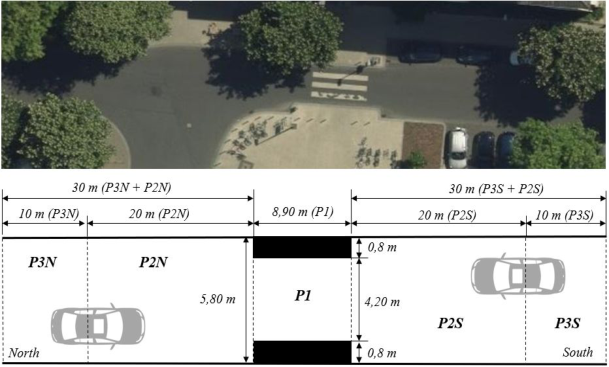
Video recordings were collected at an equal rights bottleneck with a speed limit of 30 km/h in Braunschweig (Germany) in September 2019. At this location, the roadway is narrowed by almost 2 m due to an extension of the sidewalk on both sides (see Fig. 1), which makes it difficult for two drivers to pass the bottleneck at the same time. Data was collected via stereo cameras mounted on two masts (part of DLR’s Application Platform for Intelligent Mobility, Knake-Langhorst & Gimm, 2016). The two masts were placed on both sides of the road bottleneck to capture both directions. Based on the detection performance of the stereo cameras and following previous research (Imbsweiler, 2019; Rettenmaier et al., 2019) an observation area of 30 m to both sides of the bottleneck was chosen. The area was divided into phases (Fig. 1) to allow a spatial tracking of the drivers’ communication behavior and to control infrastructural influences (side street).
To analyze the collected video material, videos were annotated using the annotation software ELAN (version 5.8). The investigated variables were the phase (P1, P2, P3; see Fig. 1) in which a vehicle was located, the longitudinal vehicle dynamics (constant speed, deceleration, acceleration, stop), the lateral vehicle dynamics (movement to the side of the road, movement to the middle
Figure 1: Road bottleneck caused by an extension of the sidewalk. P = Phase; S = South; N = North.
of the road, movement straight ahead), the activation of the headlight flasher and the turn signal (on/off) as well as the execution of hand gestures.
Only cases that met the following conditions were considered: a) both road users were cars, b) drivers did not turn off or onto the side road, c) max. 5 s difference between the points in time at which the two drivers crossed the center of the bottleneck. The final analysis consisted of N = 100 encounters. Each annotation process started as soon as a driver entered P3 and ended as soon as the first driver left the bottleneck (P1). For quality assurance of the method, two independent raters coded one third of the situations, showing substantial interrater reliability (Cohen’s Kappa κ = .77; Landis & Koch, 1977).
RESULTS
For descriptive analysis of the collected data, drivers were subdivided into the groups passes first (n = 100) and passes second (n = 100). This classification was made because in 60% of the encounters the driver who arrived second was the first to pass the bottleneck.
In a first step, the beginning of a communication process was examined by analyzing the first behavioral change. In three encounters, none of the drivers showed a behavior change. In 82% of the remaining encounters (N = 97), the first behavioral change was shown in P3. Drivers who passed the bottle- neck second initiated the first behavioral change in 77% of the encounters. Overall, defensive signals (deceleration or movement to the side of the road) were significant the most frequently (89% of all encounters) observed first behavioral changes (χ2(1, N = 97) = 57.99, p = <.001, 8 = .77).
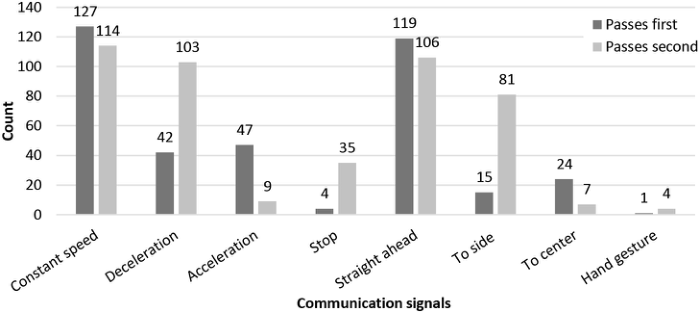
To identify which explicit and implicit communication signals were used for communication, the quantity of all observed signals (N = 838) was analyzed in a second step (Fig. 2). The results show that impli- cit communication signals were significant predominant in the observed
Communication Between Drivers in a Road Bottleneck Scenario 309
Figure 2: Type and number of communication signals at the bottleneck.
encounters (χ2(1, N = 838) = 818.12, p = <.001, 8 = .99). The only dete- cted explicit communication signal were hand gestures, of which three were observed after passing and therefore interpreted as a gesture of acknow- ledgment. Differences between the two driver groups exist especially for offensive (acceleration, to the center) and defensive (deceleration, to side, stop) communication signals (χ2(1, N = 367) = 103.14, p = <.001, 8 = .53). The signals constant speed (χ2(1, N = 241) = .70, p = .402) and strai- ght ahead (χ2(1, N = 225) = .75, p = .386), however, show no significant difference between the driver groups.
In a third step, the spatial occurrence of the communication signals was examined based on the three phases. Drivers passing the bottleneck first star- ted 19% of all communication signals in P3, 78% in P2, and 3% were started within the bottleneck (P1). In contrast, drivers passing second started 60% of all signals already within P3 and 40% of the signals were started in P2. Thus, drivers who passed the bottleneck second communicated more often at a greater distance (30 - 20m) from the bottleneck than drivers who passed first (χ2(1, N = 347) = 118.76, p = <.001, 8 = .59).
In a fourth step, it was analyzed which communication signals occurred together, looking for common communication patterns (the temporal order of the signals will be considered in the next step). The signal hand gesture was excluded from further analysis due to its low occurrence. Moreover, the signals constant speed and straight ahead were only considered in cases where they were shown during the whole encounter and will further be referred to as “no behavioral change”. A total of N = 14 different communication pat- terns for drivers who passed first as well as N = 13 for drivers who passed second were found. For each driver group, two representative communica- tion patterns were identified. Forty two percent of the drivers who passed the bottleneck first showed no behavioral change during the encounter and 21% showed a combination of decelerating and accelerating. Drivers who passed second communicated mainly by decelerating and a movement to the side of the road (41%) or by decelerating, side movement and an additional stop (25%). Fifty-five percent of all observed encounters (N = 100) show a
combination of the two most frequent communications patterns of the two driver groups. All remaining communication patterns were shown by a maxi- mum of 5% of the drivers in both driver groups, resulting in a large variety of combinations in the observed encounters, which is why a detailed description is omitted here.
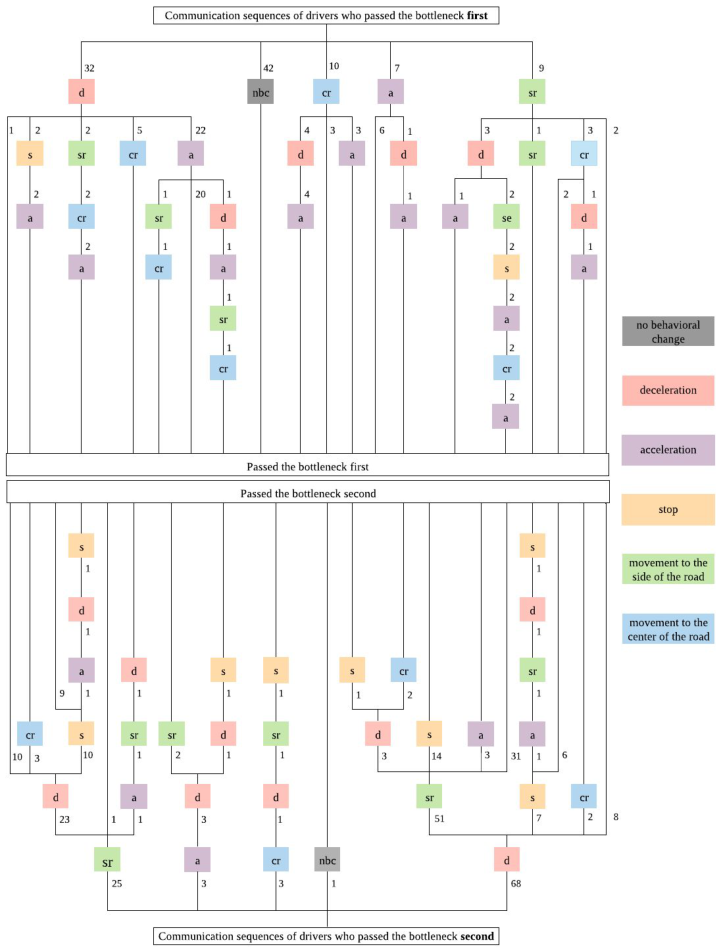
In the last step, all the identified communications patterns of both dri- ver groups were further mapped into communication sequences by including information about the temporal order and frequency of communication signals shown by a driver. The identified communication sequences are shown in Fig. 3 as a sequence diagram. Each path in the diagram corresponds to a communication sequence shown by drivers who passed the bottleneck first or second. The signals are listed hierarchically in terms of their temporal order, whereby the listed order refers to the detected start time of the signals. The numbers at the paths show the quantity of drivers that behaved according to the respective sequence.
For both driver groups, two characteristic communication sequences were identified. The predominant communication sequences for drivers passing first were a) passing straight ahead at a constant speed and b) decelerating and subsequently accelerating. Drivers passing second, on the other hand, showed an initial decelerating maneuver or lateral movement to the side of the road followed by a stop in some cases.
DISCUSSION
This work focused on the communication behavior of drivers encountering an equal rights bottleneck, with special interest in comparing drivers who pas- sed first vs. second. By analyzing video recordings, it was shown that implicit communication played a primary role in the observed encounters, which is in line with previous findings from Imbsweiler (2019) and Rettenmaier et al. (2019). Drivers showed both longitudinal and lateral movement signals, complementing the state of knowledge from previous studies in which only longitudinal communication signals were analyzed (cf. Imbsweiler, 2019; Rettenmaier et al., 2019). Accordingly, longitudinal and lateral vehicle dyna- mics seem to be an essential component in the communication process at an equal rights bottleneck.
Moreover, the presented findings confirm a difference in communication signals shown by drivers passing first vs. second, which was already repor- ted by Imbsweiler (2019) and Rettenmaier et al. (2019). This difference was shown by not only considering the occurrence of communications signals, as previous research has done (Imbsweiler, 2019; Rettenmaier et al., 2019), but also by including the temporal order of the signals. More offensive communi- cation sequences, in which the driver either drove at a constant speed straight ahead or showed a decelerating maneuver followed by acceleration, were associated with drivers who passed the bottleneck first. In comparison, more defensive communication sequences, consisting of decelerating and driving to the side of the road as well as an additional standstill, were characteristic for drivers who passed the bottleneck second. The results indicate that diffe- rent behavioral strategies might be used to signal a driver’s intention to pass
Communication Between Drivers in a Road Bottleneck Scenario 311
Figure 3: Communication sequences of drivers who passed first or second in the bottleneck scenario.
a two-sided bottleneck first or second. Further research is needed to address whether signals are intentionally shown to negotiate the right of way.
In contrast to previous work (Rettenmaier et al., 2019), it was not observed that the driver who arrived first was most often the one to pass first. The results of this study rather indicate that the passing order of the two drivers is related to the communication signals and sequences shown by a driver. This rather contradictory result could be due to the contextual dependence
of communication behavior of drivers in road traffic (Markkula et al., 2020). At the selected location, there was a side road north of the bottleneck, which may have caused drivers from the north to slow down in front of the side road to be able to give way to traffic coming from the right if necessary. Since the present study was not interested in what caused a given behavior but in the identification of communication signals which are associated with passing the bottleneck first vs. second, the interference caused by the side road was neglected. Nevertheless, this result shows that local characteristics influence traffic behavior and informal rules might emerge, which could pose further challenges for automated vehicles. It is therefore important to also include non-prototypical scenarios when analyzing communication behavior.
The communication sequences identified in this work provide initial gui- dance on what behavioral strategies might be used to signal a driver’s intention to pass an equal rights bottleneck first or second. The results can be considered as a first basis for the realization of expectation-compliant communication behavior of automated vehicles in a bottleneck scenario.
ACKNOWLEDGEMENT
The data used in this paper were collected as part of the project @CITY (Auto- mated Cars and Intelligent Traffic in the City, funded by the German Federal Ministry for Economic Affairs and Energy) within subproject 4 by the Insti- tute of Transportation Systems of the German Aerospace Center (DLR) in Braunschweig. The contributions of Chemnitz University of Technology were funded by the Deutsche Forschungsgemeinschaft (DFG, German Research Foundation), Project-ID 416228727, SFB 1410 Hybrid Societies.
REFERENCES Hensch, A.-C., Neumann, I., Beggiato, M., Halama, J. & Krems, J. F. (2020). Effects of a light-based communication approach as an external HMI for Automated Vehicles - Literaturverzeichnis a Wizard-of-Oz Study. Transactions on Transport Sciences, 10(2), 18–32. https://doi.org/10.5507/tots.2019.012 Imbsweiler, J. (2019). Kooperation im Straßenverkehr in innerstädtischen Pattsitua-
tionen. Karlsruher Institut für Technologie (Dissertation). Karlsruher Institut für Technologie. https://doi.org/10.5445/IR/1000095374 Knake-Langhorst, S. & Gimm, K. (2016). AIM Traffic Acquisition: Instrument toolbox for detection and assessment of traffic behavior. Journal of large-scale research facilities JLSRF, 2. https://doi.org/10.17815/jlsrf-2-123 Landis, J. R. & Koch, G. G. (1977). The Measurement of Observer Agreement for
Categorical Data. Biometrics, 33(1), 159–174. https://doi.org/10.2307/2529310 Markkula, G., Madigan, R., Nathanael, D., Portouli, E., Lee, Y. M., Dietrich, A., Billington, J., Schieben, A. & Merat, N. (2020). Defining interactions: a conceptual framework for understanding interactive behaviour in human and automated road traffic. Theoretical Issues in Ergonomics Science, 21(6), 728–752. https: //doi.org/10.1080/1463922x.2020.1736686 Rettenmaier, M., Requena Witzig, C. & Bengler, K. (2019). Interaction at the Bot-
tleneck – A Traffic Observation. Human Systems Engineering and Design II, 243–249. https://doi.org/10.1007/978-3-030-27928-8_37 Schaarschmidt, E., Yen, R., Bosch, R., Zwicke, L., Schade, J. & Petzoldt, T. (2021).
Grundlagen zur Kommunikation zwischen automatisierten Kraftfahrzeugen und Verkehrsteilnehmern. Carl Hanser Verlag.
LISTED IN THE AHFE DIGITAL BOOKSTORE CATALOGUE
Explore the complete digital volume
Human Factors in Transportation
Read this individual research paper free through the original publisher, or explore the full digital proceedings book.
ISBN 978-1-958651-36-0
Explore this ISBN in the AHFE Bookstore ↗Listed in the July 2026 bookstore catalogue; search by ISBN to confirm current availability · Digital book purchase optional