Huang Yongzhe, Beibei Sun (2023). A comparative study on the layout of interface elements of two types of Web pages with different uses based on beauty degree calculation. In: Intelligent Human Systems Integration (IHSI 2023): Integrating People and Intelligent Systems. AHFE Open Access, vol. 69, pp. 607–615. https://doi.org/10.54941/ahfe1002883
Based on the beauty degree calculation method proposed by Lei Zhou, et al (2013) including thirteen formulas to calculate the different attributes of the layout of interface. This paper selects six attributes to study interface elements aesthetic, such as balance, symmetry, integrity and so on, and conducting an experiment to verify the calculated results with the participants subjective evaluation results. In this study, eight different web pages were selected to evaluate the layout of interface elements, including four cultural and educational web pages and four shopping web pages, which can roughly represent the mainstream web design of these two types of web pages. First of all, the layout of selected interface elements was calculated by Matlab software(https://ww2.mathworks.cn/en/products/matlab.html?s_tid=hp_products_matlab). In the second step, Likert seven-point scale test was used to let the subjects score the beauty degree of each page. And finally, the two groups of data were compared to draw a conclusion. According to subject's evaluation, southeast university library homepage layout got the highest score of 5.5 points. Compared with the calculation results of beauty, it is consistent with the calculation results, and has achieved high scores in the calculation of attributes in balance, integrity, cohesion and proportion beauty. This shows that for the layout of the subjective evaluation and the degree of the calculation results are largely consistent with, the scientific and accuracy of the beauty degree calculation is highly can help the designers to improve interface configuration and design layout.
With the development of technology, web page, as a PC window, plays a pivotal role in the Internet world. Internet users have higher requirements for web page interface. It not only need to display the complicated information of the Internet smoothly for the users, but also put forward certain require- ments for the beauty of the web page. With the maturity of AI technology and the development of machine learning, some companies have begun to study how artificial intelligence is applied to web design. The style and category of web design are far more complex than banner, and the interface layout of web pages with different functions presents significantly different styles.
Therefore, it is necessary to study the layout of interface elements in different categories of web design. Therefore, this paper analyses and compares shop- ping websites and cultural and educational websites to provide reference for the development and research of different types of web design in the future.
In this study, six beauty indicators are mainly selected: balance, symmetry, integrity, simplicity, cohesion and ratio. The experimental study conducts the analysis and comparison of cultural and educational web page and shopping web page interface elements layout, ignoring the impact brought by shape and colour. Four representative web pages of each category were selected for beauty degree calculation and subjective evaluation, and the possible causes of the results were discussed, which may provide reference for future web design of different categories.
BEAUTY DEGREE CALCULATION Based on the characteristics of the layout of web interface elements, six obje- ctive beauty indicators – balance, symmetry, integrity, simplicity, cohesion and ratio are selected as evaluation indicators to be quantified (Lei Zhou, et al. 2013).
Balance Balance degree refers to the visual balance of the overall arrangement and layout of all elements in the interface to the user’s perception. L, R, T, and B indicate the left, right, upper, and lower parts of the interface. Aij represents the area of a single element in the region j; dij represents the distance between the Central Line position of a single element and the Central Line of the overall interface; nj represents the number of elements in the interface region.
WL−WR max(|WL|,|WR|)
Equations and mathematical formulas are available in the original paper PDF.
WT−WB max(|WT|,|WB|)
2 (1)
Symmetry Symmetry refers to the degree of symmetry of elements in the interface in three directions: vertical, horizontal and radial, good symmetry degree can bring visual comfort to the user. Svertical, Shorizontal, Sradial, Represents the vertical, horizontal and radial degree of symmetry respectively, where,
Svertical
+|Shorizontal| + |Sradial|
3 (3)
X′UL −X′UR
X′LL −X′LR
Y′UL −Y′UR
+ Y′LL −Y′LR
H′UL −H′UR
H′LL −H′LR
+ B′UL −B′UR
B′LL −B′LR
θ′UL −θ′UR
+ θ′LL −θ′LR
R′UL −R′UR
R′LL −R′LR
A Comparative Study on the Layout of Interface Elements of Two Types of Web Pages 609 ( X′UL −X′LL
X′UR −X′LR
Y′UL −Y′LL
+ Y′UR −Y′LR
H′UL −H′LL
H′UR −H′LR
+ B′UL −B′LL
B′UR −B′LR
θ′UL −θ′LL
+ θ′UR −θ′LR
R′UL −R′LL
R′UR −R′LR
X′UL −X′LR
X′UR −X′LL
Y′UL −Y′LR
+ Y′UR −Y′LL
H′UL −H′LR
H′UR −H′LL
+ B′UL −B′LR
B′UR −B′LL
θ′UL −θ′LR
+ θ′UR −θ′LL
R′UL −R′LR
R′UR −R′LL
) 12 (6) X′j, Y′j, H′j, B′j, θ′j and R′j, respectively is the dimensionless value after standardized processed of Xj, Yj, Hj, Bj, θj and Rj, there are
nj X
nj X
nj X
yij −yc xij −xc
i i
i
q
Integrity Integrity is to determine the tightness of the arrangement of elements in the interface by analysing the relationship between the arrangement and layout of elements and the interface frame.
ai alayout i
Where ai is the element area; alayout is the minimum area of the layout of design elements; aframe indicates the area of the overall interface. n is the number of elements on the interface.
610 Huang and Sun
Simplicity Simplicity is to determine the simplicity of the overall layout of the interface by calculating the alignment or composition of interface elements.
Ds,t = 1 −(nvertical −nhorizontal)/4n (14) nvertical indicates the number of aligned points in the vertical direction and nhorizontal indicates the number of aligned points in the horizontal direction. n is the number of elements in the interface.
Cohesion Cohesion refers to the degree of visual harmony between the aspect ratio of interface elements and the layout of the frame, which can be achieved by adopting similar or similar element shapes and sizes.
2 (15)
Respectively, Cfl is the measurement of the proportional relationship betw- een the layout and interface framework, and Clo is the measurement of the proportional relationship between interface elements and the layout, expressed as:
hlayout/blayout
hframe/bframe
1 ci , ci > 1 ci = hi/bi hlayout/blayout bi and hi are the width and height of the interface element i; n is the number of elements in the interface frame. blayout, hlayout, bframe, and hframe indicate the width and height of the layout and interface frame respectively.
Ratio Ratio refers to the similarity of interface elements layouts with the common aesthetic ratio (1/1, 1/1.414, 1/1.618, 1/1.732, 1/2), which is to improve the user’s visual perception.
2 (18)
pobject is the difference between element proportions, playout is the difference between layout proportions, where,
n X
1 −min(|tj −ti|) 0.5
A Comparative Study on the Layout of Interface Elements of Two Types of Web Pages 611
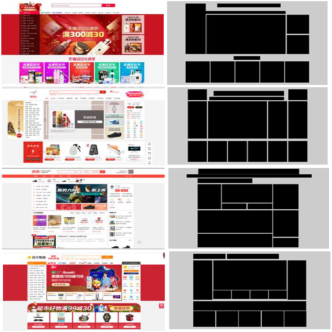
Figure 1: Shopping type webpage’s interface (1-4) element layout representation (the left one is the raw screenshot; the right one is the processing image).
0.5 (20)
hlayout blayout
(21) bi and hj are the width and height of the interface element i; blayout and hlayout are the width and height of the layout respectively. tj is five commonly used ratios, which can be expressed as:
1
EXPERIMENTAL STUDY
Materials
In this study, 8 different web pages were selected to evaluate the layout of interface elements, including 4 cultural and educational web pages and 4 shopping web pages, which can roughly represent the mainstream web design of these two types of web pages.
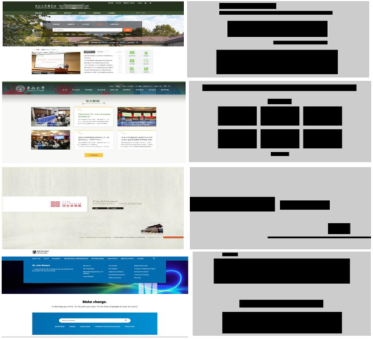
Procedure Firstly, the selected web pages are blurred, and the functional areas of the web pages are represented as minimal rectangles and filled with black. In order to distinguish the interface from elements, as shown in Figure 1 (4 pages) and number the 4 groups of pictures 1-4, Figure 2 (4 pages) is also numbered the 4 groups of pictures 5-8.
Results
According to the calculation formula of quantitative index of interface ele- ment layout evaluation, the values of balance, symmetry, integrity, simplicity,
612 Huang and Sun
Figure 2: Cultural and educational website interface (5-8) element layout representa- tion (the left one is the raw screenshot; the right one is the processing image).Table 1. Calculated value of interface sample beauty (From interface 1 to 8).
cohesion and ratio of the layout schemes of eight websites of the two types are calculated respectively. 1-4 are shopping websites and 5-8 are culture and education websites. The calculation results are shown in Table 1.
According to the results calculated by Matlab software, the data in Table 1 are analysed as follows: (1) In terms of balance degree, it can be seen that the balance degree of shopping websites is around 0.9 with little fluctuation, while the balance degree of culture and education websites fluctuates greatly. This shows that shopping websites have common characteristics in terms of balance degree, namely stable and high balance degree, while cultural and educa- tional websites do not have common characteristics in terms of balance degree. (2) In terms of symmetry, the average degree of symmetry of cultural and educational websites is 0.45, which is obviously higher than that of shop- ping websites at 0.37, and the symmetry of the two types of websites tends to its average value respectively, that is to say, their symme- try values are roughly evenly distributed on both sides of the average value. It is also obvious from the layout diagram that the symmetrical layout design adopted by cultural and educational websites may bring
A Comparative Study on the Layout of Interface Elements of Two Types of Web Pages 613
Table 2. Interface layout sample subjective evaluation results (interface 1 to 4 are shopping websites, interface 5-8 are Cultural and educational websites).
users a higher sense of comfort in the horizontal, vertical and diagonal directions. (3) In terms of integrity degree, shopping websites have higher scores. Obviously, shopping websites have more compact layout and more concentrated interface elements, while cultural and educational websites are more scattered. This may be the culture and education website more “elegant”, pay attention to “white space” caused. (4) In terms of simplicity, the average score of shopping websites is 0.1024 and the variance is small, while the average score of cultural and educa- tional websites is 0.2218. Obviously, cultural and educational websites score higher than shopping websites in simplicity, that is to say, cultural and educational websites are more concise on the whole. (5) In terms of cohesion, the average score of shopping websites is about 0.66, and the score fluctuation is very small. The average score of culture and education websites is about 0.5, except for the Southeast University Library website, which gets a high score of 0.7527. It shows that the interface elements and frame layout of shopping websites have better visual coordination, while the library websites of Southeast Uni- versity has the best visual coordination among the culture and education websites. (6) In terms of ratio, except for the Southeast University library website, the score of ratios of cultural and educational websites is closer to the value of golden ratio, while the score of shopping websites is higher. Relatively speaking, cultural and educational websites have a certain advantage in the proportion of aesthetic feeling.
Considering that the influence of many factors, such as colour, back- ground, dynamic and website content, etc. when evaluating the website interface beauty, only the interface layout diagram is presented in the que- stionnaire design, and the sample is blurred. In subjective evaluation, let the user group of eight samples by 1-7 rate respectively, 1 is divided into the worst and 7 into best, gather results and comprehensive comparison, the user’s subjective evaluation of respondents are mainly southeast university graduate level 20 groups, a total of 20 subjects.
In this survey, the average scores of users are shown in Table 2: The average score of shopping web pages is 4.43, and the average score of culture and education web pages is 4.00. After analysing and comparing the data in Table 1 and Table 2, it is found that: According to the average score of users’ evaluation, the homepage layout of the Southeast University Library got the highest score of 5.5 points. Compared with the calculation results of beauty, it is consistent with the
614 Huang and Sun
calculation results, and has achieved high scores in the calculation of beauty in balance, integrity, cohesion and ratio. This shows that the subjective evaluation of the interface layout is consistent with the beauty calculation results to a large extent, and the beauty calculation is very scientific and accurate.
The average score of the page layout of the shopping webpage is slightly higher than that of the culture and education webpage. After analysis, it is mainly due to the low score of the homepage of Xi’ an Art Museum website, which is only 2.6. Xi’ an Art Museum is the most aesthetic among users’ evaluation results of the original picture. Because of its strong artistic style, its colour matching, content and background are more important than page layout, so it is not comprehensive to evaluate it only by relying on the layout picture.
CONCLUSION
After comprehensive consideration of the calculation results of beauty and the subjective evaluation of users, the following conclusions are drawn: Interface beauty calculation, to some extent, can assist designers in impro- ving interface layout and design. The calculated results are of considerable reference significance, which can help designers grasp the overall direction of interface layout and evaluate the comprehensive beauty of the interface. In the actual design process, users’ subjective evaluation and preferences of different web uses should also be taken into full consideration. It can be found from the above that the interface layout of shopping and culture and education websites has different emphasis on symmetry, cohesion, simplicity, whole- ness and aesthetic ratio. Such calculation results can be used in the future AI intelligent system to a certain extent. In the intelligent web design system that may be developed in the future, it can focus on the targeted interface layout of different web pages from the perspective of quantification.
Design is often a combination of the designer’s inspiration and experie- nce, rather than a conformist thing. Whether artificial intelligence can truly replace designers in the future is highly controversial. In fact, in the design industry, any so-called artificial intelligence or mature “Luban” can only approach the average level of designers infinitely, replacing only the repe- titive work of designers. Design is a kind of advanced spiritual activity, and aesthetic experience is inseparable from the aesthetic feeling ability of the subject.
REFERENCES
De Angeli, A., Sutcliffe, A., Hartmann, J., 2006. Interaction, usability and aesthetics: what influences users’ preferences? In: Proceedings of the Sixth ACM Conference on Designing Interactive Systems, PA, June 2006. Lee, S., & Koubek, R. J. 2011. The impact of cognitive style on user preference based
on usability and aesthetics for computer-based systems. International Journal of Human–Computer Interaction, 27, 1083–1114.
A Comparative Study on the Layout of Interface Elements of Two Types of Web Pages 615
Lei Zhou, Chengqi Xue, Wencheng Tang. 2013. Beauty evaluation method of interface element layout design. Journal of Computer Aided Design and Graphics, 2013, 25(05):758–766. Na Zhang, Jiamin Wang, Yanpu Yang. 2015. Evaluation method of aesthetic inten-
tion in layout design of human - machine interface form elements. Mechanical Science and Technology, 2015, 34(10):1594–1598. Ngo D C L, Teo L s, Byrne J G. Modelling interface aesthetics [J]. Information Science,2003,152(8):25–46. Reiser, H., Reiser, B., 1995. Aesthetic considerations unique to interactive multime-
dia. IEEE Computer Graphics and Applications 15 (3), 24–28. Schmidt, K., Liu, Y., Sridvasan, S., 2009. Webpage aesthetics, performance and usability: design variables and their effects, Ergonomics 52 (6), 631–643. Xiaofan Ren, Chengqi Xue. 2018. Evaluation of Camera Connect APP interface
element layout based on Beauty calculation Design. 2018, 04(02): 142–143. Zhigang Wang. 2019. From shadow shadow and Imitation to Artistic Expression -- Aesthetic thinking on the present situation and future of artificial intelligence literary and artistic Production. Journal of Hangzhou Dianzi University (Social Science Edition), 2019.15(01):50–57.
LISTED IN THE AHFE DIGITAL BOOKSTORE CATALOGUE
Explore the complete digital volume
Intelligent Human Systems Integration (IHSI 2023): Integrating People and Intelligent Systems
Read this individual research paper free through the original publisher, or explore the full digital proceedings book.
ISBN 978-1-958651-45-2
Explore this ISBN in the AHFE Bookstore ↗Listed in the July 2026 bookstore catalogue; search by ISBN to confirm current availability · Digital book purchase optional