Dimitrios Ziakkas, Konstantinos Pechlivanis, Abner Del Cid Flores (2023). Artificial Intelligence (AI) implementation in the Design of Single Pilot Operations Commercial Airplanes. In: Intelligent Human Systems Integration (IHSI 2023): Integrating People and Intelligent Systems. AHFE Open Access, vol. 69, pp. 856–861. https://doi.org/10.54941/ahfe1002910
This research aims to present, identify, and propose the implementation of AI technology in aviation decision-making, as well as examine how AI can affect the transition from multi-crew to eMCO and SiPO, based on the rationale that the single-pilot human operator having accessible data in a timely and naturally interactive fashion could enhance natural decision making (NDM) (Klein, 2008; Orasanu & Fischer, 1997).According to the industrial roadmaps, the first certification of assistance for pilots is anticipated to occur in the year 2025, and this will be followed by a gradual transition to full autonomy sometime around the year 2035. The progression of events in the field of commercial air transport can be broken down into three distinct stages:•First step: crew assistance/ augmentation (2022-2025)•Second step: human/ machine collaboration (2025-2030)•Third step: autonomous commercial air transport (2035+)There have been identified two different operational concepts:Extended Minimum-Crew Operations (eMCOs), formerly known as "Reduced Crew Operations," in which single-pilot operations are permitted during the cruise phase of the flight with a level of safety similar to that of today's two-pilot operations (to be implemented beginning in the year 2025).Single-Pilot Operations (SiPOs), in which, at a later stage, end-to-end single-pilot operations might be allowed, also based on a level of safety equivalent to today's two-pilot operations, to be implemented as of the year 2030. Single-Pilot Operations (SiPOs), in which, at a later stage, end-to-end single-pilot operations might be allowed.The proposed artificial intelligence aviation decision-making research in cockpit design and users' experience was constructed by first surveying the current literature about Artificial Intelligence (AI). The findings point to the difficulties artificial intelligence poses, including its limitations and users' resistance, in shifting from multi-crew operations to e-MCO and SiPO. This resistance to change should be considered when designing any potential upgrades to the AI cockpit design or user interactions. However, the existing commercially available AI technology may be ready to serve some low-impact or non-time-critical applications (for example, weather in destination and alternate airports update during the cruise phase) in this transitional period to eMCOs and SiPOs, which would postpone the necessity for a complete flight deck redesign at this time (Stanton & Harris, 2015). The utilization of AI for the administration of systems and the retrieval of information has the potential to improve both the perception (Level 1 SA) and comprehension (Level 2 SA) of pilots (Endsley, 1995). Therefore, the single-pilot human operator in the NDM cockpit environment who has data accessible promptly and in a naturally engaging fashion would be able to make judgments that are more fulfilling and closer to optimums in the NDM environment (Klein, 2008; Orasanu & Fischer, 1997).
According to the industrial roadmaps, the first certification of assistance for pilots is anticipated to occur in the year 2025, and this will be followed by a gradual transition to full autonomy sometime around the year 2035 (EASA, 2020). The progression of events in the field of commercial air transport can be broken down into three distinct stages:
Artificial Intelligence (AI) implementation in the Design 857
First step: crew assistance/augmentation (2022–2025)
Second step: human/machine collaboration (2025–2030)
Third step: autonomous commercial air transport (2035+) There have been identified two different operational concepts (EASA,2020):
Extended Minimum-Crew Operations (eMCOs), formerly known as “Reduced Crew Operations,” in which single-pilot operations are permit- ted during the cruise phase of the flight with a level of safety similar to that of today’s two-pilot operations (to be implemented beginning in the year 2025).
Single-Pilot Operations (SiPOs), in which, at a later stage, end-to-end single-pilot operations might be allowed, also based on a level of safety equivalent to today’s two-pilot operations, to be implemented as of the year 2030.
Among the concerns identified as a result of the absence of a second crew member were a lack of monitoring and the potential for unchallenged men- tal models to lead to poor decision making (Pechlivanis & Harris, 2022). Commercial single-pilot should be aided by cognitive assistance for effective workload (WL) management and improved safety (Estes et al., 2018). Promi- sing large-scale progress in the field of AI and cognitive computing (CC) are expected to provide effective support to pilots in SiPO (Dormoy et al., 2021).
It was supported that pilots have a positive attitude towards technology; however, they are hesitant to welcome another agent in the form of digital flight assistants (DFA) in the aircraft’s cockpit (Gosper et al., 2021). Pilots’ expect AI to provide assistance in time-critical scenarios (e.g., information retrieval during diversions) and active monitoring to trap errors/mistakes (Gosper et al., 2021).
The AI in the commercial SiPO flight deck is imperative to be adaptive in the operational context to provide efficient and effective support (Gosper et al., 2021). Multimodal bidirectional communication is argued to be an added value within the human intelligent machine team (HiMT) on the future SiPO flight deck (Dormoy et al., 2021).
HUMAN SYSTEMS INTEGRATION (HSI) FRAMEWORK FOR SIPO In particular, information technology advanced significantly over the latter three decades of the 20th century. Automation can be defined as the transfer of cognitive functions from individuals to machines (e.g., pilots were manu- ally in charge of aircraft handling qualities; a task that has been recently transferred to computers). The research team’s primary goal is to construct a topology that iteratively enables system science and its application in avi- ation through the developing of HSI tools and AI to support systems design for Single Pilot Operations Commercial Airplanes. Human-automation sym- biosis will optimize the allocation of cognitive labour in the flight deck (Romero et al., 2020).
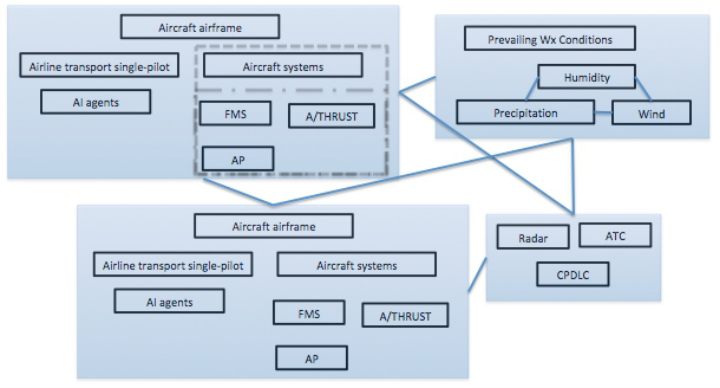
The AI applied technology could be considered as system within the system of SiPO cockpit (SoS) and altogether within the SiPO concept of operations
Figure 1: A SiPO system is a system of systems (i.e., a system includes an organized set of systems, and a system belongs to a bigger system).
(ConOps) (Figure 1) (Boy, 2021). The SoS notion is now commonly used to indicate sociotechnical interrelated systems. The research links the SiPO with the concept of SoS, delink them to the agents involved and relink them in the AUTOS pyramid.
A system can be either cognitive (or conceptual) in nature, physical, or both (Boy, 2017). Both humans and computers having cognitive capabilities. To date, autothrust, flight management systems (FMS), and autopilots meet the criteria those of cognitive agents within the sociotechnical environment of a commercial jet at present (Boy, 2021). The ongoing development of AI and CC will introduce more entities and functions to provide effective support to pilots in SiPO (Dormoy et al., 2021).
The term “system” is synonymous with “agent”. A system is a system of systems, just as an agent is a society of agents. The SiPO system is defined by structures and functions.
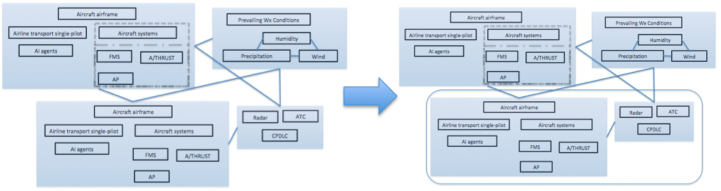
Lastly functions can differ depending on the context. The total single- piloting flight context, for instance, can be broken down into smaller contexts like as taxiing, takeoff, after-takeoff ascent, cruise, descent, approach, lan- ding, and so forth. These settings can all be broken down into even more compact contexts. Context 1 may represent nominal operations, whereas Context 2 may, for example, be an abnormal one, as a system may develop from Context 1 to Context 2 (Figure 2).
Pilots need more autonomy and flexibility when operating outside of these settings since they must solve problems on their own when an unex- pected circumstance arises. Once more, cooperation amongst knowledge- able agents is a very valuable resource. In addition, these agents—human or mechanical—need to be properly coordinated. Overall, designing for systemic flexibility is a matter of wisely allocating machine and human function. HSI experts contribute by ensuring that human capabilities and
Artificial Intelligence (AI) implementation in the Design 859
Figure 2: SiPO SoS evolution from nominal (context 1) to abnormal operations (context 2).Figure 3: Recursive definition of a system, where resources are systems themselves.
limitations are considered. Purdue suggests the AUTOS pyramid (Boy, 2021) to be utilised to that end.
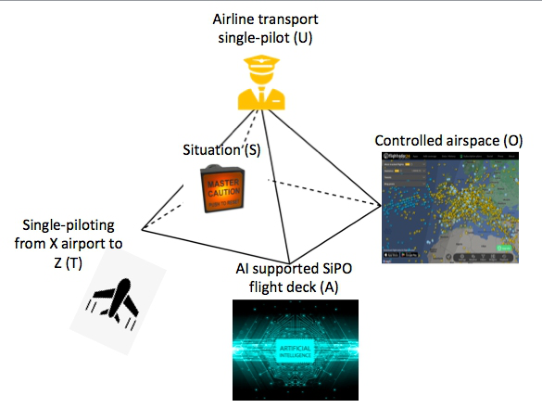
THE AI AUTOS PYRAMID FOR SIPO The AUTOS pyramid concept was created as a useful and practical HSI guide (Boy, 2021). The letters “A”stands for Artifact (i.e., AI supported flight deck), “U” for User (i.e., airline single-pilot), “T” for Task (i.e., Commercial SiPO), “O” for Organization (i.e., controlled airspace), and “S” for Situation (i.e., normal operations).
To be more explicit, an airline transport single-pilot (U) who operates an aircraft with AI supported flight deck (A) is flying a commercial jet from X departure airport to Z destination airport is an example of a high-level task (T) in a controlled airspace (O). Whether this flight is a nominal opera- tion or dealing with abnormal conditions (e.g., weather avoidance, aircraft malfunction, diversion) sets the situation (S). During the HSI iterative design particular considerations should be given to every agent in SoS based on the AUTOS pyramid (Figure 3).
The airline transport single-pilot (U) might range from experienced with SiPO (e.g., ex-military fighter or small business jet pilots) to cadet or to be prone to cultural or individual differences. The users might be also fatigued or stressed. Pilots representing the majority of potential influencing factors spe- ctrum should be included in humans-in-the-loop simulations to find emergent features and functions. The AI supported flight deck (A) could be compri- sed by the already available technology (e.g., DVI) or more sophisticated intelligent assistants providings perhaps decision-making suggestions (e.g., suitable airports for diversion). The explanation of the AI supported flight deck complexity is directly related to system’s complexity. The more complex the system is the more difficult a system is to operate and the more challen- ging testing it would be. The high-level task of single piloting a commercial jet with passengers (T) may be broken down into low-level tasks like taxiing, takeoff, climbout, cruise, and so on. The organisational context of control- led airspace (O) might consisted of other commercial or not aircrafts and air traffic controllers (ATC).
Interactions between the agents could explain (Boy, 2021):
Single-piloting task and activity analysis (U-T)
Information requirements, and AI technology requirements and restricti- ons for SiPO (T-A)
Ergonomics and training/procedures for AI supported (T-U)
Social issues between single-pilot, ground support (if any), ATC (U-O)
Commercial single-pilot role and job analyses (T-O)
Emergence and evolution (A-O)
AI utilities usability/usefulness (A-S)
Situation awareness (U-S)
Single-piloting situated actions (T-S)
Cooperation/coordination (O-S) Moreover, the concepts of the A-factors and U-factors should be conside- red. The rules of ergonomics, information density, and content management within the SoS and the agent interactions and meet cognitive performance indicators such as option workability, cue prominence, direct comprehension, fine distinctions, transparency, enabling anticipation, historic information, situation assessment, directability, flexibility in procedures and adjustable settings (Billman et al., 2019).
CONCLUSION
Aviation is approaching a new historical milestone for the industry. Techolo- gical enablers are anticipated to provide further decrewing in the flight decks of airliners. The introduced technology in SiPO sound human system inte- gration (HSI) through a structured iterative approach for HSI could ensure reliability and enhance safety levels towards eMCO and SiPO.
This research aimed to suggest a HSI framework and outline considera- tions regading the implementation of AI technology in aviation during the transition from multi-crew to eMCO and SiPO. The conceptual SiPO with
Artificial Intelligence (AI) implementation in the Design 861
AI supported flight deck presented through the AUTOS pyramid the poten- tial AI role in the human-machine interaction (HMI) to the flight deck on the SiPO Commercial Airplanes.
ACKNOWLEDGMENT
The authors thank faculty members of Purdue and Coventry Universities for their invaluable feedback contributing to this work.
REFERENCES
ATI, 2019. Accelerating Ambition: Technology Strategy 2019. Bailey, R.E., Prinzel, L.J., Kramer, L.J. and Young, S.D., 2011. Concept of operations for integrated intelligent flight deck displays and decision support technolo- gies (No. NF1676L-11270). Billman, D.O., Mumaw, R.J. and Feary, M.S., 2019. Best Practices for Evaluating
Flight Deck Interfaces for Transport Category Aircraft with Particular Relevance to Issues of Attention, Awareness, and Understanding CAST SE-210 Output 2 Report 6 of 6 (No. NASA/TM-2019-220390). Boy, G.A., 2021. Human Systems Integration and Design. Handbook of Human Factors and Ergonomics, pp. 38–54. Dormoy, C., André, J.M. and Pagani, A., 2021. A human factors’ approach for
multimodal collaboration with Cognitive Computing to create a Human Intel- ligent Machine Team: a Review. In IOP Conference Series: Materials Science and Engineering (Vol. 1024, No. 1, p. 012105). IOP Publishing. Dorneich, M.C., Rogers, W., Whitlow, S.D. and DeMers, R., 2016. Human performance risks and benefits of adaptive systems on the flight deck. The International Journal of Aviation Psychology, 26(1-2), pp. 15–35. EASA., 2020. Artificial Intelligence Roadmap: A human-centric approach to AI in
aviation. Estes, S., Helleberg, J., Long, K., Pollack, M. and Quezada, M., 2018, April. Guidelines for speech interactions between pilot and cognitive assistant. In 2018 Integrated Communications, Navigation, Surveillance Conference (ICNS)(pp. 3H2-1). IEEE. Gosper, S., Trippas, J.R., Richards, H., Allison, F., Sear, C., Khorasani, S. and
Mattioli, F., 2021, July. Understanding the utility of digital flight assistants: A preliminary analysis. In CUI 2021-3rd Conference on Conversational User Interfaces (pp. 1–5). Pechlivanis K, Harris D., 2022. Single Pilot Concept of Operations: Hazard Identification and Mitigation Measures [Manuscript sumbitted for publication]. Faculty of Engineering, Environment and Computing, Coventry University, UK. Romero, D., Stahre, J. and Taisch, M., 2020. The Operator 4.0: Towards soci-
ally sustainable factories of the future. Computers & Industrial Engineering, 139, p. 106128. Ziakkas, D., Plioutsias, A., Pechlivanis, K., 2022. Artificial Intelligence in aviation decision making process. The transition from extended Minimum Crew Operati- ons to Single Pilot Operations (SiPO). In: Tareq Ahram, Jay Kalra and Waldemar Karwowski (eds) Artificial Intelligence and Social Computing. AHFE (2022) Inter- national Conference. AHFE Open Access, vol 28. AHFE International, USA. http://doi.org/10.54941/ahfe1001452
LISTED IN THE AHFE DIGITAL BOOKSTORE CATALOGUE
Explore the complete digital volume
Intelligent Human Systems Integration (IHSI 2023): Integrating People and Intelligent Systems
Read this individual research paper free through the original publisher, or explore the full digital proceedings book.
ISBN 978-1-958651-45-2
Explore this ISBN in the AHFE Bookstore ↗Listed in the July 2026 bookstore catalogue; search by ISBN to confirm current availability · Digital book purchase optional