Vaishnavi Upadrasta, Rodney Leitner (2023). Public's Perspective on Civil Drones: Reasons to support and oppose. In: Human Interaction and Emerging Technologies (IHIET-AI 2023): Artificial Intelligence and Future Applications. AHFE Open Access, vol. 70, pp. 348–358. https://doi.org/10.54941/ahfe1002961
Drone technology is prevailing in the mainstream market with its promising innovative potential across different application scenarios. While the technological capacity of drones is explored and developed, many have addressed the societal perceptions and reactions towards its use. Recent literature inclines towards more neutral if not positive perception by the general public. This paper, performed within a European Union project ADACORSA, explores the most relevant concepts for drone technology acceptance and presents a detailed overview of the survey-based research conducted in 2022. Data was collected from a total of 601 participants across Europe and ADACORSA partner countries largely from Germany, Austria, France, Greece and Turkey. To make the survey as accessible as possible, participants could take the survey in 16 different languages. The performed risk analysis showed highest level of concerns related to security/privacy in terms of misuse and invasion of private spaces. Safety and privacy concerns are perceived as equally risky. Benefits analysis on the other hand revealed general public anticipates greater economic advantages but significantly lesser societal and environmental benefits. Apart from emergencies and humanitarian aid, and purposes to facilitate services that benefit society, industrial applications curtailed most support from the general public. Highest opposition was established for hobby/recreation-related drone use, primarily from individuals who have never used a drone. The objective of this paper is both to understand general public’s acceptance towards the use of drones and to provide a nuanced overview to drone operators of which purposes are perceived as reasonable and are accepted by the general public.
Next to technical and regulatory challenges, drone acceptance is yet another challenge that has been a topic of discussion and investigation by scholars and researchers throughout the past decade. The success of adoption of civil dro- nes within industrial and commercial applications greatly relies on the public response to the technology. Public acceptance is a key determinant for imple- mentation but also at the current stage crucial for establishing an adequate regulatory environment and a clear framework for the industry (Bergersen, 2021) and potential drone users. One of the goals of ADACORSA, a H2020 EU-funded project, is to contribute to higher public and regulatory accepta- nce of drone use and accordingly align with new European and world-wide regulation for drones. ADACORSA envisions drones as safe and efficient
Public’s Perspective on Civil Drones: Reasons to Support and Oppose 349
vehicles for observation, analysis or transport in an extended operation range beyond visual line of sight. The current study aims to explore the general public’s perspective towards civil drone and its usage. This paper attempts to answer the following research questions: 1) what purposes of drone usage is meaningful to the general public? In other words where can we identify more support towards drone usage, and 2) what factors have an effect on drone risks and benefits? The purpose of the study is to build on the findings of previous drone acceptance research and enable a better understanding of public’s support for drone use for the European continent and neighbouring countries.
BACKGROUND
Authors have attempted to determine influencing factors, positive and nega- tive, to understand drone technology acceptance and intention to use. Talley (2020) in the meta-analysis study on self-driving aircrafts reported, that the TAM (Technology Acceptance Model) has been extensively used in the domain of drone acceptance. On the other hand, risk theory was however found to be the most employed in investigating drone public acceptance, given the dynamic nature of drones (Chamata & Winterton, 2018). Rama- dan, Farah, & Mrad (2017) used the theory of planned behavior (TPB) as a framework to investigate perceived risks and perceived functional bene- fits of drones and their impact on attitudes towards service and delivery drones. While some researchers founded their studies on these well-known theories, some others (Eißfeldt et al., 2020; Watkins et al., 2020; Zwickle et al., 2019) adopted a more explorative approach to understand opinions and perceptions of public towards drone use.
Risks and benefits assessment. With diverse application domains, various researchers have provided different categorizations and levels of detail for public concerns, this construct has nevertheless within drone acceptance lite- rature remained a vital influencing factor towards attitude and acceptance of drones. In their research (Vincenzi et al. 2013) published in 2013, they found public-related concerns to be primarily dominated by privacy (46%) and safety (38%). Applin (2016) discusses a number of societal concerns that need to be addressed for a positive integration of drones in society including privacy and security from the exposure to overhead cameras, safety of wild- life due to noise, in-air accidents injuring e.g. birds, and regulatory gaps. More current literature often reports that the majority of participants were primarily concerned about among others the misuse of drones by criminals (Aydin, 2019; Eißfeldt et al., 2020), threat to one’s physical safety (Tan et al., 2021), and potential loss in job opportunities (Dannenberger et al., 2020). Noise was however reported as the least frequent concern primarily due to lack of direct interaction and experience. As to expected benefits, 381 quota- tions mention expected benefits categorized into economic benefits (49.3%, e.g. lower costs for companies in the rapidly growing and price sensitive logi- stics sector), societal benefits (20.2%, e.g. improvement of (urban) traffic, faster commuting on the ground), and ecological and environmental benefits (11.3%) (Kellermann et al., 2020). It is anticipated that the use of drones
350 Upadrasta and Leitner
would improve society’s standard of living. New high-end jobs would be cre- ated, workplace safety will be significantly improved, areas that lack proper infrastructure (mountain tops, islands) would become more accessible, and replace heavy fuel-consuming machines such as helicopters (Upadrasta et al., 2021). The usefulness of drones in health care domain as well as in the aid sector for search and rescue is seen as a huge benefit (Roberson, 2018).
Support based on application. The literature showed a consistency in levels of acceptance or support for drone use based on its application scenario (Tan et al., 2021). Applications with a social benefit (search and rescue, huma- nitarian aid, medical emergencies) often received highest levels of support (Eißfeldt et al., 2020). Other applications related to public safety and secu- rity such as scientific research, climate and geology mapping, and reactive policing such as traffic monitoring, crime scene photography, fighting crime were also considered as acceptable purposes. Commercial (Dannenberger et al., 2020) and recreational (Macias et al., 2019) applications of drones on the other hand were found to be relatively less acceptable. The literature review made it clear that acceptance level differs depending on what indivi- duals would consider as a meaningful cause. Various other hypothesis assume support for drone technology. These include a wide range from personal expe- rience (knowledge, exposure, familiarity), individual characteristics (personal innovativeness, trust, anxiety), to environmental effects (social influence and facilitating conditions). Some of these concepts are explored in the current study.
METHOD
A survey instrument was developed to assess the current opinions and attitude on drone use by the general public across Europe and neighbouring countries. The analysis is twofold, however for this paper, we focus on the results and outcomes of the survey with regards to public perception, the model analysis is ongoing and not within the scope of this article.
Survey Design. The survey questions for each individual construct were obtained from previous studies as much as possible and adapted according to the context of this study, thus strengthening reliability. Internal consiste- ncy for reliability of each construct was then tested and any items with a Cronbach’s alpha value of less than 0.75 were excluded. Table 1 provides an overview of the constructs and its Cronbach’s alpha value. The intro- ductory section contained images of industrial and commercial drones: a delivery drone, construction drone, and forestry drone so as to reinforce the image of civil drones attempting to move away from the military killer perception. Five-point Likert scale was used to measure respondents’ input for each individual construct in the model. So as to maximize our reach, the survey was made available in 16 languages: English, German, Italian, French, Dutch, Spanish, Portuguese, Greek, Czech, Polish, Swedish, Finnish, Turkish, Lithuanian, Ukrainian, and Russian.
Sample description. The Europe-wide online survey was conducted betw- een May 2022 to January 2023. Respondents who completed more than 50% of the survey were included in the analysis, the rest were excluded. Screening
Public’s Perspective on Civil Drones: Reasons to Support and Oppose 351
Table 1. Constructs and item reliability.
Table available in the original PDF paper.
Constructs No. of items Cronbach’s Alpha Perceived Meaningfulness of Purpose 7 0.77 Perceived Risks/Concerns 9 0.84 Perceived Benefits 6 0.8 Drone Familiarity 5 Weighted scores Drone-related Knowledge 5 0.89 Drone Exposure in Mass Media Channel 3 0.82 Trust in (Drone) Technology 3 0.81
criteria included residence in Europe or in ADACORSA partner countries and minimum age of 18 years. Any respondents identified to give non-sensical answers (e.g. age above 99 etc.) were also excluded from the analysis. A total of 601 (63% male, 27% female, 1% diverse, 9% missing data) respondents were included in the data analysis, ranging from 18 to 85 years (M = 39.18). Respondents were largely from five countries: Germany, Greece, Turkey, Austria, and France. 62% reside in populated areas (large cities) and rest 26% in sparsely to moderately populated areas (villages, countryside, towns, small cities), missing data = 12%. Most participants had a bachelors (21%) or higher education level (33% masters, 24% higher than masters) and majo- rity were employed (76%). Besides, for this study, respondents who use a drone (or have previously in the past) are regarded as ‘drone-users’. We dif- ferentiate however between drone-users and drone-owners and classify them into two different groups.
FINDINGS AND INTERPRETATIONS All Likert scale questions were converted from ordinal to interval scale. Fur- ther, normality assumptions were tested before running the analysis, thus confirming the chosen statistical method. When the assumption was not met, non-parametric tests were utilised. In the case of some questions (e.g. dicho- tomous, selection-based), weighted scores were assigned to establish a better overall understanding. R software was utilized for conducting the analysis.
Familiarity with Drones The degree of an individual’s familiarity or experience, both direct and indi- rect, with the use of drones was first explored. Almost half of the respondents (44%) have operated a drone, regardless of size and type at least 1–3 times in their lives (84% for recreation and 16% for work-related reasons), 21% actually own or in the past have owned a drone, 29% work/ed for companies that owned or used drones, and a whopping 77% know at least one person who owns or uses drones either for work or as a hobby. The later reflects recent findings. Nelson et al. (2019) found that the number of individuals who know a drone-user in relation to those who do not is significantly larger indicating the growing popularity of UAVs. Out of the 56% who have never operated a drone, 37% are interested in flying a drone where as 32% are not interested. The rest (30%) are undecided. Subsequent weights (0-1) on five
352 Upadrasta and Leitner
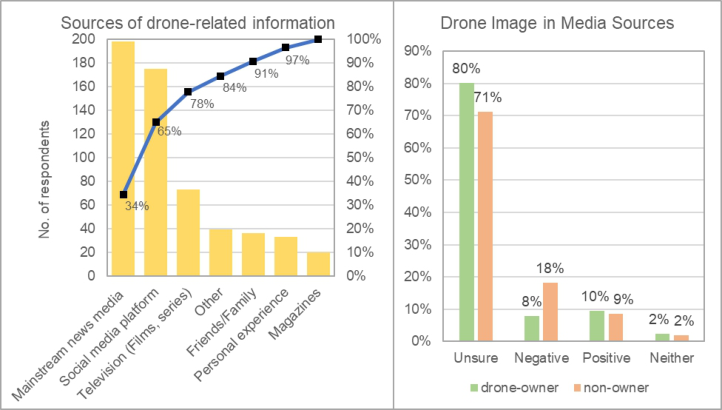
Figure 1: Frequency and cumulative percentage for drone-related information sources (left), Drone image in media sources – comparison between drone-owners and non- owners (right).
items were then provided to compute a familiarity score (sum of weights assi- gned based on respondents’ inputs on the five items). Overall, we conclude 46% of the general public with low familiarity (0-1), 44% with moderate familiarity (2-3), and only 10% with high familiarity (4-5).
Drone-Exposure in Mass Media Mass media channels have been known to inform the public and possible potential adopters about new emerging technologies. The degree to which information about a technology is received through mass media channels and the type of information received, for example positive or negative, could influence the acceptance level (Yoo et al., 2018). Drone exposure in mass media channels in particular civil drones for industrial and commercial use was explored with three items where about 40% of the general public are found to have low exposure, 28% moderate and 32 % high. A comparison between users (M=3.03, SD=1) and non-users (M=2.83, SD=0.98) indica- ted significant differences (F(1,597) = 6.08, p<.05). In other words, users showed higher exposure to drone information than non-users. The same findings were found in the case of drone-owners (M=3.22, SD=1.04) and non-owners (M=2.83, SD=0.97), (F(1,597) = 9.19, p<.01).
The sources of drone-related information were further investigated. As shown in Fig. 1, mainstream news media (including online) and social media covered a cumulative percentage of 65% of public’s information source fol- lowed by 13% television (films, series etc.). This differed to Aydin’s study (Aydin, 2019) where mainstream news media and movies/series were found to have similar impact. These findings are plausible, considering that drone sights in movies are no more novel. The open-ended answers further revealed
Public’s Perspective on Civil Drones: Reasons to Support and Oppose 353
work/job including exhibitions and scientific papers, and web sources (such as YouTube) as additional channels. The subsequent question enquired how drones are generally presented in the context, mainly positive or negative. Interestingly, majority of the respondents (73%) reported to be unsure. Based on this finding, we question to what extent can this factor influence public acceptance. Fig. 1 illustrates the descriptive data between owners and non-owner.
Drone-Related Knowledge and Familiarity The next research question addressed the role knowledge plays in public acce- ptance. The better people are informed about drones, the more they accept the use of drones (Smith et al., 2022; Eißfeldt et al., 2020). Respondents through self-assessment provided an insight on how well informed they were on drone capabilities and overall awareness of current regulations. One has to keep in mind that responses on each item are subjective and thus not an actual measurement of drone-related knowledge rather perceived know- ledge. For descriptive description, responses are coded into three categories: almost two-thirds saw themselves to have low knowledge (61%), while the rest moderate knowledge (21%) or high knowledge (18%). Here the focus is whether drone-owners resp. -users are better informed than non-owners resp. -users? And does more familiarity with drones result in better know- ledge? Aydin (2019) found that the general public’s knowledge about drones was far less than that of other stakeholders. Our investigation showed compa- rable results. We found drone-owners described themselves to have greater knowledge (M=3.13, SD=1.12) when compared to non-owners (M=2.18, SD=0.92), and similar results between drone-users (M=2.88, SD=1.1) and non-users (M=1.99, SD=0.8). The conducted two-way ANOVA was signi- ficant for both groups, (F(1,597) = 102.6, p<.001) and (F(1,597) = 52.4, p<.001) respectively, however no significant interaction effects between the groups were found (F(1,597) = 0.74, p=0.79). When drone familiarity and knowledge were compared, respondents who are more familiar with drones consider themselves significantly more knowledgeable (M=3.83, SD=0.91), whereas those that are less familiar less knowledgeable (M=1.93, SD=0.77), (F(2,598) = 129.8, p<.001).
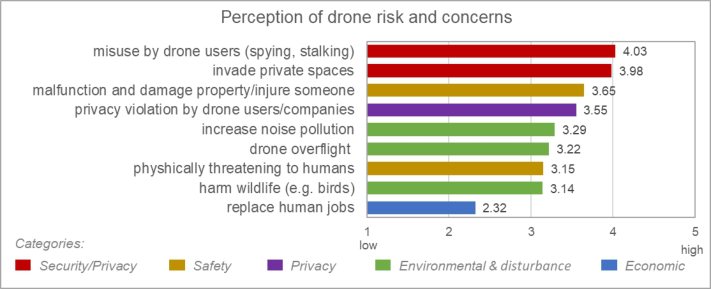
Risk Perception, Concerns and Impact of Trust and Knowledge Risks are classified based on safety, security, privacy, economic, and lastly environmental and disturbance concerns. Note that these categories often overlap with each other thus making a stark differentiation impossible. This is especially true in the case of security and privacy from the general public’s perspective. This overlap was first identified during interviews conducted within the drone stakeholder analysis (Upadrasta et al., 2021). The grea- test (highest level) concerns by the general public are acknowledged to be this combination of security and privacy. In this case misuse and invasion of private spaces (see Fig. 2). Safety and privacy concerns followed respectively. Drones replacing human-jobs was found to be least of the concerns.
354 Upadrasta and Leitner
Figure 2: General public’s perception of risks and concerns for drone use (in mean).
The one-way repeated ANOVA showed a significant difference for at least one category (F(8,4589) = 190.8, p<.001). Bonferroni pairwise comparisons using paired t-tests disclosed no significant difference between safety and pri- vacy concerns indicating equal level of risk for the two. Based on the results of the paired t-tests it was possible to rank the risks in order: highest level for 1) security/privacy, followed by 2) safety and privacy, 3) environmental and disturbance, and lastly 4) economic. These results are contrasting to Dannen- berger et al.’s (2020) findings, where participants’ main concern apart from fear of accidents and injuries was potential loss in job opportunities, howe- ver in line with Tan et al.’s (2021), Eißfeldt et al.’s (2020) and Aydin’s (2019) reports.
Respondents’ overall level of concerns towards drone use is above average (M=3.5 out of 5, SD=0.79). An observation of any potential factors that might impact this risk perception was executed. The analysis showed signi- ficant differences only in the case of drone-ownership (F(1,566) = 17.36, p<.001) and gender (F(1,518) = 9.59, p<.01), thus suggesting that drone- owners have lesser concerns (M=3.23, SD=0.82) than non-owners (M=3.57, SD=0.77). For gender, females (M = 3.65, SD = 0.73) showed significantly greater concerns than males (M = 3.65, SD = 0.78), F(1,518) = 9.59, p<.01. Drone usage, age and area of residence (high population and low population density) factors were not found to have an impact on perceived concerns, F(1,575) = 0.01, p= 0.91, F(1,518) = 0.00, p= 0.97, and F(2,518) = 1.82, p= 0.16 respectively.
The two-way ANOVA indicated that both factors, trust in technology and knowledge have a significant effect on general public’s drone risk-perception, F(2,554) = 30.26, p<.001 and F(2,554) = 9.68, p<.001) respectively. No inte- raction effect existed. Based on the Tukey comparisons respondents with low trust in technology identified more concerns (M=3.74, SD=0.79), as compa- red to those with higher level of trust (M=3.17, SD=0.78). Respondents who are less knowledgeable also associated with more risks (M=3.62, SD=0.75) than those describing to have better knowledge (M=3.36, SD=0.84).
Public’s Perspective on Civil Drones: Reasons to Support and Oppose 355
Benefits of Drone Use and Effects of Exposure, Knowledge and Trust Measures of perceived benefits with regards to general public are recognised to be societal (M=3.8, SD=0.86), environmental (M=3.42, SD=1.01) and partially economic (M=4.04, SD=0.77). A repeated measures ANOVA inve- stigated any significant differences for respondents’ perceived level of benefits between the defined categories. A significant difference was found (F(2,1149) = 150.8, p<.001) and the post-hoc Bonferroni tests indicated that the general public observe significantly higher economic benefits than societal benefits. Environmental benefits were revealed to be the lowest. The findings were similar to that of Tan et al. (2021).
In terms of overall level, it is clear that the general public comprehends drone usage to be beneficial (M=3.75 out of 5, SD=0.73). Next, the effects of knowledge, expose to drone-related information and trust in technology on the perceived benefits were inspected. A clear tendency was identified for all three factors; respondents with lower knowledge, exposure, or trust saw lesser benefits for drone usage, (M=3.65, SD=72; M=3.57, SD=0.79; M=3.5, SD=0.82 respectively) as compared to respondents with higher (M=3.99, SD=0.72; M=3.97, SD=0.65; M=4.07, SD=0.58 respectively). ANOVA tests were performed to analyse whether the perceived benefits dif- fered significantly based on the level of knowledge, exposure, or trust. The results revealed that the mean perceived benefits differed for all three factors (exposure to drone-related information: F(2,536) = 9.0, p<.001; knowledge: F(2,536) = 8.13, p<.001; trust in technology: F(2,536) = 36.33, p<.001). Lastly, effects of area of residence, gender and age were tested. Based on the perdured ANOVA and Tukey comparisons, respondents between the age of 18–39 and above 60+ years viewed significantly greater benefits to drone usage (M=3.8, SD=0.67; M=3.94, SD=0.62 respectively) to the core wor- king population i.e. 40–59 years (M=3.66, SD=0.62), F(2,516) = 5.47, p<.01. In the case of gender males’ perceived significantly greater benefits (M=3.82, SD=0.72) than females (M=3.64, SD=0.65), F(1,516) = 12.08, p<.001. Area of residence did not impact general public’s perceived benefits for drone use (F(1,516) =0.0, p = 0.93).
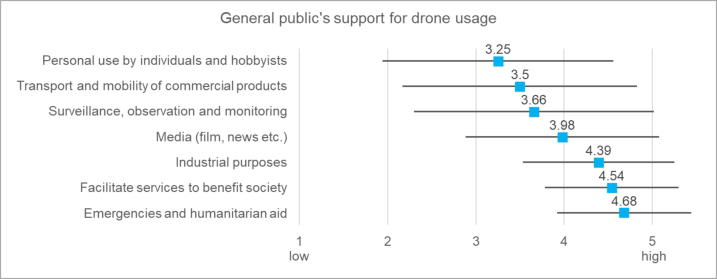
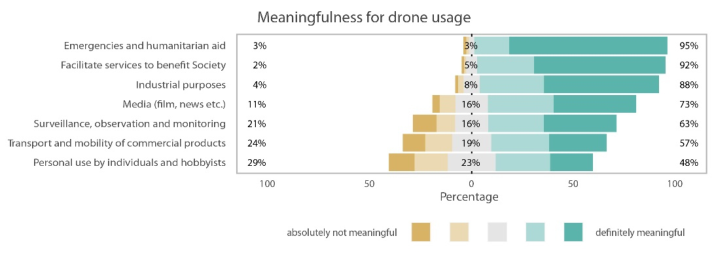
Public’s Perception of Varying Drone Use Purposes Respondents were presented with seven varying categories (see Fig. 3) with adequate deployment examples and scenarios for each. The one-way repeated measures ANOVA test revealed a significant difference between the cate- gories (F(6,3492) = 220.8, p < .001). A Bonferroni pairwise comparisons further revealed that the mean difference between all categories is less than .001 with an exception for transport and surveillance purposes (p =0.2), indicating equal support-level for both. As expected, respondents found emergencies and humanitarian aid, and purposes to facilitate services that benefit society (weather monitoring, inspection and maintenance of infra- structure) the most meaningful purposes and least controversial (see Fig. 4) for drone usage among the seven categories. Interestingly, industrial purposes closely followed. Example scenarios for this category included construction, mining, agriculture and farming e.g. crop dusting, wood/timber production
356 Upadrasta and Leitner
Figure 3: Public’s level of support towards the presented drone use categories (in mean).Figure 4: Respondents’ replies to: Which drone uses are meaningful or reasonable?
and harvesting). Less tolerant and more controversial purposes included tran- sporting commercial goods, surveillance purposes (police surveillance, police pursuit and enforcement, crowd monitoring, traffic observation), or personal usage by individuals and hobbyists. Not surprisingly, support level for perso- nal usage (flying drones for leisure, recreation, photo and video recordings during vacations/as a hobby) differed significantly between drone-owners (M=3.98, SD=1) and non-owners (M=3.09, SD=31), F(1,525) = 14.39, p < .001, and drone-users (M=3.65, SD=1) and non-users (M=3.98, SD=1), F(1,525) = 29.27, p < .001.
OUTLOOK Familiarity with drones and drone-related knowledge play an important role. The more public interacts with drones, either directly or indirectly, the bet- ter they are informed, and thus higher is the perceived knowledge. With increasing knowledge risks perceptions are expected to reduce. This is highly desirable for the acceptance and adoption of drones. Public surely compre- hends and acknowledges the economic advantages drone usage will bring, however are vary to what extent drones will positively contribute to society and the environment. More exposure to drone capabilities and facilitating
Public’s Perspective on Civil Drones: Reasons to Support and Oppose 357
trust in the technology could aid in reinforcing benefits of drone use. Fur- thermore, studies have repeatedly reported universal high support for drone usage when the drone deployment purpose is related to medical emergencies, humanitarian and catastrophic response. The findings of this study indicate that this support is being extended to industrial applications as well. More time and work would however be needed for commercial and hobby rela- ted uses. Our next steps involve reporting on the performed model analysis and identified relationships between the determinants of public acceptance of drone usage.
ACKNOWLEDGMENT
This paper is part of the ADACORSA project that has received funding within the (ECSEL JU) in collaboration with the H2020 Framework Pro- gramme (H2020/2014-2020) and National Authorities, under grant agre- ement 876019. We thank all project partners for their translation and dissemination support and all respondents for their participation in the online survey.
REFERENCES
Applin, S. A. (2016). Deliveries by Drone: Obstacles and Sociability. In B. Custers (Ed.), The Future of Drone Use: Opportunities and Threats from Ethical and Legal Perspectives (pp. 71–91). T.M.C. Asser Press. doi:https://doi.org/10.1007/978-94- 6265-132-6_4 Aydin, B. (2019). Public acceptance of drones: Knowledge, attitudes, and pra-
ctice. Technology in society, 59, 101180. Bergersen, S. (2021). Societal Acceptance of Civil Drones in Europe. Insights from policy and academic literature. Peace Research Institute, Oslo. PRIO Policy, ISBN:978-82-343-0240-4 Chamata, J., & Winterton, J. (2018). A Conceptual Framework for the Accepta-
nce of Drones. The International Technology Management Review, 7(1), 34–46. https://doi.org/10.2991/itmr.7.1.4 Dannenberger, N., Schmid-Loertzer, V., Fischer, L., Schwarzbach, V., Kellerman, R., & Biehle, T. (2020). Verkehrslösung oder Technikhype? Ergebnisbericht zur Ein- stellung der Bürgerinnen und Bürger gegen Luftraum in Deutschland (Projekt: The Sky is the. (Projekt: The Sky is the Limit – Die zukünftige Nutzung des urbanen Luftraums) (Issue June). doi:https://doi.org/10.13140/RG.2.2.16020.32642 Eißfeldt, H., Vogelpohl, V., Stolz, M., Papenfuß, A., Biella, M., Belz, J., & Kügler, D.
(2020). The acceptance of civil drones in Germany. CEAS Aeronautical Journal, 11(3), 665–676. Kellermann, R., Biehle, T., & Fischer, L. (2020). Drones for parcel and passenger transportation: A literature review. Transportation Research Interdisciplinary Perspectives, 4, 100088. doi:https://doi.org/10.1016/j.trip.2019.100088 Macias, M., Barrado, C., Pastor, E., & Royo, P. (2019). The Future of Drones
and their Public Acceptance. In 2019 IEEE/AIAA 38th Digital Avionics Systems Conference (DASC) (pp. 1–8). IEEE. Nelson, J. R., Grubesic, T. H., Wallace, D., & Chamberlain, A. W. (2019). The view from above: A survey of the public’s perception of unmanned aerial vehicles and privacy. Journal of urban technology, 26(1), 83–105.
358 Upadrasta and Leitner
Ramadan, Z. B., Farah, M. F., & Mrad, M. (2017). An adapted TPB approach to consumers’ acceptance of service-delivery drones. Technology Analysis & Strategic Management, 29(7), 817–828. https://doi.org/10.1080/09537325.2016.1242720 Roberson, C. M. (2018, February). Drones Gaining Acceptance in Healthcare.
Supply Chain Brain, 22(1), 61. Smith, A., Dickinson, J. E., Marsden, G., Cherrett, T., Oakey, A., & Grote, M. (2022).
Public acceptance of the use of drones for logistics: The state of play and moving towards more informed debate. Technology in Society, 68, 101883. Talley, S. (2020). Public Acceptance of AI Technology in Self-Flying Aircraft.
Journal of Aviation/Aerospace Education & Research, 29(1), 49–64. https://doi.org/10.15394/jaaer.2020.1822 Tan, L., Lim, B., Park, G., Low, K., & Yeo, V. (2021). Public acceptance of drone applications in a highly urbanized environment. Technology in Society, 64, 101462. Upadrasta, V., Hamdan, J., Leitner, R., & Kolrep, H. (2021). Who Are the
Stakeholders of Drone Use? Roles, Benefits, Risk Perceptions, and Solutions. In International Conference on Human Interaction and Emerging Technologies (pp. 572–579). Springer Cham. Vincenzi, D., Ison, D., & Liu, D. (2013). Public perception of unmanned aerial systems (UAS): A survey of public knowledge regarding roles, capabilities, and safety while operating within the National Airspace System (NAS). Watkins, S., Burry, J., Mohamed, A., Marino, M., Prudden, S., Fisher, A., Kloet, N.,
Jakobi, T., & Clothier, R. (2020). Ten questions concerning the use of drones in urban environments. Building and Environment, 167, 106458. Yoo, W., Yu, E., & Jung, J. (2018). Drone delivery: Factors affecting the public’s attitude and intention to adopt. Telematics and Informatics, 35(6), 1687–1700. doi: https://doi.org/10.1016/j.tele.2018.04.014 Zwickle, A., Farber, H. B., & Hamm, J. A. (2019). Comparing public concern and
support for drone regulation to the current legal framework. Behavioral Sciences & the Law, 37(1), 109–124. doi:https://doi.org/10.1002/bsl.2357
LISTED IN THE AHFE DIGITAL BOOKSTORE CATALOGUE
Explore the complete digital volume
Human Interaction and Emerging Technologies (IHIET-AI 2023): Artificial Intelligence and Future Applications
Read this individual research paper free through the original publisher, or explore the full digital proceedings book.
ISBN 978-1-958651-46-9
Explore this ISBN in the AHFE Bookstore ↗Listed in the July 2026 bookstore catalogue; search by ISBN to confirm current availability · Digital book purchase optional