In general, professional soccer players excel at situational judgment and express the game situation as if they are viewing the game from directly above the pitch.This cognitive method is called the bird's-eye view and is considered important for accurate situational judgment. It is also known that expert soccer players exhibit visual search behaviors specific to different situations, such as attacking, defending, and one-on-one play. Therefore, there is possibly a visual search behavior unique to bird's-eye view cognition. In this study, we investigated the effects of improvement in bird's-eye view ability on visual search behavior by using a training method involving virtual reality, which was already developed in a previous study. By revealing the visual search behavior specific to the bird's-eye view, we expect to develop a new training method that adds eye-gaze support. In this study, we developed a virtual reality-based bird's-eye view training system using the Unity game engine, a Head Mounted Display, and an HTC VIVE controller. The system consisted of a training task for training the bird's-eye view ability and a three-choice question for evaluating it. The training task consisted of three phases: showing a first-person video from the center of a soccer pitch, sorting player positions on a bird's-eye map of the pitch, and presenting the correct answers. First, we examined the effects of a training task on the bird's-eye view ability in a system. The experiment was conducted on nine male subjects aged between 20 and 30. The subjects were divided equally into three groups. An experimental group was assigned the training task, control group 1 were showed the first-person video and were informed about the correct answers, and a control group 2 were only provided with the first-person video. The participants answered 10 three-choice questions as a pre-task, performed the training task 10 times, and answered 10 three-choice questions as a post-task. At the end of the experiment, the participants answered a questionnaire about their experience with sports, video games, and changes in their cognition. As a result, the experimental group and control group 1 performed better on the post-task than on the pre-task in training. In particular, the growth rate of the scores of the experimental group was higher than that of control group 1. This suggests that the participants may have acquired a bird's-eye view of cognition through training. In addition, in the questionnaire, two participants in the experimental group responded that they "stopped shaking their heads a lot”. This suggests that the improvement of bird's-eye view ability may have influenced the visual search behavior. Next, we conducted an experiment to investigate the relationship between bird's-eye view cognition and visual search behavior based on eye-gaze information and head movements during training. This experiment clarified the relationship between bird's-eye view cognition and visual search behavior, and is expected to lead to the development of better bird's-eye view training using eye gaze support.
Generally, professional soccer players excel in situational judgment and express their game situation as if viewing the game from directly above the pitch. This cognitive method is called the bird’s-eye view, and is considered important for accurate situational judgment. Moreover, expert soccer players have specific visual search behaviors for various situations (Natsuhara et al. 2017). For example, in a pass decision-making task in a complex game situ- ation, expert players position their gaze on the defender before receiving the pass, and shift their gaze from the defender to a teammate before executing the pass (Natsuhara et al. 2015). In 11-on-11 defensive situations, unskilled players tend to focus more on the ball and the player passing the ball, whereas expert players tend to focus on the movement, position, and space of players but now the ball (Roca et al. 2011). Thus, although the gaze position dif- fers, expert soccer players have specific visual search behaviors for various situations, which are considered to be goal-directed information-gathering
strategies. This suggests that there may also be specific visual search behavi- ors when judging a situation based on cognition from the bird’s-eye view. We believe that the acquisition of visual search behaviors specific to the bird’s- eye view improves its ability, which, in turn, improves the ability to judge the situation accurately.
Therefore, in this study, we investigated the influence of the improvements in bird’s-eye view ability on visual search behavior by training with Virtual Reality, which has been developed in a previous study (Shitamori et al. 2016). As the visual search behavior specific to a bird’s-eye view becomes clearer, it is expected that better training will be developed by adding functions to assist or guide visual search behavior.
OVERVIEW OF BIRD’S-EYE VIEW ABILITY TRAINING SYSTEM A virtual space was constructed using the Unity game engine, and VR ima- ges were presented using a head-mounted display (HMD). An HTC VIVE controller was used as the input device.
The system consisted of a training task to train the bird’s-eye view ability, and a three-choice question to evaluate it.
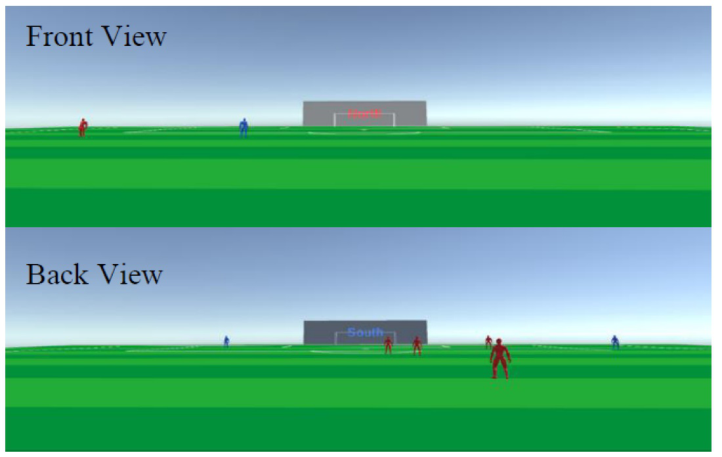
Training Tasks In the training task, ten player objects (five red and, five blue) were placed on a soccer court. The trainee watches a first-person video showing a 360
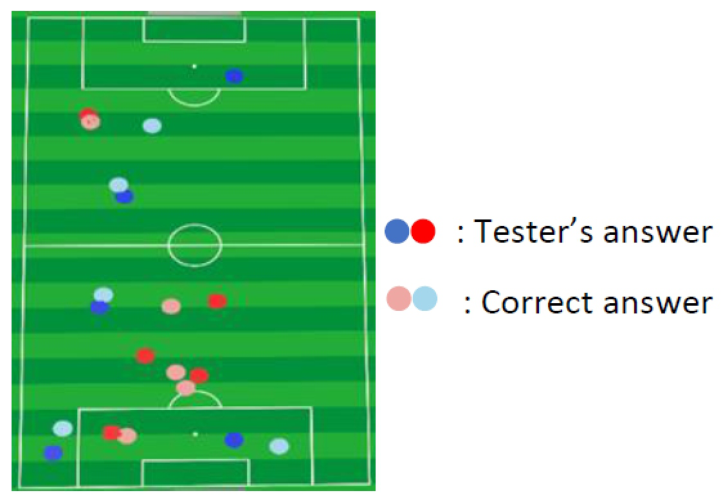
view from the center of the pitch as shown in Figure 1, for 10 seconds, and then arranges the player objects in a bird’s-eye view, as shown in Figure 2.
Figure 1: View of the first-person video.
Relationship Between Bird’s-Eye View Cognition and Visual Search Behavior 69
Figure 2: Bird’s-eye view map.
The trainee then checks the placement of the objects and the correct place- ment and repeats this process until the trainee declares that the image of the placement of the objects from the bird’s-eye viewpoint matches the actual placement of the objects.
Three-Choice Question For the three-choice question, the trainee first viewed the first-person video for 10 seconds, as in the training task. Next, three bird’s-eye views of the player objects are shown at one-second intervals, and the trainees are asked to choose the one they think is the same as the arrangement they saw in the first-person video and to indicate their confidence level in their choice. The three bird’s-eye views shown for each choice consisted of one correct placement and two randomly shifted by 0–5 m in the vertical and horizontal directions from the correct placement of each object.
ASSESSING THE IMPACT OF BIRD’S-EYE VIEW ABILITY TRAINING First, a bird’s-eye view training system was developed based on a previous study (Shitamori et al. 2016), and the effect of the training on bird’s-eye view ability was evaluated.
Experiment In the experiment, VR images were presented using an HTC VIVE Pro Eye HMD. Nine Japanese male participants (22.3±1.1 years old) were divided into three groups: experimental group, control group 1, and control group 2.
In the experimental group, the trainee performed the entire training task. In control group 1, the training task consisted of viewing a first-person vie- wpoint image and correct placement of the answers, whereas in control group 2, the training task consisted of viewing a first-person viewpoint image only. The participants first answered 10 three-choice questions as a pre-task, then performed the training task ten times, and finally answered 10 post- task three-choice questions. The pre- and post-task questions were different. At the end of the experiment, the participants were asked to respond to a questionnaire to indicate any changes in their cognitive abilities that they felt through the experiment. This study was conducted with the approval of the Ethics Committee on Research Involving Human Subjects at Saitama University (R4-E-23).
Results
The number of correct answers to the 10 three-choice questions in the pre- and post-task periods were calculated on a 10-point scale. Table 1 shows the mean score difference and score ratio of the pre- and post-tasks for the experimental group, control group 1, and control group 2.
In the questionnaire, all six participants in experimental and control group 1 responded that they had become more aware of their relative positions during the experiment. Only the top three scorers (one from the experimental group and two from control group 1) responded that they became graphi- cally aware of positional relationships. Additionally, only two participants in the experimental group stopped shaking their heads as much as they were expected to.
Discussion
Table 1 shows that the mean score difference was negative only in control group 2, with the mean score ratio being less than 1, suggesting that the trai- ning task in control group 2, with only the first-person viewing of the video, had no effect on increasing the scores, and that correct placement during the training task in the experimental and control group 1 was the factor that increased the scores. The mean score ratios were higher in the control group than in the experimental group. Furthermore, the mean score ratio of the experimental group was higher than that of control group 1, suggesting that the experimental group had a greater increase in scores than control group 1 and that the training was more effective when both reordering and correct placement were performed than when only correct placement was performed.
Table 1. Comparison of mean score difference and mean score ratio by group.
Table available in the original PDF paper.
Group name Score difference[−] Score ratio[−] Experimental 2.33 1.72 Control1 2.33 1.53 Control2 −0.333 0.952
Relationship Between Bird’s-Eye View Cognition and Visual Search Behavior 71
Moreover, participants with increased scores indicated that they percei- ved the positional relationship relatively (especially graphically), suggesting that they may have acquired a bird’s-eye view of cognition through the trai- ning conducted in this experiment. Furthermore, only two participants in the experimental group answered that they stopped shaking their heads frequ- ently, suggesting that the training may have influenced their visual search behavior.
RELATIONSHIP BETWEEN BIRD’S-EYE VIEW COGNITION AND VISUAL SEARCH BEHAVIOR An experiment to evaluate the effects of bird’s-eye view training on its abi- lity suggested that the training may have helped trainees acquire a bird’s-eye view cognitive method and influenced their visual search behavior. To eva- luate the relationship between improvements in cognitive ability and visual search behavior, we conducted an experiment using a bird’s-eye view training system.
Experiment We used HTC’s VIVE Pro Eye HMD with a Tobii eye tracker to present VR images and measure eye and head movements. Ten Japanese males (22.7±0.74 years old) participated in the experiment. The participants first answered 10 three-choice questions as a pre-task, then performed the training task ten times, and finally answered 10 post-task three-choice questions. The pre- and post-task questions were kept different. At the end of the experi- ment, the participants responded to a questionnaire to indicate the changes in their cognitive abilities that they felt through the experiment. This study was conducted with the approval of the Ethics Committee on Research Involving Human Subjects at Saitama University (R4-E-23).
Eye Movement Here, the gazing state was defined as a state in which the eye movement speed was 10
/s or less for 133 ms (eight frames) or longer, in accordance with a previous study (Kato and Fukuda 2002). Based on this definition, the number of gazes and the total gazing time were calculated from the gaze data while viewing the first-person video and answering the three-choice questions.
Head Movement To evaluate the effect of bird’s-eye view training on its ability, we defined the number of pivoting movements and analyzed them because the training also affected pivoting movements.
The rotational motion of the HMD around the y-axis (in the left-right pivoting direction) was calculated as the number of pivoting movements. In a preliminary experiment, the maximum angular velocity was 19
/s when the subject stood still while looking forward in a natural posture. Based on this definition, we calculated the number of pivots made by the participant from HMD tracking data while viewing the first-person video and answering a three-choice question.
Results
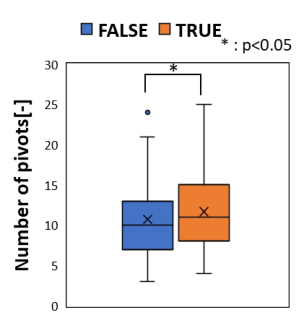
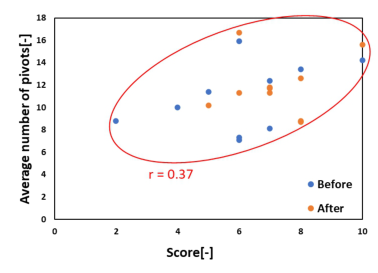
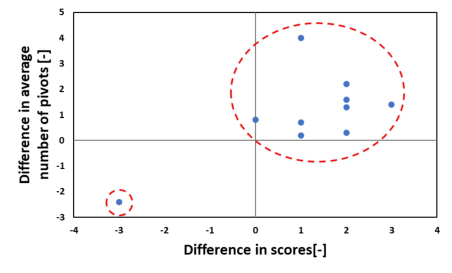
The box-and-whisker plots in Figure 3 show the number of pivots for cor- rect and incorrect answers, and the Mann-Whitney U test for the number of pivots for correct and incorrect answers showed significant differences at the 5% significance level. As shown in Figure 4, the number of correct answers in the pre- and post-assignments was calculated as a score of 10, and the correlation between the score for the three-choice questions and the average number of pivots in the pre- and post-assignment was calcula- ted. A weak positive correlation coefficient (r = 0.37) was found. Figure 5 shows that the correlation coefficient between the scores and average num- ber of pivots was weakly positive. As shown in Figure 5, the difference between the pre- and post-assignment scores and the average number of pivots increased for the nine participants whose scores increased from pre- to post-assignment, and it decreased for the one participant whose scores decreased.
There was no significant difference between the results of correct and incorrect answers in terms of the number of gazes and gazing time, nor was there any significant trend between the mean and scores.
Figure 3: The number of pivots for correct and incorrect answers.Figure 4: Correlation between scores and average number of pivots.
Relationship Between Bird’s-Eye View Cognition and Visual Search Behavior 73
Figure 5: Correlation between the differences in scores and average number of pivots.
DISCUSSION
There was a significant difference in the number of pivots between correct and incorrect answers to the three-choice questions, and a weak positive correlation between the score and the average number of pivots, indicating that an increase in the number of pivots increases the score. The number of pivots increased after training, suggesting that the training may have incre- ased the number of pivots. Besides, the number of times a player swivels his head during a soccer game is positively correlated with the number of successful passes (Marius et al. 2022). Accurate situational judgment is neces- sary for successful passing, and it is believed that cognition from a bird’s-eye view is important for accurate situational judgment. Therefore, increasing the number of pivoting movements may improve the bird’s-eye view, which in turn may improve the ability to judge the situation accurately.
No significant differences or trends were found in the number of gazing instances or gazing duration. In a previous study (Natsuhara et al. 2013) conducted on skilled and unskilled soccer players, there was no difference in the number and duration of gazing between them but the number of gazing targets was greater for skilled players than for unskilled players. Because the number of pivoting movements might increase when the number of gazing targets increases, it should be considered as a parameter in future studies.
Expert sports players use three superior techniques to perceive and reco- gnize in sports situations: visual search strategy, pattern recognition, and prediction (Williams et al. 2002). To examine the mechanism of bird’s-eye view, this study focused specifically on visual search strategies among the three. For this purpose, we developed a bird’s-eye view training system in which all memorized arrangements were randomly arranged and did not include soccer scenarios related to pattern recognition and prediction. The results revealed a tendency for the number of pivots to be higher for those who performed better on the three-choice questions in this training system. Although this study did not fully explain the visual search strategy related to the bird’s-eye view based on the number of pivots, number of gazes, and gazing time, it was found that the high frequency of pivoting, which is a characteristic of expert soccer players, may be related to the bird’s-eye view. Therefore, although it cannot be said that all expert soccer players have a
bird’s-eye view, it is possible that many possess its cognitive ability. We beli- eve that further clarification on the mechanism of bird’s-eye view may be achieved by investigating the relationship between bird’s-eye view, pattern recognition, and prediction abilities possessed by skilled sportspeople.
CONCLUSION
In this study, we conducted experiments to investigate the influence of impro- vement in cognitive ability of bird’s-eye view on visual search behavior. The results suggest that the number of pivoting movements increased by the trai- ning may have improved the bird’s-eye-view ability. In future, we will further investigate the effects of visual search behavior by adding indicators such as the number of objects to be gazed at. Using these findings, we will add a function to assist and guide visual search behavior, as well as investigate the relationship between pattern recognition and prediction and bird’s-eye view to further clarify the mechanism of bird’s-eye view and improve training.
ACKNOWLEDGMENT
I would like to thank K. Kaede and Y. Osawa for their kind guidance and encouragement throughout the course of this research.
I would also like to thank J. Nakajima, Director of FC Gois, for his many advices in the field of soccer.
REFERENCES
Kato, T., Fukuda, T. (2002). Visual Search Strategies of baseball batters during the preparatory phase of battiong, Ergonomics, Volume 38 No. 6. pp. 333–340 (in Japanese). Marius, P., Robert, R., Daniel, M., Stephan, N., Marie, K., Karl, M. A., Geir, J.,
Daniel, M. (2022). Modeling Players’ Scanning Activity in Football, Journal of Sport and Exercise Psychology, Volume 44 No. 4. pp. 263–271. Natsuhara, T., Kato, T., Nakayama, M., Asai, T. (2017). Research trends of perceptual-cognitive skills in decision-making on soccer: Implications for coach- ing science, The Japan Journal of Coaching Studies, Volume 31 No. 1. pp. 1–10 (in Japanese). Natsuhara, T., Nakayama, M., Kato, T., Nagano, T., Sasaki, R., Yoshida, T.,
Akano, Y., Asai, T. (2013). Proficiency-related Differences in Soccer Players’ Cognitive Processes From the Perspective of Eye Movemoment and Verbal Report, Proceedings of Sport and Human Dynamics, No. 307 pp. 1–5 (in Japanese). Natsuhara, T., Nakayama, M., Kato, T., Nagano, T., Yoshida, T., Sasaki, R., Asai, T. (2015). Cognitive processes underpinning the execution of passes with tacti- cal decisions in soccer, Japan Journal of Physical Education, Health and Sport Sciences, Volume 60 No. 1. pp. 71–85 (in Japanese). Roca, A., Ford, P. R., McRobert, A. P., Williams, A. M. (2011). Identifying the proces-
ses underpinning anticipation and decision-making in a dynamic time-constrained task, Cognitive processing, No. 12. pp. 301–310. Shitamori, S., Munekata, N., Ono, T. (2016). An evaluation of the training effectiveness of bird’s-eye view using a head mounter display, IPSJ Entertainment Computing Symposium, pp. 289–294 (in Japanese). Williams, A. M., Ward, P., Smeeton, N. J. (2002). Perceptual and cognitive expertise
in sport, The Psychologist, Volume 15 No. 8. pp. 416–417.
LISTED IN THE AHFE DIGITAL BOOKSTORE CATALOGUE
Explore the complete digital volume
Affective and Pleasurable Design
Read this individual research paper free through the original publisher, or explore the full digital proceedings book.
ISBN 978-1-958651-47-6
Explore this ISBN in the AHFE Bookstore ↗Listed in the July 2026 bookstore catalogue; search by ISBN to confirm current availability · Digital book purchase optional