Evangelos Markopoulos, Chrystalla Protopapa (2023). Machine Reading Comprehension and Expert System technologies for social innovation in the drug excipient selection process. In: Artificial Intelligence and Social Computing. AHFE Open Access, vol. 72, pp. 48–57. https://doi.org/10.54941/ahfe1003273
The growth of the global population together with several unpredicted crises such as political, health, and financial, create an environment of uncertainty in which social innovations can be developed to offer stability in people’s lives and create new business development opportunities for the benefit of the economy and the society. One of the undoubted rights of every human being is access to affordable medical treatment. However, the costs and time needed for research and development on new or specialized drugs are not often covered by governmental budgets and initiatives that could make such medicines accessible to all who needed them. Private companies invest tremendous amounts and expect returns on their investments. This gap, between the availability of a drug and its accessibility, created the social need for a generic drug market and the inspiration for advanced innovations to serve it. Research indicates that the price of brand-name drugs can drop up to 80% after the commercialization of a new generic which has the same action and can potentially replace them. The global generic drug market worth is expected to increase from $311.8 billion in 2021 to $442.3 billion in 2026. Excipients represent a market value of $4 billion, accounting for 0.5% of the total pharmaceutical market. The global market of AI was estimated at 43.1 billion in 2020 and is predicted to reach $228.3 billion by 2026 with a 32.7 % CAGR. On the other hand, the revenues of the AI Health market are projected to grow from $6.9 billion in 2021 to $67.4 billion in 2027 reaching $120.2 billion by 2028 with a CAGR of 45.3%.The choice of excipients in drug development is a critical and time-consuming process. Currently, excipients are chosen based on the route of administration, physicochemical characteristics, place of action, and the type of release of the active ingredient. The process involves many quality control tests on the drug such as fragility, dissolution, disintegration, dosage uniformity, and stability, which are repeated when the excipient changes. This laborious and time-consuming process considers a massive number of existing excipients categorized into different functional groups used for different purposes.This paper addresses this challenge and introduces an approach to resolve it using Artificial Intelligence for social innovation in the formulation development industry. Specifically, the paper presents an Expert system (ES) based software architecture to facilitate assess and utilize drug-excipient relationship data scattered in various forms of documentation and/or scientific literature. The inference engine of the ES operates with rule base and case-based reasoning powered by Machine Reading Comprehension (MRC) and Natural Language Processing (NLP) technologies that populate and enrich the knowledge base. The MRC and NLP technologies interpret existing drug formulations and propose potential new drug formulations, based on its physicochemical characteristics.According to research results, the time to introduce a generic drug can be reduced by 30% if there is an indicative formulation to start the process. The eight months gained can be used to market the product. This is a significant amount of time that reduces research and development costs, reduces the time to market, and increases productivity and operations efficiency. The research conducted is based on an extensive literature review, primary research with surveys and interviews but also with the analysis of several case studies to indicate the need for the proposed technology and support the system architecture design. Furthermore, the paper presents the pre and post-condition for adopting such technology, highlights research limitations, and identifies areas of further research to be conducted for the optimization of the technology and its contribution to the global economy and society.
The growth of the global population and several unpredicted political, health, and financial crises create an environment of uncertainty in which social innovations can be developed to offer stability in people’s lives and create new business development opportunities for the benefit of the economy and society.
One of the undoubted rights of every human being is access to affor- dable medical treatment. Developing a pharmaceutical formulation qui- ckly enough with secure quality is a complicated process that requires a
Machine Reading Comprehension and Expert System Technologies 49
science-based systematic approach. Key information such as the proper- ties of the drug substance and excipients, and interactions between the materials, equipment, and unit operations are necessary (Fathima et al., 2011). Formulations consist of the active ingredient along with specific quantities of excipients, and their development requires specific manufacturing proces- ses and operating conditions. The properties of the ingredients and potential interactions between them must be taken into consideration. This requires exploration in a design space where the connections between the properties are not well-defined. Experts’ knowledge is difficult to explain quantify and transmit, so expert systems can be used to capture, analyze, enrich, and utilize this knowledge.
However, the costs and time needed for research and development on new or specialized drugs are not often covered by governmental budgets and ini- tiatives that could make such medicines accessible to all who needed them. Private companies invest tremendous amounts and expect returns on their investments to reduce development costs, shorten development time, improve process design and efficiency, increase productivity, and achieve competitive advantage. The gap between drug availability and its accessibility creates the social need to accelerate the formulation development process and inspire advanced innovations to serve it.
LITERATURE REVIEW
Research indicates that the price of brand-name drugs can drop up to 80% after the commercialization of a new generic that has the same action and can potentially replace them. The global generic drug market value is projected to rise from $311.8 billion in 2021 to $531.84 billion in 2028 (Forecast, 2021; Gallagher, 2022).
Since the excipients form 90% of the pharmaceutical product, the choice of excipients in a generic formulation product is the most critical challenge. Excipients are accounting 0.5% of the total pharmaceutical market with a market value of $4 billion (Haywood and Glass, 2011) and the process of properly choosing them is crucial and time-consuming. Currently, drug for- mulation development can be briefly described with the following process. Excipients are selected based on the route of administration, physicochemical characteristics, place of action, and the release profile of the active ingredi- ent. Each formulation is then tested for its fragility/hardness, dissolution, disintegration, dosage uniformity, and stability which are the prerequisite pharmacopoeia tests. The entire process is repeated when there is a change in the release rate, the route of administration, the strength of the active ingre- dient and the pharmaceutical form, or there is a new active ingredient/new variation of a biologic or excipient. Taking into consideration that only the dissolution test takes 10 hours for each formulation and on average 30 for- mulations are tested with different combinations of excipients in various pH and manufacturing conditions the process is considered laborious, costly, and time-consuming.
50 Markopoulos and Protopapa
Research results indicate that the time to introduce a new medicine in the market can be reduced by 30% if there is an indicative formulation to start the process and potential results of the prerequisite tests. This 30% can save tremendous amounts of money from the reduction of research salaries, reduction of business operations costs, faster product delivery to the market, the time gained for the development of the next project, and other related benefits. Furthermore, reducing the tests that must be done can be considered as an environmental activity that decreases the environ- mental footprint. As a result, most pharmaceutical companies are amenable to investing in technology that will offer a clear advantage and accele- rate the process compared to the other companies (Leigh Ann Anderson, 2022). The above is verified with data collected from industry experts. The ELPEN pharmaceuticals R&D Director emphasized on having a pos- sible formulation, to begin with, can remarkably drop the time nee- ded for developing a formulation from two years to about one year and four months. The eight months gained can be used to market the product and rise the company’s profitability. Likewise, the Verisfield R&D Formulation director indicates that manual lab work on gene- rics’ decisions, without any technological help, takes about 8–10 mon- ths and requires numerous and different costly tests done by expensive experts.
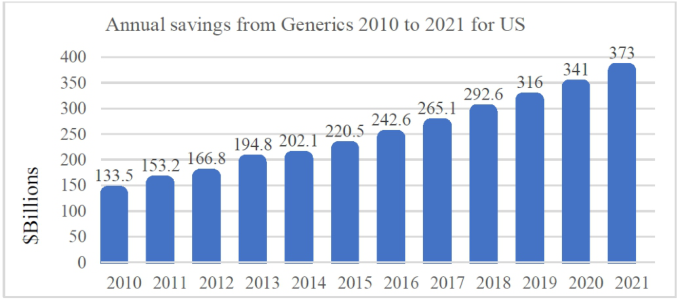
Governments worldwide are supporting generic pharmaceutical compa- nies to continue and expand their operations (Forecast, 2021). Precisely, the US health system saved the last decade $2.6+ trillion due to generics with nearly 89% of more than 3.9 billion prescriptions in the last decade being filled with generic drugs (Figure 1) (Association for Accessible medicines, 2022). In Europe each year, more than $110 billion are saved because of the generics (Thepharmaletter, 2016). As a result, Governments are pleased to support the quicker progress of generic drugs as the long-term benefits for them are significant.
Figure 1: The annual savings for the US government due to generics from 2010 to 2021 (Association for Accessible medicines, 2022).
Machine Reading Comprehension and Expert System Technologies 51
THE AI HEALTH MARKET Despite the excipients market growth, almost all the Pharmaceutical compa- nies and especially the generic pharmaceutical companies which must develop a new formulation similar to the original in less than two years, face challen- ges with the huge amount of data they must deal with (Lubis and Kartiwi, 2011). Nevertheless, there is nothing in the market to help them organize, categorize, and compare the data quickly and efficiently for the development of new formulations. AI can solve those needs and propose potential for- mulations and results on the prerequisite pharmacopoeia tests with several comparisons and analysis on the existing data.
The global market of AI was estimated at $119.78 billion in 2022 and is predicted to reach $1,597.1 billion by 2030 with a 38.1 % CAGR (PR, 2023). On the other hand, the AI Health market revenues are projected to grow from $6.9 billion in 2022 to $67.4 billion in 2027 reaching $188 billion by 2030 with a CAGR of 45.3% (CISION, 2021; GVR, 2021; Statista, 2022a). Howe- ver, when there are many companies active in this field, the more competitive the market becomes. Nevertheless, research literature shows that over 90% of pharmaceutical companies are enthusiastic to invest in AI to rise the success rates of new drugs while reducing operational costs. As of today about $54 billion are saved from pharma companies due to AI (Canterbury, 2022; ITIF, 2022). It is estimated that more than 60% of the pharma companies globally plan to adopt AI technologies by 2030.
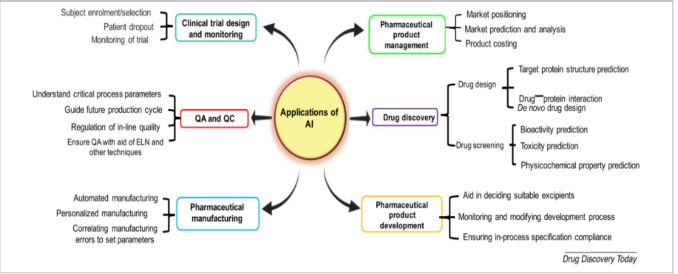
RESEARCH AND MARKET GAP Despite the advancement of Artificial Intelligence, research indicates a gap in AI applications in the formulation development process (Figure 2) (Paul et al., 2021).
Figure 2: Absence of AI excipient selection applications from the contribution of AI in the drug development process (Paul et al., 2021).
Diving further into the AI application in the pharmaceutical sector and specifically, in the drug discovery sector, Table 1 indicates several AI tools used in drug discovery (Paul et al., 2021). However, none of them is focused
52 Markopoulos and Protopapa
Table 1. Examples of AI tools used in drug discovery (Paul et al., 2021).
Table available in the original PDF paper.
on formulation development by excipient selection based on the physico- chemical attributes of the drug or in the proposition of the results of the pharmacopoeia tests.
THE PHARMESDD TECHNOLOGY Based on the excipient market growth and the costly and time-consuming tests that must be done for the medicine to enter the market there is an impe- rative need to develop an Expert system (ES) that would access and utilize drug-excipient relationship data and indicative results of the prerequisite tests scattered in scientific literature.
This research introduces PHARMESDD (PHARMaceutical Expert System Drug Development). An AI technology that integrates Machine Reading Comprehension (MRC) and Natural Language Processing (NLP) Expert System (ES) to interpret existing drug formulations using Machine Lear- ning (ML), but also Deep Learning (DL), Cheminformatics, and Big Data to recommend results based on the physicochemical characteristics of the active ingredient and the route of administration. PHARMESDD is desi- gned to suggest indicative proportions of excipients, potential results of the pharmacopoeia tests, ways of manufacturing the medicine, adverse interacti- ons between drug-excipient and excipient-excipient, and identify if a patent covers the proposed formulation.
PHARMESDD utilizes open-access online databases to develop and improve its logic and thinking process. There are however indirect thre- ats such as the Formulation diary, the FDA (Food and Drug Admini- stration), the EMA (European Medicinal Agency), and the EMC (Ele- ctronic Medicines Compendium), which are free online databases that afford information for active ingredients and excipients, but data with- out intelligent technologies like PHARMESDD cannot be utilized effici- ently. Such a technology, able to process thousands of accessible for- mulations can instantly propose potential formulations by reducing the cost, time, and effort needed for such output. Research conducted indica- tes that technology such as PHARMESDD can achieve tremendous time reductions in the drug discovery process, some of which are listed in Table 2.
Machine Reading Comprehension and Expert System Technologies 53
Table 2. Pharmacopoeia tests time reduction that can be achieved with the use of related software.
Table available in the original PDF paper.
Pharmacopeia tests Time reduction for each test Dissolution 10h to 2s Disintegration 45min to 2s Hardness/friability 15min to 2s Uniformity of dosage units 15min to 2s
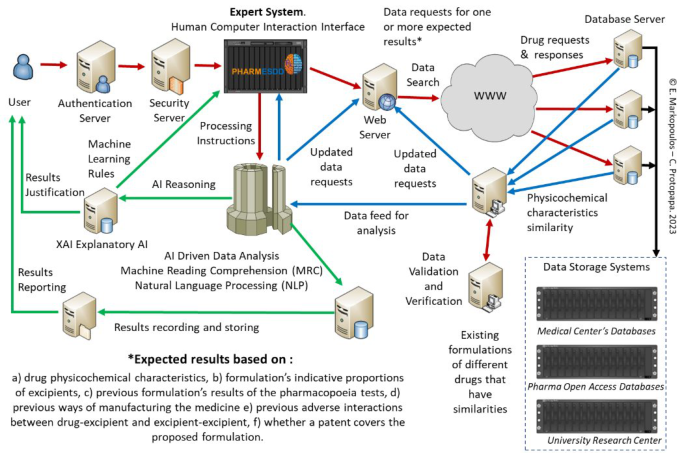
SYSTEM ARCHITECTURE OF THE PHARMESDD PHARMESDD uses Expert Systems as the core artificial technology for its operations. The user opens a dynamic dialogue with the technology where formulation requirements are passed from the expert system to two other arti- ficial intelligence technologies (the Machine Learning Comprehension and the Natural Language Processing subsystem) for the development of the out- put. In this process, data requests are made to accessible databases located in medical centers, open-access databases, universities, and on PHARMESDD data that has been collected from past experiences. The triangulated ope- rations between the Expert System, the Machine Learning Comprehension and Natural Language Processing, and the databases are continuous until the expert system rules are completed enough to deliver a result with a high certainty factor (above 80%). During this process, any data imported from the databases are checked for physicochemical characteristics similarity, validated, and verified for completion, correction, and coherence.
Figure 3 presents a high-level system architecture of PHARMESDD. It must be noted that this is XAI technology (Explanatory AI) as the results given to the user are supported by a detailed explanation of the logic, data, actions, and reasoning followed to deliver them.
Figure 3: PHARMESDD system architecture.
54 Markopoulos and Protopapa
SUSTAINABILITY AND TARGET MARKET PHARMESDD’s innovative design and the market gap in HealthTech AI lead to a blue ocean in terms of market innovation (Kim & Mauborgne, 2004) but also into a Green Ocean in terms of sustainable innovation (Markopoulos et al., 2020a) and environmental protection. Several tests for the excipients’ selection use organic solvents. The pharmaceutical industry spends hundreds of millions of dollars each year to manage millions of Kg of organic solvents. Therefore, reducing the needed tests becomes an environmentally friendly act and decreases the costs for pharmaceutical companies.
From a business suitability perspective, PHARMESDD can be primarily adapted by AI-powered organizations to identify the physicochemical pro- perties of the excipients, organize the data into smaller groups, and connect inputs and outputs. These are usually large pharmaceutical companies that develop brand-name drugs, with a significant budget to spend and inve- stments to do for the optimization of their operations. As of today, none of the technologies used offers possible formulations, potential methods to develop the formulations, potential interactions between excipient-excipient and drug-excipient, or results of the pharmacopoeia tests.
On the other hand, PHARMESDD can also be used by companies targe- ting the generics market as a Pink Ocean Strategy for social innovation that can democratize the low-cost drug development process (Markopoulos et al., 2020b). In general, PHARMESDD targets the global pharmaceutical industry and in particular the small to medium size companies that cannot afford to invest much in drug development. The global pharmaceutical market was estimated to be $1.42 trillion in 2021 (Statista, 2022b). Research indicates that Ger- many has more than 500 pharmaceutical companies leading the EU with 44.2 billion euros in revenue in 2020 (GVR, 2020). On the same note, there are 3,000 pharmaceutical companies and 10.500 pharmaceutical units in India (IBEF, 2022). Overall the global pharmaceutical market value in 2021 was $1.4 trillion (Statista, 2022c).
Even though the global number of pharmaceutical companies is not known, the numbers gathered in this research indicate that the critical mass needed for an innovation such as PHARMESDD to be successful is larger than expected for the potential success of the PHARMESDD technology.
LIMITATIONS AND AREAS OF FURTHER RESEARCH The software architecture’s design and identifying the market for PHAR- MESDD has been the first step in this research initiative. PHARMESDD as a concept and system architecture initially derived from two research projects, one of which studied the prediction of the excipients for biologic formula- tions using Natural Language Processing, and the other the market gap and commercialization of such technologies. These projects formed the base of this research, supported by primary and secondary research to identify an AI gap in pharmaceutical applications. Therefore, further research is needed to validate PHARMESDD algorithms and develop a working prototype that can
Machine Reading Comprehension and Expert System Technologies 55
be tested within the industry to measure the effectiveness of the technology and the accuracy of the results.
In terms of testing PHARMESDD data will be used from the lab of Asso- ciate professor Dr. Marilena Vlachou at the Department of Pharmaceutical Technology of the University of Athens. The lab holds formulations for vari- ous drugs with many excipients combinations throughout its 15 years of operations. Specifically, the lab holds over 300 formulations for the modi- fied release of a specific drug named Melatonin (MLT). This results in 300 combinations of over 30 excipients to be used by PHARMESDD in the pilot test phase. MLT has hypnotic properties in both animals and humans and is released at night. It is used extensively in aging jet lag and shift work where the circadian rhythm has been deregulated. Melatonin showed that can be used to improve the symptoms caused by SARS-CoV-2 when used at an early stage as it is well known for its immunomodulatory, antioxidant, and anti-inflammatory (Vlachou et al., 2022).
CONCLUSION
The evolution of technology offers a wide range of applications to be deve- loped across industries and societies. The health sector hosts many advanced innovations, ambitious plans, and state-of-the-art technologies and initiati- ves. Artificial Intelligence has always been closely related to the health sector since its early years with the development of the MYCIN and DENDRAL expert systems (Lindsay et al., 1993). This research builds on the AI innova- tion heritage in the health sector with a contribution that can revolutionize the drug development industry.
PHARMESDD attempts to democratize drug development for those in need, help organizations that aim for compliance and alignment of their operations with the ESG criteria and the United Nations 2030 Sustainable agenda (Markopoulos et al., 2021a), and contribute to health crisis resolu- tion strategies with knowledge sharing practices (Markopoulos et al., 2021b). PHARMESDD can be considered a sustainable and social innovation rese- arch. It combines environmentally friendly operations with social business impact in a circular economy that can benefit all who decide to utilize it.
REFERENCES
Association for Accessible medicines (2022) The U. S. Generic & Biosimilar Medicines Savings Report. Accessible Meds website: https://accessiblemeds.org/resourc es/reports/2022-savings-report Generic-Biosimilar-Medicines-Savings-Report.pdf. Canterbury (2022) Growth of AI in pharma. Canterbuty Website at: https://canter
bury.ai/growth-of-ai-in-pharma/ CISION (2021) Global AI in Healthcare Market (2021 to 2026) - by Sections, Diagnosis, End-user, and Geography. PR News website: https: //www.prnewswire.com/news-releases/global-ai-in-healthcare-market-2021- to-2026-\/-\/-by-sections-diagnosis-end-user-and-geography-301314928.html Fathima, N. et al. (2011) Drug-excipient interaction and its importance in dosage
form development, Journal of Applied Pharmaceutical Science, 1(6), pp. 66–71.
56 Markopoulos and Protopapa
Gallagher, A. (2022) Global Generic Drug Market Forecast to Hit $531.8 Billion by 2028, Pharmacy Times. MJH Life Sciences (August 2022), 88. Pharmacy Times website: https://www.pharmacytimes.com/view/global-generic-drug-market-fore cast-to-hit-531-8-billion-by-2028. GVR (2020) Germany Pharmaceuticals Market Size, Share & Trends Analysis
Report By Drug Class (Anti-cancer, Anti-viral, Anti-diabetics, Anti-rheumatics), By Type, By Formulation, By Application, And Segment Forecasts, 2020 - 2027. Grandview research website: https://www.grandviewresearch.com/industry-analy sis/germany-pharmaceuticals-market. GVR (2021) Artificial Intelligence In Healthcare Market Worth $120.2 Billion By 2028: Grand View Research, Inc. PR News wire website at: https://www.prnewswire.com/news-releases/artificial-intelligence-in- healthcare-market-worth-120-2-billion-by-2028-grand-view-research-inc- 301302563.html#: ∼: text=In-Language News-, Artificial Intelligence In Healthcare Market Worth %24120.2 Billion, %3A Gran. Haywood, A. and Glass, B. D. (2011) ‘Pharmaceutical excipients - where do we begin?’, Australian Prescriber, 34(4), pp. 112–114. doi: 10.18773/austpre- scr.2011.060. IBEF (2022) Indian pharmaceutical industry. IBEF website: https://www.ibef.org/ind
ustry/pharmaceutical-india. ITIF (2022) Fact of the Week: Artificial Intelligence Can Save Pharmaceu- tical Companies Almost $54 Billion in R&D Costs Each Year. ITIF: https://itif.org/publications/2020/12/07/fact-week-artificial-intelligence-can- save-pharmaceutical-companies-almost/. Leigh Ann Anderson (2022) Generic Drug FAQs. Drugs.com website: https://www.
drugs.com/article/generic_drugs.html. Lindsay R. K., Buchanan B., Feigenbaum E., and Lederberg J. (1993). DENDRAL: A Case Study of the First Expert System for Scientific Hypothesis Formation. Artificial Intelligence 61, 2: 209–261. Lubis, M. and Kartiwi, M. (2011). 12. Data Management Challenges in Pharmaceu-
tical Industry, (July 2012). PR (2023) Artificial Intelligence (AI) market. Precede- nce research website: https://www.precedenceresearch.com/artificial-intelligence- market#: ∼: text=The global artificial intelligence (AI, USD 147.58 billion in 2021. Kim W. C. and Mauborgne R. (2004). ‘The Blue Ocean Strategy’. Harvard Business Review October 2004. Pages 76-84 Market Data Forecast (2021) Generic drugs market. Market Data Forecast web-
site: https://www.marketdataforecast.com/market-reports/global-generic-drugs- market Markopoulos E., Staggl A., Gann E. L., Vanharanta H. (2021a) Beyond Corporate Social Responsibility (CSR): Democratizing CSR Towards Environmental, Social and Governance Compliance. Advances in Creativity, Innovation, Entrepreneur- ship, and Communication of Design. AHFE 2021. Lecture Notes in Networks and Systems, vol 276, pp. 94–103. Springer. https://doi.org/10.1007/978-3-030- 80094-9_12 Markopoulos E., Kirane I. S., Balaj D., Vanharanta H. (2021b) Organizing Glo-
bal Democratic Collaboration in Crisis Contexts: The International Triangulation System. Advances in Creativity, Innovation, Entrepreneurship, and Communica- tion of Design. AHFE 2021. Lecture Notes in Networks and Systems, vol 276, pp 206–213. Springer. https://doi.org/10.1007/978-3-030-80094-9_25
Machine Reading Comprehension and Expert System Technologies 57
Markopoulos E., Kirane I. S., Piper C., Vanharanta H. (2020a) Green Ocean Strategy: Democratizing Business Knowledge for Sustainable Growth. In: Ahram T., Karwowski W., Pickl S., Taiar R. (eds) Human Systems Engineering and Design II. IHSED 2019. Advances in Intelligent Systems and Computing, chapter 20, pp.115–125. vol 1026. Springer, Cham. https://doi.org/10.1007/978-3-030- 27928-8_19 Markopoulos E., Ramonda M. B., Winter L. M. C., Al Katheeri H., Vanharanta
H. (2020b) Pink Ocean Strategy: Democratizing Business Knowledge for Social Growth and Innovation. In: Markopoulos E., Goonetilleke R., Ho A., Luximon Y. (eds) Advances in Creativity, Innovation, Entrepreneurship and Communication of Design. AHFE 2020. Advances in Intelligent Systems and Computing, pp. 39- 51, vol. 1218. Springer, Cham. https://doi.org/10.1007/978-3-030-51626-0_5 Paul D, Sanap G, Shenoy S, Kalyane D, Kalia K, Tekade RK. Artificial intelligence in drug discovery and development. Drug Discovery Today. 2021; 26(1): 80–93. Available from: https://doi.org/10.1016/j.drudis.2020.10.010 Statista (2022a) Artificial intelligence (AI) in the healthcare market size worldwide
from 2021 to 2030. Statista website: https://www.statista.com/statistics/1334826/ ai-in-healthcare-market-size-worldwide/. Statista (2022b) Global pharmaceutical industry - statistics & facts. Statista (2022c) Revenue of the worldwide pharmaceutical market from 2001 to 2021.: https://www.statista.com/statistics/263102/pharmaceutical-market- worldwide-revenue-since-2001/#:∼:text=As of end-2021%2C the, what people pay for medication. Thepharmaletter (2016) Generic drugs “save European 100 billion euros per year”.
Available at: https://www.thepharmaletter.com/article/generic-drugs-save-europ ean-100-billion-euros-per-year. Vlachou, M. et al. (2022) ‘Modified Release of the Pineal Hormone Melatonin from’, Polymers for Advanced Technologies.
LISTED IN THE AHFE DIGITAL BOOKSTORE CATALOGUE
Explore the complete digital volume
Artificial Intelligence and Social Computing
Read this individual research paper free through the original publisher, or explore the full digital proceedings book.
ISBN 978-1-958651-48-3
Explore this ISBN in the AHFE Bookstore ↗Listed in the July 2026 bookstore catalogue; search by ISBN to confirm current availability · Digital book purchase optional