Jose Silva, Tiago Navarro Marques, Ema Silva (2023). Mapping beyond the horizon. In: Ergonomics In Design. AHFE Open Access, vol. 77, pp. 473–481. https://doi.org/10.54941/ahfe1003406
The design of interfaces has an extensive focus, which goes beyond the screen design. The objective of this study, developed in learning settings at the University of Évora, Course of Interface Design, first curricular semester of 22/23, was to explore two perspectives of Interface Design. The project focused on mapping six sites related to Nature Spots beyond the horizon established from the classroom. The project included a physical non-digital interface (PhiNDI) and a digital interface component. The study follows a descriptive case methodology. The results allowed the students to develop tangible Design solutions and competencies at the level of the development of affordances. The limitations of the project are related to the development of low and high-fidelity prototypes.
In the words of the philosopher Timothy Morton (Morton, 2013) the world has already ended, not because doomsday has arrived, but because what we call “the world”—a place that revolves around human beings and is defined by what we can see and feel—is too small to cope with reality anymore. Faced with massive forces whose impacts defy our physical perce- ptions, from global warming to extinction events, our parochial idea of the world falls away. The author coined the term hyperobjects, the word hype- robject offers a valuable shorthand for why threats like global warming are so difficult to understand or accept. Hyperobjects connect to the structural forces around us and even inside us that we cannot see with our eyes but strive to comprehend through data or computer modeling. Examples of hyperobje- cts are oil spills, all plastic ever manufactured, and capitalism. Hyperobjects allow us to perceive abstract information networks that contain logics of a system.
Logic and abstract conceptuality are what Otl Aicher, the german desi- gner referred to as “digital.” However, we undervalue the visual and things that come from a sensuous sense and practical experience, which Aicher calls “analogous.” Otl Aicher, a pivotal figure in the design field, was convi- nced that conceptual thought and our sensuality are inseparable, just as the abstract and digital cannot be separated from the concrete and comparable.
Physical and mental development are interconnected and dependent on one another (Aicher, 2015). We can’t ignore this mutual link.
In this project the authors used the definition of interface as a device or a system that unrelated entities use to interact (Yadav et al., 2022). Interface also can be understood as the surface of screen facilitating certain interpre- tation of the medium on the way that user perceives the communication process (Preece et al., 2015). Users engage in an ongoing cycle of informa- tion exchange exploring a changing information environment, through direct manipulation, they can select and move objects on screen, open and close windows, or navigate through different places via hyperlinks (Dillon, 2006).
Therefore we can understand interaction as a cognitive process where users possess general knowledge structures (e.g., mental models or schemata) which organize the user’s exploration and use.
RESEARCH QUESTIONS This study, developed in Learning settings, answers the following research question: How can a site mapping be translated into the combination of a physical non-digital interface (PhiNDI) (via a physical milestone) and a Mobile digital interface?
METHODS
The presented research followed a descriptive case study methodology. A descriptive case study is focused and detailed, in which propositions and questions about a phenomenon are carefully scrutinized and articulated at the outset (“Descriptive Case Study,” 2010). Descriptive case studies describe the natural phenomena within the data in question. Descriptive case studies may be narrative (McDonough & McDonough, 2016).
The data analysis of text collected from the surveys involved the creation of word clouds, informative keywords, and thematic analysis. A word cloud, also called a tag cloud, is a “visual presentation of a set of words, typically a set of tags, in which attributes of the text such as size, weight or color can represent features (e.g., frequency) of the associated terms”(Halvey & Keane, 2007). Keywords are a document’s representative words that give a high-level content specification for interested reader (Siddiqi & Sharan, 2015).
In the present study, the authors gave special attention to the informative Keywords because they refer to words recurrent in a phrase statement con- text. In thematic analysis, coding is a type of qualitative analysis that involves noting or identifying passages of text or images linked by a common theme or idea, allows the author to index the information into categories and thereby establish a “framework of thematic ideas about it” (“Thematic Coding and Categorizing,” 2007)
PROJECT GUIDELINES In the project related to the present article, students should develop an inter- face solution that maps six sites related to Nature Spots beyond the horizon
Mapping Beyond the Horizon 475
established from the classroom location. The project included a physical and digital interface component.
The project was conducted in the course of Design of Interfaces I, School of Arts, University of Evora, Portugal, in the academic year of 2022/23, first semester, from September to December, in weekly sessions of three hours. The class comprised 32 students and produced 14 group projects. Each group was formed mainly by groups of two students.
DEVELOPMENT The briefing presented to the students had as title POST APOCALYPTIC INTERFACES. The introduction of the briefing mentioned that we live in reality “built” and altered by the digital society. We are facing the challenges of climate change (destruction of natural habitats or conditions favorable to developing a natural ecosystem). How can we, as designers, explore solutions that balance the tangible associated with sense-driven exploration and digi- tal mapping? The breadth of the interface concept and implicitly augmented reality hosts recent discoveries on technological development and mapping solutions used in the past. Technological examples dating back to antiquity are the ANTIKYTHERA mechanism, described as an analog astronomical computer (Moussas, 2011) and the three-dimensional map of the bronze age discovered in Brittany, France (Nicolas et al., 2021).
The project expanded the concept of merely a digital Interface. It was also essential to awaken a reflection on what is meant by expanded reality in a broader concept of Interface.
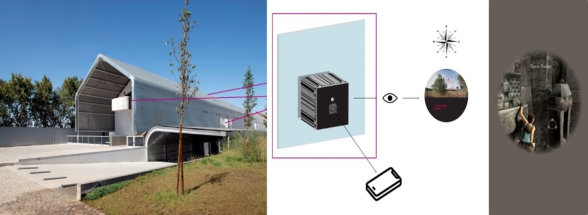
The project included the development of an exploratory component car- ried out by the class: In group work, the project integrated the development of two design solutions: An augmented reality box (minimum 6 locations) with the aesthetic implementation of a QR code. The box had a dimension (of 21cm X 29.7cm and was 21 cm deep). The presentation of locations and testimony of the concept in digital format should be accessible by QR code, Figure 1.
The project integrated five phases. from the first mappings to the final refinements, Table 1.
Figure 1: Figure showing the positioning of the PhiNDI and the connection between the interface and the digital solution.Table 1. Phases carried out in the project.
Development of technical solutions in the PhiNDI design
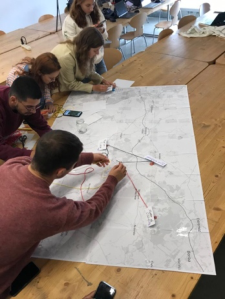
Figure 2: Students connect different elements in the exploration maps.
The students began by developing a map of connections, using maps in physical format with plasticine, paper cuts, strings, and pins. The teacher was the facilitator in this session, motivating students to reflect on the phy- sical need for discovery and motivating experimentation in this exploration session. These maps focused specifically on the area of Évora, Portugal but all possible associations beyond the boundaries of the map, Fig. 2. The discovery session lasted approximately 3 hours and ended with several locations.
It was the objective of the authors to develop a exploration based on previous experiences carried with different age groups, where the tangi- ble interaction triggered insights and experiences of discovery supported by different types of reflection (Silva-Gago et al., 2022).
In the delivery of the project, to access students’ feedback on the expe- rience, students answered a survey. The textual information was analyzed by evaluating the textual recurrence of words in describing the processes resulting from the following questions: Question 1 “The PhiNDI allowed mapping the tangible horizon in certain ways. How were these physical ele- ments (references to locations and environments) distributed in the working group’s physical interface proposal?” and Question 2, “How does the digital interface complement the PhiNDI?”.
The survey aimed to explore which concepts the students highlighted and hierarchized in their descriptions.
The authors retrieved data in two forms, textual (from the survey) and graphical, by evaluating the quality of the focus of the design project. The evaluation of the solutions at the level of visual design lasted from September to December.
Mapping Beyond the Horizon 477
In phase 3 of the project, students began to develop draft proposals and were encouraged to use the drawing as a way of reasoning the possible hypo- theses to explore. After the sketching phase, the students began to develop the first rapid prototypes of the proposed physics interfaces, testing the internal sizes and mechanics.
RESULTS
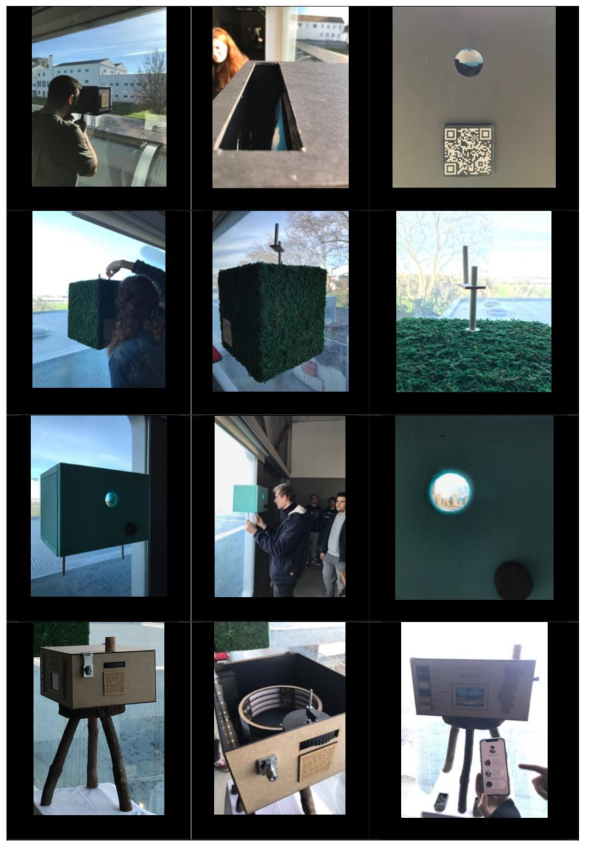
The project resulted in 12 proposals combining the PhiNDI and digital interface solutions. In the solutions of PhiNDI, the students used different materials and in the boxes systems of rotation of images referring to the points they chose, Figure 3.
Figure 3: Examples of PhiNDI solutions.
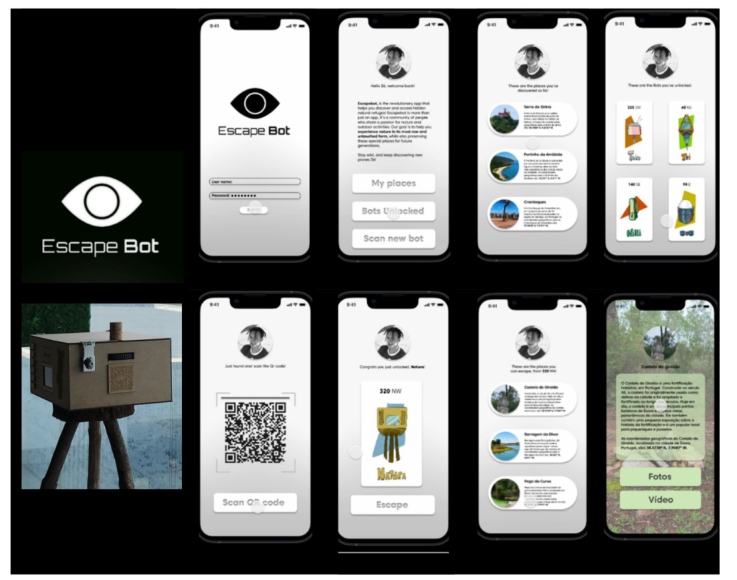
Each PhiNDI was placed in the design department facilities windows, oriented towards the points of interest previously chosen in the student’s pro- jects. The projects resulted in several types of proposals for digital interfaces. Shown below are screenshots of the applications EscapeBot and Beyond. The Escapebot app explored a hypothesis where there were other PhiNDI intera- ctions distributed in different zones and which, through the app, could unlock their location, Figure 4.
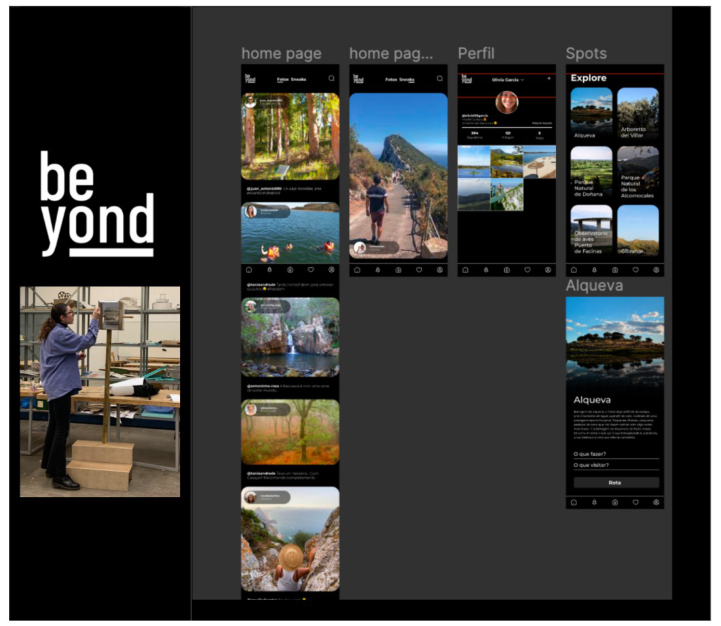
The Beyond app explored an ecosystem of points of interest whose associated information linked to a community affiliated with these sites, Figure 5.
The survey collected textual data regarding the questions: Question 1 “The PhiNDI allowed mapping the tangible horizon in certain ways. How were these physical elements (references to locations and environments) distri- buted in the working group’s physical interface proposal?” and Question 2, “How does the digital interface complement the PhiNDI?”. The answ- ers points, specifically on the issue of site mapping, to the prevalence of expressions associated with appropriating locations, designating them as islands, but with a utilitarian perspective, being something that could be exchanged.
Figure 4: Project “Escape Bot” - digital application associated with the PhiNDI. Images of the various screens and access to other bots. Project from the students: Rodrigo Luz, Luis Marques, and João del Toro.
Mapping Beyond the Horizon 479
Figure 5: Project “Beyond”. The students who produced the project: were beatriz nunes and olga anselmo.
CONCLUSION
Regarding the question guiding this study, How can a site mapping be trans- lated into a PhiNDI (via a physical milestone) and a Mobile Digital Interface? The students translated the mental mapping through a PhiNDI access point, where most of the anchor points were translated by images. Except for one group (the group that developed the Escape Bot project), this group tried to insert other sensory elements, such as sensory sample boxes commuted by textures and odors. The resulting apps followed standard interaction perspe- ctives from other interaction models associated with social media. In a given space, the PhiNDI acts as a memory marker (Attracts the attention of the user). The PhiNDI’s students proposals displayed some effort to display the concept of hyperobjects, through the connections between site curation and locations in a map configuration. Students “commodified” those locations; that is, those locations have a defined functionality. This aspect has already been observed in a previous investigation (Silva & Neves, 2019). This appro- priation distorts a valuation of a particular location since its endorsement free of human presence is not considered. This interpretation also reflects a worldview guided by a neo-liberal logic where the logic of the cultural context prevails, as already considered in a previous investigation (Gago et al., 2023).
Future research will deepen the issues of hyperobjects as a concept in and the use of implicit information present in the visual markers of the PhiNDI, such as texture or different three-dimensional shapes that can be used at the level of visible hyperlinks.
ACKNOWLEDGMENT
The authors of this article would like to acknowledge the class from the course Design of Interfaces I, 2022/23, and the coordination of the degree in Design, School of Arts, University of Evora Portugal.
Author Contributions José Miguel Gago da Silva: data collection (lead), conceptualization (lead), data curation (lead).
Tiago Navarro Marques: data collection (co- lead), data curation (co-lead). Ema Sofia Rolo da Silva: conceptualization (supporting).
REFERENCES
Aicher, O. (2015). analogous and digital. In analogous and digital (Vol. 4, Issue 1).
Ernst & Sohn - A Wiley Brand. Descriptive Case Study. (2010). In Encyclopedia of Case Study Research. SAGE Publications, Inc. https://doi.org/10.4135/9781412957397.n108 Dillon, A. (2006). User Interface Design. Encyclopedia of Cognitive Science, January
2006. https://doi.org/10.1002/0470018860.s00054 Gago, J., Rolo, E., Brandão, D., Pereira, L., & Fereira, S. (2023). Different Perceptions of Nature (pp. 415–423). https://doi.org/10.1007/978-3-031-20364- 0_36 Halvey, M. J., & Keane, M. T. (2007). An assessment of tag presentation techniques.
Proceedings of the 16th International Conference on World Wide Web - WWW ‘07, 1313. https://doi.org/10.1145/1242572.1242826 McDonough, J., & McDonough, S. (2016). Research Methods for English Language Teachers. Taylor \& Francis Group. https://books.google.to/ books?id=UckEvgAACAAJ Morton, T. (2013). HIPEROBJECTS - Philosophy and Ecology after the end of the World. In (1st ed., Vol. 4, Issue 1). University of Minnesota Press. Moussas, X. (2011). The Antikythera Mechanism. In Adapting Historical Know-
ledge Production to the Classroom (pp. 113–128). SensePublishers. https://doi.or g/10.1007/978-94-6091-349-5_8 Nicolas, C., Pailler, Y., Stéphan, P., Pierson, J., Aubry, L., Le Gall, B., Lacombe, V., & Rolet, J. (2021). AN EARLY 3D-MAP OF A TERRITORY? THE BRONZE AGE CARVED SLAB FROM SAINT-BÉLEC, LEUHAN (BRITTANY, FRANCE). Oxford Journal of Archaeology, 40(4), 367–390. https://doi.org/10.1111/ojoa .12230 Preece, J., Sharp, H., & Rogers, Y. (2015). Interaction Design: Beyond Human-
Computer Interaction. Wiley. https://books.google.es/books?id=n0h9CAAAQBAJ Siddiqi, S., & Sharan, A. (2015). Keyword and Keyphrase Extraction Techniques: A Literature Review. International Journal of Computer Applications, 109(2), 18– 23. https://doi.org/10.5120/19161-0607
Mapping Beyond the Horizon 481
Silva-Gago, J., Raposo-Martín, D., Díaz-Gómez, M., & Berbel-Gómez, N. (2022).
Cartografía visual: creación de narrativas visuales colaborativas a partir de cone- xiones acerca del barrio Nou Llevant-Soledat Sud de Palma. Arte, Individuo y Sociedad, 34(1), 275–293. https://doi.org/10.5209/aris.73851 Silva, J., & Neves, J. (2019). Exploring Climate Changes Through LSP: A Learning Experience. In J. Silva, D. Raposo, J. Neves, & F. Pinho (Eds.), Perspectives on Design, Springer Series in Design and Innovation (1st ed.). Springer. Thematic Coding and Categorizing. (2007). In Analyzing Qualitative Data (pp. 38–55). SAGE Publications, Ltd. https://doi.org/10.4135/9781849208574. n4 Yadav, V., Dubey, A. K., Singh, H. P., Dubey, G., & Suryani, E. (2022). Process
Mining Techniques for Pattern Recognition: Concepts, Theory, and Practice. CRC Press.
LISTED IN THE AHFE DIGITAL BOOKSTORE CATALOGUE
Explore the complete digital volume
Ergonomics In Design
Read this individual research paper free through the original publisher, or explore the full digital proceedings book.
ISBN 978-1-958651-53-7
Explore this ISBN in the AHFE Bookstore ↗Listed in the July 2026 bookstore catalogue; search by ISBN to confirm current availability · Digital book purchase optional