Jose Silva, Tiago Navarro Marques, Ema Silva (2023). Stories in a shoe box - Entangled narratives of Nature. In: Ergonomics In Design. AHFE Open Access, vol. 77, pp. 482–489. https://doi.org/10.54941/ahfe1003407
The present climate challenges require the development of different tactics and some outside the realm of pure rationalisation, strategies that focus on emotional and romantic relationships with the space of Nature. The investigation follows a descriptive case methodology. The narratives developed by Hans Christian Andersen were the starting point for the project developed in Learning Settings at the University of Évora in the Course of Technologies of Vector Drawing, curricular year of 2022/23. This project starts from the assumption presented by (Supriya, 2020). According to the author, the stories of Hans Christian Anderson build a romantic relationship with Nature being fundamental for a relationship of protection by the human agent. The students involved in the current project chose one of the stories of Hans Christian Anderson, followed by the development of a scenic representation in Tunnel book for the story in an area of 15x30x15. The compositions of the various students later formed a wall of stories. When the students presented the project, the authors conducted a thematic analysis of the project descriptions to assess how students interpreted the stories and whether a romantic relationship with Nature was perceptible.
Nature, in the form of forests, flowers, trees and plants and animals, birds, and insects, plays a dominant role, an enchanting and enlightening role in many fairy tales (Nadu, 2020). Children are instinctively drawn towards Nature’s denizens and empathize with them easily. Fairy tales equip chil- dren with knowledge of the environment, prompting empathy for ecological connections between themselves and other lives on earth. Hans Christian Anderson employs a double connection with Nature by enabling a “roman- tic” connection with the elements within and through different creative strategies. HC Andersen uses literary recycling as a theme, and recycling previously used themes, linguistic images, and figures (such as the elemen- tal spirits “Svimlen,” “Lisjomfruen/Sneedronningen”) as part of a creative strategy (Grum-Schwensen, 2016).
In that strategy, Andersen’s child protagonists transcend their circum- stances through the power of their imagination, and in other tales,
Stories in a Shoe Box - Entangled Narratives of Nature 483
Nature is instrumental in this imaginative transcendence. The natu- ral world conveys spiritual truths and morally influences the characters (GREYVENSTEYN, n.d.)
Anthropomorphism is a common theme in many of Hans Christian Ander- sen’s fairy tales. Andersen’s symbolic use not only of Nature but also of household objects, trinkets, toys, and even birds by which he veils more serious, poignant issues that humans endure (Paludan, 2019).
There is no possibility of acquiring knowledge about an absolute state of Nature before any human action and culture. However, it is essential to safe- guard that Nature can be a term for describing the status quo ante before we add another human intervention. All “states of nature” are, at the same time, “states of culture” (Holm, 2008).
Tales, as products of fantasy, are also a way of giving “order” to the world, of assigning meaning to it. Humans are a species that cannot live without attributing meaning to their life. In a cosmos devoid of meaning, humans invest the world and make sense of it thanks to their imagination. The autonomy of the imagination characterizes the human psyche, the ability to formulate what is not there, to perceive, in just anything, what is not there (BOUCHET, 2015).
RESEARCH QUESTIONS Although the project is based on developing solutions in Tunnel book com- position using a recipient ( a standard shoe box). This study aims to answer the following research questions;
How can individual interpretations praise a random collective composition in designing graphic compositions with different layers of depth?
What is the role of the element “nature” in the students’ interpretation of Hans Christian Anderson’s tales?
METHODS
The presented research followed a descriptive case study methodology. A descriptive case study is focused and detailed, in which propositions and questions about a phenomenon are carefully scrutinized and articulated at the outset (“Descriptive Case Study,” 2010). Descriptive case studies describe the natural phenomena within the data in question. Descriptive case studies may be in a narrative form (McDonough & McDonough, 2016).
PROJECT GUIDELINES The briefing presented to the students had as titled STORY IN A SHOE BOX. It was intended to develop a construction strategy for an image composi- tion using digital vector composition tools. The final design, the Concept image, was to be built in perspective, where the elements of the composition were distributed at various levels, from the foreground to the background. The final Concept Image should allow the impression of a three-dimensional composition adapted to an ordinary shoebox.
In this work, each student should choose one of the following stories by the writer Hans Christian Andersen:
The Little Mermaid
The Little Match Girl
The Princess and the Pea
The Ugly Duckling
The Tinderbox
The Teapot
Thumbelina
The Steadfast Tin Soldier
The Snow Queen
The Goblin and the Grocer
The Garden of Paradise
The Flying Trunk
The Angel
The Red Shoes Authors contextualized students on how Hans Christian Andersen always sought to pass patterns of behaviour that society should adopt, including pointing out the confrontations between “powerful” and “unprotected,” “strong” and “weak,” “exploiters” and “exploited.” In addition to the inten- ded demonstration that all men should have equal rights, Andersen’s tales inspired empathy for small creatures and plants. The tales attune emotions to nature and intensify feelings of harmony with others. An open mind and a sense of innocence perceive that unity. Andersen’s tales reinforce the idea that all creatures are indispensable to retaining the beauty and health of the planet. Students also understood how Fairy tales reveal a dynamic web of relationships, and each object of nature was invested with high meaning.
Students structured their compositions in various layers similar to a Tunnel book. A Tunnel book features a narrative in the form of overlapping multiple layers of paper, creating a visual tunnel perspective.
DEVELOPMENT The authors developed the Project in Learning Settings at the University of Évora in the Course of Technologies of Vector Drawing, in the academic year of 2022/23, first semester, from September to December, in weekly sessions of three hours. As previously mentioned, the narratives developed by Hans Chri- stian Andersen were the starting point for the project; the students involved in the current project chose one of the stories of Hans Christian Anderson. The class of thirty-two students produced individual compositions following a scenic representation in a Tunnel book, where students should organize the narratives into six layers, from the foreground to the background, within a card box with the dimensions of 15x30x15.
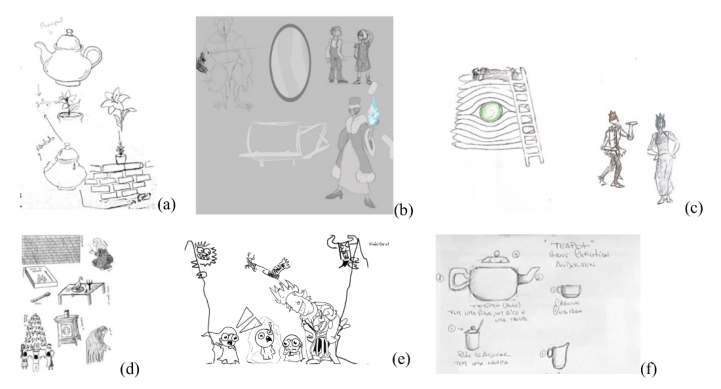
The project involved the development of five phases. from the first drafts of concepts to the final refinements, Table 1 Although the project had a core digital component, the authors aimed to associate manual graphic expression with the development of design solutions, Figure 1.
Stories in a Shoe Box - Entangled Narratives of Nature 485
Figure 1: Examples of sketches developed in the project: (a, f), The tea pot (b, e), The snow queen, (c) The princess and the pea, and (d) The little match girl.
In the delivery of the final project, to access students’ feedback on the experience of the project, students answered a survey. The survey aimed to explore which concepts the students highlighted and hierarchized in their descriptions. The textual information was analysed by evaluating the textual recurrence of words in describing the processes resulting from the follow- ing question: - The stories of the author Hans Christian Andersen, although children’s tales, communicate universal values. Within these values, those referring to human interaction with nature are patent. In the story you chose, how did you transpose that interaction with nature for the scenic construction?
Data was collected in two forms, textual (from the survey) and visual, by evaluating the quality of the focus of the design project. The evaluation of the solutions at the level of visual design lasted from September to December.
RESULTS
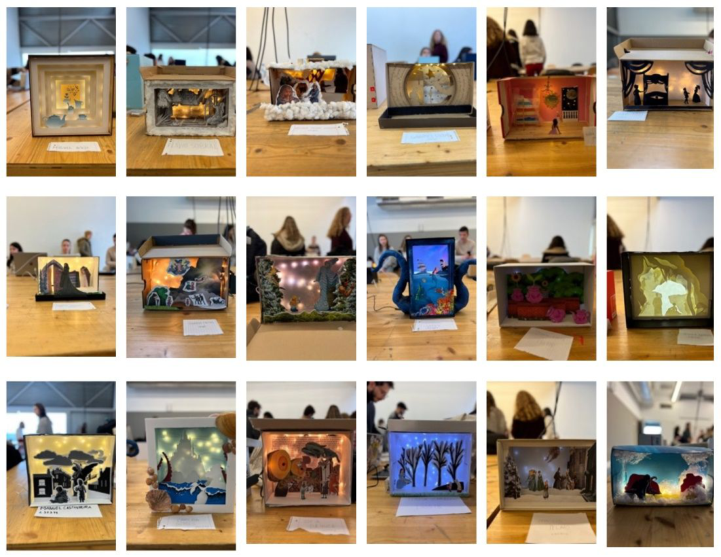
The project resulted in twenty-four compositions with various explorations at the level of compositions. The graphic compositions were presented indi- vidually, and the students justified the technical and composition resources adopted in constructing the boxes Figure 2.
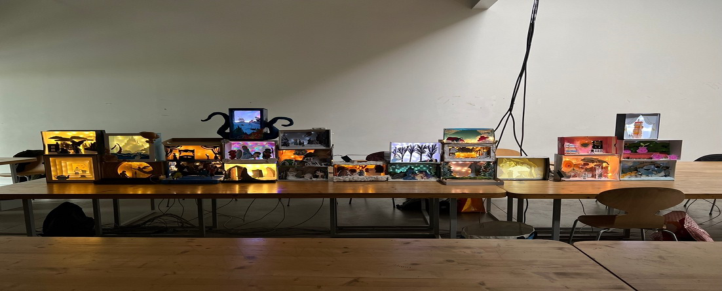
Figure 2: Examples of compositions developed by students.Figure 3: Final assembly - Wall of stories.
In the final composition, the class grouped the twenty-four compositi- ons, and the teacher facilitated a reflection on what was now their overall interpretation and how the whole wall of stories changed the individual compositions, Figure 3.
The final result of the students’ compositions, the wall of stories, is a rich visual mosaic allowing different arrangements of their compositions.
There were richer compositions than others, visually and structurally. However, the combination in a mosaic allowed different combinations that
Stories in a Shoe Box - Entangled Narratives of Nature 487
induced in the student’s final presentation and, after having experienced other configurations, a sense of balance in the whole.
Interestingly in the textual analysis of the survey, authors found the repe- tition of the concept of “inclusion,” the need for harmony between elements belonging to an environment that is not prone to decontextualization or fragmentation. The mosaic of multiple arrangements structurally resembles some writing solutions by Hans Christian Anderson, who edited his works after they were written, since the mosaic-like joining of subjects” is not just reserved for the visual arts. (Möbius, 2000).
We live delimited in a world generated by his imagination, either by fantasy or by the course of his scientific curiosity and construction of knowledge; even logical processes stem from imagination. The most rational application is also the result of an imagined process. However, which of the strategies is more compatible with the processes of imagination? Or better explained, given Dominique Bouchet’s (BOUCHET, 2015) concept of imagination, what would be the most fruitful application in defense of nature? Are we accepting the potentialities of the human imagination in creating new worlds?
We live in a world made by our imagination, part of it an autonomous imagination influenced by structures of our context. In addition to inhabiting the collective imaginary, the individual imagination is also a cabin through which one “scrutinizes” and “distorts” other “realities,” as illustrated in the series Something-Real by photographer Romain Laurent, (Laurent, 2012). Fairy tales, although not believed, transport the reader to a magical time and space and may develop a propensity or sensitivity to mythological thinking. Myths were created by humans as cryptic knowledge, as a way of transmitting certain combinations. If there is a meaning to be found in mythology, this cannot reside in the isolated elements which enter into the composition of a myth, but only in the way those elements are combined (Levi-Strauss, 1955).
CONCLUSION
Regarding the first question presented at the beginning of this research: How can individual interpretations praise a random collective composition in designing graphic compositions with different layers of depth?
Each of the boxes’ composition, by the depth of the layers and lighting of the background layer, allows different variations, enabling a unique richness open to different combinations and associations between the various boxes.
Regarding the second question presented at the beginning of this research: What is the role of the element “nature” in the students’ interpretation of Hans Christian Anderson’s tales?
The students’ compositions implicitly develop the theme of Nature from the perspective of elements that make up the narrative. The implicit and the perspective on the representation of Nature appears represented in a scenic form. Implicitly and not directly associated with Nature arises the question of detail, trim, recycling of elements and illusion, and comfort in delimitating a space free of the responsibility of “prestige,” where different variations arise. Outside the box, with the surrounding, there may be other combinations, with other “recycling” and different combinations of small compositions. By
focusing on the small avoiding the prestigious, other skills are developed that allow to expand the richness of the final composition. The medium affe- cts composition, frees students from restrictions related to the use of other expensive materials.
The proposed strategy allowed students to implicitly understand their con- tribution to a larger composition as a metaphor of life where our actions, efforts of interpretation, and creation, have value in a larger composition enriching the global by including our contribution.
As referred to in the results, the romantic interpretation of elements and components of nature, channelled by Hans Christian Anderson’s tales, allo- wed the reinterpretation and a symbolic value of assembly achieved in the “Wall of stories”.
ACKNOWLEDGMENT
The authors of this article would like to acknowledge the class from the course Design of Interfaces I, 2022/23, and the coordination of the degree in Design, School of Arts, University of Evora Portugal.
AUTHOR CONTRIBUTIONS José Miguel Gago da Silva: data collection (lead), conceptualization (lead), data curation (lead).
Tiago Navarro Marques: conceptualization (co- lead), data curation (co-lead).
Ema Sofia Rolo da Silva: conceptualization (supporting).
REFERENCES
Bouchet, D. (2015). The Specificity of Human Aesthetics. Knowledge Cultures, 3(3), 16–41. Descriptive Case Study. (2010). In Encyclopedia of Case Study Research. SAGE
Publications, Inc. https://doi.org/10.4135/9781412957397.n108 Greyvensteyn, A. (n.d.). Hans Christian Andersen’s Romantic Imagination: Exploring eighteenth and nineteenth century romantic conceptualisations of the imagination in selected fairy tales by Hans Christian Anderse [UNI- VERSITY OF SOUTH AFRICA]. https://uir.unisa.ac.za/bitstream/handle/10500/ 25146/dissertation_greyvensteyn_a.pdf?sequence=1&isAllowed=y Grum-Schwensen, A. (2016). Billeder og genanvendelse i H. C. Andersens papirarbejde. Museumodense. Dk. https://museumodense.dk/artikler/billeder-og-gen anvendelse-i-h-c-andersens-papirarbejde/ Holm, S. (2008). Being natural: An exploration of the natural in the writings of Hans
Christian Andersen. Laurent, R. (2012). Something-Real. Romain-Laurent. Com. https://romain-laurent .com/Something-Real Levi-Strauss, C. (1955). The Structural Study of Myth. The Journal of American
Folklore, 68(270), 428. https://doi.org/10.2307/536768 McDonough, J., & McDonough, S. (2016). Research Methods for English Language Teachers. Taylor \& Francis Group. https://books.google.to/ books?id=UckEvgAACAAJ
Stories in a Shoe Box - Entangled Narratives of Nature 489
Möbius, H. (2000). Montage und Collage: Literatur, bildende Künste, Film, Fotografie, Musik, Theater bis 1933. Fink. https://books.google.es/books? id=aiYhAQAAIAAJ Nadu, T. (2020). Nature in the Fairy Tales of Hans Christian Andersen. Shikha 1,
1–12. Paludan, J. S. (2019). Hans Christian Andersen’s Use of Anthropomorphism. Aktualitet - Litteratur, Kultur Og Medier, 13(1), 182–194. https://tidsskrift.dk/aktualit et/article/view/112063
LISTED IN THE AHFE DIGITAL BOOKSTORE CATALOGUE
Explore the complete digital volume
Ergonomics In Design
Read this individual research paper free through the original publisher, or explore the full digital proceedings book.
ISBN 978-1-958651-53-7
Explore this ISBN in the AHFE Bookstore ↗Listed in the July 2026 bookstore catalogue; search by ISBN to confirm current availability · Digital book purchase optional