Jose Silva, Rita Almendra, Tiago Navarro Marques, Daniel Raposo, João Neves (2022). Enveloping a day – Persona visual mapping. In: Human Dynamics and Design for the Development of Contemporary Societies. AHFE Open Access, vol. 25, pp. 202–210. https://doi.org/10.54941/ahfe1001390
The following article describes a Persona Method through Visual Clues (PMVC) in a learning setting performed in the course of Interface Design I, degree of Design, School of Arts, University of Evora, Portugal, in the academic year of 2021/22. The study follows a descriptive case methodology. The purposed PMVC concerns the project’s early stage and reveals how a mosaic assemblage of visual clues allows an itinerary on cohesive information acquisition in guiding the design project. The proposed PMVC allowed students to valorize life contexts when projecting a persona, enabling a strong focus on consumers and work contexts. Although working in fictionalized settings, the PMVC triggers the reasoning on the complexity of the contexts, deploying information that will deliver more reality into Personas. Keywords: Visual methods, Communication Design, Persona Method, Design Literacy
Persona design has been recognized as a design tool for ideation with dif- ferent user groups since the 1990s. The method originated in software development has become a widespread method adopted in many discipli- nes and design processes, such as product innovation and idealization, user experience design, agile systems development, communication, and marke- ting (Pruitt and Grudin, 2003; Adlin and Pruitt, 2010; Nielsen, 2018). In Persona design, there are two main aspects of the usage of the persona method: on the one hand, it is used as a communication device and, on the other hand, as a design aid made to help designers, developers, and project stakeholders focus on users and their needs during the design and development of the system. The persona material also can potentially com- municate the results from user research to the relevant groups. The Persona exploration support the project stakeholders in incorporating the knowledge about the users during the design process (Gudjonsdottir, 2010). Persona ideation contains the description of social. These social constructs stere- otypes, characterized by being empty of content, occur when participants
have a less professional and cultural experience and cannot add content to the person’s understanding. Its authors’ knowledge may limit the design of Personas ideations because they use their own experience to fill in the details like age and knowledge of the domain and how a person in mar- keting looks (Nielsen, 2010). In order to achieve that the product design is closer to the everyday lives of the users, design personas are a means to capture the everyday experiences and needs of users and customers. Focu- sing on the user or customer in the design process is in opposition to an artistic understanding of the designer as someone who, by experimenta- tion with materials and form, gets inspiration to create unique products (Nielsen, 2018).
Other studies developed in Learning settings showed that raising aware- ness for the mechanisms of empathy through Personas should be incorpo- rated into design education rather than relying on automatic reactions and intuition (Haag and Marsden, 2019). One of the benefits of using personas is how they make such implicit knowledge explicit and the impact this has upon the collective understanding of who our learners are(Lilley, Pyper and Attwood, 2011). Personas are created in the beginning of the design process and they seem to be well integrated into the existing design practices and used for design(Nielsen and Hansen, 2014).
This study answers to a need to amplify the perception on Personas. Fur- ther and more detailed studies need to be conducted to determine the impact on cross-cultural personas projects where the persona description moves away from the participants’ immediate area of experience (Nielsen, 2010). Therefore, strategies are needed that can guide a process that allows other inputs beyond the limitations of experiences on the part of the authors of these constructions.
In order to get product design closer to the everyday lives of the users, design personas are a means to capture the everyday experiences and needs of users and customers. Focusing on the user or customer in the design process is in opposition to an artistic understanding of the designer as someone who, by experimentation with materials and form, gets inspiration to create unique products (Nielsen, 2018).
In this study the Persona Method through Visual Clues (PMVC), puts into practice the concept of consumer, and the Persona can be described as a representation or life model of demographic possibilities in various consu- mers. Consumers relate with the use of technology to consume, the concept of users can induce a perspective that human beings can be too easily reduced to factors in complex technical systems (Dahlbom, 2003).
In the learning settings related to this study, students of higher education worked with a briefing focused on the problem of applying an indoor air cle- aning solution via a system consisting of a plant and a ventilated soil recipient (PLAVESO), a solution presented in the article “Using plants and soil micro- bes to purify indoor air: lessons from NASA and Biosphere 2 experiments” (Wolverton and Nelson, 2020). The project entitled HOMEBIOSPHERE was developed from September 2021 to January 2022. In the project briefing, the students should develop an interface solution optimized to a specific business model revealed by discovering business opportunities through the PMVC.
The project was conducted in the course of Interface Design 1, degree of Design, School of Arts, University of Evora, Portugal, in the academic year of 2021/22. The class of thirty-two students was divided into groups of two students. In the development of the PMVC, containing a day routine, the students searched for products opportunities in personas daily routines, first, each group developed two persona proposals, then the proposals of all the groups were gathered in a general map.
In order to access the feedback to the proposed PMVC, students responded to two surveys, one in November and the other in January. In November, after completing the Persona boards, and in January, after the project was delivered. The textual information was analyzed by evaluating the textual recurrence of words in the descriptions of the processes resulting from the following question: “Which aspects do you highlight in the characterization of personas on the panels developed?”. The purpose of the survey was to explore which concepts the students highlighted and hierarchized in their descriptions.
Data were collected in two forms, textual (from the survey) and graphical, by evaluating the quality of the focus of the design project. The evaluation of the solutions at the level of visual design lasted from November to January.
The montage of the General map of Persona, occurred in November and guided the project through January. The Persona method included the visual curation of the contents. Curatorship refers to the “distribution” in a con- text with organization, annotation/ identification, and presentation (P and Thilagavathy, 2016).
METHODS
The presented research followed a descriptive case study methodology. A descriptive case study is one that is focused and detailed, in which pro- positions and questions about a phenomenon are carefully scrutinized and articulated at the outset (‘Descriptive Case Study’, 2010). Descriptive case studies describe the natural phenomena which occur within the data in que- stion. Descriptive case studies may be in a narrative form (McDonough and McDonough, 2016).
The data analysis involved the creating of word clouds and informative keywords. A word cloud, called also a tag cloud is a “visual presentations of a set of words, typically a set of tags, in which attributes of the text such as size, weight or color can be used to represent features (e.g., frequency) of the associated terms”(Halvey and Keane, 2007). Keywords are set of representa- tive words of a document that give high-level specification of the content for interested readers (Siddiqi and Sharan, 2015). In the present study, the auth- ors gave special attention to the informative keywords because they refer to words recurrent in a phrase statement context.
PMVC The tested PMVC applied a visual mapping entitled “Find products opportu- nities in personas daily routines”, which applied image stereotypes depicted
Enveloping a Day – Persona Visual Mapping 205
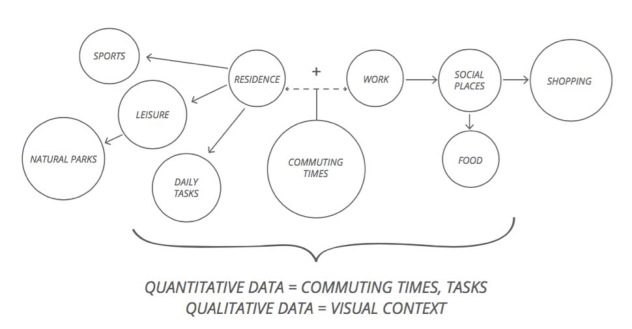
Figure 1: Interconnecting the “Residence” and the “Work” to obtain others frequent places and commuting’s in stock images suppliers, and commuting times and places retrieved from Google Maps-based to contribute to the development of hypothetical scena- rios, Figure 1. This method is based on previous studies (Silva, Raposo and Neves, 2017). The steps in accessing possible scenarios in the design of the mosaic Persona aim to find the fragile and subtle connection between acce- ptable scenarios and future expectations in the user/consumer, consisting of the following phases:
1. Choosing a Profession on a Certain Context/ Country Finding information about workplaces, culture and social context 2. Searching for the Persona’s Photo Guided by the cultural and social context search for the persona’s photo in a stock image supplier 3. Finding the Persona Name Guided by the cultural and social context 4. Choosing the Place of Residence and the Workplace Through a map search engine and retrieving commuting times. 5. Interconnecting the “Residence” and the “Work” to obtain others frequ- ent Places and Commuting’s Matching the quantitative data to commuting times and the tasks quali- tative data to visual context.
RESULTS
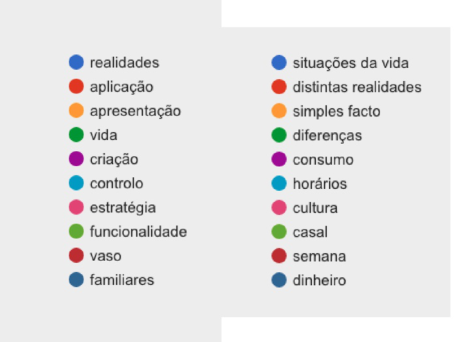
In the analysis of textual information, after delivering the Persona panels and montage of the general map, in the student’s response to the survey, the “assessment of life situations” “realities” appears first, followed by “application”, Figure 2, left column.
In the project submission, in the analysis of the students’ responses to the survey appear in the first place the “contexts of life” followed by “different realities”, Figure 2, right column.
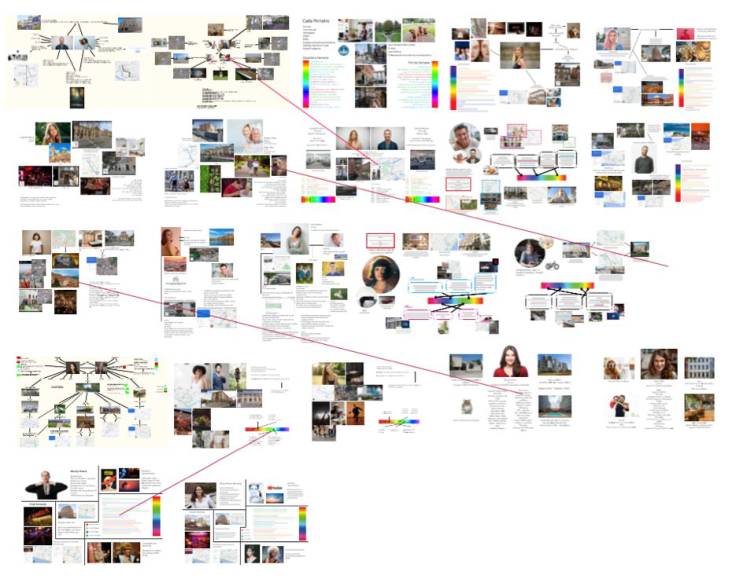
Based on the PMVC general map, Figure 3, although all related with the PLAVESO solution, different perspectives have been gathered in the sixteen
Figure 2: Ranking of Informative keywords retrieved from the first assessment before the project development, left column. Ranking of informative keywords retrieved from the last assessment after the final submission of the project, right column.Figure 3: PMVC general map containing connections between boards.
projects, supported by a problem discovery and its ecosystem (stakeholders’ and external variables), ranging from the issue of health care and sensory stimulation to the feasibility of a commercial product, from those, two are summarized in this article.
Enveloping a Day – Persona Visual Mapping 207
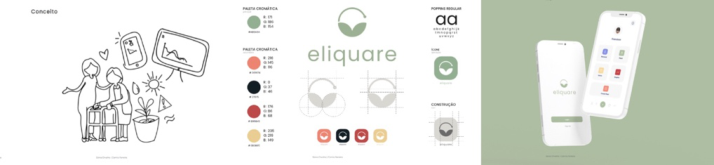
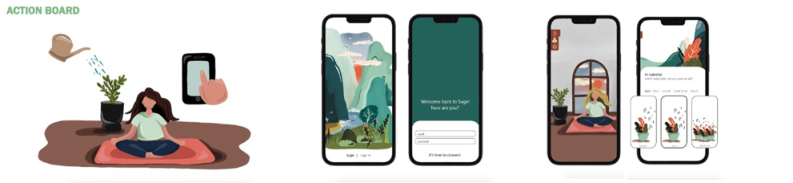
Figure 4: Project Eliquare developed by the Students, Sónia Orvalho and Camila Ferreira.Figure 5: Project SAGE, developed by the students Catarina Couquinha and Filipa Batista.
From the submitted projects related to health care, the project ELIQU- ARE, emphasizes the PLAVESO functionality on the improvement of the air quality and sensory stimulation to residents in elderly residences. The focus group of the project are elderly who are dependent on help from third parties, and the possible consumers consist of a public with elderly family members dependent on third-party geriatric services, Figure 4.
The SAGE project focused on an audience between 20 and 40 years of age living in a densely urban environment who want to explore a relaxation expe- rience through sound and visual stimuli delivered by the PLAVESO system, associated with a mobile app, Figure 5.
All sixteen proposals focused on different targets and business opportu- nities and associated contexts discovered by identifying stress points in the PMVC. Stress points, in the Persona life, that lead directly or indirectly to identifying problems and their contexts.
DISCUSSION
Concerning the search for business opportunities anchored on problem iden- tification, it seems more appropriate to describe the finding and solving of “problems”as a dynamic, cyclically self-sustaining process. The primary pur- pose appears to be the creation of connection points for the continuation of the process (Jonas, 1993). It is necessary to accept the imprecision in the pro- ject practically. A goal only achieved by perceiving the complexity of contexts and how they require a perception of their mutation. Complexity can be seen as “a fabric (complexus: what is woven together) of inseparably associated heterogeneous constituents: it poses the paradox of one and multiple” and
also as “the fabric of events, actions, interactions, feedback, determinations, accidents that constitute our phenomenal world” (Morin and Postel, 2008). Understanding contexts and their complexities allow one to challenge closed and pre-deterministic cycles of project reflection.
Design as a discipline must extend towards analyzing the problem-space, e.g. the mechanisms of how “problems” emerge. It could be called a problem definition competence, leading to “problem-design.”(Jonas, 1993).
In the survey conducted on the project HOMEBIOSPHERE final submis- sion, in the analysis of the project justifications, the words “context of life” stands out, showing how there was an interpretation of the complexity of the contexts and how these shapes the Persona. Personas create a strong focus on users and work contexts through the fictionalized setting (Pruitt and Gru- din, 2003). This reasoning contrasts with the first survey after the Persona panel’s conception, where “realities” originate different “applications”. Per- sona’s most significant value is in providing a shared basis for communication (Pruitt and Grudin, 2003).
Personas represent not just a demographic target in the range of users who can buy the developed product. Personas can describe consumers embed- ded in cultural contexts and modeled by professional contexts. From diving into these complex contexts, students can measure possibilities and pra- ctical constraints of everyday life. Where, following a Double Diamond method providing divergent and creative assessments, new inputs can arise not only from a product but from a broad array of possibilities (Mesa et al., 2020). The development of the PMVC allowed students to explore life contexts that will implicitly amplify students’ knowledge of consumers, helping them to anchor the focus of their proposals throughout the development of the pro- ject. A contribution in promoting reflection-based research interventions that will promote the synergetic relationship between speculation and reflection (Grocott, 2010).
CONCLUSION
The PMVC had as a major outcome, the growth of a student’s literacy over potential consumers. The development of the presented PMVC allowed stu- dents to explore life contexts, that will implicitly amplify their knowledge of consumers, helping them to anchor the focus of their proposals throughout the development of a design project.
This study’s limitations relate to the time required for exploration with the PMVC, the students’ life experiences, and the necessity of a facilitator that can guide the process.
In a development of the PMVC the resulting General map of Persona can include in future research, satellite boards displaying information related to context variables. These satellite boards will present context variables rela- ted to the daily life of the Persona, summoning relevant information for opening connection points for reflection on the Design project dynamics of problem/opportunities’ finding.
Enveloping a Day – Persona Visual Mapping 209
ACKNOWLEDGMENT
The authors of this article would like to acknowledge the coordination of the Degree of Design of the School of Arts of the University of Évora, Portugal, and the Interface Design I course students for the academic year of 2021/22.
REFERENCES
Adlin, T.and Pruitt, J.(2010) The Essential Persona Lifecycle: Your Guide to Building and Using Personas. Elsevier Science. Available at: https://books.google.es/books? id=fvmN0Fr5c_MC. Dahlbom, B. (2003) ‘From users to consumers’, Scandinavian Journal of Information
Systems, 15(1), p. Art. 3. ‘Descriptive Case Study’ (2010) in Encyclopedia of Case Study Research. 2455 Teller Road, Thousand Oaks California 91320 United States: SAGE Publications, Inc. doi: 10.4135/9781412957397.n108. Grocott, L. (2010) ‘Design Research & Reflective Practice’. Gudjonsdottir, R. (2010) Personas and scenarios in use. doi: 10.13140/RG.2.1.
1145.3922. Haag, M. and Marsden, N. (2019) ‘Exploring personas as a method to foster empathy in student IT design teams’, International Journal of Technology and Design Education. Springer Netherlands, 29(3), pp. 565–582. doi: 10.1007/s10798-018- 9452-5. Halvey, M. J. and Keane, M. T. (2007) ‘An assessment of tag presentation techni-
ques’, in Proceedings of the 16th international conference on World Wide Web - WWW ’07. New York, New York, USA: ACM Press, p. 1313. doi: 10.1145/ 1242572.1242826. Jonas, W. (1993) ‘Design as problem-solving? or: Here is the solution —what was the problem?’, Design Studies, 14(2), pp. 157–170. doi: 10.1016/0142- 694X(93)80045-E. Lilley, M., Pyper, A. and Attwood, S. (2011) ‘Understanding the student expe-
rience through the use of personas’, ITALICS Innovations in Teaching and Learning in Information and Computer Sciences, 11(1), pp. 4–13. doi: 10.11120/ ital.2012.11010004. McDonough, J. and McDonough, S. (2016) Research Methods for English Language Teachers. Taylor \& Francis Group (Hodder Arnold Publication). Available at: https://books.google.to/books?id=UckEvgAACAAJ. Mesa, D. et al. (2020) ‘Design and Science: A workshop-based approach for identif-
ying commercial opportunities in universities’, in. doi: 10.21606/drs.2020.182. Morin, E. and Postel, R. (2008) On Complexity. Hampton Press (Advances in systems theory, complexity, and the human sciences). Available at: https://book s.google.es/books?id=frQkAQAAIAAJ. Nielsen, L. (2010) ‘Personas in Cross-Cultural Projects’, in, pp. 76–82. doi: 10.1007/978-3-642-11762-6_7. Nielsen, L. (2018) ‘Design Personas – New Ways, New Contexts’, Persona Studies,
4(2), pp. 1–4. doi: 10.21153/psj2018vol4no2art799. Nielsen, L. and Hansen, K. S. (2014) ‘Personas is applicable- A study on the use of personas in Denmark’, Conference on Human Factors in Computing Systems - Proceedings, (May 2014), pp. 1665–1674. doi: 10.1145/2556288.2557080. P, P. and Thilagavathy, D. R. (2016) ‘The Impact of Content Curation for Perso-
nal / Informal Learning’, International Journal of Science and Research (IJSR), 5, pp. 1673–1676.
Pruitt, J. and Grudin, J. (2003) ‘Personas: Practice and Theory’, in Proceedings of the 2003 conference on Designing for user experiences - DUX ’03. New York, New York, USA: ACM Press, p. 1. doi: 10.1145/997078.997089. Siddiqi, S. and Sharan, A. (2015) ‘Keyword and Keyphrase Extraction Techniques:
A Literature Review’, International Journal of Computer Applications, 109(2), pp. 18–23. doi: 10.5120/19161-0607. Silva, J., Raposo, D. and Neves, J. (2017) ‘Persona Diagnostic, A Mosaic Approach - Diagnostic Learning Module In Mobile App Design’, in Research and the Teaching in Design and Music. Edition IPCB. 1st edn. IPCB, pp. 157–161. Wolverton, B. C. and Nelson, M. (2020) ‘Using plants and soil microbes to purify
indoor air: lessons from NASA and Biosphere 2 experiments’, The journal of field action - Field Actions Science Reports, (21-Indoor air quality: tackling the challenges of the invisible), pp. 54–59.
LISTED IN THE AHFE DIGITAL BOOKSTORE CATALOGUE
Explore the complete digital volume
Human Dynamics and Design for the Development of Contemporary Societies
Read this individual research paper free through the original publisher, or explore the full digital proceedings book.
ISBN 978-1-958651-01-8
Explore this ISBN in the AHFE Bookstore ↗Listed in the July 2026 bookstore catalogue; search by ISBN to confirm current availability · Digital book purchase optional