Timothy Laseinde (2023). Harmonizing the graduate attributes of mechanical and industrial engineering with the Fourth Industrial Revolution needs in automotive production. In: Production Management and Process Control. AHFE Open Access, vol. 104, pp. 48–56. https://doi.org/10.54941/ahfe1003052
Significant global shifts have inundated the production of automotive components over the past few years. To meet global "Sustainable Development Goals," the industry is moving from internal combustion engines to electric vehicles. The fourth industrial revolution has changed the current phase of global manufacturing's competitiveness and can potentially increase competitiveness in the future. Because of this shift, manufacturers of automotive components now need different skill sets. Consequently, a better alignment of graduate attributes with evolving industry demands is necessary to create sustainable job opportunities for industrial and mechanical engineering graduates expected to fill critical roles in the automotive manufacturing industry. This paper presents the findings of an investigation into the engineering programs of higher education institutions within South Africa and how the engineering graduate attributes in the mechanical and industrial programs align with the automotive industry demands. The advent of the Fourth Industrial Revolution has caused significant upheaval in employment stability. Apprentices are being phased out of the workforce and replaced by smart machines. The automobile industry has seen revolutionary changes in its production methods in the last century. Conversely, higher institutions have not implemented major curriculum changes and still practice traditional teaching processes. The technology used in the average classroom has barely changed in the past three to four decades. The study's overarching goal was to create a model that colleges and universities can use to close the skills gaps through curriculum updates that better prepare students for success in the workplace. The automotive sector and academic institutions collaborated on an action research project to develop this framework. A framework emerged from the study aimed at assessing how well higher education institutions meet the needs of industries, and it shows the required measures to remain competitive.
There has been a far-reaching shift in the skills employed by the engineering labor force in the 21st century. Industry-specific knowledge has been and is still being reshaped by the Fourth Industrial Revolution.
Harmonizing the Graduate Attributes of Mechanical and Industrial Engineering 49
This study compares the competence required by automotive manufa- cturers in the Fourth Industrial Revolution to those learned in engineering programs of study at higher institutions to meet the minimum academic requirement to qualify for a “Bachelor of Mechanical and Industrial engi- neering (BEngTEch & BEng).” The study is motivated by the need to help the next generation of engineering graduates prepare to cope effectively in the industry after completing their qualifications.
According to Laseinde and Kanakana (2017) and Ikome et al. (2022), the disparity between industry skill requirements and college learning outcomes significantly affects South African graduates’ ability to find gainful employ- ment after college. The movement toward smart manufacturing and factory automation is called Fourth Industrial Revolution (4IR/ Industry 4.0).
The 4th industrial revolution encompasses the Internet of Things (IoT), machine learning, robotics, cloud computing, cyber-physical systems, and cognitive computing (Majstorovi, 2018) (Dada et al., 2023). 4IR affects how society views education and employment in the future (Schwab, 2016). This calls for rapid upskilling of the working population (Laseinde et al., 2015).
Comparisons of existing Graduate Attribute (GA) outcomes from the institutions to the manufacturing industry workforce demands require a focus on teaching philosophies and learning paradigms (Dada et al., 2023; Laseinde and Kanakana, 2017). The low unemployment rate is primarily due to the efforts to create new jobs and retain current workers. Often, businesses are too quick to claim that “engineering graduates from our colleges are not market-ready. Graduate Attributes (GAs) are the quali- ties, skills, and understandings a university community agrees its student should develop during their academic years studying toward a Bachelor’s degree in Engineering/Technology in higher institutions (Maneschijn, 2016). The GAs, also known as Exit Level Outcomes (ELO) defined below, are stated generically and may be assessed in various engineering disciplinary contexts in a provider-based or simulated practice environment (Manesch- ijn, 2016). In the context of this study, the GAs applied from the year 2021 is presented herein. Furthermore, the modules where competencies are tested from 2021 onward are presented accordingly, shuffling them around over five years (2017 to 2021) until they were flawlessly (perfectly) assi- gned to the different engineering modules. All summative assessments are only in final-year modules, while formative assessments are in the first and second-year modules.
Graduate Attributes (GA 1 to GA11):
GA1: Problem-solving This GA tests learners’ competence in systematically applying engineering principles to diagnose and solve well-defined engineering problems. Problem-solving compete- ncy is assessed in the summative assessment of an exit-level (final year) module, fluid mechanics. The formative evaluation is through first-year mathematics modules, second-year fluid mechanics, and second-year theory of machines modules.
50 Laseinde
GA2: Application of scientific and engineering knowledge The GA tests the competence in applying mathematics, natural science, and engi- neering sciences knowledge to engineering procedures, processes, systems, and methodologies to solve well-defined engineering problems. The final year design pro- ject is designated for evaluating the summative assessment. The formative evaluation modules are electrotechnology, applied strength of materials, engineering physics, and “strength of material.” GA3: Engineering design The GA tests the competence in performing procedural design of components, systems, works, products, or processes to meet desired needs typically within appli- cable standards, codes of practice, and legislation. The summative competence level is attributed to a final-year design project assessment. Furthermore, the formative assessment considered are engineering design and engineering drawing modules. GA4: Investigation, experiments, and data analysis GA4 assesses how investigations of well-defined problems are conducted by loca- ting and searching relevant codes and catalogs and conducting standard tests, experiments, and measurements. Turbomachines summative assessment is used to test competence level. Furthermore, the formative assessments considered are in thermodynamics. GA5: Engineering methods, skills, and tools, including Information Technology Competence is assessed by using appropriate techniques, resources, and modern engi- neering tools, including information technology, to solve well-defined engineering problems with an awareness of the limitations, restrictions, premises, assumpti- ons, and constraints. The summative is assessed through the strength of materials, while the formative is in hydraulic machines, first-year computer skills modules, and entry-level AutoCAD. GA6: Professional and Technical Communication (Maneschijn, 2016) The level of oral and written communication of engineering work is assessed through a final year project (summative), machine design, and engineering communications skills module (formative). GA7: Sustainability and Impact of Engineering Activity The GA assesses how knowledge is demonstrated and the understanding of the impact of engineering activity on the society, economy, industrial and physical envi- ronment (Maneschijn, 2016). The summative assessment applicable is the final year design project module, while the formative assessments are environmental management and African insight. GA8: Individual, team, and multidisciplinary Working “Demonstrate knowledge and understanding of engineering management princi- ples and apply these to one’s work, as a member and leader in a technical team and to manage projects” (Maneschijn, 2016). In the summative assessment, teamw- ork is evaluated in automatic control hands-on design. The formative modules are hydraulic machines, machine design, and electrotechnology. GA9: Independent Learning “Engage in independent and life-long learning through well-developed learning skills” (Maneschijn, 2016). The summative module assessed is the final year design project, and the formative will be in steam plant and engineering communications skills. GA10: Engineering Professionalism “Understand and commit to professional ethics, responsibilities, and norms of engi- neering” (Maneschijn, 2016) technical practice. The summative module assessed is the final year design project, and the formative will be in workshop practice.
Harmonizing the Graduate Attributes of Mechanical and Industrial Engineering 51
GA11: Engineering Management (formerly workshop practice) The GA evaluates competence in engineering project management and effective workplace practices to solve engineering problems consistent with academic lear- ning achieved. The competence is assessed through a final-year design project and multiple workshop practice modules. This GA was formerly tagged “Workshop Pra- ctice”; However, in 2020, it was replaced by engineering management with a broader scope
Industry-Academia Training & Skill Gap As higher institutions engage in training undergraduate engineering students, the industry also sets expectations based on their production/manufacturing processes. The industry’s expectations sometimes differ from higher insti- tutions’ theoretical knowledge and laboratory training. Tertiary institutions introduce students to a theoretical framework governing fundamental princi- ples. Conversely, industries are practically focused and in need of specialized skills.
The target students are enrolled in mechanical and industrial engineering courses, concentrating on those classes that may be directly applied to the automobile manufacturing industry. The relevance gap between mechanical and industrial engineering graduates’ tertiary exit level and the automotive industry has become an issue for the industries. Some of the related feedback sought in this study are indicated herein:
Which teaching structures are applied in higher institutions, and which modules test competence in preparation for the automotive industry?
Which modules are applicable, and what teaching philosophy should be applied in preparation for the automobile industry?
How can the gap in traditional engineering teaching and industry gaps be bridged?
How should engineering professors educate students to be fit for the automobile industry?
How do institutions educate, and which modules are useful for the automobile industry?
What are the emerging technologies in the different tiers of automotive manufacturing industries?
How will graduate and employer skills transfer be aligned?
What recommendations can be given to the university and automotive industry 4.0 to develop skill transfer or bridge the gap between the classroom and automotive demands?
The above questions significantly influenced the methodology applied. How- ever, Additional questions were considered while developing a framework.
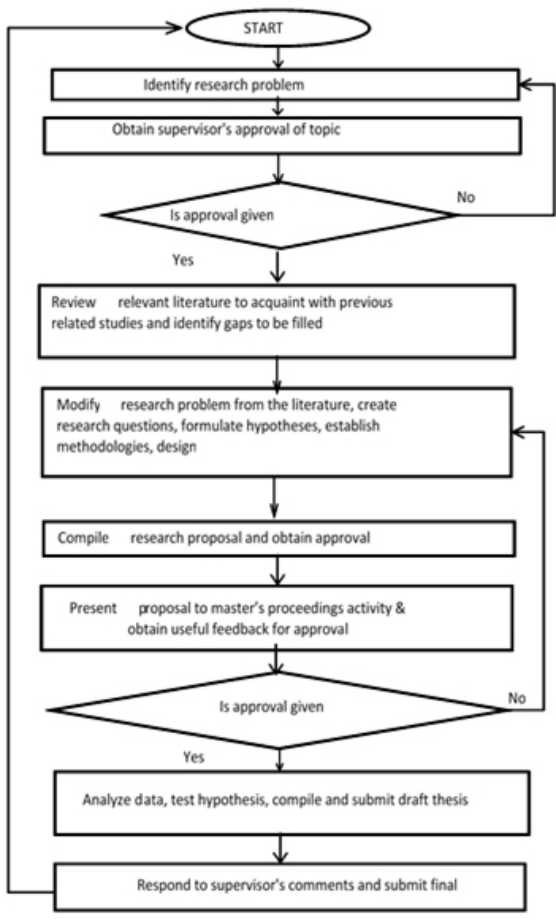
METHODOLOGY AND RESEARCH STRATEGIES The research is motivated by the desire to identify the challenges in enginee- ring education teaching & learning relative to the gap in the manufacturing industry. The steps in figure 1 were taken.
52 Laseinde
Figure 1: The flowchart of the process used in carrying out the research project from concept generation to completion.
The research used a conceptual model to develop a skills transfer frame- work for identifying how each Graduate Attribute (GA) aligns with various industry skill gaps. To facilitate a skill transfer framework to bridge the gap between the classroom and automotive skills demands, series of explorator- y/investigative approaches were taken. The research study thus attempted to generate a framework that connects numerous indicators that influence the teaching and learning at the institutions and the automotive industry’s minimum expectations of incoming graduates employed within the sector.
Harmonizing the Graduate Attributes of Mechanical and Industrial Engineering 53
To acquire the gap between classroom and industry, there is a need to create a framework that includes institutions and industry concepts.
Data Collection, Participants, and Data Scope The primary data collection method adopted in the research was question- naire surveys via an online google form sent to all participants. The data included qualitative and quantitative data. Four sets of questionnaires were prepared for the four (4) different categories of respondents. The questionnai- res were grouped according to unique categories, and the questions for each of the categories were correlated with the same questions for the different respondents. Since a mixed method was utilized, the qualitative questions were designed for seamless feedback analysis. Short answer questions for- med this part of the analysis. Furthermore, the questions for quantitative analysis were prepared for easy analysis using measures of central tendency and dispersion. Some questions were structured with multiple choices, while some were based on the five-point Likert scale for easy interpretation and accuracy of feedback.
For each category of respondents, a percentage of the population was sought. The final year student population in the mechanical and industrial engineering of the study area was approximately 100 based on the observa- tion after the data collected was subjected to a data smoothing and clean-up process, representing 30% of the total population within this category. Other categories of respondents had fewer population; as such, 30% of possible respondents from each category was desired from teaching staff, managers in the automotive industry, and university graduates from mechanical & indu- strial currently employed in the automotive manufacturing industry. Outliers and missing data were rejected for accuracy purposes because of the need for a unified correlation process. Figure 2 shows the investigation framework adopted.
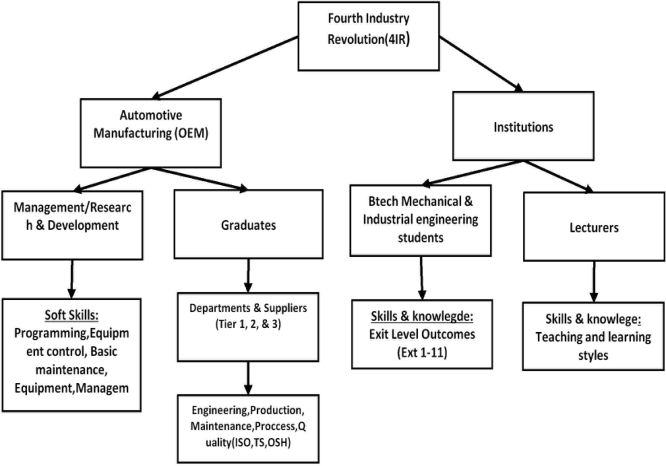
Findings Related to Teaching & Learning Skills and Knowledge The teaching & learning skills influenced by lecturers, students at the institution, graduates & management in the automotive manufacturing indu- stry influenced the framework development as presented in figure 3. South Africa’s higher institutions can adopt the framework to conduct a drilled- down study on various programs that must align with industry demands. The framework considers all the stakeholders, the learning outcomes, and the requisite tools required in a bid to bridge the widening gap between the skills demanded by labor in the industry and the skills acquired in the uni- versity (Laseinde et al., 2021). The framework consists of two main stages: the automotive manufacturing industry and higher institutions. These pil- lars have correlations and are interdependent. They are broken down into categories, which they are made of. The automotive manufacturing industry faces the 4IR challenges, leading to the institution’s classroom gap for its curriculum.
54 Laseinde
Figure 2: The data collection framework.
Harmonizing the Graduate Attributes of Mechanical and Industrial Engineering 55
CONCLUSION
The fourth industrial revolution will continue to impact education and manu- facturing as many industries are still not exposed to the 4IR pillars. The findings show the view of various stakeholders involved in the teaching, learning, and acquisition of skilled labor fit for the industry. Extensive recom- mendations have emerged from the research, and skills frameworks have been developed. The gaps in current systems have been identified, and mitigating measures that can be integrated into current systems to reduce the gap betw- een the industry and the classroom was identified. To ensure a lasting solution to the widening gap between the industry and the institutions, Industry 4.0 tools should be researched and adopted. Lecturers should be able to share the required knowledge with the students by applying other teachings and lear- ning methods or styles such as interactive boards, Short Learning Courses (SLC), Massive Open Online Courses (MOOC), and simulation laborato- ries. The institution and the engineering departments should also consider taking lecturers through specialized training on the active engagement of industry 4.0-driven tools such as VR applications, virtual labs, and cloud computing resources. The students should be given industry-based research projects which allow them to implement continuous improvement effecti- vely and enhance the integration. In summary, students should be prepared to solve real-world problems to acquire the experience needed for planning projects and problem-solving, which will yield much-needed innovation in the South African automotive industry.
ACKNOWLEDGMENT
The authors would like to acknowledge the joint support from the Royal Academy of Engineering, UK, and the National Research Foundation (NRF), South Africa.
REFERENCES
Dada, D., Laseinde, O. T., & Tartibu, L. (2023). Student-Centered Learning Tool for Cognitive Enhancement in the Learning Environment. Procedia Computer Science, 217, 507–512. Ikome, J. M., Laseinde, T., & Katumba, M. K. (2021). An Empirical Review
and Implication of Globalization to the South African Automotive Industry. In Advances in Manufacturing, Production Management and Process Control: Pro- ceedings of the AHFE 2021 Virtual Conferences on Human Aspects of Advanced Manufacturing, Advanced Production Management and Process Control, and Additive Manufacturing, Modeling Systems and 3D Prototyping, July 25-29, 2021, USA (pp. 263–270). Springer International Publishing. Ikome, J. M., Laseinde, O. T., & Katumba, M. G. K. (2022). The Future of the Automotive Manufacturing Industry in Developing Nations: A Case Study of its Sustainability Based on South Africa’s Paradigm. Procedia Computer Science, 200, 1165–1173. Laseinde, O. T., Adejuyigbe, S. B., Mpofu, K., & Campbell, H. M. (2015). Edu-
cating tomorrows engineers: Reinforcing engineering concepts through Virtual Reality (VR) teaching aid. In 2015 IEEE International Conference on Industrial Engineering and Engineering Management (IEEM) (pp. 1485–1489). IEEE.
56 Laseinde
Laseinde, O. T., and Kanakana, G. M. (2017). Interventions to Skills Development in the Automotive Manufacturing Sector of South Africa. Skills Development for Sustainable Manufacturing, 10. Majstorovi´c, V. D., Velimirovi´c, M., Gliši´c, M., Kosti´c, J., Ðura, E., Ranˇci´c, M. and
Mitrovi´c, R., 2018, June. Cyber-physical manufacturing in context of industry 4.0 model. In International Conference on the Industry 4.0 model for Advanced Manufacturing (pp. 227–238). Springer, Cham. Schwab, K. (2016). The Fourth Industrial Revolution: what it means, how to respond”. World Economic Forum.
LISTED IN THE AHFE DIGITAL BOOKSTORE CATALOGUE
Explore the complete digital volume
Production Management and Process Control
Read this individual research paper free through the original publisher, or explore the full digital proceedings book.
ISBN 978-1-958651-80-3
Explore this ISBN in the AHFE Bookstore ↗Listed in the July 2026 bookstore catalogue; search by ISBN to confirm current availability · Digital book purchase optional