Biyun Zhou, Bo Chen, Jingyu Liu, Yingfang Ao, Li Ding (2023). Effect of ambient temperature and humidity on muscle fatigue of pilots. In: Social and Occupational Ergonomics. AHFE Open Access, vol. 106, pp. 29–39. https://doi.org/10.54941/ahfe1003963
Key Laboratory of Biomechanics and Mechanobiology (Beihang University), Ministry of Education Beijing Advanced Innovation Center for Biomedical Engineering School of Biological Science and Medical Engineering, Beihang University, Beijing, 100191, China ↗
From scientific research and accident investigations, we are aware of the effects of fatigue on our performance. Pilots’ fatigue has been considered a contributing factor in various aviation accidents; many researchers found that pilots’ muscle fatigue makes pilots slow to respond and slow down their movements, which will bring potential safety hazards to flight. The aim of this study is to investigate the effect of different cockpit ambient temperatures (Ta) and relative humidity (RH) on pilots’ muscle fatigue. Thirteen subjects participated in the simulated flight experiments at 21℃/30%, 30℃/45%, and 38℃/60%RH. Continuous measurement of the skin temperature (Tsk) and skin humidity (Hsk) throughout the experiment, the surface electromyography (EMG) signals of biceps brachii (BB), flexor carpi radialis (FCR), rectus femoris (RF), and tibialis anterior (TA) were recorded, the mean power frequency (MPF) of EMG data were analyzed. This study found that the mean power frequency of rectus femoris (RF) and tibialis anterior (TA) at 38°C/60% and 30°C/45% were lower than 21°C/30% (p<0.001), and the MPF of RF at the high ambient temperatures and relative humidity condition was lower than that of TA, biceps brachii (BB) and flexor carpi radialis (FCR) (p<0.001). Through the analysis of binary linear regression, it was found that there was a relationship between ambient temperatures and relative humidity and the change of root mean square (p<0.003). This study showed that the ambient temperatures and relative humidity would impact flight fatigue, and high temperature and humidity are more likely to cause fatigue. Also, in this study, the rectus femoris is more likely to cause fatigue during flight. This study can provide a reference for biological therapies targeting flight fatigue and fatigue prevention of fighter pilots.
Pilots’ fatigue has been considered a contributing factor in various avia- tion accidents. Data from the US Army Safety Center shows that fatigue is involved in 4% of army accidents, and statistics from the Air Force Safety Center blame fatigue, at least in part, for 7.8% of Air Force Class A mishaps (Gaines et al., 2020). Pilots are affected by high temperatures and humidity when flying at low altitudes or entering the first-level combat readiness state
(Nunneley et al., 1981). Previous studies have shown that high cabin thermal load may lead to pilot muscle fatigue and thermal discomfort(Lee and Kim, 2018; Murray et al., 2016b). After flight fatigue will make pilots slow to respond and slow down their movements, which will bring potential safety hazards to flight (Diaz-Piedra et al., 2016). Therefore, it is a critical problem to study the surface electromyographic signals of ambient temperature and humidity on the pilot.
Muscle fatigue represents a complex phenomenon encompassing various causes, mechanisms, and forms of manifestation. Some researchers have shown that many factors contribute to pilot fatigue. Arsintescu et al. studied the relationship between pilot workload, performance, subjective fatigue, sleep duration, and flight duration during short-haul operations; they found that time was not an essential factor causing fatigue for short flights (Arsin- tescu et al., 2020). Caldwell et al. researched the effects of sleep on pilot and crew fatigue. They found that good sleep can reduce fatigue and enh- ance the productivity and safety of air ambulance operations (Caldwell, 2001). Booyong et al. conducted real-time monitoring of gastrocnemius ele- ctromyography under overload flight training of pilots; they found that integrated absolute value and waveform length showed a rapid decay during the fatigue phase (Choi et al., 2015). However, there are few relevant stu- dies to prove the impact of air ambient temperature and humidity on pilot fatigue.
Many studies have been performed yielding electromyography signal- based quantitative criteria of fatigue. Cifrek et al. gave an overview of classical and modern signal processing methods and techniques from the standpoint of applicability to EMG signals in fatigue-inducing situations, including time domain, frequency domain, time-frequency, time-scale repre- sentations, and other methods(Cifrek et al., 2009a). Xu et al. studied flight muscle fatigue using a Boeing 777-200ER flight simulator and a physiology monitoring system, and a hybrid multi-class Gaussian process model is proposed to identify the fatigue status of pilots by analyzing the surface electromyogram signals on the back of their neck and upper arm muscles (Xu et al., 2020), it indicated that the proposed method is feasible and precise. It has been reported that, during fatigue, there is an increase in the EMG signal amplitude and power and a decrease in both mean and median frequencies(Balasubramanian and Jayaraman, 2009; Nadal and Oliveira, 2004). In conclusion, it is reliable to evaluate fatigue by EMG.
Therefore, this experiment aimed to compare the effect of different cock- pit temperatures and humidity environments on pilot-localized muscle fatigue by EMG. The experiment was conducted in the cockpit of a retired Chinese fighter jet, and all subjects were required to simulate the flight mission. It was hypothesized that high temperature and humidity would increase pilot fatigue, while skin temperature and skin wittedness would be the critical influence on EMG variables. This study can provide a reference for bio- logical therapies targeting flight fatigue and fatigue prevention of fighter pilots.
Effect of Ambient Temperature and Humidity on Muscle Fatigue of Pilots 31
METHODS
In this paper, based on the standard of anthropometric parameters of pilots, We recruited 13 volunteers f for this experiment, with no physical disabi- lity or other restrictions, and their physical conditions met the requirements of the experiment. The average age was 23.6±0.63 years, the height was 170.9±4.22cm, and the weight was 61.67±5.16kg. When recruiting volun- teers, inform the experimental process and the risks associated with the study and sign informed consent forms. Before the beginning of the experiment, all the volunteers carried out the same intensity simulation flight training and were familiar with the experimental task.
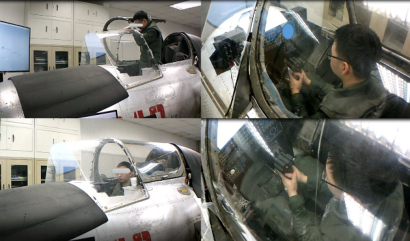
The equipment used in the present experiments included: a 3rd-generation fighter cockpit (Fig. 1), the capsule anti-G suits, the Noraxon-DTS16 wireless surface electromyography test system, and the iButton-DS1923 temperature and humidity sensors from Dallas Semiconductor. Cabin envi- ronmental control system temperature and humidity control range of 10∼50
C, 20∼90%RH, the accuracy of ±0.2
C and ±5%, respectively. The measuring range of iButton-DS1923 was −20∼85
Cand 0∼100%, and the accuracy of temperature and humidity are ±0.5
C and ±5%, respectively.
Experimental protocol: This experiment was carried out in the simulated cockpit of a specific type of fighter; all subjects can simulate flight operati- ons with the flight simulator in the cockpit. The summer weather south of the Yangtze River in China is hot and humid (Zhou et al., 2021). Pilots may be affected by the high temperature and humidity environment during the ground preparation phase before take-off, flying at a low altitude, or entering first-class combat readiness. Therefore, according to the Chinese early war- ning reference for high-temperature weather, the temperature and humidity in the cockpit are set to (23 ±0.2
C, 30±5%RH, 30±0.2
C, 45±5%RH, 38±0.2
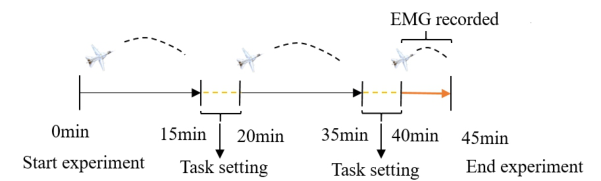
C, 60±5%RH) respectively, and the flowing velocity of air less than 0.1m/s. The subjects experienced the experiments in assigned random orders. The experiments were conducted between 9:00 and 10:00 am or 15:00 and 16:00, and each subject experimented at least 24h after the previ- ous experiment. All subjects wore anti-G capsule suits to enter the simulated cockpit of the fighter. The experimental task process is shown in Fig. 1, and
Figure 1: Fighter cockpit for simulated flight experiments.
subjects simulated fighter take-off and cruise tasks. Also, the EMG signal was recorded five minutes before the last take-off of the fighter flight operation.
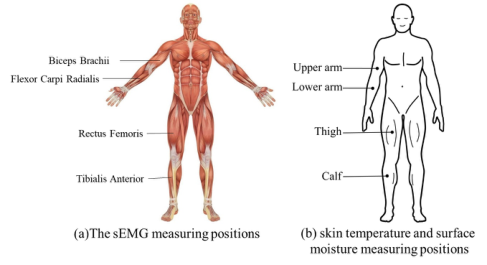
Parameter measurement: A wireless EMG sensor system from Noraxon acquired the raw EMG at a sampling frequency of 1,500 Hz(Cifrek et al., 2009b). As shown in Fig. 3(a), the surface EMG signals of biceps brachii(BB), flexor carpi radialis(FCR), rectus femoris(RF), and tibialis anterior (TA) on the right side was recorded in this paper. During measurement, the two recor- ding electrodes were separated by 2cm and kept parallel to the myofiber axis(Cifrek et al., 2009b). The two recording electrodes formed an equila- teral triangle with the reference electrode. Before placing the electrodes, the relevant skin areas were shaved and cleaned. The position of each measuring point of the body is shown in Fig. 3(b); the skin temperatures and humidity were recorded once per minute with iButton sensors.
The processing of EMG and the calculation of eigenvalues were achieved in MATLAB R2020a. A second-order notch filter with a 49–51 Hz band stop was utilized to eliminate alternating current line interference. Given the varying signal characteristics and noise in the wavelet domain, the original signals were reconstructed via wavelet transform, separating the noise from the original signals. The MPF and root mean square (RMS) was calculated. The critical parameters selected were the wavelet function db5 (Chowdhury et al., 2013).
In this paper, statistical analysis was performed with Origin 2018 software. According to the normality of the data, the Friedman test was carried out for the MPF, skin temperature, and humidity. To determine whether these
Effect of Ambient Temperature and Humidity on Muscle Fatigue of Pilots 33
features significantly differ among different conditions and muscle groups. Linear regression was used to analyze the changes in the MPF. Results were considered to be statistically significant at p<0.05.
RESULTS
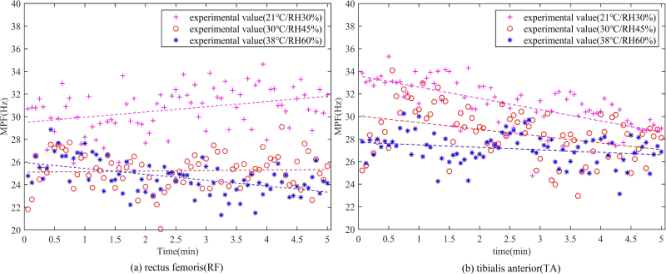
In order to analyze the effect of the cockpit air temperature and humidity on the muscle fatigue of volunteers, we analyzed the MPF of subjects during the simulated flight in this study. As shown in Fig. 4(a), the MPF of RF at 30
C/45% and 38
C/60% conditions were significantly decreased compa- red with that at 21
C/30% conditions (p<0.001). The MPF of RF showed a decreasing trend at 38
C/60%, while it increased at 21
C/30% during this period. In terms of TA, Fig. 4(b) showed that the MPF of the TA under the conditions of 30
C/45% and 38
C/60% was significantly lower than that at 21
C/30% (p<0.001), and the MPF of TA at 38
C/60% was also significan- tly lower than that at 30
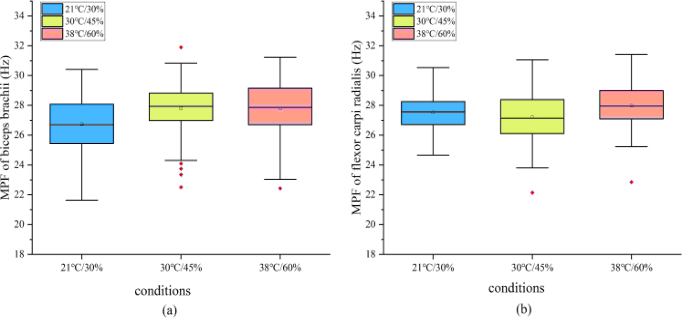
C/30% (p = 0.004). Also, the MPF of TA showed a decreasing trend with time under all conditions. In addition, we analyzed the changes in the MPF of BB and FCR under different conditions. As shown in
Figure 4: The MPF of rectus femoris (RF) and tibialis anterior (TA) at different conditi- ons, “---” presented its one-order fitting.Figure 5: The MPF of biceps brachii(BB) and flexor carpi radialis(FCR) in subjects at different conditions.
Fig. 5(a) and 5(b), there was no significant difference in the MPF of BB and FCR among three varied working conditions.
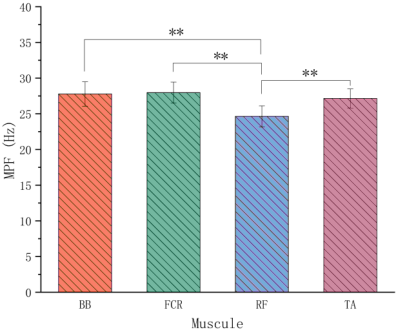
Because the environment of high temperature and humidity may make volunteers more prone to fatigue, this paper analyzed the MPF of different muscles. As shown in Fig. 6, when subjects were exposed to the 38
C/60% condition, the MPF of RF was significantly lower than that of other muscles (p<0.001). There was no significant difference between the MPF of BB, TA, and FCR (p>0.28).
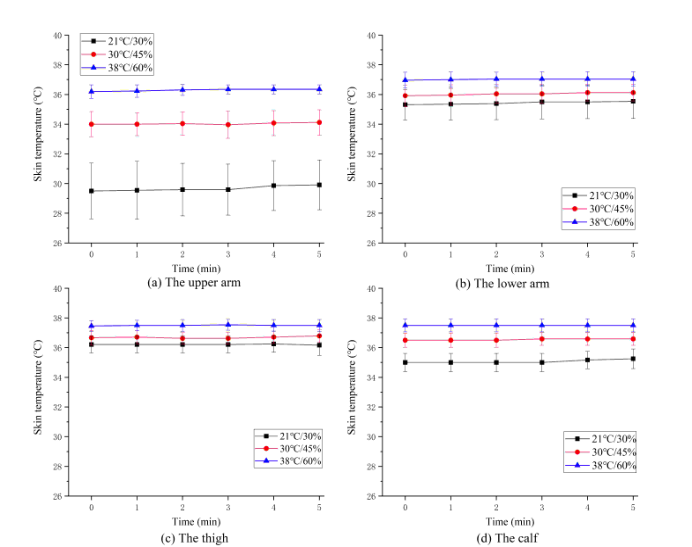
Figure 6: The MPF of different muscles at 38◦C/60%, “**” denotes p<0.001.Figure 7: The skin temperature of all positions at different conditions.
Effect of Ambient Temperature and Humidity on Muscle Fatigue of Pilots 35
In order to analyze the effect of skin temperature and skin humidity on electromyographic signals, the skin temperature of the subject’s upper arm, lower arm, thigh, and the calf was tested. As shown in Fig. 7(a), 7(b), 7(c), and 7(d), the Tsk of all four positions at 38
C/60% was significantly higher than in other conditions. (p<0.05). The Tsk of each position was diffe- rent under the same condition, the upper arm was significantly lower than other positions (p<0.05), and the skin temperature of each position had no significant difference with time(p>0.05).
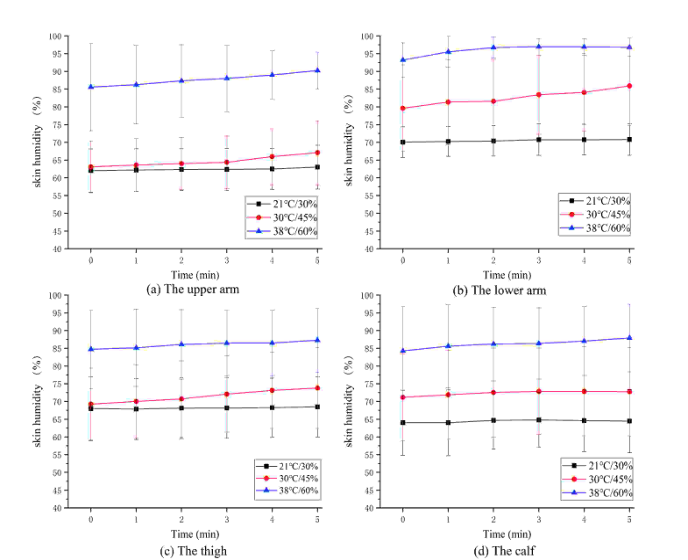
The local skin humidity was also analyzed in this paper. As shown in Fig. 8(a) and 8(c), the skin humidity of the thigh and upper arm had no difference between 21
C/30% and 30
C/45% (p>0.05), and the skin humi- dity of all positions at 38
C/60% was significantly higher than that of other conditions (p<0.01). As shown in Fig. 8(b) and 8(d), the skin humidity of the lower arm and calf was significantly different among the three different conditions(p<0.01).
Table 1. Results of binary linear regressions between Tsk and Hsk and RMS.
Figure 8: The skin humidity of all positions at different conditions.
This study analyzed the relationship between Tsk, Hsk, and the root means square (RMS) by binary linear regression. The regression model was statisti- cally significant for RMS (F = 6.55, p<0.003), the regression coefficients as shown in Table 1, and the goodness of fit was R2 = 0.44, which illustra- ted that the Tsk and Hsk affected the change of EMG. The effect of skin temperature was greater than the impact of skin humidity.
DISCUSSION
The main objective of this paper is to investigate whether different Ta and RH affect muscle fatigue. The results showed that participants under a higher temperature would reduce the mean power frequency of RF and TA compa- red with the 21
C/30% condition (Fig. 4), indicating a temperature effect on the EMG signal. Bell et al. evaluated the influence of different air temperatu- res (10
C, 23
C, and 40
C) on EMG during contractions of the quadriceps muscle; they found the EMG amplitude was reduced at a given force as tem- perature increased (Bell, 1993); this is consistent with the results of this study. Also, many studies on muscle fatigue showed that fatigue occurs when RMS increases and MPF decreases(Lecocq et al., 2020; Rampichini et al., 2020; Skrzat et al., 2020). Petrofsky et al. studied the isometric contraction of forearm muscles in 10
C, 20
C, 30
C, and 40
C temperature environments, and the results showed that the centre frequency of the EMG power spectra decreased during fatiguing isometric contractions (Petrofsky and Lind, 1980). Above all, muscle fatigue is prone to occur in environments with high tempe- ratures and high relative humidity. The MPF of RF increased at 21
C/30% during this period (Fig. 4(a)) because it has not been fatigued. The MPF of BB and FCR had no significant difference among all conditions(Fig. 5), possibly because they have not yet developed fatigue, which might be related to the smaller exercise intensity of BB and FCR compared with the lower limbs. Also, the subjects could adjust their upper limb working posture slightly during the mission.
In addition, this work also reported the discrepancy of the fatigue level in different body parts when continuously exposed to the 38
C/60% environ- ment (Fig. 6); the fatigue between different body positions is connected to the muscle’s labour intensity. Murray et al. studied the pilot’s neck and shoulders muscle fatigue and found a significant difference between different muscles (Murray et al., 2016a). Srinivasan et al. researched the fatigue of cyclists’ medial biceps brachii, medial trapezius, and so on, also reporting a signifi- cant discrepancy between different muscles, and not all muscles were found tired (Srinivasan, 2007), which corresponded with the result of this work. Interestingly, the MPF of RF was lower than TA, BB, and FCR in this work (Fig. 6), which indicated that the fatigue of RF may occur more consequently in this mission. It might suggest that the subjects’ legs had to bend during the hold mission to keep a position to control the aircraft pedal, which means the RF cannot fully relax. Moreover, it was speculated that the result was also related to cockpit seat comfort or the subject’s sitting position.
The reasons for EMG change in the high temperature and relative humidity environment are critical. During the experiment, the high air temperature and
Effect of Ambient Temperature and Humidity on Muscle Fatigue of Pilots 37
humidity will cause changes in human skin temperature and skin humidity; the Tsk and Hsk are higher in the high-temperature and humidity environ- ments than in the 21
C/30% condition (Fig. 7, Fig. 8). Many studies have shown that the high temperature and high humidity environments can lead to the increased skin temperature and skin humidity (Li et al., 2018; Wu et al., 2020), which is consistent with the results of this study. Due to the results above and to further explore the relationship between the pilot’s fatigue and the condition, we also analyzed the relationship between skin temperature and humidity with RMS and found that the Tsk and Hsk have significant effe- cts on EMG signals. Coletta et al. studied the effects of core temperature and skin temperature on neuromuscular response during dynamic muscle contra- ction, which showed that skin temperature was the primary thermal afferent during a position task requiring dynamic maintenance of joint angle with minimal core temperature influence (Coletta et al., 2018), this was consistent with the results of this work.
Also, many studies have shown that EMG may be related to muscle action potential conduction velocity change. A reduced muscle temperature has been shown to increase the duration of each action potential propagating along the muscle fibres (Buchthal et al., 1954). Lindstrom et al. believed that H +, a metabolite produced by local muscles during fatigue, slows down the con- duction velocity of the action potential along muscle fibres, resulting in a significant decrease in MPF and MF values (Lindstrom et al., 1970). In addi- tion, EMG might relate to the distribution of fluids within the muscle; more blood and thus fluid is shunted to the periphery to help the sweating response under the hot environment (Chiesa et al., 2016; Kalsi et al., 2017; Wong and Hollowed, 2017). To summarize, skin temperature and skin humidity can also affect flight fatigue.
CONCLUSION
This study aimed to explore the muscle fatigue of volunteers under diffe- rent cockpit Ta and RH, and the EMG signals, skin temperature, and skin humidity were measured. The main conclusions of this study are as follows: (1) The results showed that high cockpit Ta and RH could affect muscle fati- gue, and participants under a higher temperature will reduce the MPF of RFC and TA compared with the 21
C/30% condition. (2) In addition, it was shown that the fatigue severity of different positions of the subjects is different at 38
C/60% condition, and the RF was prone to show fatigue in this study. (3) The skin temperature and humidity significantly affect the changes of EMG signals, and muscle fatigue might be caused by the change of fluid body distribution and action potential conduction velocity along muscle fibre caused by the change of Ta and RH.
This study provided a reference for monitoring the fatigue level of pilots and planning operations, and making the mission more in line with
ergonomics. In the future, fatigue research can also be carried out in combi- nation with long flight times, overload, and different flight difficulties, and more reliable prevention strategies can be put forward.
REFERENCES
Arsintescu, L., Chachad, R., Gregory, K. B., Mulligan, J. B., Flynn-Evans, E. E.,
2020. The relationship between workload, performance and fatigue in a short- haul airline. Chronobiology International 9, 3. Balasubramanian, V., Jayaraman, S. J. J.o. B., 2009. Surface EMG based muscle activity analysis for aerobic cyclist. Bodywork Movement Therapies 13, 34–42. Bell, D. G., 1993. The influence of air temperature on the EMG/force relationship of
the quadriceps. European Journal of Applied Physiology 67, 256–260. Buchthal, F., Pinell, P., Rosenfalck, P., 1954. Action potential parameters in normal human muscle and their physiological determinants. Acta Physiol Scand 32, 219– 229. Caldwell, J. A., 2001. The impact of fatigue in air medical and other types of operati-
ons: A review of fatigue facts and potential countermeasures. Air Medical Journal 20, 25–32. Chiesa, S. T., Trangmar, S. J., González-Alonso, J., 2016. Temperature and blood flow distribution in the human leg during passive heat stress. J Appl Physiol 120, 1047–1058. Choi, B., Lee, Y., Cho, T., Koo, H., Kim, D., 2015. Detection of G-Induced Loss of
Consciousness (G-LOC) prognosis through EMG monitoring on gastrocnemius muscle in flight, Annu Int Conf IEEE Eng Med Biol Soc. Chowdhury, S. K., Nimbarte, A. D., Jaridi, M., Creese, R. C., 2013. Discrete wavelet transform analysis of surface electromyography for the fatigue assessment of neck and shoulder muscles. Journal of Electromyography and Kinesiology 23, 995– 1003. Cifrek, M., Medved, V., Tonkovic, S., Ostojic, S., 2009a. Surface EMG based muscle
fatigue evaluation in biomechanics. Clinical Biomechanics 24, 327–340. Cifrek, M., Medved, V., Tonkovi´c, S., Ostoji´c, S., 2009b. Surface EMG based muscle fatigue evaluation in biomechanics. Clinical Biomechanics 24, 327–340. Coletta, N. A., Mallette, M. M., Gabriel, D. A., Tyler, C. J., Cheung, S. S., 2018. Core
and skin temperature influences on the surface electromyographic responses to an isometric force and position task. PLoS One 13, e0195219. Diaz-Piedra, C., Rieiro, H., Suárez, J., Rios-Tejada, F., Catena, A., Stasi, L. L. D.,
2016. Fatigue in the military: towards a fatigue detection test based on the saccadic velocity. Physiological Measurement 37, N62. Gaines, A. R., Morris, M. B., Gunzelmann, G., 2020. Fatigue-Related Aviation Mishaps. Aerospace Medicine and Human Performance 91, 440–447. Kalsi, K. K., Chiesa, S. T., Trangmar, S. J., Ali, L., Lotlikar, M. D., González-Alonso,
J., 2017. Mechanisms for the control of local tissue blood flow during thermal interventions: influence of temperature-dependent ATP release from human blood and endothelial cells. Exp Physiol 102, 228–244. Lecocq, M., Lantoine, P., Bougard, C., Allegre, J. M., Bauvineau, L., Bourdin, C., Marqueste, T., Dousset, E., 2020. Neuromuscular fatigue profiles depends on seat feature during long duration driving on a static simulator. Applied Ergonomics 87, 10. Lee, S., Kim, J. K., 2018. Factors contributing to the risk of airline pilot fatigue.
Journal of Air Transport Management 67, 197–207.
Effect of Ambient Temperature and Humidity on Muscle Fatigue of Pilots 39
Li, Y., Li, C., Han, X., Zhang, X., 2018. Human responses to high air temperature, relative humidity and carbon dioxide concentration in underground refuge chamber. Building and Environment 131, 10. Lindstrom, L., Magnusson, R., Petersén, I., 1970. Muscular fatigue and action poten-
tial conduction velocity changes studied with frequency analysis of EMG signals. Electromyography 10, 341–356. Murray, M., Lange, B., Chreiteh, S. S., Olsen, H. B., Nornberg, B. R., Boyle, E., Sogaard, K., Sjogaard, G., 2016a. Neck and shoulder muscle activity and posture among helicopter pilots and crew-members during military helicopter flight. J Electromyogr Kinesiol 27, 10–17. Murray, M., Lange, B., Chreiteh, S. S., Olsen, H. B., Nørnberg, B. R., Boyle,
E., Søgaard, K., Sjøgaard, G., 2016b. Neck and shoulder muscle activity and posture among helicopter pilots and crew-members during military helicopter flight. Journal of Electromyography and Kinesiology 27, 10–17. Nadal, J., Oliveira, C. G. D., 2004. Back muscle EMG of helicopter pilots in flight: effects of fatigue, vibration, and posture. Aviat Space Envir Med 75, 317–322. Nunneley, S. A., Stribley, R. F., Allan, J. R., 1981. Heat stress in front and rear
cockpits of F-4 aircraft. Aviation Space Environmental Medicine 52, 287–290. Petrofsky, J. S., Lind, A. R., 1980. The influence of temperature on the amplitude and frequency components of the EMG during brief and sustained isometric con- tractions. European Journal of Applied Physiology and Occupational Physiology 44, 189–200. Rampichini, S., Vieira, T. M., Castiglioni, P., Merati, G., 2020. Complexity analysis
of surface electromyography for assessing the myoelectric manifestation of muscle fatigue: a review. Entropy 22, 529. Skrzat, J. M., Carp, S. J., Dai, T., Lauer, R., Hiremath, S. V., Gaeckle, N., Tucker, C. A., 2020. Use of surface electromyography to measure muscle fatigue in patients in an acute care hospital. Phys Ther 100, 897-906. Srinivasan, J., 2007. Low back pain and muscle fatigue due to road cycling—An
sEMG study. Bodywork Movement Therapies 11, 260–266. Wong, B. J., Hollowed, C. G., 2017. Current concepts of active vasodilation in human skin. Temperature (Austin) 4, 41–59. Wu, Q. Q., Liu, J. H., Zhang, L., Zhang, J. W., Jiang, L. L., 2020. Study on thermal
sensation and thermal comfort in environment with moderate temperature ramps. Building and Environment 171, 6. Xu, B., Wu, Q., Xi, C., He, R., 2020. Recognition of the fatigue status of pilots using BF-PSO optimized multi-class GP classification with sEMG signals. Reliab Een Syst Safe 199, 106930. Zhou, B., Ding, L., Chen, B., Shi, H., Ao, Y., Xu, R., Li, Y., 2021. Physiological
Characteristics and Operational Performance of Pilots in the High Temperature and Humidity Fighter Cockpit Environments. Sensors (Basel) 21.
LISTED IN THE AHFE DIGITAL BOOKSTORE CATALOGUE
Explore the complete digital volume
Social and Occupational Ergonomics
Read this individual research paper free through the original publisher, or explore the full digital proceedings book.
ISBN 978-1-958651-82-7
Explore this ISBN in the AHFE Bookstore ↗Listed in the July 2026 bookstore catalogue; search by ISBN to confirm current availability · Digital book purchase optional