Biyun Zhou, Xue Lihao, Xiaopeng Liu, Qing Yang, Liangsheng Ma, Li Ding (2022). The physical load of the Human body during Motion with BP Neural Network. In: Physical Ergonomics and Human Factors. AHFE Open Access, vol. 63, pp. 196–204. https://doi.org/10.54941/ahfe1002613
1 Key Laboratory of Biomechanics and Mechanobiology (Beihang University), Ministry of Education, Beijing Advanced Innovation Center for Biomedical Engineering, School of Biological Science and Medical Engineering, Beihang University, Beijing, 100191, China ↗
2 The 4th Dept., Institute of Aviation Medicine of Air Force, Chinese People’s Liberation, Army, Beijing 100036, China ↗
3 Wuhan 2 nd Ship Design and Research Institute, Wuhan, Hubei, 430205, China ↗
Background: Unreasonable tasks will increase the person’s physical load, leading to safety accidents and occupational diseases. To ensure a reasonable physical load and improve the operational efficiency of the person as far as possible, it is necessary to predict and evaluate the physical load of workers in real-time.Objective: A prediction model of the physical load intensity of the human body based on a neural network was established, and its effectiveness was verified.Methods: Twelve volunteers completed four movements walking, jogging, climbing, and jumping. The surface electromyography (sEMG) on the left and right sides of the rectus femoris and biceps femoris was measured, and the motor posture of volunteers was obtained by Vicon, the joint torque, maximum muscle activity, and muscular force parameters were calculated based on the reverse dynamic model of human motion. The sEMG eigenvalue and mechanical load parameters in different postures were considered input and output, respectively, and 80% of all data were used as the training set and the rest as the validation set.Results: In this study, we found that the hip joint, knee joint, and ankle joint have a sizeable joint torque during movement, in which the joint torque of the ankle joint is the largest and twice human body weight at its peak. Besides, a larger muscle load occurs at the beginning and end of contact between the human foot and the ground, and the muscle strength of the rectus femoris was significantly higher than that of the biceps femoris (p<0.05). The number of neurons in the input layer, an output layer, and a hidden layer of the model is 32, 13, and 12, respectively. This study found that the prediction error of maximum muscle activity was 6.4%. The average prediction error of joint torque was 8.7%, and the prediction error of the muscular force of the rectus femoris muscle was no more than 9.5%. This model can reasonably predict the physical load of the human body.Conclusions: A workload evaluation model based on the BP neural network was established in this research, which can analyze the biomechanics of the human body in motion and judge the human body’s physical load effectively according to the EMG signal.Application: This model can measure the body load of soldiers and firefighters in real-time during task training and provide a reference for task design.
The Physical Load of the Human Body During Motion with BP Neural Network 197
INTRODUCTION
The physiological and behavioural ability of the human body is the basis for the human to complete various tasks, so it is crucial to accurately judge the physiological and behavioural ability of the human body for much work. In training or combat, soldiers are often required to carry a certain load weight according to the mission requirements, mission time or mission environment, and other conditions. Making an effective judgment on the decline of soldiers load capacity in training and adjusting tactics in time according to the change in soldiers’ load capacity will play a positive role in the victory (Bullock et al. 2010, Zhong et al. 2012). To maintain a better physiological state to complete combat and training tasks and reduce the occurrence of various injuries, many researchers have studied the mechanical load of the human body. Epstein et al. studied the energy consumption of long-distance walking with a load of 25 kg and 40 kg, which showed that in the two-hour walking exercise, the work intensity exce- eds 50% of the maximum working capacity, the increase in load will lead to physical fatigue, which will lead to a rise in energy cost (Epstein et al. 1988). Park et al. have studied different gait strategies of normal gait and weight-bearing gait. The results show that additional load not only increa- ses the reaction parameters of vertical foundation and sheer foundation in proportion but also increases impulse, momentum, and mechanical work (Park and Min 2016). Kenton et al. investigated the research of musculoske- letal system load of the US army before 2000. They found that the injury rate during military training was very high and varied, primarily caused by high running mileage, high weekly exercise, and biomechanical factors (Kaufman et al. 2000). Filzah et al. conducted a comprehensive analysis of soldiers’ gait and motion during a long time loaded march and obtai- ned different kinematic characteristics of soldiers’ critical joints, such as angle changes and motion range. The method was able to identify impor- tant joints that were most affected by weight-bearing (Damit et al. 2017). Dempsey et al. studied vertical jumps, landing with a focus on safety, jumping, and landing with distraction. They found that the average jump height decreased as the load increased or the running task progressed. Peak gravitational acceleration increases by 13-19% under load, while after vigo- rous exercise, the peak gravitational acceleration further increases by 4-9% (Dempsey et al. 2014).
To sum up, many studies have been done on the mechanical load and injury of the human, and have proved that it is feasible to use a neural network to study human load. Kipp et al. used a neural network to pre- dict the joint torque of the hip, knee, and ankle during weight lifting. The percentage difference between the results of inverse dynamics calculation and the peak net joint torque predicted by the neural network is between 5% and 16% (Kipp et al. 2018). Uchiyama et al. used the comprehen- sive EMG signals of the muscles between the shoulder and elbow and the angle of the shoulder and elbow joint as the input of an artificial neural network to predict the flexion and extension moment of the elbow joint (Uchiyama et al. 1998). McBride et al. used the neural network model to
analyze the biomechanical gait data, took the joint angular velocity and the three-dimensional reaction force on the ground as the input of the model, and took the score of the Lawrence scale as the output of the model to predict the joint deterioration and pain of the participants with knee osteoarthri- tis. The results showed a strong correlation between gait dynamics and joint deterioration and pain in patients with osteoarthritis (Mcbride et al. 2011). The above researches show that it is feasible to use a neural network to pre- dict human body load. This paper aims to establish a prediction model of human exercise load intensity based on the BP neural network and verify its effectiveness.
METHODS
In this paper, twelve healthy male college students were recruited as volun- teers, their average height was 174.83±3.85cm, and their average weight of 71.87±6.80 kg, their Body Mass Index (BMI)was 23.53±2.29. None of them had any history of heart disease, physical disabilities, or other limita- tions, whose physical conditions met the experimental requirements. During recruitment, the volunteers were informed of the purpose, procedure of the experiments, and research-related risks, each of whom signed an informed consent form. The experiments were approved by the ethics committee. All the volunteers completed four movements: walking, jogging, climbing, and jumping.
The experimental equipment used in this study mainly includes the Vicon optical motion capture system developed by the British Oxford Metrics Limi- ted company, and the sampling frequency is set to 100Hz. In the American Applied Molecular Transport (AMTI) three-dimensional force measuring platform, the DTS-16 wireless EMG acquisition system developed by the American Noraxon, the sampling frequency is set to 1500Hz.
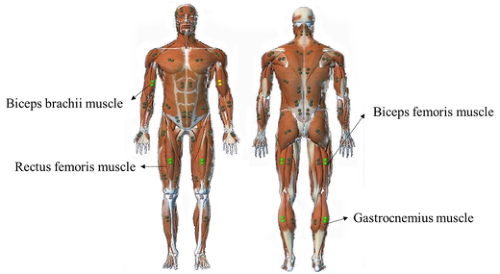
As shown in Figure 1, the surface EMG signals of the left and right the biceps brachii, rectus femoris, biceps femoris, and gastrocnemius muscle of the volunteers were collected. The low-pass filter is used to filter the EMG signal, and the primary information of EMG 10-200Hz is retained. The second is to eliminate the baseline drift, and the adaptive 50Hz filter is used to remove the 50Hz power frequency noise in EMG. The posture data of 37 Mark points of volunteers (7 marked points of left and right upper and lower limbs, five marked points of trunk, and four marked points of the pelvis) were collected. Vicon Nexus 2.5 was used to process the data. The consistency of 37 markers with the experimental scheme, the advantages and disadvantages of data quality, and the data loss phenomenon were determined.
The surface EMG signal eigenvalues and human body mechanics load in different postures are taken as input and output, respectively. 80% of the data was used as a training set and the rest as a validation set. The integral EMG value (IEMG), root mean square (RMS), median frequency (MDF), and average power frequency (MPF) are selected as the input characteristics of mechanical load forecasting, which are calculated as shown in equation (1), (2), (3) and (4).
The Physical Load of the Human Body During Motion with BP Neural Network 199
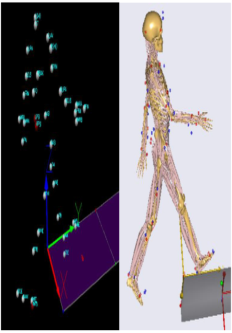
Figure 1: The EMG measuring point.Figure 2: The model initialization.
Equations and mathematical formulas are available in the original paper PDF.
i (2)
MDF X
M X
M X
Pj (3)
M (4) Where xi represents the EMG signal, and N represents the length of the EMG signal. Pj is the power spectrum of the EMG signal at the frequency domain j, and M is the length of the frequency domain.
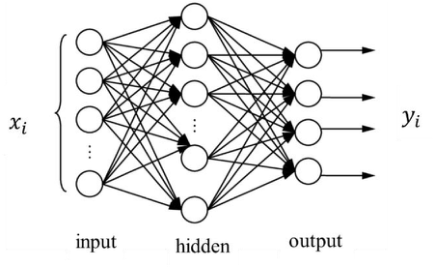
Figure 3: The BP neural network model.
As shown in Figure 2, the model was established based on the Anybody biomechanical simulation system, and the reverse dynamic model is initia- lized according to the data captured by the subjects. The collected motion capture data drive the Anybody model to simulate and calculate the muscle activity or joint torque.
This paper established the prediction model of the human physical load based on the BP neural network. As shown in Figure 3, BP neural network is a multilayer feedforward neural network trained according to the error reverse propagation algorithm, which consists of one input layer, one output layer, and one or more hidden layers. The activation function in this paper is the sigmoid function, whose output is limited to [0, 1], and its analytical equation is shown in (5).
RESULTS AND DISCUSSION
As shown in Table 1, the maximum muscle activity of the volunteers was not more than 1, which indicated that the muscle load did not reach the state of injury and reached the state of muscle fatigue during regular exercise. The joint torque and muscle force of all volunteers were analyzed, and it was found that the maximum torque of the elbow joint was kept at a low level. Compared to other joints, the joint torque of the ankle joint of the lower limb was the largest. Besides, the muscle force of the rectus femoris was gre- ater than the biceps femoris, which may be caused by the solution of muscle recruitment. There are differences in mechanical load among volunteers due to the incomplete body weight, posture, and speed.
In this paper, Python was used for training and prediction. The activation function is the sigmoid function, the training times are set to 5000, and the learning rate of the network is set to 0.05. The neural network was trai- ned after setting the parameters. Finally, 2764 groups of sample data are randomly sorted, and the training and test sets are divided at 8:2.
In this paper, BP neural networks were established according to the num- ber of these hidden layers. The number of neurons in the input layer is 32,
The Physical Load of the Human Body During Motion with BP Neural Network 201
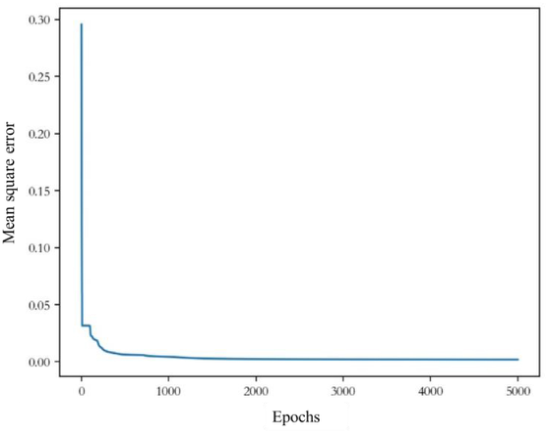
and the number in the output layer is 13. As shown in Table 2, the hidden layer neurons range from 7 to 17. The model convergence advantages and disadvantages were preliminarily calculated when other conditions were con- sistent. In the case of constant control of other states, when the number of neurons in the hidden layer is 12, the convergence algebra of the model is the smallest, which indicates that the convergence speed of the BP neural netw- ork is the fastest, so the number of neurons in the hidden layer is set to 12. The variation of the mean square error during the model training is shown in Figure 4, and the network converges after 1500 generations of conditioning.
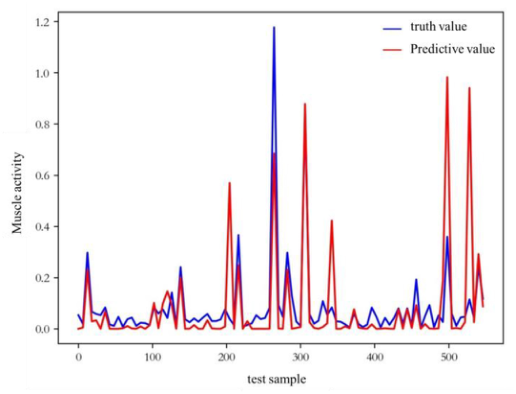
After completing the training set, the test set data is used to verify the model. As shown in Figure 5, the whole-body mechanical load predicted by the model, the maximum muscle activity is compared with the experimental value. The blue dot represents the actual mechanical load calculated by the
The Physical Load of the Human Body During Motion with BP Neural Network 203
Figure 5: Model prediction result.Table 3. Output prediction error.
Table available in the original PDF paper.
The output characteristics The training error Maximum muscle activity 0.064 Left elbow torque 0.082 Left hip torque 0.088 Left knee torque 0.111 Left ankle torque 0.104 Left rectus femoris muscle force 0.095 Left biceps femoris muscle force 0.097 Right elbow torque 0.071 Right hip torque 0.092 Right knee torque 0.067 Right ankle torque 0.057 Right rectus femoris muscle force 0.085 Right biceps femoris muscle force 0.120
Anybody model, and the red dot represents the mechanical load predicted by the BP neural network, the goodness of fit of the network is better.
AS shown in Table 3, the error of the overall physical load and the local physical load was calculated. The maximum muscle activity prediction error is 6.4%, which is low among all the physical load prediction errors. The prediction error of joint torque is less than that of muscle force, which may be due to the need for muscle recruitment in the calculation process. How- ever, the physiological recruitment mechanism is unclear, and there may be some errors in simulation calculation. The maximum error of all physical load calculations is less than 12%, and the average error is 8.7%, indicating that the model can well realize the prediction of human physical load.
The present study is limited by its single sample source. Only volunteer col- lege students were taken as samples, who somewhat differed in the physical
constitution of the soldiers. Besides, further research is needed concerning the physical load of the human body under different load conditions.
CONCLUSION
In this paper, a model of human physical load evaluation based on the BP neural network was established, which takes the EMG characteristic value as the input and the mechanical load of humans as the output, and realizes the prediction of the mechanical load of humans, with an average prediction error of 8.7%. Mainly, the model can effectively judge the mechanical load of humans and can real-time measure the body load of soldiers and firefighters in task training, which provides a reference for task design.
ACKNOWLEDGMENT
This work was supported by the Defense Industrial Technology Development Program (JCKY2021601B021).
REFERENCES
Bullock, S.H., Jones, B.H., Gilchrist, J. & Marshall, S.W., 2010. Prevention of physical training–related injuries. American Journal of Preventive Medicine, 38 (1-supp-S), S156-S181. Damit, D., Senanayake, S., Malik, O.A. & Tuah, P., 2017.Instrumented measurement
analysis system for soldiers’ load carriage movement using 3-d kinematics and spatio-temporal features. Measurement, 95, 230-238. Dempsey, P.C., Handcock, P.J. & Rehrer, N.J., 2014. Body armour: The effect of load, exercise and distraction on landing forces. Journal of Sports Sciences, 32 (4), 301–306 Available from. Epstein, Y., Rosenblum, J., Burstein, R. & Sawka, M.N., 1988. External load can
alter the energy cost of prolonged exercise. Eur J Appl Physiol Occup Physiol, 57 (2), 243–247 Available from. Kaufman, K.R., Brodine, S. & Shaffer, R., 2000. Military training-related injuries: Surveillance, research, and prevention. American Journal of Preventive Medicine, 18 (3 ), 54–63. Kipp, K., Giordanelli, M. & Geiser, C., 2018. Predicting net joint moments during
a weightlifting exercise with a neural network model. Journal of Biomechanics, 74 (2). Mcbride, J., Zhang, S., Wortley, M., Paquette, M. & Zhao, X., Year. Neural network analysis of gait biomechanical data for classification of knee osteoarthritised.ˆeds. Biomedical Sciences & Engineering Conference. Park, J. & Min, K.Y., 2016. Analysis of the gait characteristics of soldier between the
normal and loaded gait. International Journal of Mechanical and Mechatronics Engineering, 115 (13), 38–42. Uchiyama, T., Bessho, T. & Akazawa, K., 1998. Static torque-angle relation of human elbow joint estimated with artificial neural network technique. Journal of Biomechanics, 31 (6), 545. Zhong, L.I., Tie-Gang, L.I., Yi, L.I. & Wang, Q.Y., 2012. The analysis of the present
state and countermeasures of military physical training (MPT) in nudt. Journal of Higher Education Research, 35 (2), 24–26.
LISTED IN THE AHFE DIGITAL BOOKSTORE CATALOGUE
Explore the complete digital volume
Physical Ergonomics and Human Factors
Read this individual research paper free through the original publisher, or explore the full digital proceedings book.
ISBN 978-1-958651-39-1
Explore this ISBN in the AHFE Bookstore ↗Listed in the July 2026 bookstore catalogue; search by ISBN to confirm current availability · Digital book purchase optional