Qing Zhang, Mengxiong Ye, Shaojun Cai, Changhua Gao, Peng Yu, Jiachen Nie, DING Li, Qing Yang (2025). Effects of different humidity levels on the human body in a high-temperature environment at high altitude. In: Physical Ergonomics and Human Factors. AHFE Open Access, vol. 185, pp. 41–48. https://doi.org/10.54941/ahfe1006462
1 Beijing Advanced Innovation Center for Biomedical Engineering, Key Laboratory for Biomechanics and Mechanobiology of Ministry of Education, School of Biological, Science and Medical Engineering, Beihang University, Beijing, 100191, China ↗
2 Wuhan Second Ship Design and Research Institute, Wuhan, 430205, China ↗
Workers in high-temperature, high-humidity, and low-oxygen environments face multiple environmental stressors, leading to increased blood circulation, changes in metabolic heat production, elevated heart rates, and reduced nerve sensitivity. These factors may contribute to a significant heat stress on the body, which directly reduces physical work capacity and impacts overall performance.As society advances, greater emphasis is placed on the safety of human factors, particularly in the most challenging work environments involving high temperatures and humidity at high altitudes. This issue has garnered significant attention. Previous studies mainly focused on one specific aspect, such as the impact of high-temperature environments on the human body. To address the need for comprehensive research on human factors in complex working conditions, this study aims to investigate thermophysiological indicators of the human body under high-temperature, high-humidity, and low-oxygen conditions. The findings will serve as a reference for improving human safety and ergonomic standards in challenging environments.METHODS: To enhance current protective measures and reference standards for specialized work and mitigate risks to human health, this study examined the effects of varying humidity levels on body surface temperature and humidity under 40℃ conditions at simulated 3000 meters above sea level. Eight participants (four males and four females) sat in a high-temperature chamber at high altitude with humidity levels of 30% and 60% for 40 minutes. During this period, body surface temperatures and humidity of seven different body segments, including forehead, chest, back, upper arm, hand, thigh and calf, were recorded using button-temperature sensors, while participants completed subjective scales.The temperature and humidity of body surface at each measured segment were linearly fitted to time to determine the correlation between these variables and time. Paired T-tests were conducted on the temperature and humidity of body surface at each 5-minute interval compared to the initial values to assess the stability. Independent T-tests were performed to compare the temperature and humidity between male and female groups at each time interval for different ambient humidity levels to identify gender-based differences. Additionally, independent T-tests were used to evaluate the effect of ambient humidity on the temperature and humidity of each body segment for both genders.RESULTS & CONCLUSIONS: Statistical analysis indicated that temperature and humidity levels varied across different body segments over time under two ambient humidity conditions. Body surface humidity showed significant differences based on body segment but was less influenced by temperature changes. Additionally, gender differences were observed. Females exhibited higher and more variable body surface temperatures compared to males in both ambient humidity conditions, while trends in body surface humidity over time differed between genders. Overall, the small-sample study in this research suggests that the design of protective clothing should incorporate breathable and moisture-absorbing fabrics tailored to specific body areas, while should also consider gender-specific requirements. Besides, the weak correlation between subjective thermal comfort ratings and body surface temperature and humidity indicates that the current indicators are insufficient to fully represent human thermal comfort in such environments, and more comprehensive or combined indicators are needed.
As society advances, greater emphasis is placed on the safety of human factors, particularly in the most challenging work environments, which has garnered significant attention. For example, the adverse environment during the flight has gradually become an obstacle for the pilots to operate the aircraft accurately, as the temperature inside the well sealed cockpit can reach
C with an inside air pressure at an altitude of 2000∼4000 meters (Li et al., 2015). Workers in such environments face multiple environmental stressors, leading to increased the risk of misoperation caused by thermal discomfort. Therefore, it is necessary to study the thermal regulation of the human body in high-temperature and hypobaric environments.
Several studies have investigated the effects of altitude and temperature conditions on human thermoregulation. Current research primarily focuses on high-altitude regions and decompression chambers. In such environments, lower air density, reduced specific heat, and decreased water vapor content diminish convective heat transfer efficiency while enhancing evaporative cooling (Kandjov, 1999). Physiologically, hypoxia triggers increased respiratory and circulatory rates, leading to tachypnea, elevated heart rate, dizziness, headaches, and fatigue, particularly affecting brain tissues (Luks et al., 2021). Studies highlight compensatory responses, including vasodilation of skin vessels, higher metabolism, and increased extremity skin temperatures at rest (Burtscher et al., 2019; Burtscher et al., 2018; Maximov and Maximova, 2004; Masseyet al., 2018), along with reduced oxygen saturation and aerobic capacity during exercise (Moraga et al., 2019). Sympathetic activity shifts were observed as barometric pressure dropped from 2400m to 3400m, causing lower peripheral temperatures and impaired circulation (Fukuda-Matsuda et al., 2007; Kolka et al., 1987). Continuous monitoring also revealed elevated oxygen saturation at 3050m– 6354m (Tannheimer et al., 2017) and increased heart rate and trunk thermal sensation between 1000m and 4000m (Ohno et al., 1991). Moreover, studies noted reduced maximal heart rate and parasympathetic overactivity during exercise between 2000m and 3500m (Mourot, 2018). Besides, the simulation of thermal responses was also studied by developing various thermoregulatory models for applications in wide fields, especially in extreme environment (Fiala et al., 1999; Weng et al., 2014; Ferreira and Yanagihara, 2009; Tanabe et al., 2002; Lai and Chen, 2016). However, previous studies mainly focused on one specific aspect, such as the impact of high-temperature environments on the human body. Little research relating to thermophysiological responses has taken the influence of different humidity levels and gender indicator in high-temperature and high-altitude environments into consideration. To address the need for comprehensive research on human factors in complex working conditions, this study aims to investigate thermophysiological indicators of the human body under high-temperature, high-humidity, and low-oxygen conditions. The findings will serve as a reference for improving human safety and ergonomic standards in challenging environments.
METHODS
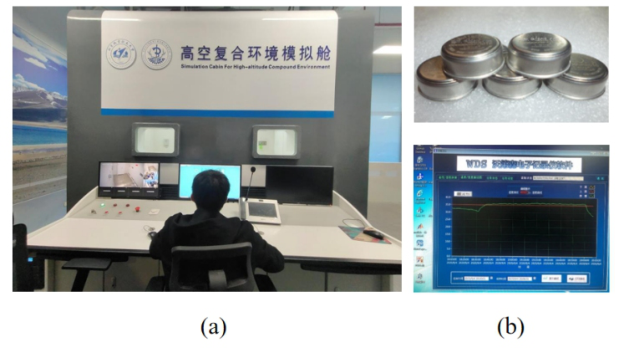
Experimental Platform and Testing Instruments The experiment was conducted in a fully sealed cabin for high-altitude environmental simulation (Figure 1(a)). This chamber can simulate a variety of single environments or composite environments (altitude range: 0∼20,000 meters, temperature range: –40 to 60
C, humidity range: 20∼60
C). It is
Effects of Different Humidity Levels on the Human Body 43
used for aerospace, high-altitude medical research, scientific experiments, and personnel training in related fields. Communication and monitoring systems, including external surveillance equipment, communication devices, and in-chamber temperature and humidity sensors, were used to ensure participant safety and allow interaction with the researchers. During the procedure of the experiments, the local skin temperature were measured by wireless sensors (Figure 1(b)) with 0.1
C accuracy (iButton, DS 1921H, WDS Co.Ltd., Shanghai, China), which were put on the skin surface of forehead, chest, back, upper arm, hand, thigh and calf (Cheng and Chen, 2019). The sensors were set to collect data every 0.5 minutes.
Figure 1: Experimental platform and testing instruments.
Multi-variable monitoring device was used to monitor participants’ blood oxygen levels and heart rate during the experiment. If heart rate exceeded 150 bpm or blood oxygen levels dropped below 85%, the experiment was immediately terminated.
Participants Eight participants (4 male, 4 female, aged 20∼24) with no prior history of medical conditions or high-altitude exposure and BMI values between 18.5 and 23.9 were selected for the study.
Experimental Design To enhance current protective measures and reference standards for specialized work and mitigate risks to human health, this study examined the effects of varying humidity levels on body surface temperature and humidity under high-temperature conditions at simulated high altitude. The experiment was conducted under an altitude of 3000m, temperature of 40
C, with two humidity levels (30% and 60%). Participants sat in a high- temperature chamber at high altitude with two different humidity levels for 40 minutes.
Participants entered the chamber and remained seated for 20 minutes at room temperature to stabilize physiological parameters. The altitude was then gradually increased to 3000 meters, and the temperature was set to 40
C. Once the desired altitude and temperature were reached, the humidity was set to 30% for the initial 40 minutes. Afterward, the humidity was increased to 60% for another 40 minutes. After the whole procedure, the altitude was then gradually decreased to 0m, and once the pressure inside and outside the chamber was equalized, the chamber door was opened to terminate the experiment. The temperature and humidity data from the sensors were then exported.
Data Processing The temperature and humidity of body surface at each measured segment were linearly fitted to time to determine the correlation between these variables and time. Paired T-tests were conducted on the temperature and humidity of body surface at each 5-minute interval compared to the initial values to assess the stability. Independent T-tests were performed to compare the temperature and humidity between male and female groups at each time interval for different ambient humidity levels to identify gender-based differences. Additionally, independent T-tests were used to evaluate the effect of ambient humidity on the temperature and humidity of each body segment for both genders.
RESULTS & DISCUSSION Effect of Different Humidity Levels on Body Surface Temperature in High-Altitude, High-Temperature Environments
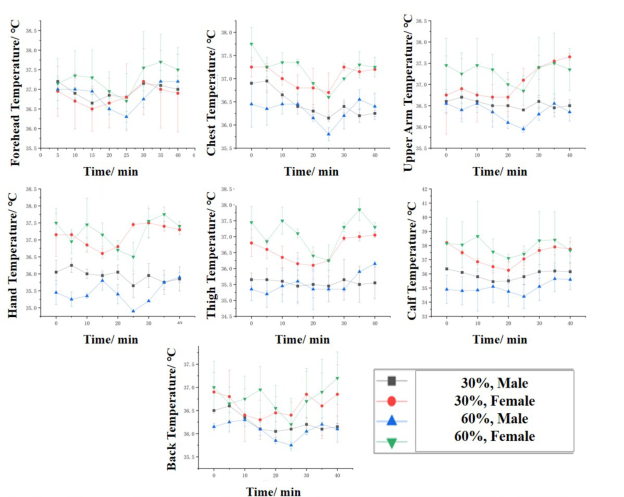
Existing studies suggest that physiological indicators such as skin temperature and humidity may be correlated with subjective thermal responses (Lin et al., 2019; Tian et al., 2018). Moreover, skin temperature and humidity, as critical physiological parameters, can effectively reflect the body’s physiological state. Under the 30% humidity condition, the forehead skin temperature of both male and female participants remained relatively stable over time, with no significant fluctuations. Additionally, independent T-test results showed no significant differences between the male and female participants (p > 0.05). Under the 60% humidity condition, the forehead skin temperature of both male and female participants showed larger fluctuations, either with no significant difference in the trend over time. However, T-test results showed a significant difference in forehead temperature between males and females in the 60% humidity environment (p < 0.05), with female participants consistently exhibiting higher forehead temperatures throughout the test period. Previous studies have shown that there is a significant difference in the baseline body temperature between males and females, with males having a lower baseline body temperature than females (Liu et al., 2004). The findings of this experiment, particularly the significant relationship between forehead temperature and environmental humidity for both genders, are consistent with previous research.
Effects of Different Humidity Levels on the Human Body 45
Figure 2: The experimental results of skin surface temperature (seven segments) in different environmental humidity conditions and different genders.
For the temperature measurements at the chest, upper arm, hand, thigh, and calf segments, the changes exhibited similar trends. Under the 30% humidity condition, male participants’ temperatures decreased over time, showing a linear correlation, while female participants exhibited a decreasing-then-increasing trend, though overall, no significant changes were observed (p > 0.05). Under the 60% humidity condition, both male and female participants showed a decreasing-then-increasing trend in temperature. The changes were more significant compared to the 30% humidity condition (p < 0.01), although the linear correlation with time was low. The temperature changes of male and female participants under different humidity conditions were quite distinct (p < 0.001), with females having higher temperatures under the 60% humidity condition, while males generally had higher temperatures in the 30% humidity condition. The back temperature remained stable over time with no significant differences, though temperature fluctuations were larger in the 60% humidity condition. Throughout most of the experiment, female participants had higher temperatures in the 60% humidity environment, while male participants had higher temperatures in the 30% humidity environment.
Overall, these results suggest that, in different body segments, female body temperature fluctuates more than male body temperature under both 30% and 60% humidity conditions. Furthermore, female body temperature is significantly higher than male body temperature. This could be due to females having a higher initial body temperature and their larger fluctuations in temperature, which may indicate greater heat tolerance in females (Liu et al., 2004).
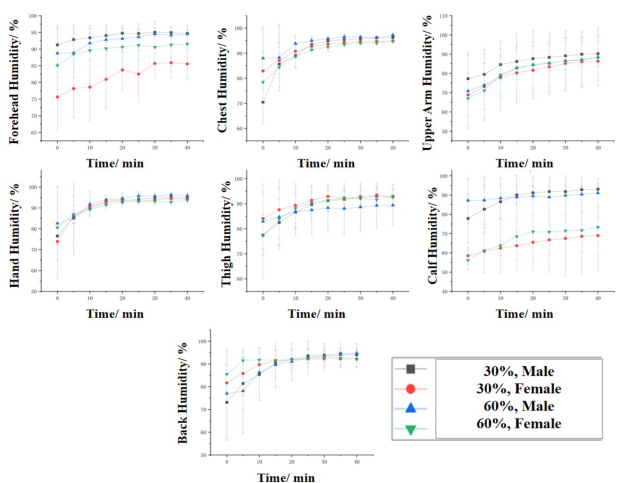
Effect of Different Humidity Levels on Body Surface Humidity in High-Altitude, High-Temperature Environments Data from different measurement segments show that changes in body surface humidity were significantly influenced by the measurement location. The humidity measurements over time showed considerable differences across various body segments, but generally, there was an upward trend in body surface humidity over time. Significant differences were observed between measurements at the forehead and calf (p < 0.01), with male and female participants showing distinct patterns under 30% and 60% humidity conditions. In both environmental conditions, males had higher body surface humidity than females (p < 0.05), with the gender difference being particularly notable at the calf, where males had much higher body surface humidity than females.
Figure 3: The experimental results of skin surface humidity (seven segments) in different environmental humidity conditions and different genders.
Under both humidity conditions, the body surface humidity at the chest, hand, thigh, and back showed minimal gender differences and remained relatively stable, though an upward trend could be observed over time. The increase generally occurred within the first 10 minutes, after which it plateaued. Considering all results of measured segments, it can be concluded that male participants had higher body surface humidity at the 30% humidity condition in almost all time intervals, while female participants exhibited higher body surface humidity under the 60% humidity condition. In general, male participants exhibited a decrease in body surface humidity as external humidity increased, while female participants’ body surface humidity exhibited opposite trend.
Effects of Different Humidity Levels on the Human Body 47
CONCLUSION
In summary, statistical analysis indicated that temperature and humidity levels varied across different body segments over time under two ambient humidity conditions. At 30% experimental humidity, compared to 60%, the change in skin surface temperature at each segment was smaller for both gender groups. Moreover, skin surface humidity showed significant differences based on body segment but was less influenced by experiment changes.
Additionally, gender differences were observed. Females exhibited higher and more variable body surface temperatures compared to males in both ambient humidity conditions. Besides, trends in body surface humidity over time differed between genders. As environmental humidity increased, the skin humidity of males tended to decrease, while female body surface humidity increased.
Overall, the small-sample study in this research suggests that the design of protective clothing should incorporate breathable and moisture- absorbing fabrics tailored to specific body areas, while should also consider gender-specific requirements. Future studies should focus on expanding the sample size, incorporating a broader range of physiological parameters, and exploring the underlying mechanisms of thermal comfort in extreme environments. This will provide more comprehensive data to improve protective measures for high-altitude, high-temperature operational environments.
ACKNOWLEDGMENT
The authors would like to acknowledge all participants for their contribution to the experiments in this study.
REFERENCES
Cheng, P. and Chen, D. (2019) ‘Simulation study on the effect of underwear on thermal reaction of human body based on heat and mass transfer theory’, International Journal of Numerical Methods for Heat & Fluid Flow, 29, pp. 4724–4745. https://doi.org/10.1108/HFF-03-2019-0236 Fiala, D., Lomas, K. J. and Stohrer, M. (1999) ‘A computer model of human
thermoregulation for a wide range of environmental conditions: The passive system’, Journal of Applied Physiology, 87, pp. 1957–1972. https://doi.org/10. 1152/jappl.1999.87.5.1957 Ferreira, M. S. and Yanagihara, J. I. (2009) ‘A transient three-dimensional heat transfer model of the human body’, International Communications in Heat and Mass Transfer, 36, pp. 718–724. https://doi.org/10.1016/j.icheatmasstransf er.2009.03.010 Fukuda-Matsuda, E., Yamada, M., Tanobe, K. and Saito, S. (2007) ‘Peripheral
circulation monitored by surface temperature and autonomic nervous function in hypobaric hypoxic environment: Effects of submaximal exercise’, International Journal of Environmental Health Research, 17, pp. 53–60. https://doi.org/10. 1080/09603120601124215
Kandjov, I. M. (1999) ‘Heat and mass exchange processes between the surface of the human body and ambient air at various altitudes’, International Journal of Biometeorology, 43, pp. 38–44. https://doi.org/10.1007/s004840050114 Kolka, M. A., Stephenson, L. A., Rock, P. B. and Gonzalez, R. R. (1987) ‘Local
sweating and cutaneous blood flow during exercise in hypobaric environments’, Journal of Applied Physiology, 62, pp. 2224–2229. https://doi.org/10.1152/jappl. 1987.62.6.2224 Lai, D. and Chen, Q. (2016) ‘A two-dimensional model for calculating heat transfer in the human body in a transient and non-uniform thermal environment’, Energy and Buildings, 118, pp. 114–122. https://doi.org/10.1016/j.enbuild.2016.02.051 Lin, Y. F., Yang, L. and Zheng, J. (2019) ‘Physiological regulatory responses and
subjective feelings of human body under the threshold of thermal adaptation’, HVAC, 49(12), pp. 7. (in Chinese). Luks, A. M., Ainslie, P. N., Lawley, J. S., Roach, R. C. and Simonson, T. S. (2021) High altitude medicine and physiology, CRC Press. Maximov, A. and Maximova, N. (2004) ‘Individual typological profiles for human
heart rate under local cold and hypoxic exposures’, Journal of Thermal Biology, 29, pp. 809–813. https://doi.org/10.1016/j.jtherbio.2004.08.062 Moraga, F. A., Osorio, J., Jimenez, D., Calderon-Jofre, R., Moraga, D. (2019) ‘Aerobic capacity, lactate concentration, and work assessment during maximum exercise at sea level and high altitude in miners exposed to chronic intermittent hypobaric hypoxia (3, 800 m)’, Frontiers in Physiology, 10. https://doi.org/10. 3389/fphys.2019.01149 Mourot, L. (2018) ‘Limitation of Maximal Heart Rate in Hypoxia: Mechanisms
and Clinical Importance’, Frontiers in Physiology, 9. https://doi.org/10.3389/fphy s.2018.00972 Ohno, H., Kuno, S., Saito, T., Kida, M., Nakahara, N. (1991) ‘The effects of hypobaric conditions on man’s thermal responses’, Energy & Buildings, 16, pp. 755–763. Tannheimer, M., van der Spek, R., Brenner, F., Lechner, R., Steinacker, J. M. and
Treff, G. (2017) ‘Oxygen saturation increases over the course of the night in mountaineers at high altitude (3050-6354 m)’, Journal of Travel Medicine, 24. https://doi.org/10.1093/jtm/tax041 Tanabe, S., Kobayashi, K., Nakano, J., Ozeki, Y., Konishi, M. (2002) ‘Evaluation of thermal comfort using combined multi-node thermoregulation (65MN) and radiation models and computational fluid dynamics (CFD)’, Energy and Buildings, 34, pp. 637–646. https://doi.org/10.1016/S0378-7788(02)00014-2 Tian, G. H., Di, Y. H. and Wang, J. (2018) ‘Experimental study on the thermal
responses of heat-resistant and non-heat-resistant human bodies in a steady-state environment’, Refrigeration and Air Conditioning (Sichuan), 32(2), pp. 6. (in Chinese). Weng, W. G., Han, X. F. and Fu, M. (2014) ‘An extended multi-segmented human bioheat model for high temperature environments’, International Journal of Heat and Mass Transfer, 75, pp. 504–513. https://doi.org/10.1016/j.ijheatmasstransfer .2014.03.091 Weng, W. G., Han, X. F. and Fu, M. (2014) ‘An extended multi-segmented human
bioheat model for high temperature environments’, International Journal of Heat and Mass Transfer, 75, pp. 504–513. https://doi.org/10.1016/j.ijheatmasstransfer .2014.03.091
LISTED IN THE AHFE DIGITAL BOOKSTORE CATALOGUE
Explore the complete digital volume
Physical Ergonomics and Human Factors
Read this individual research paper free through the original publisher, or explore the full digital proceedings book.
ISBN 978-1-964867-61-8
Explore this ISBN in the AHFE Bookstore ↗Listed in the July 2026 bookstore catalogue; search by ISBN to confirm current availability · Digital book purchase optional