De Vere-Michael Kiss (2023). Enhanced User-System Learning Interface. In: Usability and User Experience. AHFE Open Access, vol. 110, pp. 241–253. https://doi.org/10.54941/ahfe1003197
College of Engineering and Computing, Department of Human Centered Design, Florida Institute of Technology 150 W. University Blvd. Melbourne, Florida 32901, USA ↗
This paper describes a new informational navigation tool to augment user learning and/or knowledge transference strategies for complex Human-System-Integrative (HSI) machines. The device is designed to augment a reduction in the amount of time required to navigate machine operating manuals when searching for operational information, including a) systems and systems integration, b) normal operational procedures c) abnormal operational procedures d) emergency operational procedures, and d) machine limitations. The device can be applied to many different domains including Academia (textbooks), Automotive, Aviation, Medical, Nuclear, Space, and any other domain requiring complex Human-Machine-Interaction (HMI). Current methods using paper and digital technologies are challenging to circumnavigate; they can make learning unreasonably problematic and laborious; and can require a large amount of the user’s time. As a result, operators can lose efficiency in time and cognitive development when utilizing current state-of-the-art methods. To improve learning resources, the Enhanced User-System Learning Interface (EUSLI), an Advanced Interactive Media (AIM), was developed. Preliminary tests using professional airline pilots (the users) and aircraft manuals (the knowledge transfer system) as the testing experiment, demonstrated an efficiency increase of 65.5% when compared to state-of-the-art methods. Additionally, results indicate increases in cognitive resources, cognitive compatibility, situation awareness, usability, and enjoyment (an emotive factor); and decreases in user fatigue and workload. This paper describes the qualitative and quantitative data and analysis of the research conducted in association with previous research of the Enhanced Pilot Learning Interface published with AHFE in 2018. The results indicate the current research study verified the findings of the previous experiment, with enhanced formative information to be included in the experimentation's conclusions.
Over the years, machine systems have become more complex as automa- tion allocation has been granted increased authority (Cambell and Bagshaw, 1992; and Boy, 2012). The goals were to decrease the number of required users, lessen user workload and enhance safety (Hawkins, 1997; and Boy, 2012). During this human-system-integration (HSI) evolutionary maturing,
the user-role has shifted from manual operator to one of a manager of systems and automation (Boy, 2012).
While automation was intended to reduce user workload and enhance safety, there is a caveat (Cusick, Cortes, and Rodrigues, 2017). Complex machine systems such as aircraft, spacecraft, nuclear power plants, subma- rines, etc., require a deep knowledge and understanding of their operations during many different operational conditions including: nominal (normal) and off-nominal (abnormal or emergency) situations (Salas and Maurino, 2010). In this study, comercial airline pilots and their machine interactions were used as the experimental subjects.
Currently, commercial aircraft require a well-trained and competent crew for enhanced safety. For such a crew to be qualified in operating such a complex machine, they must possess significant and specific: education, expe- rience, and training (Ericsson, Krampe and Tesch, 1993; Hawkins, 1997; Dismukes, 2010; Salas and Maurino, 2010; and Cusick, Cortes, and Rodri- gues, 2017). Therefore, a great number of training hours must take place before any pilot can participate as a flight crew member. With that in mind, the same can be said about any operator interfacing with a complex mach- ine. From this point forward in the paper, a pilot is considered a user and an aircraft is considered a complex machine and the terms are interchangeable as examples for the research.
In today’s airline industry, current paper and digital (PDF) knowledge transference methodologies are complex and ardous to navigate. This is the case with most industries as knowledge transference methods are based on paper and/or PDF format (s). These formats can make it difficult for users to find system information, neadlessly increasing the time required to accom- plish individual tasks when users seek to resolve specific “what-if” questions they ask themselves after anticipating problem scenarios during their systems training.
Therefore, the primary research question that guided this research was, “What if we can reduce the complexity of navigating complex machine manu- als? Could reducing the navigational complexity reduce the time it takes a candidate to find system information? If so, could the extra time gained be available for the student to learn their procedures?”
Note: The research hypothesis was: Can time be reduced for the user to find system information, and, if true, could this result in a higher quality learning experience? Thus, the goal of the research was to prove the concept. For this research, airline pilots (users) were the Research Subjects (RSs) and are considered expert users.
Current Information Transference Methods When utilizing paper and PDF methods to find information in an complex manual, students must identify a potential scenario and then sort through many different areas of the manual to find the desired information to solve the specific situation.
Note: in the context of this manuscript, PDF is synonymous with the terms Electronic Flight Bag (EFB), and vice versa.
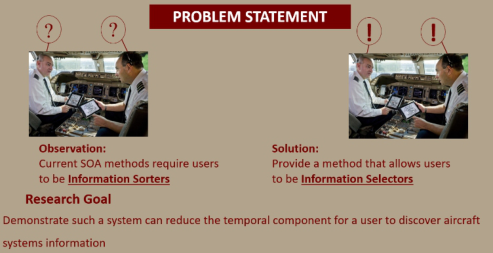
Problem Statement Using current technologies, pilots act as information sorters (Connor, 1985) and they must sort through a plithura of material to find the desired infor- mation within a specific context of a “what if” scenario. Thus, searching for information using current methods is tedious, time consuming, and dimi- nishes cognitive resources. Additionally, when an individual is navigating numerous pages to find information, cognitive fatigue can be increased redu- cing user motivation. This can lead to frustration because it takes mental resources to locate the system information (Nielsen, 1993; and Nokes, 2010). Therefore, finding information under current state of the art methods is less then desirable.
Problem Solution A more desirable method would be to design a sysetm which would allow a user to select the desired information, and, therefore, finding information could became a more enjoyable experience. Can user motivation be increa- sed by decreasing the complexity of navigating machine operating manuals? Accordingly, a solution would be to design a navigational platform to aid the user in selecting the needed information, see Fig. 1.
Figure 1: Research Goal (Kiss, 2018).
CONCEPT, DESIGN AND PRESENTATION EUSLI Concept
Currently, trainees must spend more time and dedicate themselves to learn the deep declarative knowledge of an aircraft’s systems, systems integration, limitations, procedures, performance and warnings (Hawkins, 1997). This is needed to transition to simulator training. Without that knowledge, trainees would not be able to perform adequately during their simulator training.
Using today’s newest technologies, current infermation transference meth- odologies can be enhanced (Boy, 2012). Different design options were considered and the following were applied to enhance current state of the art methods: – Reduced the complexity of navigating manuals, – Applied natural affordances for ease of navigation,
244 Kiss
– Utilized visualization, – Integrated accelerators (icons vs. tabs or indexing), – Linked contexual information to inputs (I.e., icons on a tablet face), – Added the right amount of granularity into current technologies, and – Provided efficient navigation.
These utilized methods created a new platform enhancing user naviga- tion of complex machine manuals. For this project, Integrated Navigational Documents (INDs) were developed. INDs integrate static paper into digital documents, simplifying user interaction.
EUSLI Design Designing EUSLI required the integration of the following concepts:
– A proper input system (Tactile touchscreen), and – Symbol representation (Familiar system icons) which incorporated:
Associated language (Aircraft manual) embedded within,
Contextual links (mind mapping) to,
Inspire the desired system actions, and
Reduce the complexity of current navigation methods.
The design goal was to accelerate user-system interaction and enhance the user experience. When the interaction style is easy, access to meaningful infor- mation can be facilitated (Boy, 2011). Integrated Navigtional Documents (INDs) were developed using Integrated Objects (IOs) as symbolic icons, and Integrative Discriptors (IDs) (diagrams) in combination with Computer Integrated Documents (CIDs) (Kiss, 2018).
The INDs contextually link the different domains of study and change sta- tic documents into dynamically changing system information needed during evolutionary dynamic changes which occur during cognitive scenarios of dif- ferent conditions engendered by “what if” questions users consider during systems integration study. I.e., INDs make available a dynamically context sensitive plan, engendering the user with quick answers for apposite “what- if” scenarios, providing the user with a sense of control of their study time, augmenting their attitude and motivation for learning (Novak, 2011 and Kiss, 2018).
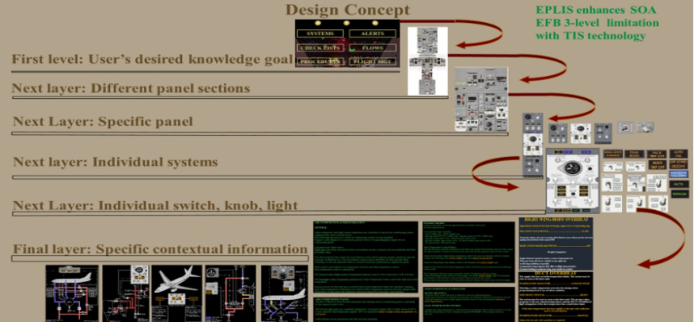
EUSLI Presentation For Presentation, an interactive touchscreen tablet, the MS Pro 3, was utilized with contextual links via recognizable visual icons, IOs, and IDs of virtual system schematics, and systems controls and indications; along with other operational documentation; i.e., the CIDs. This allows the user to select speci- fic information. The system was envisioned to afford operators with intuitive recognition of easily identifiable symbols. Therefore, agents are afforded with intuitive actions to navigate the system through useful visual ques, reducing system complexity and enhancing user awareness of the systems, systems operations, task operations, and checklist usage. The use of familiar icon sym- bology was intended to deliver transparency for the user. EUSLI is superior to
other contextually linked devices. SOA devices are limited to a maximum of three contextually linked levels. EUSLI has no limitations as it incorporates a circular prolongation of interlinking with no limit. The user can continually navigate the device without having to reacquire the index page, see Fig. 2.
Figure 2: The multiple levels of EUSLI’s INDs (Kiss, 2018).
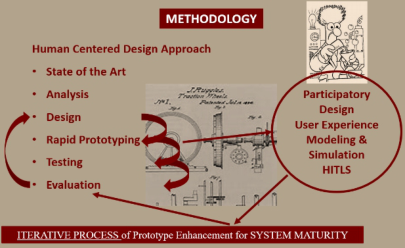
TESTING METHODS Human-Centered Design (HCD) research is an iterative process using experts with modeling, and simulation. This Human-in-the-Loop-Simulation (HITLS) process affords discovery of the human and machine interaction anomalies and incorporates iterative redesigning of the artifact to address irregularities discovered during the process, see Fig 3.
Thus, HITLS was utilized for the testing of EUSLI. Pilots (the users) were tested using the device during specific scenarios to accomplish the HITLS. The primary research question was to explore the relationship between pilots finding system information using EUSLI and compare those findings with the results of traditional paper and PDF formats. Thus, the research project was conducted to compare current knowledge transference methods with EUSLI. HCD typically works with 6 to 9 expert users. However, 38 pilots were tested to augment research validity.
The targeted pilot population was FAR Part 121 Commercial Airline pilots (CAs), and FAR parts 91 and 141 General Aviation pilots (GAs). The pri- mary research question which guided the study was, whether a pilot could conserve the resource of time using the EUSLI when compared to current knowledge transference methods, and to enhance cognitive resources as well as emotional attributes.
The research study was conducted from August 16, 2018, through Septem- ber 26, 2018, at the Florida Institute of Technology’s College of Engineering and Sciences Department of Human Centered Design, and the College of Aeronautics Buhler Aviation and Research Building located at the Melbourne Airport, providing the data set from which to draw.
246 Kiss
Figure 3: HCD process for mature design (Kiss, 2018).
Quantitative Results For the quantitative portion of the study, I examined the effect that EUSLI had on finding aircraft system information and compared the time differences with SOA methods. The results, on average, were:
– 20.23 minutes to retrieve information using the paper format, – 21.65 minutes to retrieve information when using the EFB method, – 7.74 minutes to retrieve information using EUSLI.
Therefore, on average, EUSLI is 63% faster when compared to the average of the paper and EFB methods.
Qualitative Results Qualitative testing was used because quantitative analysis does not provide a determination of acceptable performance levels by the user (Casner and Gore, 2010). Measuring speed does not consider the operator’s account of the workload or measure the user’s assessment of the system. Casner and Gore explain that the operator’s feeling of high workload or low workload is negated when measuring performance alone, and, therefore, it is beneficial in measuring the user’s evaluation of a system. The qualitative assessment methods used were System Usability Scale (Usability), CC-SART (Cogni- tive Comaptibility), Modified NASA-TLX (Workload), and Self-Assessment Manikin (Emjoyment).
Usability Research Subjects (RSs) were provided with the System Usability Scale (SUS) rating questioner. SUS delivers an easy-to-understand score from 0 (negative) to 100 (positive) (Bangor, Kortman and Miller, 2009; Brooke, 2013; Lebson, 2014; and Brooke, 2018). The following specifies SUS scores:
– 90-100: Acceptable, A, Excellent: Exceptional Usability – 80-89: Acceptable, B, Good/Excellent: Good Usability – 70-79: Acceptable, C, Good: Acceptable Usability – 60-69: High Marginal, D, OK, Cause for Concern – 50-59: Low Marginal, F, OK, Cause for Concern
– 40-49: Not acceptable, F, Poor, Not Usable The SUS Scores were:
– EUSLI 92.37 – Paper 37.83 – PDF 37.24 When measuring usability, EUSLI was rated very high. This qualitative measure was determined by the users’ performance measure and is positive towards EUSLI as a system information retrieval method. Therefore, the SUS qualitative measure supports the quantitative data supplied in the research.
NASA TLX (Task Load Index) The RSs were also provided with the NASA TLX questionnaire. The determi- nation of workload is different for different people (Casner, 2010). I.e., what is considered low workload to a highly skilled individual may be considered high workload to a novice. The NASA TLX is a multi-dimensional subje- ctive workload assessment method (Gawron, 2004). According to Gawron, Workload is defined as the “cost incurred by human operators to achieve a specific level of performance” including Mental, Physical, and Temporal demands, and Performance, Effort, and Frustration Levels (Gawron, 2004).
A study conducted by Hart and Staveland determined the NASA TLX is a good indicator of overall workload (Hart and Staveland, 1987). The study also determined that each of the NASA TLX dimensional magnitudes pro- vided valuable diagnostic information about task loading sources (Hart and Staveland, 1987), see table 1. They reported that the NASA TLX scale is use- ful in operational environments similar to the testing milieu of EUSLI, i.e., establishing working scenarios in combination with HITLS to test the infor- mation retrieval times. Essentially, the RS answers the questions on a rating sheet. The lower the number, the less workload required.
The NASA TLX results for the three information retrieval methods were: – EUSLI 17.80 – EFB 63.65 – Paper 70.83
Therefore, EUSLI required very low workload in terms of cognition, physical, time, effort, and frustration levels when rated by the users.
CC SART: Cognitive Compatibility Rating Taylor suggests that it is difficult for a designer to sustain focus on the needs of the human user when a system possess high levels of complexity in system functioning (Taylor, 1996). This is due to a gulf in the knowledge gap betw- een the designer and the user. Therefore, the associated cognitive functions and processes can be more difficult to define than physical tasks and, as a result, they can change more rapidly during changes of the operational environment (Taylor, 1996). Consequently, there was a need to test cogni- tive quality. Cognitive compatibility (CC) refers to the ease of perceiving,
248 Kiss
Table 1. NASA TLX Rating-Scale Descriptions (Hart and Staveland, 1987).
Table available in the original PDF paper.
Title Endpoints Descriptions Mental Demand Low, High How much mental and perceptual activity was required (e.g., thinking, deciding. calculating, remembering, looking, searching, etc.)? Was the task easy or demanding, simple or complex, exacting or forgiving? Visual Demand
Low/High How much visual activity was required to process the visual scene (Clustering effects, visual cues, relative size, etc.). Physical Demand
Low, High
How much physical activity was required (e.g., pushing, pulling, turning, controlling, activating, etc.)? Was the task easy or demanding, slow or brisk slack or strenuous, restful, or laborious? Temporal Demand
Low, High
How much time pressure did you feel due to the rate or pace at which the tasks or task elements occurred? Was the pace slow and leisurely or rapid and frantic? Performance Good, Poor
How successful do you think you were in accomplishing the goals of the task set by the experimenter (or yourself)? How satisfied were you with your performance in accomplishing these goals? Effort Low, High
How hard did you have to work (mentally or physically) to accomplish your level of performance? Frustration Level
Low, High
How insecure, discouraged, irritated, stressed, and annoyed versus secure, gratified, content, relaxed, and complacent did you feel during the task?
the ease of thinking and doing, and a user’s experience, training, and expe- ctations (Taylor, 1995). In pursuit of finding a way to measure CC, Taylor developed the CC-SART using the following working model (Taylor, 1995): CC = AoK + EoR – LoP Where: AoK = Activation of Knowledge EoR = Ease of Reasoning LoP = Level of Processing CC rating scores are between 0 – 100. The larger the number, the better the CC. The research CC Cognitive Compatibility Results were:
– EUSLI 92.40 – Paper 57.75 – EFB 44.44 The CC-SART results for EUSLI were exceptional indicating that the cognitive compatibility of EUSLI is significantly superior to the paper and EFB retrieval formats. Additionally, it should be noted that the CC for paper manuals, once again, was rated superior to the EFB manual.
Self-Assessment Manikin (SAM) Another area of interest was whether EUSLI was more enjoyable to work with when compared SOA methods. Because it is difficult to evaluate how people
feel when interacting with a device (Bradley, 1994), the Self-Assessment Manikin (SAM) measured the research subjects’ level of enjoyment using EUSLI and the paper and EFB methods. SAM directly assesses the following three dimensions of a person’s response to an act, object, or event (Bradley, 1994).
– Pleasure, – Arousal, and – Dominance.
To measure enjoyment using SAM, I simply added the scores for Ple- asure (1-9), Arousal (1-9) and Dominance (1-9) and divided the total by 3. The following is an example: Pleasure (6) + Arousal (4) + Dominance (7) = 17/3 = 5.67. SAM was applied to all 38 users. The scores for paper, EFB and EUSLI were than totaled and divided by 38 (n = 38) for an average enjoyment score of each method. The rating score can be from 0 – 9. The larger the number, the more enjoyable the system is for the user. The results were: – EUSLI 8.20 – EFB 4.15 – Paper 3.78
The results indicate EUSLI is much more enjoyable to work with when compared to the paper and EFB methods.
FUTURE APPLICATIONS There are many possible future projects that can be applied to EUSLI. I restricted the research to the training application. There were several other potential innovations considered through the observation of the testing subjects interacting with the device.
Flight Station Use Many of the CAs involved in the research felt, very strongly, that EUSLI should be utilized in the flight station for normal, abnormal, and emerge- ncy operations. I agree with those pilots. However, developing research for that application, would have been expensive. It would have required renting simulators, hiring flight crews and developing scenarios for HITLS during normal, abnormal, and emergency operations. This was beyond my resou- rces. However, it is possible to generate grant oppotuinites for such reserch and report the results of those potential future experiments.
Potential Use for Operational Checklists and Onboard Context-Sensitive Information System (OCSIS) Additionally, it should be noted that the airlines are currently looking for a way to replace the paper version of the Quick Reference Handbook (QRH). The QRH holds the normanl, abnormal, and emergency checklists. The infor- mation is retrieved much faster with the paper format than with the EFB. During an emergency, the flight crew must have the ability to retrieve the
250 Kiss
information as soon as possible. Hence, EUSLI could be a potential repla- cement for the QRH. In fact, RSs were able to retrieve the EUSLI QRH checklists in mere seconds, on average, when compared to the other two methods which took tens of seconds to minuets. Therefore, there are two potential research projects in this regard. One for training, the other for replacing the QRH.
EUSLI could also be tested as an Onboard Context-Sensitive Information System (OCSIS) which could also be used to display useful information for operators when they need the right information at the right time. Context- Sensitivity information, via appropriate operational information, can be used to solve current issues in real time. EUSLI could be utilized in this area.
Linking EUSLI to Warning Systems Additionally, one of the projects considered was linking EUSLI directly to the warning systems of the machine. If EUSLI was linked to the warning systems, checklists could be activated and ready to use before the users could physically pick up and handle EUSLI. In other words, the agent could grab EUSLI and immediately run the necessary checklists instead of attempting to retrieve the checklists, saving valuable seconds. Another research project could test that application.
Augmented Reality I used a tactile tablet for this research. However, the application I most desi- red was using EUSLI in the capacity of augmented reality so the users could wear glasses and use the associated aircraft flight station in combination with panel posters to learn systems and, at the same time, develop the muscle pro- prioception (muscle memory) for switch, lever, and button location. This is a very important aspect of training and one that many pilots use. This is to instill natural and automatic actions to enhance resilience and robustness against unstable situations.
Voice Recognition, Activation, and Response Work is underway to incorporate EUSLI as a voice recognition, activation, and proper response for a single-pilot application. The goal is to utilize EUSLI as a tool to assist pilots with the ability to ask pertinent questions during abnormal and emergency scenarios with the intent for EUSLI to give voice commands for situation resolution during unstable events. The user could call for actions and EUSLI will accomplish the requested procedures.
Domains Beyond Aviation In addition to aviation, there are many other domains that could benefit from a device like EUSLI. The following lists a few of those domains:
– Automobiles, – Medicine, – Textbooks, and – Any domain requiring a complex manual.
CONCLUSION
The main objective of this project was to determine if it is possible, using recent technologies, to improve current knowledge transference methodolo- gies. The research indicates that it is possible to simplify the complexity of navigating system information in a manual and, therefore, the resource of time can be preserved. While EUSLI saves the user a substantial amount of time, the qualitative results suggest that cognitive resources can also be enha- nced. Thus, it can be concluded that the quantitative and qualitative methods present enough significant data to verify that EUSLI is superior to the paper and PDF manuals and, therefore, users gain a learning advantage. Further, the qualitative and quantitative results of this research indicate that current knowledge transference methodologies of complex machine manuals are: – Tedious, – Time-consuming, – Less enjoyable to work with, – Promote negative motivation and attitude, and – Demoralize the user.
Conversely, the research indicates that EUSLI is superior to Paper and EFB methods as the: – SUS results rate EUSLI remarkably high in usability acceptance, – NASA TLX results rate EUSLI with low workload, – CC SART results show EUSLI has a high cognitive compatibility, – SAM results indicate that EUSLI is enjoyable for the user, – Quantitative results specify that EUSLI dose indeed reduce the time it takes a user to retrieve specific information when compared to the traditional methods as the RSs required 63% less time to retrieve information.
In the HITLS study, the RSs clearly preferred using EUSLI over the other two methods. Many of the RSs stated that they wished EUSLI was available for current training. One individual, who was retired, stated, “I wish this EUSLI had been available during my career. It would have made learning the different aircraft I flew much more enjoyable and simpler.”
When I started this project, my intent was to find a better way to make system knowledge transference methods more efficient, comfortable, and, ultimately, safer for the industry. I did not realize the full implications of what EUSLI might possibly achieve. The feedback and results of the research were beyond my expectations. The response of the research subjects has been very positive and provided additional motivation, on my part, to continue working on EUSLI.
252 Kiss
REFERENCES
Bangor, A., Kortum, P., and Miller, J. Determining what individual SUS scores mean: Adding an adjective rating scale. Journal of usability studies, Vol. 4, Issue 3, May 2009, pp. 114–123. Boy, G. A.: Cognitive Function Analysis. Ablex Publishing corporation, London, UK
(1997). Boy, G. A. The handbook of human-machine interaction: A human-centered approach. Ashgate, Burlington, VT, 2011. Boy, G. A. What do we mean by human centered design of life critical systems?
Lansdale, PA, IOS Press, 2012. Bradley, M. M., and Lang, P. J. Measuring emotion: The self-assessment manikin and the semantic differential. Journal of Behavior Therapy and Experimental Psychology. Vol. 25, No. 1. Pp. 49-59, 1994. Brooke, J. SUS A retrospective. Journal of Usability Studies. Vol. 8, Issue 2, February
2013 pp. 29–40. Brooke, J. SUS – A quick and dirty usability scale. Redhatch Consulting Ltd., Early, UK. Retrieved from: www.usability.gov/how-to-and-tools/methods/system- usability-scal.html. August 2018. Campbell, R. D., and Bagshaw, M.: Human Performance and Limitations in Aviation.
BSP books: Oxford, England (1992). Casner, S. M., and Gore, B. F. Measuring and evaluating workload: A primer. NASA, San Jose, CA, 2010. Connor, C. R. Human Performance Capabilities; What are the Operational Capa-
bilities. Technical Report, SAE Aerotech, Long Beach, CA. October 14–17, 1985. Cusick, S. K., Cortés, and Rodrigues C. C.: Commercial Aviation Safety. McGraw Hill, New York, NY (2017). Dismukes, R. K.: Understanding and Analyzing Human Error in Real-World Ope-
rations. In Salas, E. and Maurino, D. eds. Human Factors in Aviation. Academic, San Diego, CA (2010). Ericsson, K. A., Krampe, R. T., and Tesch-Romer, C.: The role of deliberate practice in the acquisition of expert performance. Psychological Review 100, 363–406 (1993). Gawron, V. Psychological factors expectation. In Previc, F. H., & Ercoline, W. R.
(Eds.), spatial disorientation in aviation. American Institute of Aeronautics and Astronautics, Inc.: Reston, VA, 2004, pp. 145–195. Hart, S. G. and Staveland, L. E. Development of NASA TLX (Task Load Index): Results of empirical and theoretical research. In P. A. Hancock and N. Meshkati (Eds) Human mental workload. Amsterdam: Elsevier; 1987. Hawkins, F. H. Human factors in flight. 2nd Edition. Ashgate Publishing: Burlington,
VT (1997). Hollnagel, E., Woods, D., and Leveson, N.: Resilience Engineering: Concepts and Precepts. Ashgate, Burlington, VT (2010). Kiss, D. M.: Enhanced Pilot Learning Interface. Springer, AHFE 2018 Conference
[ISBN: 978-1-5323-8203-1] (2018). Lebson, C. Usability: What a project manager needs to know – Part 1. Lebsontech LLC, 2014. Nielsen, J.: Usability Engineering. Academic, San Diego, CA (1993). Nokes, T. J., Schunn, C. D., & Chi, M. T. H.: Problem Solving and Human Expertise.
Novak, J. D.: A Theory of Education: Meaningful Learning Underlies the Constructive Integration of Thinking, Feeling, and Acting Leading to Empowerment for Commitment and Responsibility. Aprendizagem Significativa em Revista/Mea- ningful Learning Review-V1 (2). Pp. 1–14 (2011). Salas, E., and Maurino, D.: Human Factors in Aviation. 2nd Edition. Academic: San
Diego, CA (2010). Taylor R. M., Shadrake, R., Haugh J., and Bunting, A. “Situational awareness, trust, and cognitive compatibility”. In “Situation Awareness: Limitations and enhance- ment in the aviation environment”. AGARD Conference Proceedings. (AGARD, Neuilly-sur-Seine), April 1995. Taylor, R. M. Cognitive compatibility: A conceptual Framework for cognitive quality
in advanced crew system design. DRA Center for Human Sciences. Farnborough, HANTS GU14 6SZ, 1996.
LISTED IN THE AHFE DIGITAL BOOKSTORE CATALOGUE
Explore the complete digital volume
Usability and User Experience
Read this individual research paper free through the original publisher, or explore the full digital proceedings book.
ISBN 978-1-958651-86-5
Explore this ISBN in the AHFE Bookstore ↗Listed in the July 2026 bookstore catalogue; search by ISBN to confirm current availability · Digital book purchase optional