Masaaki Kurosua, Seiji Hayakawab, Sachi Mizobuchib, Darold Davisb, Masaya Andoc (2022). Certification of HCD Professionals in Japan. In: Advances in Ergonomics In Design, Usability & Special Populations: Part I. AHFE Open Access, vol. 18. https://doi.org/10.54941/ahfe100787
The certification program of HCD-Net started for responding to the demand of the society for the usability professionals who have a certain level of skills and knowledge. A competence model was first established and the framework for assessing the expertise was then formed. The program that started in 2009 has been recognized as the unique system and more than 300 professionals are now playing the leading role in the area of HCD
While products/systems/services in our society have been advancing rapidly with increasingly complex user interfaces, we had not sufficient number of HCD specialists who have skills of designing products/systems/services to provide good experiences to users. Human Centered Design Organization (HCD-Net) was established in 2005 to bring the concept (and process) of human-centered design to product/system/service development.
This article addresses activities of the organization, particularly focusing on the certification system of HCD specialist. Our goal is to achieve the following objectives under six activity domains detailed below. (1) To change the product/system/service development process from product-centered to human (user)-centered. (2) To change the product/system/service development process from the problem solving to the attractive experience creation. (3) To accomplish customer satisfaction while at the same time reducing the company's cost of reworking.
ACTIVITY OF HCD-NET HCD-Net has six activity domains as follows.
[HCD Survey & research] In addition to fundamental survey and research related to HCD, HCD-Net conducts research studies to raise the efficiency of system implementation and quality of use. It also holds an annual workshop to discuss human-centered design, and publishes journals once or twice a year.
[Education] HCD-Net provides lectures, seminars, and workshops to help the audience gain knowledge of HCD and to exchange their experience and practice, as well as publishing textbooks and reference books. HCD-Net is also organizing and constructing the HCD Body of Knowledge, which is necessary to put HCD into practice.
[Public relations] Ergonomics In Design, Usability & Special Populations I (2022)
HCD-Net provides various events to learn about HCD including "HCD-Net salon" (a meeting for both members and non-members) approximately once a month and special events for supporting members. It performs the PR activity to mass media, communicates with related organizations, and constructs the human resources network.
[International activity related to HCD] HCD-Net shares the information about the organization to audiences outside of Japan. This activity includes performing the international PR activity through the website and serving as a window on HCD communities in Japan.
[Development] The main activity is to collect information of development tools and methods related to HCD and provide them to members, and to investigate and design HCD of social infrastructure system. HCD-Net also organizes several special interest groups (SIG), including Kansei SIG, Sci-Fi movie SIG (leaning user interface ideas from Science Fiction movies), method-developing SIG.
[Standardization/Certification] HCD-Net develops HCD-related standards, participates in the process of HCD-related standardization, certifies HCD specialists, and product/system/service, which are designed by HCD.
In addition to above activities in six domains, HCD-Net has a general symposium (HCD-Net forum) once a year under a particular theme.
CERTIFICATION OF HCD SPECIALISTS In 2004, a major number of Japanese ministries and agencies developed electronic application systems on their websites. As problems arose due to poor usability of the systems, a guideline was formulated to develop websites, which are easy to use/understand for users. However, although this guideline instructed to have usability specialists in the design process, there was no certification system for usability professionals at that time. This motivated HCD- Net to establish a certification system for the specialist.
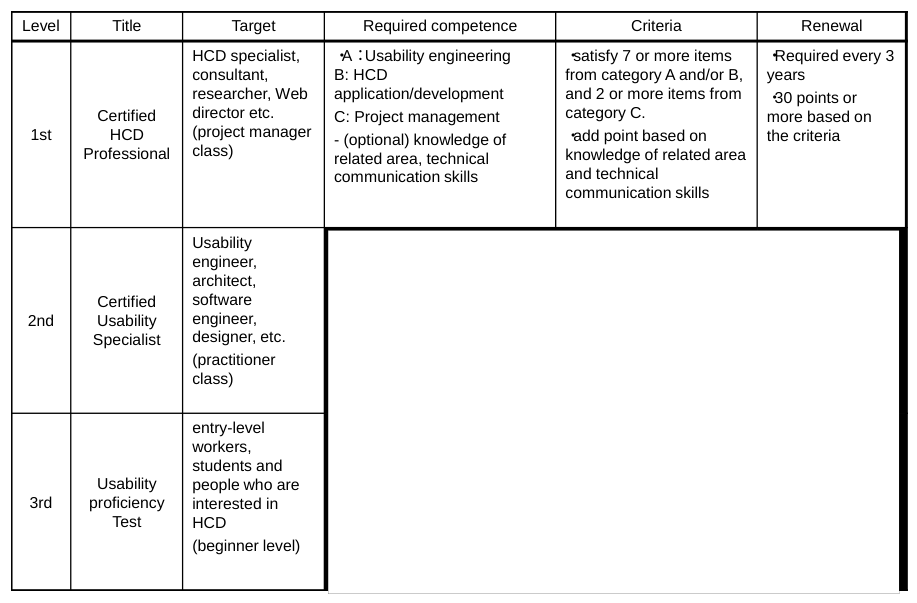
Goals of developing the certification system are; 1. To establish a system to certify professionals who can carry out the human-centered design process in product/system/service development in practice 2. To clarify a necessary set of competences for the professional 3. To set clear activity goals for people who develop the specialty 4. To educate people who want to use the professional’s specialty We designed three levels of specialists in our certification system (however, only the first level has been exercised so far). Target of the first level (HCD specialist) is assumed for project managers, web producer and consultant, with experience of 5 years or more of practice in the HCD field, who can play a role in leading other people. The second level, a usability specialist (temporary title), is assumed for system engineers, designers and marketing researchers who have experience of 3 years or more, and who can create requirement specification, user interface specification and can conduct usability tests. The third level is assumed for entry-level workers, students and other people who are interested in HCD.
Ergonomics In Design, Usability & Special Populations I (2022)
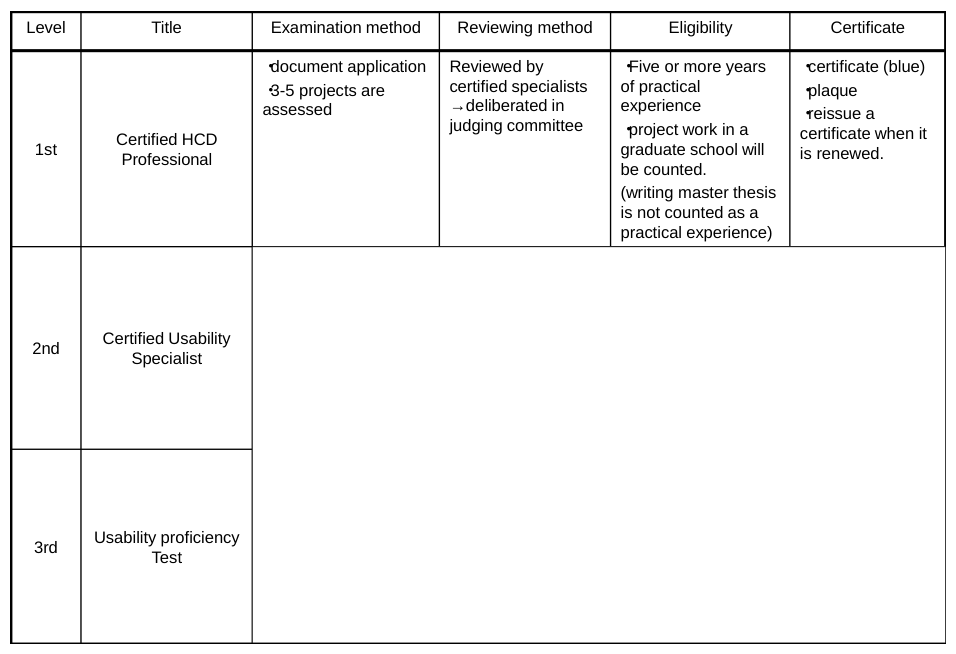
Table 1. HCD specialist certification system (draft) Part 1 Level Title Target Required competence Criteria RenewalTable 2. HCD specialist certification system (draft) Part 2
Table available in the original PDF paper.
Ergonomics In Design, Usability & Special Populations I (2022)
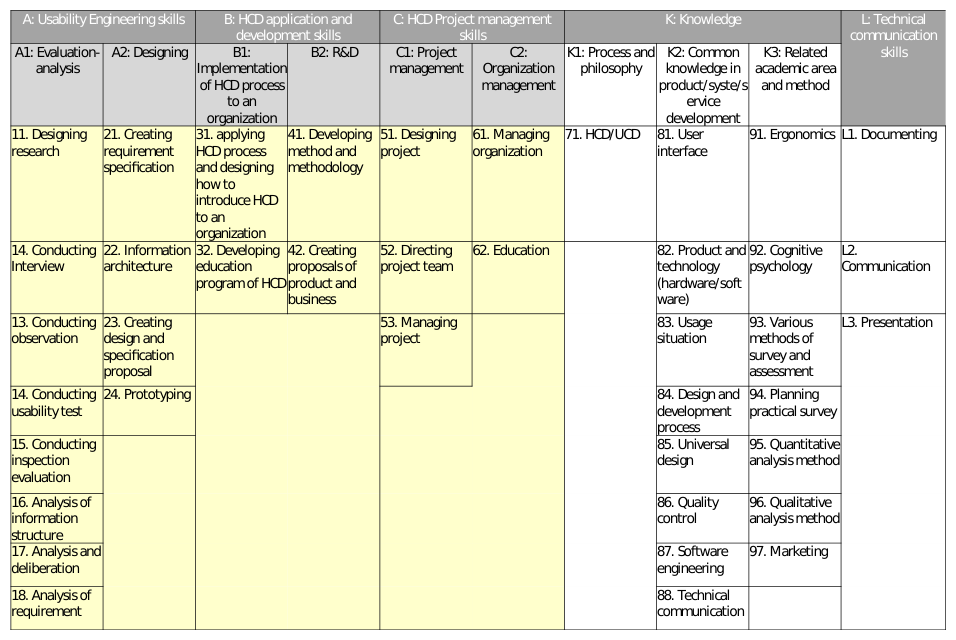
Table 3. HCD specialist certification system (draft) Part 3.
Ergonomics In Design, Usability & Special Populations I (2022)
Most of the requirements for human systems integration are derived from requirements for performance, efficiency, environmental, operational, maintenance, and training (see Table 1). Some will be buried in mechanical and electrical requirements. One of the obstacles to realizing the substantial potential of HSI is the lack of clear articulation of human engineering requirements in the Statement of Work (SOW) or other authorizing documentation received from the customer, and the lack of an HSI software or the architecture framework to track requirements changes.
The first level and second level are assessed based on application documents which mainly describe the past record of applicants while the third level will be assessed by a proficiency test. The application document consists of an application sheet which describes educational and work history, a practical activity sheet which describes past projects that the applicant worked on and her/his competence in the projects, appendices which indicate educational records, published papers, books, creation and output. This structure was designed based on the JES (Japan Ergonomics Society) Certification Program for Professional Ergonomist, which had been working in practice prior to our system. Competence, which is the main object of judgment, is divided into 3 categories with detailed subcategories in each competence area.
[Usability Engineering] competence of research, analysis and design [HCD application and development] competence to apply and drive the HCD process in an organization
[HCD project management] competence to manage an HCD project and to develop an HCD-conscious organization Knowledge of the (HCD) process, philosophy, methodology, academic knowledge of related areas, technical communication skill are also considered as a general competence. These knowledge areas and skills are assessed while to form a part of the total score. Based on a certain criteria, reviewers judge whether the application documents prove that the applicant's competences were exercised in practice. We have already issued certificates for 222 HCD specialists (the first level) as of 2011 with a large number of practitioners and web creators. We are currently planning to start the second and third level certification within the next year (2013).
Ergonomics In Design, Usability & Special Populations I (2022)
POSITIVE EFFECTS OF CERTIFICATION SYSTEM Number of HCD-Net members grown rapidly maybe for the reason that the annual certified membership fee (12,000 JPY) is equal to the annual HCD-Net membership fee. In 2009, most of the applicants were HCD-Net members. Since 2010, those who weren’t HCD-Net members became certified members, thus became HCD-Net members. In the future, the renewal fee will support HCD-Net financially.
CONCLUSION
The certification program of HCD-Net started for responding to the demand of the society for the usability professionals who have a certain level of skills and knowledges. A competence model was first established and the framework for assessing the expertise was then formed. The program that started in 2009 has been recognized as the unique system and more than 300 professionals are now playing the leading role in the area of HCD.
In 2014, the revised certification system based on a new competence model was established of which the detailed information will be introduced at the conference.
400
350
300
250
Member
200
Certified Pro
150
100
50
0
2006 2007 2008 2009 2010 2011
Figure 1. Growth of HCD-Net Members and Certified Professionals
Figure available in the original PDF paper.
REFERENCES
Kurosu, M., Mizobuchi, S. Davis, D. and Hayakawa, S. (2013) “Human Centered Design and Certification System of the HCD Specialist” Document Submitted to the Board of UXPA
Ergonomics In Design, Usability & Special Populations I (2022)
LISTED IN THE AHFE DIGITAL BOOKSTORE CATALOGUE
Explore the complete digital volume
Advances in Ergonomics In Design, Usability & Special Populations: Part I
Read this individual research paper free through the original publisher, or explore the full digital proceedings book.
ISBN 978-1-4951-2106-7
Explore this ISBN in the AHFE Bookstore ↗Listed in the July 2026 bookstore catalogue; search by ISBN to confirm current availability · Digital book purchase optional