Martina A. Clarke, Lisa L Neitzke, Kathryn M Cooper (2023). Usability of Documentation Software Used by Direct Support Providers: A Proof-of-Concept Study. In: Human Factors in Aging and Special Needs. AHFE Open Access, vol. 88, pp. 153–160. https://doi.org/10.54941/ahfe1003672
Direct support professionals (DSPs) face high levels of stress and burnout while providing care for individuals with intellectual and developmental disabilities (I/DDs). This paper examines the usability challenges associated with documentation software used by DSPs. A proof-of-concept study surveyed six DSPs to assess the subjective usability of the software using the Usefulness, Satisfaction, and Ease of use (USE) Questionnaire. Results showed that DSPs rated the software neutrally or negatively across dimensions of Usefulness (mean = 4.12; SD = 2.66), Ease of use (mean = 3.65; SD = 2.17), Learnability (mean = 3.46; SD = 2.52), and Satisfaction (mean = 2.75; SD = 1.50). Addressing usability issues is crucial to improve DSPs' well-being and the quality of care provided to individuals with I/DD. User-centered design principles and usability testing are necessary to improve health information technology (HIT) systems, reduce cognitive load, streamline workflows, and increase user satisfaction. By recognizing the significance of HIT usability and its impact on burnout, organizations can prioritize the design and implementation of systems that support DSPs. Future research include larger sample size and qualitative data collection to gather user feedback to create intuitive and effective documentation software to better support DSPs.
Direct support professionals (DSPs) are instrumental in promoting the well- being and independence of individuals with intellectual and developmental disabilities (I/DDs). They assist with various tasks, including personal care, medication administration, community integration, and skill development. However, the demands of this profession can be overwhelming, leading to high levels of stress and burnout (Finkelstein et al., 2018). Burnout is a psych- ological syndrome characterized by emotional exhaustion, depersonalization, and reduced personal accomplishment (Maslach et al., 2001).
Usability of Health Information Technology Health information technology (HIT) has the potential to revolutionize healthcare delivery, but poorly designed systems can introduce significant
usability issues. Badly created HIT systems often suffer from complex inter- faces, unintuitive workflows, and inconsistent terminology, all of which can lead to usability challenges for healthcare professionals (Patel & Kannampal- lil, 2015). These issues can result in increased cognitive load, frustration, and errors, ultimately undermining the efficiency and effectiveness of healthcare delivery. For example, a study by Poorly designed electronic health record (EHR) systems can lead to information overload, leading to difficulties in locating and interpreting essential patient data (Raj M Ratwani et al., 2018). Such usability issues not only disrupt healthcare workflows but also con- tribute to burnout and dissatisfaction among healthcare providers (Shachak et al., 2009). To improve usability, it is crucial for HIT developers and imple- menters to prioritize user-centered design principles, conducting thorough usability testing and incorporating feedback from end-users throughout the development process.
Direct Support Professionals Experience With HIT Usability Usability can be defines as, “he extent to which a product can be used by specified users to achieve specified goals with effectiveness, efficiency, and satisfaction in a specified context of use.” (International Organization for Standardization, 2013). Usability refers to the ease of use and overall user experience when interacting with a technology (Nielsen, 1994). Poor usability can result in increased cognitive load, decreased efficiency, and frustration, ultimately contributing to burnout among DSPs (Edward R Melnick et al., 2020). For example, complex interfaces, and unintuitive workflows can hin- der DSPs’ ability to efficiently complete tasks and may lead to errors or delays in providing care. Furthermore, the unique needs and challenges faced by individuals with I/DDs require DSPs to adapt and customize the technologies they use. However, many existing systems lack flexibility and customization options, forcing DSPs to work around rigid workflows that do not align with their specific requirements (Simmons et al., 2023). This lack of customization can further exacerbate usability issues and impede DSPs’ ability to provide personalized and effective care.
Improving HIT Usability By improving the design and functionality of technology systems used by DSPs, organizations can reduce cognitive load, streamline workflows, and increase user satisfaction, ultimately mitigating burnout and improving the quality of care provided to individuals with I/DDs. Recognizing the signifi- cance of HIT usability and its impact on burnout, is the first step to improve the design and implementation of these systems. User-centered design princi- ples, comprehensive usability testing, and iterative feedback loops involving healthcare providers are essential for creating HIT systems that are intuitive, efficient, and supportive of clinical workflows. By addressing the usability challenges and reducing burnout among healthcare professionals, organi- zations can enhance the overall well-being of their workforce and improve patient outcomes.
Usability of Documentation Software Used by Direct Support Providers 155
Objective Direct support professionals (DSPs) play a crucial role in providing care and support to individuals with intellectual and developmental disabilities (I/DDs). However, the demanding nature of their work, combined with usabi- lity issues associated with the technologies they use, has resulted in increased levels of burnout among DSPs. Burnout can have detrimental effects on both the well-being of DSPs and the quality of care provided to individu- als with I/DDs. This objective of this paper is to examine the usability of documentation software used by DSPs.
METHODOLOGY
To gain insights into the perception of usability regarding the software used for daily documentation among DSPs, a proof of concept study was conducted.
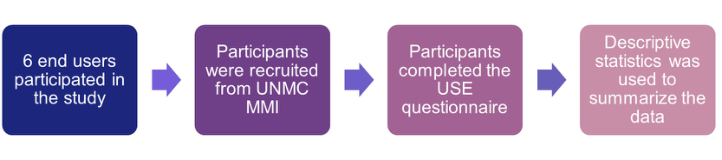
Data Collection The study involved surveying six DSPs who regularly utilize the software in their daily work (Figure 1). The survey aimed to assess the subjective usability of the software, employing the USE Questionnaire: Usefulness, Satisfaction, and Ease of use (USE) (Gao et al., 2018; Lund, 2001). The USE survey is a widely recognized and validated 30-item questionnaire that evaluates the subjective usability of a product or service. It encompasses four key dimensi- ons: (1) usefulness, (2) ease of use, (3) ease of learning, and (4) satisfaction. These dimensions provide a comprehensive understanding of the usability of the software from the perspective of the DSPs. For the study, DSP were recruited from the University of Nebraska Medical Center (UNMC) Mun- roe Meyer Institute (MMI) Adult I/DD clinic. The recruitment took place following their clinic visit.
Data Analysis To maintain data security and integrity, the survey responses were securely recorded and stored in a database. Descriptive statistical analysis was con- ducted, which includes frequency, percentage, mean, median, and standard deviation, enabling a comprehensive understanding of the DSPs’ perceptions of the software’s usability. The software is rated positively in the USE if ave- rage scores are higher than 5, neutral if average scores is rated an average of 4,and negatively if average is below 4.
Figure 1: Proof of study methodology.Table 1. DSP participant demographics.
Table available in the original PDF paper.
Demographics % n Age range 27 - 57 Gender Man 67% 4 Woman 33% 2 Transgender 0% 0 Non-binary / third gender 0% 0 Prefer not to say 0% 0 Race Black or African American 67% 4 Asian White 33% 2 American Indian or Alaskan Native Pacific Islander Ethnicity Hispanic or Latino(a) 17% 1 Non-Hispanic 83% 5 Education Did not graduate high school High school graduate/GED 17% 1 Trade / some college 17% 1 College graduate 33% 2 Post graduate degree 33% 2 Comfort level using computers Very uncomfortable 33% 2 Neutral 17% 1 Comfortable 0% 0 Very comfortable 50% 3 Uncomfortable 0% 0
RESULTS
Demographics
Table 1 shows participants’ demographics. Majority of participants identified as a man (67%), were Non-Hispanic Black or African American (67%), have a college or post graduate degree (67%), and felt very comfortable using computers (50%).
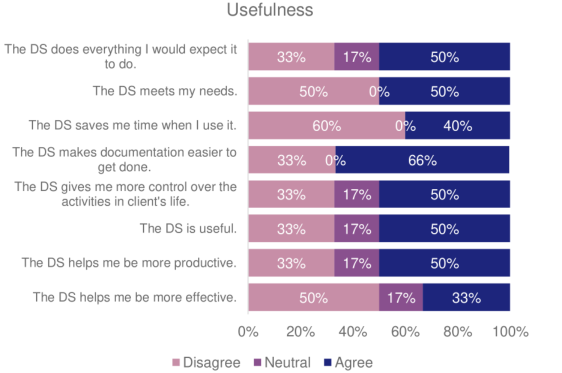
Usefulness Usefulness is the system’s capability to assist users in achieving their inten- ded goals or completing specific tasks effectively (Figure 2). DSPs rated the documentation software neutrally in the USE for the Usefulness subscale (mean = 4.12; SD = 2.66).
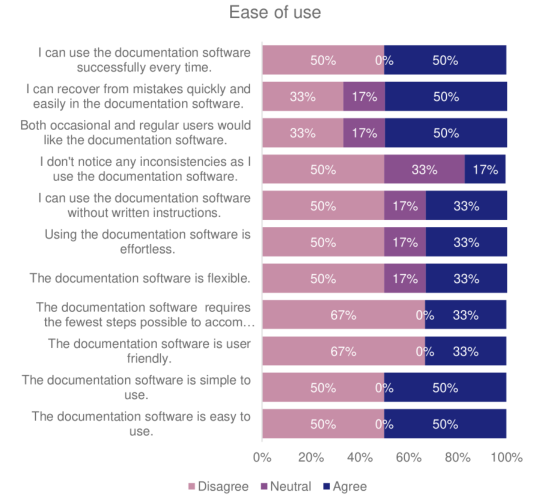
Ease of Use Ease of use refers to the user’s ability to accomplish tasks with minimal effort or challenges (Figure 3). DSPs rated the documentation software negatively in the USE for the Ease of use subscale (mean = 3.65; SD = 2.17).
Usability of Documentation Software Used by Direct Support Providers 157
Figure 2: Average results of the usefulness subscale from the USE survey about documentation software use. DS - documentation software.Figure 3: Average results of the ease of use subscale from the USE survey.
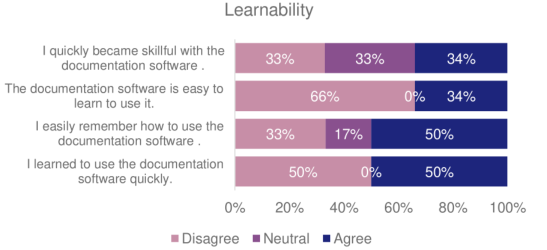
Learnability Learnability is the ease with which users can grasp and successfully perform basic tasks when first encountering the design (Figure 4). DSPs rated the documentation software negatively in the USE for the Learnability subscale (mean = 3.46; SD = 2.52).
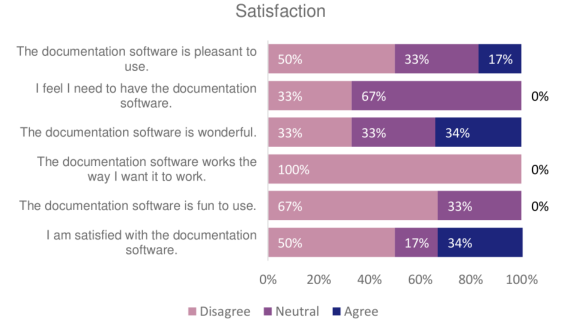
Figure 4: Average results of the learnability subscale from the USE survey.Figure 5: Average results of the satisfaction subscale from the USE survey.
Satisfaction Satisfaction relates to the overall pleasantness experienced by users while using the system (Figure 5). DSPs rated the documentation software nega- tively in the USE for the Satisfaction subscale (mean = 2.75; SD = 1.50).
DISCUSSION
Participants rated the documentation system negatively or neutrally in all four subscales. These results are similar to previous studies that shows poor usability in EHR systems being associated with negative effects on healthcare providers and patient care (Edward R. Melnick et al., 2020; Middleton et al., 2013). Previous research demonstrates that usability issues in EHRs can lead to decreased efficiency, increased cognitive workload, and potential patient safety risks (R.M.Ratwani et al., 2018; Schwappach & Ratwani, 2023). Poor usability can disrupt workflow and hinder the effective use of EHRs in com- plex healthcare systems (Sittig & Singh, 2015). It can also result in user stress, errors, and decreased job satisfaction (Kaihlanen et al., 2020). These usability challenges can also contribute to medication-related errors and reduced adhe- rence to clinical decision support alerts (Hardenbol et al., 2018). EHR design
Usability of Documentation Software Used by Direct Support Providers 159
flaws can negatively impact patient safety and contribute to communication failures between healthcare providers (Zahabi et al., 2015). Like clinicians, poor EHR usability can have detrimental effects on DSP’s performance, client safety, workflow efficiency, and overall satisfaction.
The burnout experienced by DSPs poses significant challenges to the qua- lity of care provided to individuals with I/DD. Usability issues associated with the technologies used by DSPs contribute to this burnout, impeding their abi- lity to fulfill their responsibilities efficiently and effectively. These issues can also exacerbate the DSP Workforce crisis. Addressing these usability issues is crucial to enhance the overall well-being of DSPs and improve the care and support provided to individuals with I/DDs.
REFERENCES
Finkelstein, A., Bachner, Y. G., Greenberger, C., Brooks, R., & Tenenbaum, A. (2018).
Correlates of burnout among professionals working with people with intellectual and developmental disabilities. J Intellect Disabil Res, 62(10), 864–874. https: //doi.org/10.1111/jir.12542 Gao, M., Kortum, P., & Oswald, F. (2018). Psychometric Evaluation of the USE (Usefulness, Satisfaction, and Ease of use) Questionnaire for Reliability and Vali- dity. Proceedings of the Human Factors and Ergonomics Society Annual Meeting, 62(1), 1414–1418. https://doi.org/10.1177/1541931218621322 Hardenbol, A. X., Knols, B., Louws, M., Meulendijk, M., & Askari, M. (2018).
Usability aspects of medication-related decision support systems in the outpatient setting: A systematic literature review. Health informatics journal, 26(1), 72–87. https://doi.org/10.1177/1460458218813732 International Organization for Standardization. (2013). Usability of Consumer Products and Products for Public Use—Part 2: Summative Test Method. In: ISO London, UK. Kaihlanen, A.-M., Gluschkoff, K., Hyppönen, H., Kaipio, J., Puttonen, S., Vehko, T.,
Saranto, K., Karhe, L., & Heponiemi, T. (2020). The Associations of Electro- nic Health Record Usability and User Age With Stress and Cognitive Failures Among Finnish Registered Nurses: Cross-Sectional Study. JMIR Med Inform, 8(11), e23623. https://doi.org/10.2196/23623 Lund, A. M. (2001). Measuring usability with the use questionnaire12. Usability interface, 8(2), 3–6. Maslach, C., Schaufeli, W. B., & Leiter, M. P. (2001). Job burnout. Annual review of
psychology, 52(1), 397–422. Melnick, E. R., Dyrbye, L. N., Sinsky, C. A., Trockel, M., West, C. P., Nedelec, L., Tutty, M. A., & Shanafelt, T. (2020). The association between perceived electro- nic health record usability and professional burnout among US physicians. Mayo Clinic Proceedings. Melnick, E. R., Dyrbye, L. N., Sinsky, C. A., Trockel, M., West, C. P., Nedelec,
L., Tutty, M. A., & Shanafelt, T. (2020). The Association Between Perceived Electronic Health Record Usability and Professional Burnout Among US Physi- cians. Mayo Clinic Proceedings, 95(3), 476–487. https://doi.org/https://doi.org/ 10.1016/j.mayocp.2019.09.024 Middleton, B., Bloomrosen, M., Dente, M. A., Hashmat, B., Koppel, R., Overhage, J.
M., Payne, T. H., Rosenbloom, S. T., Weaver, C., & Zhang, J. (2013). Enhancing patient safety and quality of care by improving the usability of electronic health
record systems: recommendations from AMIA. J Am Med Inform Assoc, 20(e1), e2-8. https://doi.org/10.1136/amiajnl-2012-001458 Nielsen, J. (1994). Usability engineering. Morgan Kaufmann. Patel, V. L., & Kannampallil, T. G. (2015). Cognitive informatics in biomedicine and healthcare. Journal of Biomedical Informatics, 53, 3–14. https://doi.org/https: //doi.org/10.1016/j.jbi.2014.12.007 Ratwani, R. M., Savage, E., Will, A., Arnold, R., Khairat, S., Miller, K., Fairbanks,
R. J., Hodgkins, M., & Hettinger, A. Z. (2018). A usability and safety analysis of electronic health records: a multi-center study. J Am Med Inform Assoc, 25(9), 1197–1201. https://doi.org/10.1093/jamia/ocy088 Ratwani, R. M., Savage, E., Will, A., Fong, A., Karavite, D., Muthu, N., Rivera, A. J., Gibson, C., Asmonga, D., & Moscovitch, B. (2018). Identifying electronic health record usability and safety challenges in pediatric settings. Health Affairs, 37(11), 1752–1759. Schwappach, D., & Ratwani, R. (2023). Electronic Health Record Usability Contri-
butions to Patient Safety and Clinician Burnout: A Path Forward. In (pp. 10.1097): LWW. Shachak, A., Hadas-Dayagi, M., Ziv, A., & Reis, S. (2009). Primary care physicians’ use of an electronic medical record system: a cognitive task analysis. J Gen Intern Med, 24(3), 341–348. https://doi.org/10.1007/s11606-008-0892-6 Simmons, C. A., Moretti, A. E., Lobo, A. F., & Tremoulet, P. D. (2023). Direct Sup-
port Professionals’ Perspectives on Using Technology to Help Support Adults With Autism Spectrum Disorder: Mixed Methods Study. JMIR Form Res, 7, e40722. https://doi.org/10.2196/40722 Sittig, D. F., & Singh, H. (2015). A New Socio-technical Model for Studying Health Information Technology in Complex Adaptive Healthcare Systems. In V. L. Patel, T. G. Kannampallil, & D. R. Kaufman (Eds.), Cognitive Informatics for Bio- medicine: Human Computer Interaction in Healthcare (pp. 59–80). Springer International Publishing. https://doi.org/10.1007/978-3-319-17272-9_4 Zahabi, M., Kaber, D. B., & Swangnetr, M. (2015). Usability and Safety in Ele-
ctronic Medical Records Interface Design: A Review of Recent Literature and Guideline Formulation. Human Factors, 57(5), 805–834. https://doi.org/10.1177/ 0018720815576827
LISTED IN THE AHFE DIGITAL BOOKSTORE CATALOGUE
Explore the complete digital volume
Human Factors in Aging and Special Needs
Read this individual research paper free through the original publisher, or explore the full digital proceedings book.
ISBN 978-1-958651-64-3
Explore this ISBN in the AHFE Bookstore ↗Listed in the July 2026 bookstore catalogue; search by ISBN to confirm current availability · Digital book purchase optional