Alexey Anokhina, Igor Gorodetskiyb, Vladimir Lvovc, Pavel Padernod (2022). Education and Professional Development of Ergonomists in Russia. In: Advances in Ergonomics In Design, Usability & Special Populations: Part I. AHFE Open Access, vol. 18. https://doi.org/10.54941/ahfe100789
1 National Research Nuclear University ‘MEPhI’, Obninsk Institute for Nuclear Power Engineering, Studgorodok 1, Obninsk 249040 Kaluga Region, Russia ↗
2 Russian State Techological University “MATI”, Orshanskaya str., 3, Moscow 121552, Russia c Inter-Regional (Russian) Ergonomics Association, Zinaida Konoplyannikova str, 89, Tver 170021, Russia ↗
3 Inter-Regional (Russian) Ergonomics Association Zinaida Konoplyannikova str, 89, Tver 170021, Russia ↗
4 Saint-Petersburg Electrotechnical University “LETI” Professor Popov str., 5, St. Petersburg 197376, Russia ↗
The paper describes current state of education and professional development of specialists in human factors and ergonomics in Russia. University education in Russia is regulated by the fixed list of specialities and by the State learning standards. Currently, there are four university specialities that can serve as “umbrella” for education of ergonomists, namely: “System Analysis and Control”, “Biotechnical Systems and Technologies”, “Psychology”, “Design”. Two Russian leading universities offer bachelor and master programs on ergonomics. Postgraduate ergonomics education is available in the form of training courses and courses for preparation of candidate or doctoral dissertation. Any dissertation must be attributed to one of the predetermined scientific specialities. The most relevant speciality is “Occupational psychology, engineering psychology, ergonomics”. Nearly half of all candidates and doctors of sciences who have defended research work on ergonomics have degree in technology, one third – in psychology. Currently, Russian ergonomics society is elaborating procedure for certification of professional ergonomists following the CREE (Centre for Registration of European Ergonomists) model. As a first step to this target, the Standard for certification of the specialists designing human-machine systems has been developed. This standard establishes three evaluation criteria concerning of applicant’s educational level, professional experience, and professional development and self-education.
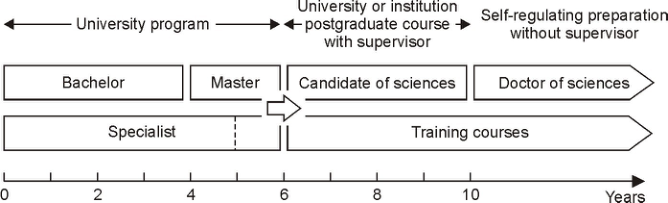
RUSSIAN EDUCATIONAL SYSTEM Professional education in Russia is based on university programs. List of educational specialities (Ministry of Education and Science, 2013) is fixed by the federal Ministry of Education and Science which regulates education in Russia. In order to launch educational program, university has to pass a licensing procedure and to obtain state accreditation. In according with the Bologna model, most of university programs (about 180) are divided into four- years bachelor and two-years master levels (Fig. 1). However, about 100 programs covering the defence, nuclear,
Ergonomics In Design, Usability & Special Populations I (2022) medicine, art and other domains are still focused at continuous five- or six-years education of specialists such as engineer, doctor, etc.
Postgraduate diploma structure remains invariable from the Soviet period. It includes two successive scientific degrees (candidate of sciences and doctor of sciences) and two successive academic degrees (docent and professor). In order to obtain scientific degree, applicant must perform novel scientific work, publish papers in peer-reviewed journals and defend dissertation. Dissertation has to be attributed to one of 23 field of science (such as mathematics, physics, etc.) and to one of more than 420 scientific specialities determined by (Ministry of Education and Science, 2009). Preparation of candidate degree dissertation may be done during university four-years postgraduate course. Preparation of doctor degree dissertation is a self-regulating process.
Professional development of practicians working in utility is possible in frame of supplementary professional education provided by universities, companies, research institutions and dedicated organizations. The most widespread kind of this education is a short two-weeks (usually 72 academic hours) training course focusing on enhancement of knowledge in some narrow field. There are more long programs (500 and more academic hours) which are intended to retrain practicians.
Figure 1. Levels of education in Russia
UNIVERSITY EDUCATIONAL PROGRAMS IN THE FIELD OF ERGONOMICS AND HUMAN FACTORS Education in the field of ergonomics was launched in 1968 in the Leningrad (Saint-Petersburg) State University (LSU). Learning of ergonomics and engineering psychology was originally included into the speciality of “Psychology”. The program was concentrated at such problems as interaction between human-operator and technological system, distribution of functions, designing and modelling of operator activity.
In 1980 the LSU launched the one-year retraining program on engineering psychology supervised by G.V. Sukhodolsky. This program was oriented to the specialists graduated from universities with degrees in engineering. The program included intensive courses on general and experimental psychology, ergonomics, data handling and analysis, engineering psychology, occupational psychology, etc. More than 300 professional graduated from this program which has been closed down in 1992.
Similar program was organized by A.I. Gubinsky in the Leningrad State Electrotechnical University in 1982. This program was focused at computerized control systems. The program was remaining till 1986, and about 40 specialists (naval officers mainly) finished it.
Until the late 1990s the Leningrad and the Moscow State Universities offered education in the field of ergonomics in frame of the “Psychology” speciality. However, in the beginning of 2000s Russian industry created the need for ergonomists having not only psychological but also engineering competence. The devoted speciality “Ergonomics” was established and approved by the Ministry of Education and Science in 2004. The “Ergonomics” was an one- level program for education of specialists. Graduates from this program were qualified as an “engineer-ergonomist”.
Two university launched realization of this education program, namely Saint-Petersburg Electrotechnical University Ergonomics In Design, Usability & Special Populations I (2022)
(SPETU “LETI”) and Russian State Technological University (former Moscow State Aviation Technological University) (RSTU “MATI”). The core knowledge of both programs includes mathematics, informatics, basics of human anatomy, physiology, biophysics and biochemistry, general and occupational psychology, anthropometry, biomechanics, habitability, system analysis and modelling the human-machine system, theory of control systems, selection and training of operators. A specific feature of the SPETU “LETI” program is an orientation to information technology, ergonomics assessment, user interface design and reengineering, while the RSTU “MATI” program focuses on aviation and space ergonomics, aviation indicators and controls, pilot chairs, etc. Graduates from these two universities occupy the position of ergonomist in research and design institutes (in naval, aviation, space, military and other domains), industrial plants and IT-companies.
Unfortunately, the “Ergonomics” was removed from the official list of specialities in 2010 as a result of another modernization of Russian education system.
Currently there are four university educational specialities covering the field of ergonomics and human factors, namely: “System Analysis and Control”, “Biotechnical Systems and Technologies”, “Psychology”, “Design”. All these programs include the bachelor and the master levels. Content of each speciality is regulated by dedicated State learning standard which is approved by the Ministry of Education and Science.
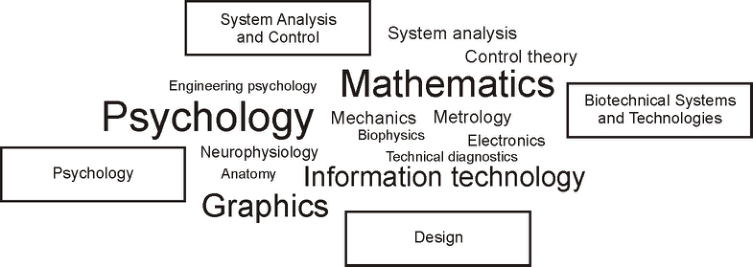
System Analysis and Control. Ergonomics is a multidisciplinary field involving knowledge of mathematics, psychology, physiology, technology, design and computer science. It is well known that system analysis is the most appropriate methodology for integration and harmonization of diverse knowledge. This was the main argument for incorporation of ergonomics education program into the “System Analysis and Control” speciality. This speciality is focused on control of complex systems including the human-machine systems. Core of the curriculum is formed by mathematics, control theory, theory of decision making and information technologies. The System analysis program with specialization in ergonomics is offered by two universities – SPETU “LETI” and RSTU “MATI”.
Biotechnical Systems and Technologies. This speciality covers equipment, facilities and methodology for medical and biological measurements. The curriculum includes mathematics, biophysics, metrology, system analysis, electronics, information technologies. Combination of these knowledge with traditional ergonomics courses provides deep specialization in physical ergonomics. This specialization is available in the SPETU “LETI”.
Psychology is a traditional “umbrella” for education of professional ergonomists. Currently, most of Russian universities offer psychological educational programs where the organizational psychology prevails over the other areas of psychology. Specialization in ergonomics is available only at the department of Occupational and Engineering Psychology in the Moscow State University.
Design. In according with the federal categorization, this speciality is attached to the group of art and culture. The core of the curriculum includes painting, drawing, polygraphy and art graphics, colour and spatial composition. However, quite large part of the curriculum is devoted to apply courses, such as design of costume, transport vehicle, interior, industrial environment. Similarly to the Western countries, art designers play prominent role in creation of ergonomical goods and products, and large number of these products are designed without participation of professional ergonomists.
The “umbrella” specialities and their main courses prescribed by the corresponding State Learning Standards are shown in the Fig. 2. These courses are supplemented by special disciplines when one of the “umbrella” specialities is used for education of ergonomists. For example, the bachelor curriculum of the “System analysis and control” speciality used for education of ergonomists in the SPETU “LETI” includes the following courses (in addition to basic ones): Introduction to ergonomics, Ergonomics measurements, Knowledge engineering, Engineering and occupational psychology, Decision making support methods, Methods and tools for representation of information, Reliability of human-machine systems and technologies, Computer-aided design, Designing of machines and user interface, Practical psychology, Software for ergonomics data handling, Psychological evaluation of activity, Anthropometry and biomechanics, Ergonomics design of operator activity, Ergonomics design of computer-based data handling systems.
Ergonomics In Design, Usability & Special Populations I (2022)
Figure 2. Cloud of the bachelor core competences and the specialities serving as an “umbrella” for education of ergonomists
POSTGRADUATE DEVELOPMENT OF ERGONOMISTS There are the following kinds of postgraduate education: master’s educational program, postgraduate course for preparation of candidate (PhD) dissertation, preparation of doctoral dissertation, and training course.
Master courses. Similarly to the bachelor programs, master courses are realized under the same umbrella specialities. Unlike the bachelor programs, the master curricula are not so strictly regulated by State Learning Standards. When defining content of master course, universities can take into account their specific researches and projects. As a rule, ergonomics master programs have research orientation. On graduation from such program student must defend master’s thesis comprising novel original results. The SPETU “LETI” master curriculum includes such disciplines as Ergonomics design, Ergonomics assessment, Personnel selection, Training technologies, Decision making support systems, Workplaces and environmental design, Quality assessment, Ergonomics of sociotechnical systems, Ergonomics methods to support activity, Data mining systems, Statistical modelling.
Candidate of sciences postgraduate course. Graduate of master course can continue education at the next postgraduate level followed by defence of candidate dissertation (analogue of Western PhD degree). Main part of this course is devoted to research work and preparation of dissertation, and just about 300 hours are to be spent for learning of foreign language and methodology of scientific research. Candidate or doctoral dissertation must be categorized to one of the predetermined scientific specialities (current list of the specialities approved by the Ministry of Education and Science includes about 420 items) and to one of the 23 fields of science (such as technology, psychology, biology, etc.). The most relevant speciality is titled “Occupational psychology, engineering psychology, ergonomics”. It covers all psychological and technological aspects of analysis and designing of occupational activity. The following subjects for study are mentioned in the definition of this speciality: worker, human-machine interface, information models, allocation of functions, algorithms of work, team interaction and work, psychological climate, training simulators and technologies, personnel selection, support systems, workplace, interior, human reliability, wellbeing, workers with limited abilities. Anthropological, physiological, biomechanical and system aspects of designing and operation of human-machine system are covered by other specialities, such as “System analysis, control and data processing”, biological and medical specialities.
The choice of speciality and field of science depends on the methods that have been used in research work. Most part (about 45–50%) of all candidates and doctors of sciences who have defended research work on ergonomics have degree in technology, one third – in psychology, and the rest – in biology and in medicine. Dissertation should be defended at a session of special dissertation board which has permission to consider dissertations on the particular speciality. The only dissertation board on “Occupational psychology, engineering psychology, ergonomics” which can award degree in technology is located in SPETU “LETI”. Other 10 boards on this speciality operating in Moscow State University, in the Institute of Psychology and in other organizations can award degree in psychology.
Training courses. The overwhelming majority of training courses is formed by short educational programs dealing with narrow range of questions. Typical length of such program is 72 academic hours (or two weeks). Upon completion of training course, learners can take examination (optionally, depending on the program) and receive Ergonomics In Design, Usability & Special Populations I (2022) certificate.
An example of short training course is described below. This course is offered by Obninsk Institute for Nuclear Power Engineering and is titled “Ergonomics of Human-Machine Interface (HMI) for Workstation of Supervisory and Control System”. The course consists of four 2–3 days modules. Lessons are conducted in the form of lectures and case studies. The curriculum is as follows.
Module 1: Basics of ergonomics. Subjects: Ergonomics as a discipline, Human abilities, Requirements for work- place and work environment.
Module 2: Analysis and design of work processes. Subjects: Structural modeling of operator activity, Reliability of operator, Ergonomics design of human-machine systems, Ergonomics assessment and relevant standards.
Module 3: Organization of human-machine interface (HMI). Subjects: HMI for control of nuclear power systems, Coding of information and stereotypes, Basics of cognitive psychology.
Module 4: Design and evaluation of HMI. Subjects: Subject to be designed when developing supervisory and con- trol system, Basics of visual design, Operator support systems, Evaluation of HMI.
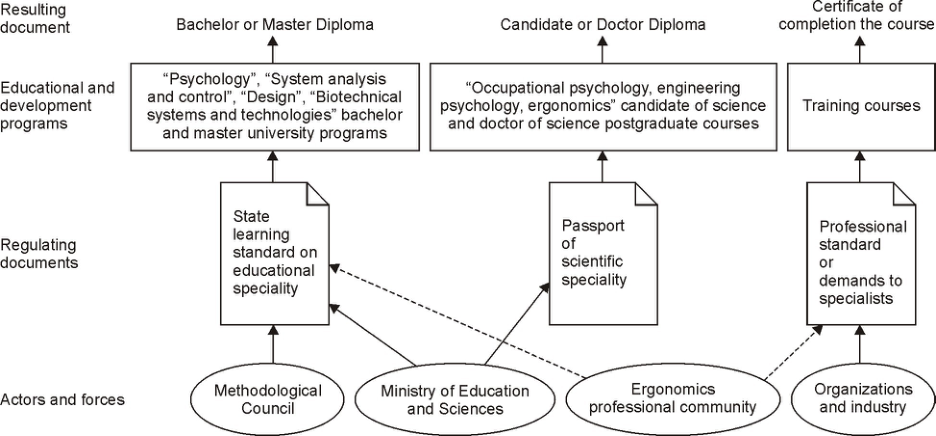
ROLE OF PROFESSIONAL COMMUNITY Generalized current picture of ergonomics education is shown in Fig. 3. Four main actors have direct influence on content and conditions of ergonomics education. Methodological Council is a special body consisting of representa- tives of universities. The Council is responsible for determination of minimum content of university programs and competences of graduates on particular speciality. Usually Council includes a few well known practicians from in- dustry and design or research institutes. Council prepares draft of State Learning Standard which is to be approved by the Ministry of Education and Science. Any university’s curriculum must be consistent with the corresponding standard. All standards are available at the Ministry official website.
The scientific sphere is regulated by the Highest Attestation Commission that is a special department of the Ministry of Education and Science. The Commission establishes rules for dissertation boards (Government of Russian Federation, 2013) and approves so called “passports of specialities” determining scope of speciality. Passports of speciality is a short one page description used for attribution of research work to particular speciality. In spite of the evident intersection, the list of educational specialities is not the equal of the list of scientific specialities.
Content of training courses is not a subject of regulation. Usually, organizations develop curriculums and offer train- ing courses following current demands from industry and market.
The Russian society of ergonomists known as the Inter-Regional Ergonomics Association (IREA) originated from the Soviet Ergonomics Association (SEA) established in 1986. The founder and first president of SEA was Profes- sor A.I. Gubinsky. SEA hosted annual All-Union conferences involving design, evaluation and optimization of sys- tem operation, inter-regional workshops on ergonomics and efficiency of human-machine systems, and symposia on efficiency, quality and reliability of human-machine systems. SEA became a federated society registered with the IEA. In 1993 SEA suspended any activity. The IREA was established on August 7th, 1995 as an assignee of the SEA. First president of IREA was Professor P.Ya. Shlaen. During past 18 years IREA conducted 8 national confer- ences on ergonomics “Psychology and Ergonomics: Unity of Theory and Practice”, became member of the Federa- tion of European Ergonomics Societies (FEES), established the journal “Human Factors: Problems of Psychology and Ergonomics” and information bulletin “Ergonomist”, launched official website www.ergo-org.ru.
IREA played the key role in establishing and developing of the educational speciality “Ergonomics” in 2004. Major part of the Methodological Council on this speciality consisted of the key members of IREA, and most of all deci- sions have been made on the basis of IREA recommendations. Main courses and textbooks were considered at IREA Council meetings. Now IREA patronizes the ergonomics educational program created on the basis of the specialities “System Analysis and Control” and “Biotechnical Systems and Technologies” (currently, these specialities serve as an umbrella for two ergonomics educational program).
Ergonomics In Design, Usability & Special Populations I (2022)
Figure 3. Main educational programs, documents and parties exerting influence on ergonomics education
CERTIFICATION OF ERGONOMISTS In Western countries there are three main sorts of professional activity for graduates from ergonomics program. First role is a researcher/teacher in university or researcher/member of design team in a large scale company. Professional activity of such professional includes study of typical work processes, gathering of new knowledge and laws, and creating of guideline and recommendations for designers. Second kind of ergonomists’ activity is the consulting. Professional consultant (an individual or a member of a small consulting firm) offers service to open market. The conducting of ergonomics assessment and evaluation and the solving of ergonomics problems at any stage of prod- uct or manufacturing lifecycle are typical consultancy tasks. Third role of professional ergonomist consists in day- to-day work at industrial enterprise such as assembly shop, processing/refinement plant, power plants, carrier com- pany, etc. His professional activity consists in continuous analysis and improvement of particular work processes and environmental conditions.
In Russia a “researcher” is a prevailing role for ergonomists. This role is especially needed in aviation (both in de- sign institutes and in airline companies) and in manned space activity. Power engineering and navy also are opened for intensive ergonomics researches. The role of “industrial ergonomist” is played in Russia by the specialists on labour protection who are concentrated at the problem of safety rather than usability or effectiveness. Meanwhile, some modern enterprises (especially assembly plants belonging to the well known companies such as Peugeot-Cit- roen, Michelin, Nissan, Volkswagen, Philips, etc.) have introduced the position of ergonomist. The category of “er- gonomist-consultant” is just arising in Russia.
The ergonomics is not a profession which requires any license or certificate in contrast to pilot, nuclear operator and driver professions. In our opinion, professional certification is especially important for ergonomist-consultant. This can be explained be the following. Usually, large scale industrial companies have their own corporative training and probation courses, and new employee passes through them. After this training company can believe in competence of this specialist and doesn’t need any additional recommendations. And vice versa, ergonomist-consultant working at open market has to have positive professional history and good references which can convince potential client of his professional competence. Certification is one of the most effective instrument for this. Also, certification may be useful for those specialists who work in design institutes. The presence of certified ergonomists can provide organi- zation with competitive advantage when participating in bidding for design contract.
Ergonomics In Design, Usability & Special Populations I (2022)
The IREA initiated the establishing of certification of ergonomists in 2009. The CREE model (Centre for Registra- tion of European Ergonomists, 2010) has been used as a base for national certification program. In according with this model professional has to satisfy the following requirements to be registered as a European Ergonomist:
1. Education: Three years at university level, at least one of which is dedicated to ergonomics; 2. Supervised training: At least one year; 3. Professional experience: Two years following supervised training.
The strategic target of the IREA is to harmonize national procedure and requirements with the CREE model and to join CREE and Global registration system.
As a first step to this target, the Standard for certification of the specialists designing human-machine (ergatic) sys- tems (Scientific and Methodological Centre, 2013) has been developed by the Institute of Ergonomics and Socio- Economic Technologies in collaboration with IREA. The standard is relevant to the following categories of special- ists:
designer of human-machine system;
person who is responsible for satisfaction of ergonomics requirements when designing human-machine system;
consultant providing service intended for improvement of design and operation of human-machine system;
teacher giving courses on ergonomics, engineering or occupational psychology in university.
The standard establishes the following evaluation criteria:
1. Education. Applicant has to have one of the following educational levels: degree of candidate or doctor of sci- ence; degree of specialist or master on the speciality that is relevant to ergonomics, engineering or occupational psy- chology; degree of bachelor on relevant speciality and diploma which confirms professional ergonomics retraining; degree of specialist or master on irrelevant speciality and retraining diploma. Any other levels require applicant to pass through 400 hours ergonomics course including the following modules:
1) Basics of ergonomics 2) Methodology of human-centered design and evaluation of systems 3) System analysis and modeling of human-machine systems. 4) Human-computer interaction 5) The using of simulators for professional training 6) Medical aspects in ergonomics. Capacity for work and professional health of operators 7) Analysis and arrangement of team work 8) Methodology for professional selection of specialists 9) Mathematical methods for processing of experimental data in ergonomics and engineering psychology 10) Life support and occupational safety.
2. Professional experience. Applicant has to have three years experience of full time work (or equivalent in case of part-time employment) as a specialist, consultant or teacher in the field of design or operation of human-machine systems.
3. Professional development and self-education. Applicant has to participate workshops and conferences on er- gonomics and to have published papers or patents.
CONCLUSIONS
Currently, Russia has a multilevel system for education of professional ergonomists. This system includes two successive university levels (bachelor and master in “System Analysis and Control”, “Biotechnical Systems and Technologies”, “Psychology” or “Design”) and two successive scientific levels (Candidate of Sciences and Doctor of Sciences in “Occupational psychology, engineering psychology, ergonomics). There is a standard regulating procedure for certification of ergonomists. Nearest task is to harmonize national requirements with the European Ergonomics In Design, Usability & Special Populations I (2022) ones in order to ensure consistency with the CREE model.
REFERENCES
Centre for Registration of European Ergonomists (2010). Requirements for registration of European Ergonomists. (Accepted on 18th June, 2010). Website: http://www.eurerg.org/ck/files/CREE%20Minimum%20Requirements%20V11.pdf Government of Russian Federation. (2013). Regulations on conferment of scientific degrees (Decree No 842, September 24,
2013). Website: http://vak.ed.gov.ru/web/guest/90 Ministry of Education and Science. (2013). On approving the list of higher education specialties (Order No 1061, September 12, 2013). Website: http://fgosvo.ru/uploadfiles/prikaz_miobr/10611.pdf Ministry of Education and Science. (2009). On approving the list of scientific specialties (Order No 59, February 25, 2009).
Website: http://www.edu.ru/db/mo/Data/d_09/m59.html Scientific and Methodological Centre for Facultative Certification of Organizations, Specialists, Products and Technological Processes in the Field of Labour Protection. (2013). Requirements for certification of the specialists designing ergatic systems and systems supporting life of personnel (labour protection). Moscow: Scientific and Methodological Centre.
Ergonomics In Design, Usability & Special Populations I (2022)
LISTED IN THE AHFE DIGITAL BOOKSTORE CATALOGUE
Explore the complete digital volume
Advances in Ergonomics In Design, Usability & Special Populations: Part I
Read this individual research paper free through the original publisher, or explore the full digital proceedings book.
ISBN 978-1-4951-2106-7
Explore this ISBN in the AHFE Bookstore ↗Listed in the July 2026 bookstore catalogue; search by ISBN to confirm current availability · Digital book purchase optional