Huai Cao, Xinyue Gong (2023). Design of Smart Subway Travel Products Based on Scene Theory. In: Usability and User Experience. AHFE Open Access, vol. 110, pp. 401–408. https://doi.org/10.54941/ahfe1003214
In recent years, thanks to the development of digital, subway is no longer just a means of transportation to meet people's fast travel, but can meet people's diverse needs and provide rich and thoughtful humanized services.In the process of smart city construction in China, new technologies such as big data, cloud computing, artificial intelligence and 5G are increasingly applied to urban rail transit. "Smart subway" is developing rapidly everywhere. Services such as intelligent navigation, face scanning, automatic temperature measurement and other services are gradually entering the subway of some cities. It improves the experience and efficiency of people's travel.This paper takes the internal product facilities of subway trains as the research object and conducts desktop research based on Context theory. By gaining insight into the behaviour and experience needs of subway passengers riding scenarios, design opportunity points for optimising the product experience are derived and combined with design tools to solve the problems currently encountered by passengers when travelling on trains in order to improve the user experience.
With the advent of the experience economy and the development of intel- ligent technology, people are beginning to focus more on comfortable and user-friendly product interaction, and the demand for product experience in the carriages has increased dramatically. Passengers no longer expect the subway carriage to be just a public transport space for quick travel, but to be able to have a better experience in the carriage during the journey.
CURRENT SITUATION Lack of Value in the Existing Subway Travel Experience
Now that China’s metro system has been largely completed at a functional level, the builders of subway, the core means of travel in today’s urban rail transport, need to start paying more attention to how to improve the pas- senger experience. Firstly, from a safety perspective, subway trains, as the core part of the subway system, need to be carefully designed and developed based on national standards. At the same time, as people’s standard of living increases, the subway train is no longer just a public space for transport, but a more comfortable, convenient and enjoyable experience for passengers (Chao, 2007). In addition, the literature also points out that usability and comfort enhancements to metro trains, while ensuring safety and efficiency, are in line with the current need for subway train design in China, and the combination of Maslow’s needs theory reveals that passengers’ demands for
an enhanced travel experience are well documented (Ximing, 2009). In the past, the basic functions of the existing metro and the relatively safe and orderly train carriages have met people’s physiological and safety needs, but what needs to be addressed now are passengers’ gradually increasing needs for social interaction, respect and even self-fulfilment and satisfaction. The- refore, the design of the interior of subway trains is an important factor in improving the user experience of passengers, which means that designers need to optimize the design from the perspective of passengers’ riding habits and travel scenarios.
Smart Hardware Development Offers the Potential for Innovation in Subway Train Design Subway intelligence has become an important focus of rail transit deve- lopment in countries around the world. With the rapid development and maturity of new generation information technology, such as mobile Internet, big data, cloud computing, Internet of Things and artificial intelligence, rail transit enterprises in Europe, Japan, Korea, North America and other coun- tries and regions are actively exploring the use of high technology to improve the transportation efficiency and service quality of rail transit (Ping et al., 2009). In March 2020, the “China Urban Rail Transit Smart City Rail Deve- lopment Outline” released by China Urban Rail Transit Association depicts the ambitious goal of building China’s smart city rail by relying on emer- ging technologies such as big data, 5G and blockchain, which also means that China’s urban rail transit industry starts to take a new step towards the smart era.
In the article “intelligent train helps the development of intelligent urban rail” systematically summarizes that the intelligent development level of train is the key factor to promote the rapid development of intelligent urban rail, and the intelligent level of train is mainly reflected in three aspects of con- trol, diagnosis and passenger service (Sansan, 2021): In the control aspect, in recent years, the train control and management system based on 100 mega- bit bandwidth set control, maintenance, media equal to the application of multi-network integration technology In terms of control, the application of multi-network convergence technology, which integrates control, maintena- nce and media based on 100 megabit bandwidth, can realize the intelligent control level of the whole train, facilities and functions inside the train; in terms of diagnosis, the advanced sensing technology can pick up the cro- wded situation inside the train in real time; in terms of passenger service, the new generation of display technology provides passengers with a richer three-dimensional display experience, using OLED, TFEL and embedded LCD technology to upgrade the information prompt to interactive interactive service. In summary, the use of advanced technology to study the innovative design of metro trains is in line with the strategic need of national constru- ction of smart urban rail, and also helps to improve the design of China’s metro trains, so as to improve the design level and comprehensive quality of metro trains in China as a whole.
Design of Smart Subway Travel Products Based on Scene Theory 403
RESEARCH METHODS Research Related to the Internal Design of Subway Trains
Compared with the late start of universal design and experience design in China, some foreign countries with faster development of metro trains have developed more perfect design of metro trains and people. In the field of accessibility design of public space such as rail transit train car, European countries such as the United States and Glasgow and Japan have incorpora- ted “accessibility standards” into the design of subway trains, and there are many mature achievements in design practice and theoretical research. Dome- stic research on the design of subway passenger interface is mainly in three aspects: the first aspect focuses on the material and structure of the vehicle, the second aspect is based on the historical development of the subway car interior design evolution of induction integration, the third aspect is mainly around the construction of passenger interface evaluation index system to guide the establishment of environmentally friendly passenger room space. Taking the design of subway seats as an example, domestic rail trains cur- rently mostly adopt the layout of joint-row settings. Scholars combined with the human body size data of adults in China, through a lot of research and testing finally produced a set of universal subway seat size standards, provi- ding effective data guidance for the design of subway seats (Ming and Chai, 2015). Based on the characteristics of Guangzhou city, the structural design and color optimization of the seats, passenger room handrails, doors and other facilities inside the metro trains were carried out (Binglin and Anzu, 2011). A study stratified the population of metro passengers from the per- spective of universal design, and summarized the universal design of metro car interior systems applicable to various groups (Yan, 2006). The evalu- ation methods concerning the interior passenger interface vary according to the different stages of train design: a design solution for the interior handrails without auxiliary gripping elements was combined with the human factors analysis software JACK to evaluate the number of available gripping points (Liangkui et al., 2011). A three-dimensional modeling-based evaluation of the 3+2 and 2+2 carriage swivel seating arrangements in terms of passenger comfort and crew ease of operation concluded that the 2+2 solution is more compatible with human-computer interaction and increased cabin occupancy (Yong et al., 2011).
Research Related to the Scene Theory Scenario-driven design thinking, mainly applied in the practical phase of product design, shifts the focus of work from defining systems to people. Another application of scenario-driven theory is scene interaction design, proposed by Karen Holzblatt and Hugh Bayer, which emphasizes a user- centered design process from a user experience perspective. This application integrates the use of multiple disciplinary approaches and emphasizes the collection of product-related information and demand points through qua- litative and quantitative research during the design research phase. The domestic scenario-driven theory design approach is mainly focused on inte- raction design and media communication in the mobile Internet industry.
404 Cao and Gong
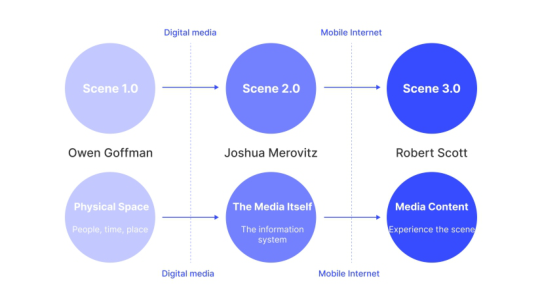
The arrival of electronic media and mobile Internet technology has driven the development and evolution of the scenario concept from 1.0 to 3.0 (see Figure 1). Scene 1.0 is represented by the sociologist Irving Goffman’s “mime- sis theory”, which refers to scenes in the physical space dimension; Scene 2.0 refers to the new scene concept developed by Joshua Merovitz under the influence of the emerging electronic media and the “new media - new scene - new behavior”theory. Scene 3.0 is Robert Scoble’s view on scene composition in the era of mobile Internet of Things.
1. Theoretical model based on scenario design
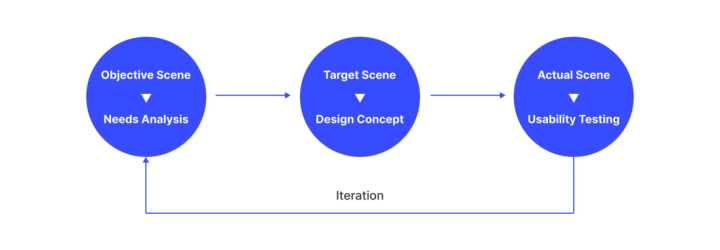
Scenes can be categorized as objective, target, and actual contexts (see Figure 2). One of them is objective scene. The objective scene describes the most realistic usage environment of users. Designers use the objective scene to analyze and insight user needs, research and analyze the current situation of the product and target users, so as to understand the most real needs of users. For the objective scene of the construction, analysis is to find the pro- blem point, through user research, to obtain the preliminary user information to assist the design, in order to build a persona, accurate understanding and communication of user needs. Second, the objective scene. On the basis of the objective scene demand insight, through cluster analysis, set priorities, targe- ted to solve the user’s demand problems, and according to the relevant design principles, design strategies, etc. to guide product design, resulting in a preli- minary product design concept. Third, the actual scene. The designer uses the actual scene to test the usability and ease of use of the product, and iteratively optimizes the design according to the user test results. The real-world context is the evaluation of the product before the design is implemented, and it is also the scenario verification of the production and commercialization of the product.
2. Scenario-driven design strategy
The framework of scenario-based design constructed by Mary Beth Rosen and John M. Carroll is based on the classification of scenes, and they
Figure 1: Development and evolution of the concept of scene. (Self-drawn by author).
Design of Smart Subway Travel Products Based on Scene Theory 405
Figure 2: Classification of scene. (Self-drawn by author).
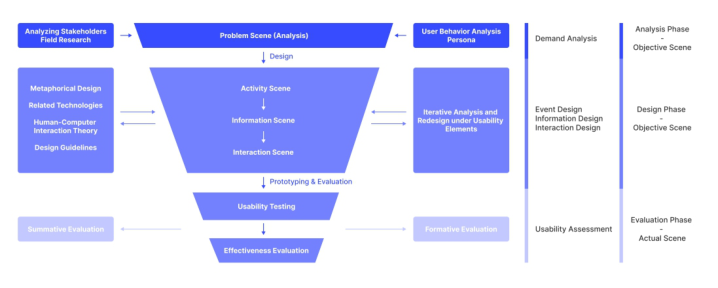
classify four major categories of scenes: problem, activity, information, and interaction scenes (Carroll, 2000). First, problem scene: describes the chara- cteristics of the current environment and the user’s situation; second, activity scene: realizes the transformation from problem scene to design function scene; third, information scene: refers to how users perceive and understand information; fourth, interaction scene: formulates and responds to the beh- avior of user goals and needs. Based on the division of the four types of scenes, the framework of scene-based design is built (see Figure 3). Stage 1 - Requirement stage: mainly through the problem scene to explore and analyze the user’s needs; Stage 2 - Design stage: through the construction of activi- ties, information and interaction scene to complete the design, and based on information technology, human-computer interaction and other theories, constantly in the usability Phase 3 - Evaluation phase: Usability testing is con- ducted, and on the basis of the results of user testing, optimization iterations of the scenarios are carried out. The framework based on scenario design considers the process of a design task from requirements analysis to usabi- lity evaluation in a more comprehensive way, and lays the foundation for the development of subsequent scenario design theories (Yanagida, 2009).
Figure 3: Classification of scenes. (Self-drawn by author).
406 Cao and Gong
DESIGN RESEARCH Through qualitative and quantitative research, I obtained and analyzed the intelligent experience needs of typical users of Wuhan Metro, and summari- zed the main user pain points and demand points of related facilities in the metro trains.
Research Framework The research session atmosphere is in the following 4 stages. In the first stage, desktop research was conducted to find out the type of metro trains curren- tly running in Wuhan subway, the current situation of product experience of the internal facilities of this type of trains, and the scale of Wuhan subway passengers. In the second stage, field research was conducted, mainly using the natural observation method to observe users’ riding habits, experiences and service issues inside the metro trains, which were recorded in the form of videos and photos. In the third stage, user interviews and questionnaires were conducted, using qualitative research methods, such as in-depth inte- rviews and desktop research, to obtain passengers’ needs and pain points about Wuhan in different experience scenarios and stages. With quantita- tive research methods, such as using questionnaires as auxiliary support, questionnaires were designed and distributed for the intelligent experience problems identified in the qualitative research, and the final quantitative data were used to verify the insight points obtained in the qualitative research. Finally, the interview results are sorted out and cross-analysis of the questi- onnaire data is conducted to summarize and derive the potential experience needs and expectations of passengers.
Research Summary
1. User stratification
By classifying subway passengers according to age, education, occupation, purpose of riding, and frequency of riding, combined with research analy- sis, subway passengers can be classified as commuter users, loitering users, elderly users, disabled users, and full-time housewife users (see Table 1).
2. User needs insights
The needs of users before, during and after the ride are studied. Before the ride, users’ needs focus on information acquisition, such as the crowding level in the carriage and the location of the barrier-free area; during the ride, users’ needs focus on seat comfort, additional support system, station information display and provision of special areas (such as wheelchairs, bulky luggage, baby carriages, etc.); after the ride, users’ needs focus on repeated arrival information and door side prompts.
3. Needs prioritization
The user needs and opportunity points from the research are prioritised, and the KANO model analysis is used to classify the product functions into basic, satisfied and exceeded expectations, unsatisfied and disappointed, and
Design of Smart Subway Travel Products Based on Scene Theory 407
Table 1. User stratification (Self-drawn by author).
Table available in the original PDF paper.
Pain point analysis
Commuter users Basically no seats and few handrails during rush hours/ easy to ignore the arrival reminders Loitering users Don’t know what attractions or food recommendations are near each station/ Transfer information and door opening side tips are not clear enough Elderly users Seats too slippery, seats too cold in summer and winter/ Can’t see station information Disabled users Not knowing which carriage has an accessible area, someti- mes occupied by other passengers/ Difficult to get on and off the train alone/especially when there are many people/ Lack of information on wheelchair seat belts, difficult to operate Full-time housewife users
Children crying can disturb other passengers/ have to hold the stroller at all times when getting into the carriage, so can’t get hands free and it’s cramped/ No mother and baby room in the carriage
then the user needs analysis is combined with QFD in order to clarify the design elements related to human-computer interaction such as shape, stru- cture and function of the facilities used in the metro train, and the data analysis is combined to determine the weight of the user needs. The results of the analysis were then used to identify the priority elements for improvement, specifically the intelligent rotatable seats, the optimisation of the grip system, the OLED smart windows and the multi-sensory interaction design (lighting, voice technology, etc.).
CONCLUSION
The value of future subway carriages should be mined and considered from three aspects: reconfiguration of user groups, reconfiguration of riding expe- rience, and reconfiguration of subway train definition. Based on the current situation of subway train technology development, national policy support, and user research reports, the needs and pain points of users are sorted out. By means of advanced intelligent information technology, the relevant personnel can make subway ride a new way of travel and a high-quality transportation medium.
REFERENCES
Binglin, L. and Anzu, H. (2011). Guangzhou Metro Vehicle Interior Design. Machinery Management Development, (2), pp. 42–44. (in Chinese) Carroll, J. M. (2003). Making use: scenario-based design of human-computer
interactions. MIT press. Chao, W. and Bochu, X. (2007). A review of research into the design of the interior space of metro vehicles (Doctoral dissertation, Sichuan: Southwest Jiaotong University). (in Chinese)
408 Cao and Gong
Liangkui, J., Zerui, X. and Feng, L. (2017). Design of handrail arrangement in metro cars without auxiliary gripping elements. Packaging Engineering, (2), pp. 15–20. (in Chinese) Ming, L. and Yu, C. (2015). Research on the design of Shenyang metro seats based
on ergonomics. Design, (4), pp. 105–106. (in Chinese) Ping, L., Sai, S., Rui, X. and Xiaodong, Z., 2019. Study on the development trend of digitalisation and intelligence in foreign railways. China Railway, 2, pp. 25–31. (in Chinese) Sansan, D. (2021). Smart trains help smart city rail development. Intelligent Rail
Transit. (in Chinese) Ximing, D. (2009). Rail train reliability, availability, serviceability and safety (RAMS). China Railway Publishing House. (in Chinese) Yan, Z. (2006). Universal design research and its application to the Shanghai Metro
carriage ride system (Doctoral dissertation, Tongji University). (in Chinese) Yanagida, K., Ueda, Y., Go, K., Takahashi, K., Hayakawa, S. and Yamazaki, K. (2009). Structured scenario-based design method. In International Conference on Human Centered Design (pp. 374–380). Springer, Berlin, Heidelberg. Yong, Z., Bochu, X., Jingyi, Z. and Ping, X. (2016). Ergonomically improved design
of rotating seats for high-speed trains. Mechanical Design, 33(8), pp. 109–112. (in Chinese)
LISTED IN THE AHFE DIGITAL BOOKSTORE CATALOGUE
Explore the complete digital volume
Usability and User Experience
Read this individual research paper free through the original publisher, or explore the full digital proceedings book.
ISBN 978-1-958651-86-5
Explore this ISBN in the AHFE Bookstore ↗Listed in the July 2026 bookstore catalogue; search by ISBN to confirm current availability · Digital book purchase optional