Paulo Eduardo Hauqui Tonin, Elton Moura Nickel (2023). Experience compelling map: an auxiliary tool for user experience design in physical retail. In: Usability and User Experience. AHFE Open Access, vol. 110, pp. 428–435. https://doi.org/10.54941/ahfe1003217
The growth of online shopping is a recognized phenomenon and its strength has become even more evident during the Covid-19 pandemic. Despite the ease and speed of digital retail, one cannot lose sight of the physical store, responsible for ensuring the vitality of urban centers and promoting a more humane shopping experience. Current market and consumer movements call for a “Phygital” reality, an expression designed to represent the intersection of physical (offline) and digital (online) commercial environments.Design is about people. According to Lowdermilk (2018), you cannot create products for users without going to them. User-Centered Design (UCD) emerged from Human-Computer Interaction (HCI) and essentially consists of a design methodology based on people's true needs and interests, developing products and services that are easy to understand and use. Deep knowledge of the public is the reason for the success of brands commonly associated with good commercial performance, after all, everything is created with the intention to be bought and thus become part of people's daily lives.An intrinsic relationship is found between Cognitive Ergonomics and User-Centered Design. Cognitive Ergonomics comes from Cognitive Psychology and its studies are linked to memory, concentration, attention, reasoning and decision-making processes. User Experience (UX), one of the focuses derived from User-Centered Design, addresses the entire experience that the user has with a product or service, including physical and emotional reactions (LOWDERMILK, 2018).Cognitive and behavioral methods, such as the focus group, have their original foundation in the disciplines of psychology and are strong allies of User-Centered Design and UX. These user assessment methods or techniques provide information about individuals' perceptions, cognitive processes and potential responses. The information obtained is perceived through sensory systems, which influence the way the user interacts with the task, his decision making and also satisfaction. Through these methods, users are placed at the center of the entire process of designing experiences (WICKENS, 1992).For Stanton (2006), no single method can, by itself, collect all the information necessary to conduct an effective research and, therefore, to achieve factual results, it is advisable to use a combination of methods. In the case of research involving retail, such methods can be personalized and related to the brand, its target audience and commercialized products. To facilitate users' understanding and ensure greater participation during a focus group session, for instance, a design thinking tool can be incorporated: the Experience Compelling Map. In this tool, accessed by Tonin during a “Design Thinking for Better Business” workshop held at The New School-PARSONS in 2018 and conducted by Melissa Rancourt, volunteers are invited to share insights from a structured exercise that sequentially maps the experience into five moments: 1-attraction, 2-entry, 3-engagement, 4-exit, 5-extension.In order to illustrate the benefits of using the tool as a support to the user experience design process in physical stores, the present study presents an experiment in which the Experience Compelling Map is used during focus group sessions involving 25 volunteers equally divided between the 5 different generations they belong: Silent Generation, Baby Boomers, Generation X, Generation Y and Generation Z. Based on the results obtained through the experiment, it is possible to propose guidelines to improve the consumer experience in physical retail. The guidelines presented are divided into 14 categories and are a synthesis of the insights collected from users, showing that the tool can not only be a great ally when applying cognitive-behavioral methods, but is also capable of significantly contribute to user experience design.
The growth of online shopping is a recognized phenomenon and its strength has become even more evident during the Covid-19 pandemic. Despite the ease and speed of digital retail, one cannot lose sight of the physical store, responsible for ensuring the vitality of urban centers and promoting a more humane shopping experience. Current market and consumer movements call for a “Phygital” reality, an expression designed to represent the intersection of physical (offline) and digital (online) commercial environments.
Good and accurate Design predictions require a lot of information and it is up to the Designers to encourage ways of obtaining information in a more sympathetic approach, using methods that sensitively map users’ perceptions. To create pleasant experiences, one must understand the user in a holistic, complete way. Therefore, it is necessary to understand how people enjoy and occupy physical retail, the role it plays in their lives and how the user’s rela- tionship with the store takes place. The secret behind the experience offered lies in the choice of user-centered evaluation methods that best adapt to the user-environment relationships that one wishes to investigate.
Experience Compelling Map: An Auxiliary Tool for User Experience Design 429
Design is about people. According to Lowdermilk (2018), one cannot cre- ate products for users without going to them. User-Centered Design (UCD) emerged from Human-Computer Interaction (HCI) and essentially consists of a design methodology based on people’s true needs and interests, develo- ping products and services that are easy to understand and use, consequently generating satisfaction. Deep knowledge of the public is the reason for the success of brands that are commonly associated with good commercial per- formances. After all, everything is created with the intention to become part of people’s daily lives.
By analysing the complexity of user behavior throughout their purchase journey, Experience Design works on the store’s image and allows the ela- boration of strategies that involve and conquer users during their stay at physical stores, increasing the possibility of sales and satisfaction. The image of a store, according to Martineau (1958), consists of a complex of attribu- tes such as layout and architecture, symbols and colors, advertising and sales personnel. Users often visit stores whose image is congruent with their self- perceptions and unconscious needs and therefore the store’s image influences purchasing behavior (DARLEY & LIM, 1993).
Methods to Evaluate Users and Assist Experience Design Processes An intrinsic relationship can be noticed between Cognitive Ergonomics and User-Centered Design. Cognitive Ergonomics comes from Cognitive Psycho- logy and its studies are linked to memory, concentration, attention, reasoning and decision-making processes. User Experience (UX), one of the focuses derived from User-Centered Design, addresses the entire experience that the user has with a product or service, including physical and emotional reactions (LOWDERMILK, 2018; STERNBERG, 2016).
Cognitive and behavioral methods, such as the focus group, have their original foundation in the disciplines of psychology and are strong allies of User-Centered Design and UX. These user assessment methods or techni- ques provide information about users perceptions, cognitive processes and potential responses. The fifteen cognitive and behavioral methods, for Stan- ton et al. (2004), are classified into four groups: a) General Analysis Methods, b) Cognitive Task Analysis Methods; c) Error Analysis Methods; d) Methods of Situational Analysis and Mental Load.
Tonin (2021), deriving out of Stanton et al. (2004), presents a selection of methods related to usability and decision (making), assuming that these, as they deal with consumer satisfaction and the act of purchasing, are the most relevant in investigations involving retail environments. The methods selected by the author are: 1- Interview, 2- Verbal Protocol, 3- Repertory Grid, 4- Focus Groups, 5- HTA (Hierarchical Task Analysis), 6- CDM (Critical Decision Method) and 7- ACWA (Applied Cognitive Work Analysis); the first four belonging to the General Analysis Methods and the last three to the Cognitive Task Analysis Methods.
With a strong indication for research involving user experience in physical retail, group interviews allow researchers to gather a large number of opi- nions at the same time. In focus groups, participants can also support each
430 Tonin and Nickel
other in saying things that they, otherwise, would not be willing to discuss with an interviewer alone. However, conducting the group interviews and analysing the data can be time consuming. They require extensive planning and an expert moderator, as the lack of standardization in the application can raise concerns about their reliability.
For Stanton et al. (2004), no single method can collect by itself all the information that is necessary to conduct an effective research and, therefore, to achieve factual results, it is advisable to use a combination of methods. In the case of researches involving retail, such methods can be personalized and related to the brand, its target audience and commercialized products.
Design Thinking is fundamentally an exploratory process that seeks to translate observations into insights, and these into products and services that improve people’s lives. If design, by itself, is about providing a satisfying experience, design thinking is about creating a multipolar experience where everyone has the opportunity to participate in the conversation. It starts with divergence, the deliberate attempt to expand the range of options rather than limit them. Professionals working with this approach observe how people behave and how the context of an experience affects their reactions to pro- ducts and services. They take into account the emotional meaning of things as well as their functional performance. Moreover, they try to identify people’s undeclared and latent needs, translating them into opportunities (BROWN, 2010). To facilitate users’ understanding and ensure greater participation during a focus group session, design-thinking tools as the Experience Compelling Map can be incorporated. In order to illustrate the benefits of using this particular tool as a support to the user experience design process in physical stores, this study presents an experiment in which the tool is used during focus group sessions involving 25 volunteers equally divided between the five generations they belong: Silent Generation (SG), Baby Boomers (BB), Generation X (GX), Generation Y (GY) and Generation Z (GZ).
METHODOLOGY
The present study is characterized as an experimental research. The data is qualitative and obtained through a structured process, gathering insights and opinions from users. The sample of 25 volunteers is equally distributed into 5 groups according to the consumption generation to which they belong: 1-Silent Generation (62 years or older); 2- Baby Boomers (50 to 62 years old); 3-Generation X (35 to 49 years old); 4-Generation Y (22 to 34 years old); 5- Generation Z (18 to 21 years old). The division of generations follows the standards defined by the Nielsen Norman Group. Due to the Covid- 19 pandemic, the experiments took place in October and November 2021 synchronously in a virtual environment (Google Meet).
In order to standardize and improve the focus group method, the experi- ment incorporates a design-thinking tool: the Experience Compelling Map. In this tool, accessed by Tonin during a Workshop held at The New School- PARSONS in 2018 and conducted by Melissa Rancourt, volunteers are
Experience Compelling Map: An Auxiliary Tool for User Experience Design 431
invited to share insights according to a structured exercise that sequenti- ally maps the experience. The moderator starts the exercise by describing its objective “We will do a design thinking exercise to understand and change user experience in a physical store”. Subsequently, the moderator frames the camera for a whiteboard and creates five columns with the following titles for each: 1-Attract (What happens before entering the store); 2-Enter (What happens when the user arrives); 3-Engage (What happens during the main offer); 4-Exit (What happens when the user prepares to leave); 5-Extend (What happens after the user leaves the store and keeps him/her engaged).
For each of the five moments of the experience, the moderator asks the participants which aspects could be included in order to make the experience more satisfying and memorable. With the aim of mapping the different points of contact between users and the physical store, from before entering until the moment one returns home; post-its are used to record the activities shared by the volunteers for each stage of the experience, such as thoughts, words, insights and opinions, which are distributed within the columns created on the board.
RESULTS
In order to facilitate the reading and transcription of the results obtained with the Experience Compelling Map, all opinions and insights shared by users were grouped into 14 categories. The function of each of the categories is to represent a series of words and comments made about each theme (see Table 1).
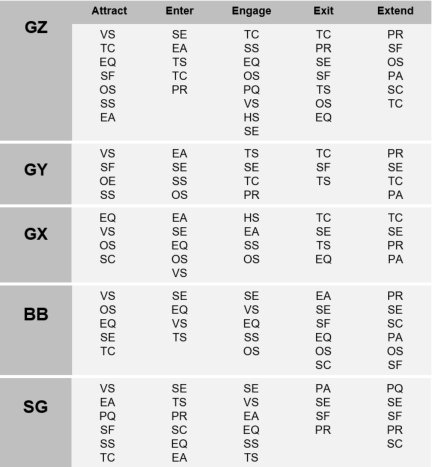
In Figure 1, it is possible to see how the different generations distributed the categories during the five moments of the experience. By analysing each category separately, relevant information was revealed.
Generations X and Y insights involving technology, for instance, were quoted during the end of the purchase experience, at the exit and extension phases. This is due to the fact that participants from these generations indi- cate the need for a faster exit, through faster payment methods and without human interference, such as self-checkout devices. As for the Silent Genera- tion and Baby Boomers, technology was evidenced at the beginning of the experience, by the moment of attraction. Users of these generations repor- ted that Instagram and other social networks can attract them to a physical store through images, comments and ratings; however, they prefer a more analogical relationship at the end of the shopping journey, through the staff assistance.
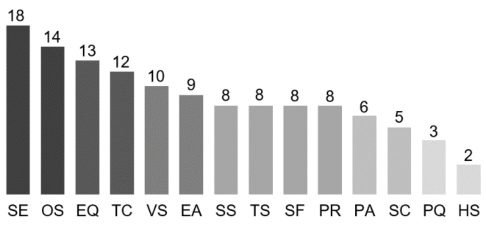
Solutions involving sensory stimuli (VS, OS, SS, TS, and HS) were widely mentioned by participants of all generations, being perceived mainly in the first stages of the experience, contemplating the moments of attraction, entry and engagement. During the engagement, they became even more evident, showing the great influence they exert on the user when he/she embraces the discovery and choice of the product. It was noticed that in all phases in which they were quoted, users presented ideas that led to a combination stimuli (see Figure 2).
432 Tonin and Nickel
Table 1. Categories and insights (Author. 2008).
Table available in the original PDF paper.
Category Insights VS or Visual Stimulus Showcase, product display, colors, presence of focal points, visual media (screens and televisions) OS or Olfactory Stimulus Global aromas, specific smells SS or Sound Stimulus Ambient sound, music TS or Taste Stimulus Offer of food and drinks, “treats” HS or Haptic stimulus Tasting and touching products, furniture texture EA or Environmental Arrangements
Circulation, accessibility, logical and clear sectorization, organization, breadth, layout SE or Service Empathy, information with ownership and security, accessible conversation, search for feedback, receptiveness TC or Technology Quick payment, pre- and post-sales contact, use of social networks, little human intervention, “instagrammable” spaces, use of applications and other facilitating devices EQ or Environmental Quality
Lighting and luminosity, environmental comfort, visual comfort, temperature, cleanliness, spaces for permanence (sitting) PQ or Product Quality Quality of materials, origin PA or Packaging Special care when packing, packing according to need, material innovation, possibility of using it as a bag (ecobag) SF or Surprise Factor Offer of “treats” and samples, presence of something that instigates curiosity, boldness, unusual element, breaking rhythms in the exhibition of products SC or Sustainability and Social Concern
Donations to communities, use of recycled materials, care with the origin of materials, non-polluting and reusable packaging PR or Personalization Customization, delivery of a card referring to the person by name (personal treatment), handmade elements, self-service, availability of different sizes
The olfactory stimulus was the most mentioned by all generations, mainly by Z and Baby Boomers, during the five moments of the journey. Shared ideas about this category were the second most cited category during the develo- pment of the exercise, second only to customer service, which for the sample of the experiment is the most important aspect in a physical store experience, especially for members of the Silent Generation and Baby Boomers. Users of the Silent Generation seem, in fact, to mention sensoriality more discreetly than the others.
In addition to technology and sensory stimuli, aspects related to environ- mental arrangements, personalization and surprise factors were also widely shared by the volunteers, the latter being evidenced during the attraction and extension phases. Generation Z shared insights involving the presence of unusual elements for the attraction phase, quoting a “chocolate foun- tain” and live music performances as possible solutions to attract them to
Experience Compelling Map: An Auxiliary Tool for User Experience Design 433
Figure 1: Experience compelling map by generation, showing the distribution of categories along the shopping journey. (Author, 2023).Figure 2: Occurrence of citation by category. (Author, 2023).
stores. Generation Y shared the need for a break in the rhythm of product exposure, as, according to the participants, “everything the same gets tiring”.
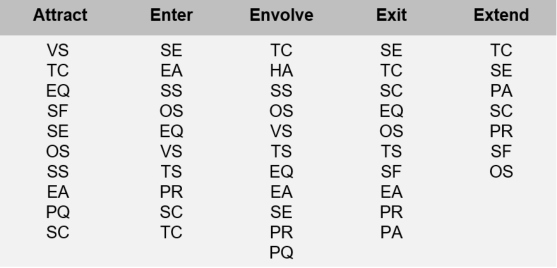
The experiences built by each of the generations were crossed and are pre- sented in a synthesis (see Figure 3). Through this, it is possible to see the distribution of categories, showing that actions aimed at each of them can be developed throughout all the five moments.
CONCLUSION
Based on the data obtained through the Experience Compelling Map, it is clear that the tool can be a great ally to the focus group method. The combination of the two methods brings a more sympathetic, integrated and detailed view; eliminating some disadvantages of the focus group method when applied alone, which are the lack of standardization and reliability. In this experiment, the methodology adopted for data collection and analy- sis enabled the election of 14 categories that can act as guidelines and thus optimize the user experience in physical retail.
From the tool, it can be seen which categories are important for each of the five moments of the experience according to users from different generations; which are the most quoted categories; and how they can be distributed along the shopping journey to improve experience design. The sample, although reduced, shows the particularities of each generation and gives an overview of the real interests and needs of consumers today. Since this research was based on the understanding of User-Centered Design, it is important to point out that the individuals were the ones who guided the Design process.
The experiments showed that the tool can significantly contribute to experience design processes, as it offers guidance so that solutions can be developed to benefit both brands and their users. It is up to the designer to guide the retailer so that the user’s desirability is balanced with the practicality and viability of the company (BROWN, 2010).
It is suggested to replicate this study with a larger sample of participants residing in different regions and countries, in order to perceive the different cultural nuances and how they could influence the categories that were listed by the users of each sample. However, given the complexity of conducting the focus group method and the tool used, a larger number of researchers would be required to collect and analyse all the data.
Experience Compelling Map: An Auxiliary Tool for User Experience Design 435
REFERENCES
Brown, T. (2010). Design thinking: uma metodologia ponderosa para decretar o fim das velhas idéias. Rio de Janeiro: Elsevier. Darley, W. K., Lim, J. S. (1993) Store-choice behaviour for pre-owned merchandise.
Journal of Business Research, Volume 21, pp. 17–31 Lowdermilk, T. (2018). User-centered design: a developer’s guide to building userfriendly applications. Sebastopol: O’Reilly & Associates. Martineau, P. (1958). The personality of the retail store. Harvard Business Review,
Volume 36, No. 1, pp. 47–55. Stanton et al. (2004). Handbook of human factors and ergonomics methods. Boca Raton: CRC Press. Sternberg, R. J. (2016). Psicologia cognitiva. 6ed. São Paulo: Cengage Learning. Tonin, P. E. H. (2021). Behavioral and cognitive methods to assess users and assist
physical point of sale experience design. In: The 21st Triennial Congress of the International Ergonomics Association – IEA2021, Vancouver. Volume 5, LNSS 223 proceedings.
LISTED IN THE AHFE DIGITAL BOOKSTORE CATALOGUE
Explore the complete digital volume
Usability and User Experience
Read this individual research paper free through the original publisher, or explore the full digital proceedings book.
ISBN 978-1-958651-86-5
Explore this ISBN in the AHFE Bookstore ↗Listed in the July 2026 bookstore catalogue; search by ISBN to confirm current availability · Digital book purchase optional