Ezaes Rashad Sultan Alazazi, Linong Dai (2023). Design of the living room based on the survey of children's parent-child families - Take Shanghai as an example. In: Usability and User Experience. AHFE Open Access, vol. 110, pp. 510–517. https://doi.org/10.54941/ahfe1003226
People's living standards have improved with the continuous development of the times. The lifestyles of today have changed dramatically, which has led to an increase in living space requirements. Additionally, young children's growth is particularly concerning to many people.The living room serves as the focal point for family communication and emotional interaction. Consequently, the living room receives more attention.We begin this paper by examining the family lifestyles of modern Chinese consumers, examining the life patterns of children's families, and demonstrating the importance of the living room through research, using the Shanghai area as an example, in order to improve the home market's understanding and attention to parent-child users so that products that fit their needs can be developed.
As China enters the era of experience economy, consumers are no longer buying goods just to meet the necessities of life, but more to pursue a new lifestyle and meet the emotional pursuit. This is also reflected in the incre- asing importance they attach to living space, with per capita consumption expenditure on living in China reaching 5,641 yuan in 2021, an increase of 8.2%. At the same time, the size of the children’s furniture market also rea- ched 131.36 billion yuan, and is in a growing trend. It can be seen that the Chinese residents for housing consumption demand is increasing year by year, at the same time, for children’s living environment is also increasingly impor- tant, which also brings great benefits for the parent-child home market. In the home environment, the family’s main and also the longest time together is the living room, parents and children a lot of parent-child interaction is also in the living room, but many living room designs on the domestic mar- ket are on the adult side, more to meet the needs of adults in their daily lives, ignoring the needs of young children growing up.
RESEARCH SCOPE Children Aged 3–6 Years
The age of 3 to 6 years is the golden period for children’s character develo- pment and the most sensitive period for children’s personality development.
Design of the Living Room Based on the Survey of Children’s Parent-Child Families 511
After a particular sensitive period, children’s motivation and interest will fade or disappear, so it is especially important to study the living environment of children aged 3 to 6 years for children’s growth, and this age is also an important age for developing good habits and establishing a sense of rules.
Parent-Child Families in Shanghai In this study, Shanghai parent-child families were chosen as the scope of the study area. Shanghai is represented as the number one international metro- polis in China in terms of economy and trade. The improved quality of life has led parents to pursue a higher level of quality of life and pay more atten- tion to the future development of their children and the improvement of the quality of life brought by the environment.
PARENT-CHILD FAMILY AND LIVING ROOM DESIGN Research Related to Early Childhood Home Environment and Living Room Design
The surrounding environment plays an important role in the development and growth of human intelligence. The environment includes both internal and external environments, and when children are in childhood, the environ- ment is very critical to their growth and development, and most of the time they discover, learn, and grow from the environment they are exposed to. According to research in environmental psychology, children’s adverse sym- ptoms can be improved by reasonable consideration of the design of the living room environment, which can be improved for children who view the status quo (Lin, 1997). Researcher Mao Mao (1997) also suggested that the envi- ronment and education will affect people’s lives, and the atmosphere created by children’s space will also be able to influence children’s growth, develo- pment and learning. At the same time, Shi et al. (2004) also proposed that residential space should be people-oriented, and they summarized the design methods from function, space division, children’s furniture and furnishings by studying the changes of children’s physiology and psychology, and sum- marizing the space of children’s room at school age should be simple and clear with practical functions.
It can be seen that a reasonable space for children will have a positive impact on them, cultivating their good habits, shaping their personality, having a positive meaning on aesthetics and even enhancing the quality of the educational aspect.
The environment is shaped by the interaction between children and their environment, primarily through their activities in the environment.
The most common behaviors that children engage in at home are: playing alone, parent-child interaction, visiting socialization, interest learning, aca- demic learning, short sleep rest, long sleep, eating, and exercise. Depending on the nature of these activities, they can be classified as dynamic and sta- tic activities. Also, young children’s behaviors are influenced by family and society, and there are significant differences between weekdays and holidays.
512 Ezaes and Dai
Living Room Design A living room, in professional terms, is a place dedicated to entertaining gue- sts. In China, most people have a living room that serves both as a place to receive guests and as a place for daily living. How to design the living room reasonably, to achieve the best effect, mainly through the division of space, interface design and treatment, furniture arrangement, furnishings and ligh- ting design to bring out the overall atmosphere and achieve the desired effect (Li, 2018).
With the change of society, people’s living habits have changed and the family structure has quietly started to change. Especially within large cities, the previously large family-type group living gradually diverged into multi- ple small-scale families living alone. Since then, the living room’s consecration and ritual functions are gradually weakening, with more and more emphasis on meeting the needs of the modern family’s internal living life. Most con- sumers believe that the living room needs to be more of a multi-functional family sharing space in addition to aesthetic and meeting functions (Wang, 2011).
Living Room Design for Parent-Child Families The living room, as the center of the home environment, is the main place of recreation for the family, and most families still choose to keep it, especially for parent-child families. Children in early childhood are still young, so they still need to act under the control of their parents, and this is when parents usually let their children move around in the living room, so that they can supervise them. At the same time, the living room is also one of the main pla- ces for parent-child family interaction and entertainment, and parent-child interaction helps to promote the exchange of emotions between parents and children, forming a harmonious and warm family atmosphere, which has a direct impact on children’s cognitive development, happy growth and social development, and at the same time, in the process of getting along with chil- dren, a simple and happy atmosphere can also make parents calm and happy to communicate, relieving life and When parents are in a good state of mind, what they can pass on to their children is a positive and optimistic attitude, so that the children have a positive example to learn from in terms of perso- nality development. This is an important influence on the child’s growth and development.
RESEARCH AND ANALYSIS OF PARENT-CHILD FAMILY LIVING ROOM ACTIVITIES FOR YOUNG CHILDREN IN SHANGHAI Qualitative Research Design
Based on the summary of the desktop study, it is possible to understand the diversity and complexity of young children’s activities in the home envi- ronment. In order to determine the relationship between their integrity and activities A small sample of qualitative research was used to conduct observations and interviews.
Design of the Living Room Based on the Survey of Children’s Parent-Child Families 513
The structure of the qualitative research was divided into 3 parts. First, basic information was collected about the children and families. Second, the living room was observed to understand parents’ attitudes and current functi- onal use, and finally, interviews were conducted to get a complete picture of all the children’s activities at home by interviewing them about the flow of their day on weekdays and holidays.
Findings from the Qualitative Research First of all, the activities of young children in the overall house can be divided into two major categories, dynamic activities and static activities (Table 1). Through qualitative research, it was found that most of the activities of young children are conducted in the guest dining room, especially dynamic activities. Some of the static activities such as short sleep lounging and long sleep were conducted in the relatively quiet children’s room or master bedroom. On working days, children’s behavioral activities at home would be relatively less than those on holidays, but without affecting the location where they occurred, they still occurred mainly around the living room.
Table 1. Children’s home behavior activities.
Table available in the original PDF paper.
Dynamic Playing alone Parent-child interaction Visiting Social Exercise Static Interest in learning Academic Learning Short sleep rest Eating Long sleep
Questionnaire Quantitative Research Questionnaire Design Qualitative research was used to compile all the activities that young children do in the residence. From there, a foundation and framework for quantitative research was established. All activities of children in the home environment were organized into scale questions, and parents were asked to score their children’s behavior in each room by observing them using Richter’s 5-point scale.
Questionnaire Collection In this study, a random sample of only-child families with children aged 3 to 6 years old in Shanghai was selected as the study population. A total of 129 questionnaires were collected, and 94 were valid. In the questionnaire, besides the basic information, the city, the child’s situation, the permanent resident, and the home situation were also added in order to select the users
514 Ezaes and Dai
who meet the requirements. The questionnaire also asked about the children’s daily routine at home, including two different schedules of holidays and weekdays, the children’s main behavior in the living room, and the parents’ rating of the importance of the living room.
LIVING ROOM DESIGN BASED ON RESEARCH AND ANALYSIS OF YOUNG CHILDREN’S FAMILY ACTIVITIES Through the analysis of quantitative research data, the behavior and needs of children at home and parents’ attitudes toward the living room were analyzed and summarized to identify the needs of modern child-friendly family living room design.
Attitudes of Parent-Child Families Toward the Living Room In the survey on the importance of living room scoring, 94 respondents, more than 90% of people chose “very important” and “important”. Among them, 72.83% chose “very important”, 23.91% chose “important”, and only thirty-two percent chose “average”. No one chose “very unimportant” or “unimportant”. This shows that the majority of modern families with young children attach great importance to the living room and consider it an essential area of the home.
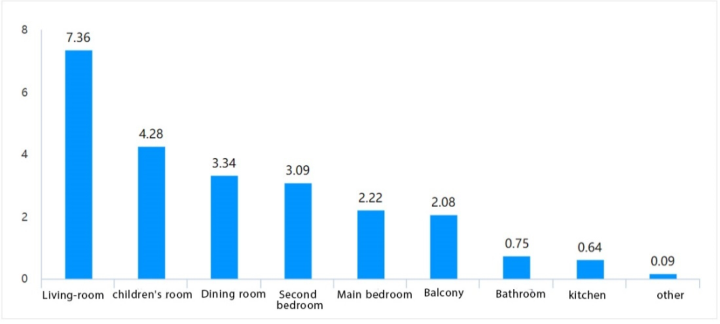
At the same time, the study compared different rooms in the home environ- ment for children’s activities (excluding sleeping). This shows that children spend most of their time in the living room.
Figure 1: Ratio of space for children’s daily activities rating scale.
Comparison of Children’s Activities in Each Room As seen in Figure 1, most of the children’s behaviors in the home occurred in the living room, followed by the children’s room, and the balcony, the closest space to the living room, was often associated with some of the children’s activities. There are relatively few behaviors that occur in other rooms as seen in Table 2.
Design of the Living Room Based on the Survey of Children’s Parent-Child Families 515
Table 2. Table of children’s home activity behavior.
Table available in the original PDF paper.
Topic Selection Living room Children’s room Master bedroom Second bedroom Restaurant Restrooms Kitchen Balcony Other
Table 3. Importance of living room needs for young children.
Table available in the original PDF paper.
Title \ Options Very important Important General Not important Very unimportant
Can be recreational 31 (33.7%) 50 (54.35%) 8 (8.7%) 2 (2.17%) 1 (1.09%) Parent-child activity area 28 (30.43%) 56 (60.87%) 7 (7.61%) 1 (1.09%) 0 (0%) Can be properly exercised 11 (11.96%) 27 (29.35%) 26 (28.26%) 18 (19.57%) 10 (10.87%) There is an eating area 8 (8.7%) 27 (29.35%) 23 (25%) 29 (31.52%) 5 (5.43%) You can watch TV 19 (20.65%) 42 (45.65%) 27 (29.35%) 3 (3.26%) 1 (1.09%) Visiting Social Area 60 (65.22%) 19 (20.65%) 8 (8.7%) 4 (4.35%) 1 (1.09%) Hobby Zone 30 (32.61%) 48 (52.17%) 13 (14.13%) 1 (1.09%) 0 (0%) Academic Learning Zone 14 (15.22%) 27 (29.35%) 47 (51.09%) 3 (3.26%) 1 (1.09%) Nap lounge area 17 (18.48%) 10 (10.87%) 16 (17.39%) 32 (34.78%) 17 (18.48%)
516 Ezaes and Dai
The top rated behaviors in the living room were “playing alone”, “parent- child inte-raction”, “visiting socially”, “interest learning”, and “academic learning”. Some children also engage in physical exercise and eating in the living room. From this, we can see that the living room is mainly contracted for children’s dynamic activities, while the static activities are carried out in the children’s room and other areas of the home.
The Importance of Each Behavioral Need of Young Children in the Living Room Further analysis was conducted on the scale of parents’ perceived behavi- oral needs of their children in the living room. As seen in Table 3, parents rated the importance of “relaxation and entertainment”, “parent-child acti- vity area”, “visiting social area”, “hobby area”, followed by “can watch TV”, and “can exercise properly”, “have food area”, “academic study area”, and “can study”. The demand for “academic study area” and “nap area” is not high. In descending order of rating, “parent-child activity area”, “recreation area”, “visiting social area”, “hobby area”, “can watch TV”.
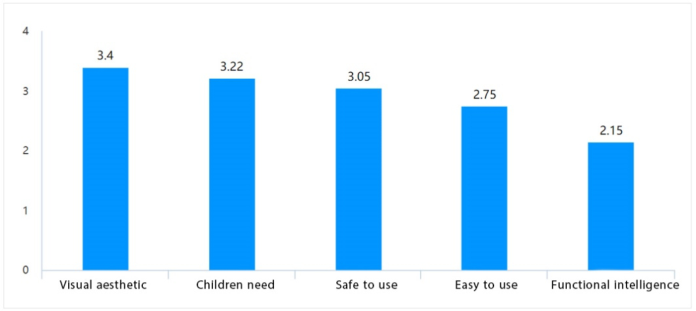
Analysis of the Spiritual Needs of Young Children’s Parent-Child Family Living Room Design The living room is designed to meet the spiritual needs of the family, in addition to the specific functions of carrying activities. In the ranking of the importance of living room decoration can be seen (Figure 2), parents in the living room decoration, the first thing to consider is the visual aesthetic needs of the living room, and then to meet the living room aesthetic needs, the first thing to consider is the growth needs of children, followed by the use of safety, it can be seen that young parents in the living room decoration, the growth needs of children is also the decoration of the living room The first consideration is the growth needs of the child.
Figure 2: Decoration importance ranking.
Design of the Living Room Based on the Survey of Children’s Parent-Child Families 517
CONCLUSION
This study verifies the argument that the living room is increasing in impor- tance in modern parent-child families by examining factors such as the daily habits of young children users in parent-child families. The study also conclu- des that the living room carries most of the activities of young children, especially dynamic activities. And the parents’ attitude and demand for the design of the living room. Although this paper verifies the importance of the living room, specific design guidelines and solutions require more rigorous and detailed user needs mining to develop appropriate products for them. With the continuous improvement of economic development and change of lifestyle, modern parent-child families have more needs for home environ- ment. It is hoped that this study can raise the home market’s attention to the needs of parent-child families in the living room environment and create sui- table products for them to create a more comfortable and beautiful life for parent-child families.
REFERENCES
Li, Yanwei. (2018). Study on the evolution of domestic living room, Shanxi Architecture Volume 44 No. 4. Lin, Xiaoya. (1997). Room beautification and human healt. Beijing: Chemical
Industry Press. Mao, Xiaoguang. (1997). Human growth and development. Beijing: Social Sciences Academic Press China. Shi, Xiaojuan, Yang, Chuangchuang, Liu, Yansong and Jiang, Lihua. (2004). Rese-
arch on design of children living environment, Journal of Northwest Forestry University Volume 19 No. 4. Wang, Tao. (2011). From spiritual hall to living- room: the change of living-room in Chinese housing, Design Community Volume 2 No. 4.
LISTED IN THE AHFE DIGITAL BOOKSTORE CATALOGUE
Explore the complete digital volume
Usability and User Experience
Read this individual research paper free through the original publisher, or explore the full digital proceedings book.
ISBN 978-1-958651-86-5
Explore this ISBN in the AHFE Bookstore ↗Listed in the July 2026 bookstore catalogue; search by ISBN to confirm current availability · Digital book purchase optional