Kimi Ueda, Maho Sasaki, Ayumi Noda, Hirotake Ishii, Hiroshi Shimoda (2023). An Experimental Examination of the Effects of the Invisible Human Experience on Self-esteem. In: Human Systems Engineering and Design (IHSED 2023): Future Trends and Applications. AHFE Open Access, vol. 112, pp. 258–263. https://doi.org/10.54941/ahfe1004136
Moderate self-esteem is considered desirable from perspectives such as leading to effective decision-making (Baumeister et al. 2003; Kirkpatrick and Ellis 2003). One factor that can lead to low self-esteem is the perceived large difference between the ideal self and the actual self-views (Bills, Vance, and McLEAN 1951; Hannover, Birkner, and Pöhlmann 2006). Therefore, we hypothesized that through an experience as if one had become an “Invisible Human”, self-esteem reduction could be prevented by diminishing one's existence and removing their awareness of comparing one's ideal self with one's actual self-views. The purpose of this study is to evaluate the impact of the Invisible Human experience of the invisible human on self-esteem.In the experiment, participants experienced the Invisible Human experience through Augmented Reality (AR). (1) the feeling of being an invisible human, (2) the sense of one's physical self-presence, (3) the self-evaluation consciousness, (4) the difference between the ideal self and the real self, and (5) state self-esteem scale were evaluated through questionnaires before and after the AR experience. In the experience, images acquired using a camera attached to a head-mounted display (HMD) were processed in real-time to create an image in which only the body of the participants seems to have disappeared from the real view, which was then presented on the HMD. Valid data obtained were N=24 (15 females and 9 males, age 21.3²2.3 years).The results showed that Significant differences were found in (1), (2), and (3) before and after the experience, which indicates that the Invisible Man experience made participants feel more as if they were invisible, their sense of self-presence decreased, and their self-evaluation consciousness weakened. There was also a tendency for (4) the difference between the ideal self and actual self-views to become smaller. However, there was no significant difference in the (5) state self-esteem scale. The impact of the Invisible Human experience might change depending on the participants' usual level of self-esteem. If low self-esteem can be high and high self-esteem can be low, then the Invisible Human experience may work effectively to maintain their self-esteem to be moderate. In future studies, more evaluations with a larger number of participants are needed.Baumeister, Roy F., Jennifer D. Campbell, Joachim I. Krueger, and Kathleen D. Vohs. 2003. “Does High Self-Esteem Cause Better Performance, Interpersonal Success, Happiness, or Healthier Lifestyles?” Psychological Science in the Public Interest: A Journal of the American Psychological Society 4 (1): 1–44.Bills, R. E., E. L. Vance, and O. S. McLEAN. 1951. “An Index of Adjustment and Values.” Journal of Consulting Psychology 15 (3): 257–61.Hannover, Bettina, Norbert Birkner, and Claudia Pöhlmann. 2006. “Ideal Selves and Self-Esteem in People with Independent or Interdependent Self-Construal.” European Journal of Social Psychology 36 (1): 119–33.Kirkpatrick, Lee A., and Bruce J. Ellis. 2003. “An Evolutionary-Psychological Approach to Self-Esteem: Multiple Domains and Multiple Functions.” Blackwell Handbook of Social Psychology: Interpersonal Processes, 409–36.
Moderate self-esteem is considered desirable from perspectives such as lead- ing to effective decision-making (Baumeister et al., 2003; Kirkpatrick and Ellis, 2003). One factor that can lead to low self-esteem is the perceived large difference between the ideal self and the actual self-views (Bills, Vance, and McLEAN 1951; Hannover, Birkner, and Pöhlmann, 2006). Therefore, we hypothesized that through an experience as if one had become an “Invisible Human”, self-esteem reduction could be prevented by diminish- ing one’s existence and removing their awareness of comparing one’s ideal self with one’s actual self-views. This study aims to evaluate the effect of the invisible human experience on self-esteem and relevant psychological factors.
METHOD
In the experiment, participants experienced the invisible human experience through Augmented Reality (AR) and answered some questionnaires.
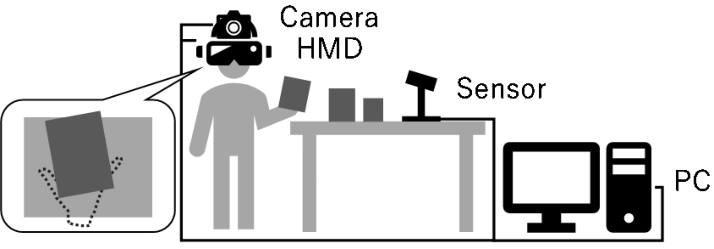
An overview of the system is shown in Figure 1. In this system, a camera (UCAM-CX80FBBK) acquires images of the user’s perspective and transfers
An Experimental Examination of the Effects of the Invisible Human Experience 259
them to a PC. The PC uses the network to generate an image in which the body is invisible. Then the PC displays this image on the HMD. Some objects are placed on the desk, and the user can touch or lift them even when the user’s body is invisible.
Figure 1: Experimental system overview.
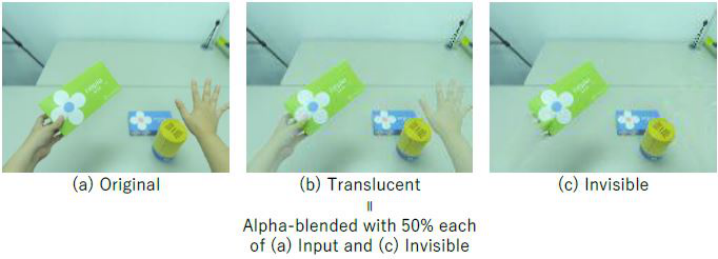
Three types of AR experiences were prepared, as shown in Figure 2. The experimental procedure is shown in Table 1. The (a) original is the video acquired by the camera attached to the head-mounted display (HMD) and displayed on the HMD as is in real-time and was used as a practice experience to familiarize the participants with the view while wearing the HMD. In the (c) invisible human experience, images acquired by a camera attached to an HMD were processed in real-time using deep learning, and presented on the HMD as if only the participant’s body had disappeared from the real view. In the subjective evaluation questionnaire described below, some items were difficult to answer if the participants only saw the images in which their arms and legs were visible. Thus, we prepared the (b) translucent experience, real-time images that alpha-blended with 50% each of (a) and (c). After the translucent experience was treated as “before” and after the transparent experience as “after” the (c) invisible human experience.
Figure 2: Three kinds of AR experiences prepared for the experiment.Table 1. Experimental procedures.
Table available in the original PDF paper.
Procedure Time (min.)
10
Explanation, participation consent 15 Change of appropriate clothes for imaging, practice wearing HMD The experimenter exits from the room to prevent observer bias.
Instructions were provided via recorded voice. AR experience practice using (a) original view 3 Questionnaire: self-esteem, short break 3 AR experience (b) translucent 5 Questionnaire: all five questionnaires, short break 5 AR experience (c) invisible 5 Questionnaire: all five questionnaires 3 The experimenter enters the room Interview 10 Reward procedure 5
In the (c) invisible human experience as shown in Figure 2, we devised the learning data so that even when an object placed in the experience space is lifted, only the hand holding the object disappears and the object appears to float. In addition, the instruction during the experience was unified with the same wording in all conditions, and the participants were instructed to lift the prepared object. In this way, we devised the (c) invisible human experience that is not one in which the subject’s body “disappears”, but one in which the subject’s body “exists” and can touch something, but the body is just “invisible”.
Because there was concern that wearing glasses would make it difficult to wear the HMD and affect the evaluation of the experience, we required applicants to have normal vision with either naked eyes or contacts when recruiting participants.
For subjective evaluations, five questionnaires were conducted: state self- esteem scale, the sense of one’s physical self-presence, feeling of invisibility, the self-evaluation consciousness, and the difference between the ideal self and the real self. The questionnaire detail is shown in Table 2.
Table 2. Subjective evaluation index.
Table available in the original PDF paper.
Index Questionnaire detail State self-esteem scale (Abe and Konno 2007) Self-esteem - Composed of 9 items on a 5-point Likert scale - Sum of responses for each item used as self-esteem score Original questions: 5-point Likert scale (1: Disagree, 5: Agree) Self-presence “Compared to usual, I felt as if my body did not exist.” Invisibility “I felt like I was an invisible human.” Self-evaluation “Compared to usual, I felt less inclined to evaluate myself.” Self-views gap “Compared to usual, I felt like I was closer to my ideal self.”
An Experimental Examination of the Effects of the Invisible Human Experience 261
In the interview session, four questions were asked: “Did you feel your body was invisible?”, “What was the reason that you felt you were invisible or not invisible? When did you feel that?”, “Did you feel any change in your mood by AR experiences?”, and “What is your usual self-perception of self- esteem? Did the AR experiences affect your self-esteem?” Participants were also allowed to respond freely after four questions.
RESULT
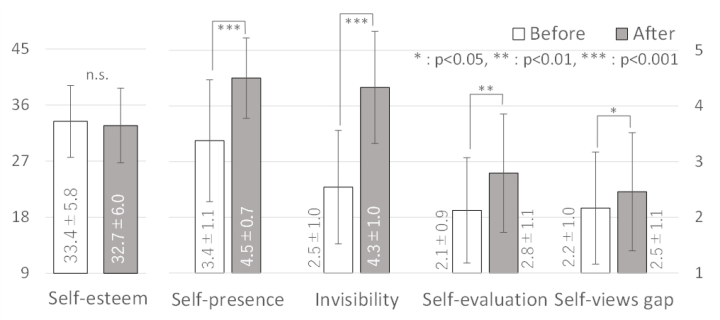
Valid data obtained were N = 24 (15 females and 9 males, age 21.3±2.3 years). The results of each subjective evaluation before and after the (c) invisible human experience and the results of the t-test are shown in Figure 3.
There was no significant difference in the state self-esteem scale before and after the (c) invisible human experience. The results showed that Significant differences were found in self-presence, invisibility, and self-evaluation before and after the invisible human experience, which indicates that the invisi- ble human experience made participants feel more as if they were invisible, their sense of self-presence decreased, and their self-evaluation consciousness weakened. There was also a tendency for the self-views gap to decrease.
Figure 3: The average scores of the five questionnaires before and after the invisible human experience.
DISCUSSION
Among the subjective evaluations, the self-presence and the invisibility: the sense of being an invisible human increased significantly after the (c) invisi- ble human experience. The experience was designed with the idea that the invisible human is the one whose body exists and can touch things, but whose appearance is invisible. However, the results also indicated that even if people know they can touch things, their sense of self-presence is similarly diminished. In interviews, some participants said, “When I heard the word ‘invisible human,’ I imagen someone who would go through things when I tried to touch them, so I felt uncomfortable (being able to hold things),” or “It would be more like an invisible person if I could vaguely see the outline of
the person.” Therefore, it is possible that individual differences in the image of the invisible human had some effect on the experimental results.
In addition, the sense of self-evaluation was significantly lower after the Invisible Man experience, and the gap between the ideal and real self-views tended to be diminished. However, there was no significant dif- ference in self-esteem. Initially, it was thought that diminishing the sense of self-evaluation and the narrowing of the gap between their real and ideal selves would eliminate the factors that reduced their sense of self-esteem, increasing self-esteem. However, this tendency was not observed as a sta- tistical difference. Based on the interviews, we will discuss the impact of the experience.
Some participants showed particular differences in self-esteem scores before and after the (c) invisible experience in the subjective evaluation ques- tionnaire. The two participants whose self-esteem scores increased the most after the experience had the highest scores, with a difference of 3 points, both of whom reported that their usual self-esteem was low. On the other hand, there was one participant whose self-esteem score decreased the most after the experience, with a difference of 8 points, and one participant had a difference of 7 points. Both of these two participants reported rel- atively high usual self-esteem. Although it was difficult to infer from the interviews the reason for the change in self-esteem scores for these four participants, it could be inferred that the impact of the invisible human experience might differ depending on whether usual self-esteem was high or low.
Among those who reported low usual self-esteem, those who said that dur- ing the invisible human experience, “I was immersed in the experience and my thoughts were shut down”, “I had the impossible experience of becoming invisible and had a universal feeling that I could do anything”, and “I enjoyed the experience and my self-esteem may have increased.” However, their self- esteem scores before and after the experience showed different trends of +1, −1, and +2, suggesting that the experience did not lead to a uniform improvement in self-esteem.
One participant who reported in the interview that they usually had high self-esteem said about the invisible human experience, “I felt scared and alone. I felt like my existence was threatened, and I lost confidence.” Another participant who answered that they did not know their usual self-esteem and whose self-esteem score after the practice experience was moderate: 29, also said “I might have felt anxious because I felt like I was going to disappear.” Although there were no changes in the self-esteem scores in both cases, it inferred that strongly reduced self-presence could cause some negative effects.
Other statements that the experience was fun, interesting, or happy were obtained from 13 of the total 24 participants. Self-esteem after the practice experience averaged 33.0 (SD = 5.3, Md = 37) for those participants who said positive emotions, and 32.4 (SD = 6.2, Md = 29) for the others. It is generally believed that there is a correlation between positive emotions and high self-esteem, and it is also said that people with higher self-esteem are more likely to get affected by positive emotions (Wood et al., 2003). It might have been the case in this experiment. Although we did not include items
An Experimental Examination of the Effects of the Invisible Human Experience 263
related to the mood in the subjective evaluation items, it might be possible that mood could be involved in the mechanism of the effects of the experience.
CONCLUSION
In this study, we attempted to examine the effect of the experience as if one becomes an invisible human on self-esteem through an experiment. Results showed that the invisible human experience made the participants feel as if they had become invisible indeed, reduced the gap between the ideal and the real self-views, and reduced their self-evaluation consciousness. On the other hand, there might be individual differences in the effect on self-esteem, and although no overall trend was obtained in results statistically. Interview results inferred that those with high usual self-esteem might experience a reduction in self-esteem by the invisible human experience, and vice versa.
There were some limitations in this study, such as the short duration of the experience and the limited space for the experience, which could diminish the effect of the experience. In future studies, it is required to conduct evalu- ation experiments with a larger number of participants to consider individual differences in the effects, to ask participants about their usual self-esteem in advance, and to examine other items such as mood that are relevant to the influence mechanism.
REFERENCES
Abe, Miho, and Hiroyuki, Konno. (2007). “Development of State Self-Esteem Scale (in Japanese).” The Japanese Journal of Personality Volume 16. No. 1. pp. 36–46. Baumeister, Roy F., Jennifer D. Campbell, Joachim I. Krueger, and Kathleen D. Vohs.
(2003). “Does High Self-Esteem Cause Better Performance, Interpersonal Success, Happiness, or Healthier Lifestyles?” Psychological Science in the Public Interest: A Journal of the American Psychological Society Volume 4 No. 1. pp. 1–44. Bills, R. E., E. L. Vance, and O. S. McLEAN. (1951). “An Index of Adjustment and Values.” Journal of Consulting Psychology Volume 15 No. 3 pp. 257–261. Hannover, Bettina, Norbert Birkner, and Claudia Pöhlmann. (2006). “Ideal Selves
and Self-Esteem in People with Independent or Interdependent Self-Construal.” European Journal of Social Psychology Volume 36 No. 1 pp. 119–133. Kirkpatrick, Lee A., and Bruce J. Ellis. (2003). “An Evolutionary-Psychological Approach to Self-Esteem: Multiple Domains and Multiple Functions.” Blackwell Handbook of Social Psychology: Interpersonal Processes, pp. 409–436. Wood, Joanne V., Sara A. Heimpel, and John L. Michela. (2003). “Savoring ver-
sus Dampening: Self-Esteem Differences in Regulating Positive Affect.” Journal of Personality and Social Psychology Volume 85 No. 3 pp. 566–580.
LISTED IN THE AHFE DIGITAL BOOKSTORE CATALOGUE
Explore the complete digital volume
Human Systems Engineering and Design (IHSED 2023): Future Trends and Applications
Read this individual research paper free through the original publisher, or explore the full digital proceedings book.
ISBN 978-1-958651-88-9
Explore this ISBN in the AHFE Bookstore ↗Listed in the July 2026 bookstore catalogue; search by ISBN to confirm current availability · Digital book purchase optional