Frank Wawrzik, Johannes Koch, Sebastian Post, Christoph Grimm (2023). AI-Enabled Semantic Modeling for Enhanced Boardnet Integration in Automotive Design. In: Artificial Intelligence, Social Computing and Wearable Technologies. AHFE Open Access, vol. 113, pp. 279–289. https://doi.org/10.54941/ahfe1004200
The integration of artificial intelligence (AI) techniques in the automotive industry has revolutionized various aspects, including object identification, hazard recognition, speech recognition, and driver assistance. In this scientific paper, we propose a novel approach that leverages AI to enhance the integration of boardnet design in the automotive domain. The primary objective of the boardnet is to ensure reliable power distribution, efficient energy management, data communication, effective sensor integration, precise actuator control, and the integration of advanced features while prioritizing safety, reliability, and optimal performance of the vehicle's electrical system.Our proposed model utilizes inference-based AI techniques, incorporating both external and internal routing AI within a semantic framework. By aligning the model with a top-level ISO 26262 standard definitions ontology, we establish a systematic systems and electronics semantic framework that seamlessly integrates with existing design processes. The model accommodates the expertise of system engineers and knowledge engineers, enabling the harmonious integration of their distinct approaches.Furthermore, this paper explores the automation of design process gaps through the deduction of valuable information. By employing OWL DL 2 and logical axioms, we demonstrate the reasoning capabilities of our approach, highlighting its advantages in terms of speed, usability, and integration within the overall design process.The integration of AI and semantic modeling in boardnet design facilitates intelligent decision-making, optimization, and automation. The semantic framework enables a comprehensive understanding of the boardnet and its components, improving the efficiency and effectiveness of the design process. The proposed approach contributes to the advancement of automotive design and development practices, enhancing power distribution, energy management, data communication, sensor integration, actuator control, and the integration of advanced features.To validate the effectiveness of our approach, we conducted a series of experiments and evaluations. The results demonstrate that AI-enabled semantic modeling significantly improves the boardnet integration process. It facilitates improved power distribution, makes the energy management more pervasive, the data exchange among components seamless, and precises regulation of actuators. Moreover, the integration of advanced features becomes smoother, providing enhanced functionalities to vehicles while maintaining safety, reliability, and optimal performance.Additionally, we highlight the practical implications of our research by discussing real-world use cases. By using property classifications, inverse object properties, property chains and complex class expressions, the design process is amended by filling additional and complementary information which reduces development time. The benefits extend to increased vehicle performance, and reduced maintenance requirements.In conclusion, this paper establishes the significance and potential of AI-enabled semantic modeling for boardnet integration in automotive design. By leveraging AI techniques and semantic frameworks, engineers and researchers can achieve superior design outcomes, drive innovation, and meet the evolving demands of the automotive industry. The experimental results and real-world use cases presented herein provide a solid foundation for further exploration and adoption of AI in boardnet integration, contributing to the advancement of automotive technologies and the realization of intelligent, efficient, and reliable vehicles.
AI and semantic modeling play a crucial role in the design and integration of modern boardnet architectures. AI-driven algorithms can optimize the place- ment and connectivity of electronic components, leading to reduced wiring complexity, improved energy efficiency, and enhanced data flow.
Semantic modeling allows for a higher-level understanding of the inter- actions between components, enabling a more comprehensive and efficient boardnet design. By applying AI to analyze large datasets and simulate dif- ferent scenarios, designers can identify optimal configurations and make data-driven decisions.
AI-driven boardnet design offers numerous advantages over traditional methods. Firstly, it enables a more systematic and efficient design pro- cess, reducing development time and costs. AI algorithms can analyze vast amounts of data and simulate complex scenarios, leading to optimized archi- tectures that meet performance, safety, and cost targets. Secondly, the integra- tion of AI and semantic modeling allows for a holistic approach to boardnet design, considering various factors simultaneously. This results in better coordination between different vehicle systems and improved compatibility
with future technologies. Thirdly, AI-driven boardnet design enhances func- tional safety and reliability. AI algorithms can identify potential failure points and suggest redundant pathways or fail-operational strategies, making the boardnet more robust. Finally, AI-based design methodologies enable faster adaptation to changing regulatory requirements and customer preferences. By using digital twins, engineers can test different configurations and assess their compliance with regulations before implementing them in physical vehicles.
STATE-OF-THE-ART Complex systems have long been subject to agile development, which priori- tizes flexibility over fixed initial designs (Beck et al., 2001). This is extended to operations by the DevOps mindset, allowing for quick upgrades (Bass, Weber, and Zhu, 2015). Robust deployment, fail-safe operations, and auto- mated testing are all components of a more stringent application known as iDevOps. However, there is no effective automated testing approach for sec- tors like the automotive. It can be difficult to close this gap, especially for safety-critical, complicated, and heterogeneous systems (Zimmerer, 2018). Adding hierarchy and composing components to handle complexity is one such method. Fundamental knowledge is provided through research in the area of hybrid system runtime verification (Frehse, 2006).
Reasoning in the context of the semantic web refers to the process to make inferences based on logical axioms. Hereby the axioms are restrictions on concepts, triples, object properties, datatype properties or others. Based on these restrictions explicit and implicit conclusions can be drawn. For exam- ple, by defining the “part of” property as the inverse of the “has part” object property, we now can traverse the part structure not only from bottom up but now also semantically from top to down. The missing class relationships get inferred by the reasoner. E.g. “system has part engine” now creates the addi- tional triple “engine part of system” which was not stated explicitly before the reasoning process, but is now made explicit with an additionally entry in the knowledge base.
Reasoning in semantic models is still rare, because most ontologies are built as domain models and thus usually just describing classes and their rela- tionships. Here, this works contributes by integrating various reasoning types actively in a use case boardnet model. In the caligraph ontology (Heist and Paulheim, 2022) mostly fill new instances with relationships with “hasValue” restrictions. The GENIAL! Basic Ontology (Wawrzik and Lober, 2021) has a tight ontological commitment to only allow concepts which are the exact words by differentiating it from related concepts. The human disease ontol- ogy (Shriml et al., 2021) is mostly a taxonomy with labels. It has relatively to its size few object properties with no complex expressions. In (Lu et al., 2023) the authors, like this work, use both OWL and SysML/OCL in conjunction to detect inconsistencies in their models, whereas we use it here to amend the knowledge construction process. They also translate SysML to OWL and use consistency check over state machines. (Riboni and Bettini, 2011) cre- ate an activity ontology and use it for reasoning in distributed environments
AI-Enabled Semantic Modeling for Enhanced Boardnet Integration in Automotive Design 281
and for sensor data aggregation. (Batsakis et al., 2016) implement a tem- poral reasoning approach. For this they combine OWL with SWRL and implement complete and tractable reasoning with time instants and intervals and natural language expressions like “before” and “after.” In the work of (Weser et al., 2020) a metamodel based on an ontology is presented, which is also rather a domain ontology, but which also demonstrates some reasoning to deduce implicit capability facts. In comparison to this work, they focus more on complex class expressions to assess the feasibility by checking if certain resources match the required manufacturing task.
BOARDNET DESIGN OVERVIEW AND GOALS The boardnet in the automotive industry refers to the electrical system responsible for energy supply, communication, and data exchange between various electronic components within the vehicle. As automotive technology advances and the demand for smart, connected vehicles grows, the role of boardnet design becomes increasingly critical. The effective integration of electronic systems is vital for achieving optimal vehicle performance, safety, and efficiency. This section introduces the importance of boardnet design in modern vehicles and the challenges it faces.
In the past, vehicles had relatively simple electrical systems, consisting of basic lighting and ignition systems. However, with the evolution of automo- tive technology, the boardnet has become significantly more complex. It now includes power distribution, electronic control units (ECUs), sensors, actua- tors, infotainment systems, and advanced driver-assistance systems (ADAS). The boardnet serves as the central nervous system of the vehicle, facilitating communication between different subsystems and enabling seamless vehicle operation.
With the introduction of more electronic components, the length and weight of wiring harnesses increased substantially, leading to cost and space constraints. This issue prompted the development of multiplexed wiring solutions to reduce the number of wires required. As vehicles transitioned to electric powertrains and advanced driver assistance systems (ADAS), the demand for higher data rates and faster communication protocols emerged, further influencing boardnet design.
Requirements and Challenges Boardnet design in modern vehicles is subject to stringent requirements and challenges. The increasing number of electronic components, varying voltage levels, data communication demands, functional safety, and electromagnetic compatibility are some of the key challenges faced by designers and engineers.
One of the primary challenges is to strike a balance between the growing number of electronic components and the weight, complexity, and cost of the wiring harness. As new vehicle features, such as electric powertrains and advanced driver-assistance systems, are integrated, the demand for power and data transmission increases, putting additional strain on the boardnet.
Ensuring functional safety and reliability is of utmost importance, espe- cially in the context of automated driving. The boardnet must be designed to
handle fault tolerance, fail-operational capability, and redundant communi- cation pathways to ensure continued functionality in case of failures.
Moreover, with the increasing digitalization and connectivity of vehi- cles, the boardnet faces cybersecurity threats. Preventing unauthorized access and ensuring data integrity are vital to protect drivers and passengers from potential risks.
Architecture Before the advent of advanced technologies, traditional boardnet architec- tures relied on separate wiring harnesses and numerous control units for specific functions. Each control unit would manage a particular feature, such as engine control, air conditioning, infotainment, and ADAS, resulting in a high number of ECUs scattered throughout the vehicle.
While this architecture served its purpose for many years, it had several limitations. The proliferation of ECUs led to increased complexity, weight, and costs. Additionally, the lack of communication between ECUs and the extensive wiring harness posed challenges for further integration of new functionalities.
The automotive industry is currently undergoing a disruptive paradigm shift, triggered by new mobility and usage concepts. The emergence of auto- mated and connected driving, coupled with the push towards electrification, has fundamentally altered the requirements for boardnet design.
Automated driving demands higher technical capabilities from the board- net. It must handle the increasing volume of data generated by sensors and cameras while providing real-time responses to control actuators. At the same time, connectivity requirements demand faster and more reliable communi- cation protocols to support V2X (vehicle-to-everything) communication.
To address the limitations of traditional architectures and support the requirements of automated driving, the concept of intelligent zonal and centralized boardnet architectures emerges. These new concepts aim to con- solidate functionalities and reduce the number of ECUs, resulting in a more integrated and efficient system.
In a zonal architecture, multiple ECUs are integrated into larger modules, known as zones, each serving specific functions. These zones collaborate closely, leading to reduced communication overhead and better control of power distribution and data flow.
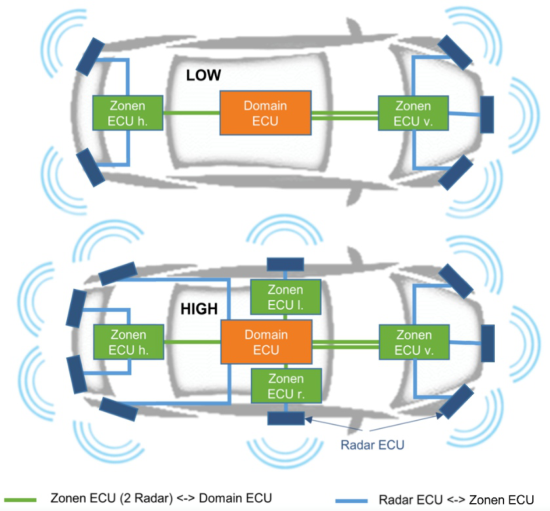
On the other hand, centralized architectures concentrate critical functions into a few high-performance controllers. By centralizing processing power, centralized architectures facilitate efficient data exchange, enable more sophisticated data fusion, and offer greater flexibility for future upgrades. Figure 1 exemplifies the architecture models.
SEMANTIC MODEL OF THE BOARDNET AND SYSTEM MODEL VS. ONTOLOGY MODEL This section will first introduce our general conceptualisation of electronic and system engineering design in the next subsection. Based on that under- standing we show a short semantic model of the boardnet. The motivation
AI-Enabled Semantic Modeling for Enhanced Boardnet Integration in Automotive Design 283
of the work presented in this section is the following: In using our web- based tool we are both interoperable with SysML v2 standard as well as an ontology-based knowledge graph in a graph database. In the context of this work, we investigate the results of a system modeller who has been roughly trained in semantics and constructed the boardnet model of future car sys- tems. This investigation takes place from the viewpoint of the knowledge engineer in order to assess the suitability to the graph database world. We will address various investigation points and discuss them in this chapter.
Figure 1: Centralized vs. zonal architecture of the boardnet for wire length calculation. Here showing 2 zones vs. 4 zones alternative.
GENIAL! Basic Ontology The GENIAL! Basic Ontology (in short GBO) is the standard reference model for our knowledge base. It is a system engineering and electronic description in the form of an OWL file. It describes terms such as hardware, software, properties, functions. systems and its parts and their dependencies. It is a minimal ontology which still can describe most of what is relevant for the domain and is based on the upper ontology Basic Formal Ontology.
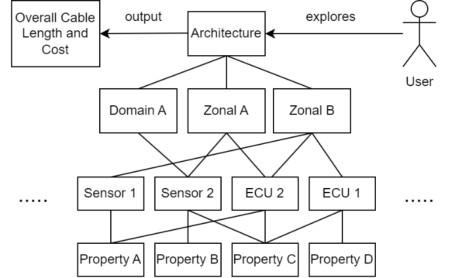
Boardnet Design In previous works, we built the boardnet model and built our own constraint solver, which can calculate dependencies of the connected parts and proper- ties in a forward as well as backward directed, meaning bi-directional way. In this way, we address the main challenge of exploring different architec- tures and estimating the overall cable length, cost and other parameters such
as data rates and the overall automotive context and their other properties. Figure 2 illustrates the challenge.
Transmission Technologies (Ethernet, I2C, CAN), BUSes, Data Rates, Var- ious Properties like Cost, Length, Latencies, Positions, Locations and others Our overall automotive models currently consist of various libraries, such as
Car Model, Mechanical Parts, Hierarchical Decomposition
Detailed Sensor Models with Properties, Functions, Radar Model, Hard- ware Accelerator Model with Neural Net
Figure 2: Agile exploration of the boardnet architectures with its properties and parts via the tool and user interface.
In the following rather than describing the model we focus on the differ- ences between that a knowledge engineer sees to improve the consistency for the computer assisted use as well as the possibilities for reasoning with the model.
Naming and Terms System modellers often name things intuitively, based on their background, experience and usage. In system models we sometimes find abbreviations, numbers and combination of words. The knowledge engineer on the other hand, carefully investigates known terms and their definitions at the begin- ning before putting the word/term/concept/class into the ontology. Often doing state of the art research on given ontology models.
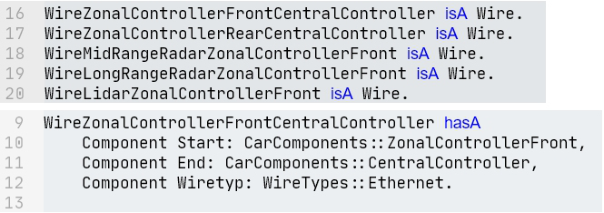
In Figure 3 we see an example how connecting different components is done with wires. Here, we see every wire gets its own “semantic” name by indicating how it is connected as part of its name. Because we work at an interface and every class is an element it seems plausible to assign a unique name. Otherwise, it would not show up in the knowledge base. On the bot- tom part of the image, we can see how the wire between the zonal controller
AI-Enabled Semantic Modeling for Enhanced Boardnet Integration in Automotive Design 285
and the front central controller is connected. They have a start and end point at the component.
Figure 3: Connecting controllers and sensors with wires.
Resolution: In that case for the knowledge engineer it makes most sense to reside in the modeling paradigm and to assign the wires unique ids in combination with a name, but semantically to keep it a “wire.” With the corresponding SPARQL query, the actual meaning of the wire is maintained by its connection, not requiring an entry in the ontology as a class implicitly stating the location, but an instance in the knowledge base as an assertion. This way the purpose of the ontology is retained, and we have no unnecessary “clutter.” Here, the distinguishment comes from what an ontology class is supposed to represent. At the same time in our textual language, we must still refer to the modelling construct we want to modify.
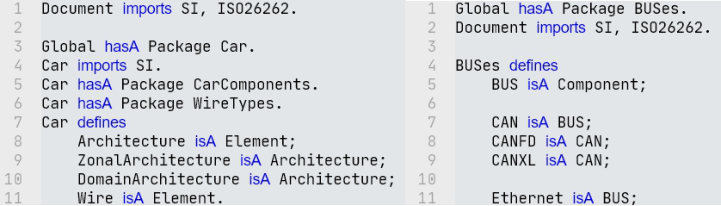
Alignment With Vocabulary The vocabulary of GBO serves as a basis for correct construction of the knowledge base as well as a general reference across domains and applica- tions. As a modelling guideline for the developer also of our systems models, we discuss some aspects of the modelling result in Figure 4. Two basic classes of the meta model (of our tool SysMD) are “element” and “component.” They are connection points to construct the model. Sinilar to SysML v2, we import the corresponding packages (e.g. ISO26262) and modules (e.g. Car- Components). “Car” is our package which then defines the elements, like the BUSes package on the right.
From the modeling perspective on the left of the figure we see the architec- ture defined as an element. The architecture in the semantic sense represents a type of boardnet. However, in the model we do not refer to is as a board- net, but just a general architecture. Further the architecture/boardnet type is more accurately classified as a system in the ontology since it consists of controllers. The model element here functions as a maximum abstraction to simplify classification at the disadvantage of computational correctness. A similar occurrence can be found on the right side, where BUS is a component rather than a hardware part (meaning it is one hierarchy level down). The construction of correct taxonomies which are at the same time useful is a challenge.
Figure 4: Architecture and its semantics and imports.
Correct Semantics
Figure 5 shows how the property “wireLength” gets summed up over each connected component and forms a “TotalLength” at the system level. From the knowledge engineers’ point of view the new property is allocated to the right hierarchy level, though it is not defined that it is a property of wires. Thus “Total Length” could be the length of anything and would not be well findable in the overall model.
Figure 5: Total wire length on the system level.
REASONING WITH SEMANTIC BOARDNET DESIGN We already implemented a variety of algorithms and functions in our lan- guage. As seen in Figure 5 “sumOverParts” propagates the values to the next higher hierarchies. Further we have basic arithmetic functions that form a constraint, see “TotalWeight” or “TotalCosts” in the figure. This subsec- tion shows work on complementing our model with the expressiveness of the Ontology Web Language OWL-DL 2. We also show how the reasoner will fill missing information to aid the modeler and continue to build the knowledge base.
Investigating Application and Capabilities of SysMD As can be seen in the example base model as well as in the previous sec- tion in Figure 4, basic taxonomic structures can be created with the SysMD language, they can be put into packages and documents, their properties, parts and functions can be described. Mathematical constraints can be solved quicker than with the Semantic Web Rule Language (SWRL) and are thus to be used preferably in case of mostly arithmetic. Our solver additionally supports backpropagation to allow for calculations in the opposite direction
AI-Enabled Semantic Modeling for Enhanced Boardnet Integration in Automotive Design 287
simultaneously. In case of dominant semantics, rather than arithmetic, rules may be preferable. Since reasoning time is an issue, it makes sense to with- draw load from the reasoner as much as possible. Existential restrictions are partly mimicked as well. For example, temperature ranges from sensors can be inherited downward and further restrict certain sensor types and their allowed ranges.
Object Property Axioms One of the first part of the work is to make the content of our knowledge base more searchable and spare modeling time. We connect sensors, controllers, cameras, wires and other components via the “is_connected_to_directly” object property. The wires are extra instances, since their properties are important for the architecture considerations, especially regarding the prop- erties “length”, “cost per meter”, “data rate”, “overhead per frame” and others. This object property has itself as an inverse and is non-transitive. It is further a subclass of “is_connected_to” which is transitive. This allows to ask the competency question CQ1: “What component is connected to which component?” According to the axioms, this includes the wires as well as the components.
The second competency question is CQ2: “What type of connection (e.g. ethernet, I2C, etc.) connects which components?”
Property Chains Superproperty Of (Chains) in short property chains are used to couple object properties. In this way a characteristic can be transferred along certain relationships. We coupled the current environment temperature to the car instance as well as the current acceleration as part of the DevOps cycle. And chained the property_of axiom with the has_parts_directly axiom. In this way all the boardnet components have both properties explicitly stated as their system context.
Disjoint Classes Disjoint classes are 1) inherited down from the upper ontology to separate and distinguish parts from properties and functions. And 2) from the GBO ontology to identify the exact hardware or software elements for unam- biguous use. In the current scenario, using disjoint classes in combination with complex class expressions is not feasible for performance reasons and calculated by an external solver.
Complex Existential Restrictions As being part of the TBox (Terminology Box, meaning concept part of the ontology), these expressions make most sense in the realm of definitions and controlling these definitions. The modeler in our use case neither has known the constructs nor has used definitions as is typical in system modelling. With complex definitions we can for example formalize qualitative and quanti- tative properties of properties and parts. Additional building control is for
example introduced with similar axioms like “domain_architecture Subclass Of: has_part_directly only (domain_controller or not zonal_controller)”.
Rules Here two rules are exemplified. Rule 1 is similar to the sumOverParts func- tion in Figure 5. Rule 2 simplifies and automates the has_part hierarchy construction in the model and uses property chains.
Table 1. Sample rules of boardnet implementation.
Table available in the original PDF paper.
SWRL Rule / OWL Axiom Explanation
Adds all masses to the totalmass
ns:mass(?m) ˆ om-2:hasNumericalValue(?m, ?val) -> om-2:hasNumericalValue(ns:totalmass, ?val) has_part SuperProperty Of (has_part o is_connected_to)
Electronics components that are connected to each other are all part of its superpart
CONCLUSION
In this paper we showed how the system modeler can improve his design rationale to be well interoperable with computer understandable knowledge bases. We also showed how to utilize basic and advanced reasoning con- structs to speed up the design process of modern boardnet architecture design. The boardnet design is a critical aspect of modern automotive development, especially in the context of automated and connected driving. By embrac- ing AI-driven semantic modeling and intelligent architectures, automotive manufacturers can revolutionize boardnet design, leading to more efficient, safer, and adaptable vehicles. The integration of AI technology in boardnet design is expected to have a significant impact on the automotive industry’s future, driving innovation and revolutionizing vehicle electronics. As this field continues to advance, further research and collaboration between academia and industry will be essential to harness the full potential of AI in board- net design and beyond. With continuous advancements in AI algorithms, boardnet design will become more sophisticated and dynamic, ensuring that vehicles of the future are at the forefront of automotive innovation and safety.
ACKNOWLEDGMENT
This work has been supported by the GENIAL! project with funding from the BMBF under grant agreement No 16ES0865K.
REFERENCES
Bass, Len, Ingo Weber, and Liming Zhu (2015). DevOps: A software architect’s perspective. Addison Wesley Professional. Batsakis, Sotiris et al. (Nov. 2016). “Temporal representation and reasoning in
OWL 2”. In: Semantic Web 8, pp. 1–20. doi: 10.3233/SW-160248.
AI-Enabled Semantic Modeling for Enhanced Boardnet Integration in Automotive Design 289
Beck, Kent et al. (2001). The agile manifesto. Frehse, Goran (2006). “On timed simulation relations for hybrid systems and compositionality”. In: International Conference on Formal Modeling and Analysis of Timed Systems. Springer, pp. 200–214. Heist, Nicolas and Heiko Paulheim (2022). The CaLiGraph Ontology as a Challenge
for OWL Reasoners. arXiv: 2110.05028 [cs. AI]. Lu, Shan et al. (Jan. 2023). “Detection of Inconsistencies in SysML/OCL Models Using OWL Reasoning”. In: SN Computer Science 4. doi: 10.1007/s42979-022- 01577-0. Riboni, Daniele and Claudio Bettini (2011). “OWL 2 modeling and reason-
ing with complex human activities”. In: Pervasive and Mobile Comput- ing 7.3. Knowledge- Driven Activity Recognition in Intelligent Environments, pp. 379–395. issn: 1574–1192. doi: https ://doi.org/10.1016/j.pmcj.2011.02.001. url: https://www.sciencedirect.com/ science / article/pii/S1574119211000265. Schriml, Lynn M et al. (Nov. 2021). “The Human Disease Ontology 2022 update”.
In: Nucleic Acids Research 50. D1, pp. D1255–D1261. issn: 0305-1048. doi: 10.1093/nar/gkab1063. url: https://doi.org/10.1093/nar/gkab1063. Wawrzik, Frank and Andreas Lober (2021). “A Reasoner-Challenging Ontology from the Microelectronics Domain”. In: Proceedings of the Semantic Reason- ing Evaluation Challenge (SemREC 2021) co-located with the 20th International Semantic Web Conference (ISWC 2021), Virtual Event, October 27th, 2021. Ed. by Gunjan Singh, Raghava Mutharaju, and Pavan Kapanipathi. Vol. 3123. CEUR Workshop Proceedings. CEUR-WS.org, pp. 1–12. url: http://ceur-ws.org/ Vol-3123/paper1.pdf. Weser, Michael et al. (2020). “An Ontology-based Metamodel for Capabil-
ity Descriptions”. In: 2020 25th IEEE International Conference on Emerg- ing Technologies and Factory Automation (ETFA). Vol. 1, pp. 1679–1686. doi: 10.1109/ETFA46521.2020.9212104. 7 Zimmerer, Peter (2018). “Strategy for continuous testing in iDevOps”. In: Proceedings of the 40th International Conference on Software Engineering: Companion Proceeedings, pp. 532–533.9
LISTED IN THE AHFE DIGITAL BOOKSTORE CATALOGUE
Explore the complete digital volume
Artificial Intelligence, Social Computing and Wearable Technologies
Read this individual research paper free through the original publisher, or explore the full digital proceedings book.
ISBN 978-1-958651-89-6
Explore this ISBN in the AHFE Bookstore ↗Listed in the July 2026 bookstore catalogue; search by ISBN to confirm current availability · Digital book purchase optional