Daniele Ruscio, Adrien Metge, Marvin Schopp, Daniel Dreyer, Benedikt Petermeier (2024). The General Automation Level Allocation (GALA) Framework, or: Why Do We Need Another Level of Automation Framework?. In: Human Factors and Systems Interaction. AHFE Open Access, vol. 154, pp. 247–256. https://doi.org/10.54941/ahfe1005372
In the realm of sociotechnical systems, Level of Automation (LoA) frameworks are commonly used to determine adequate types of automation support for tasks in which human operators are involved. This paper introduces the General Automation Level Allocation (GALA) framework in response to recognized limitations in existing LoA frameworks. While these frameworks have contributed significantly to the formalization of human-automation interaction for the systems they were designed for, they often struggle when dealing with new sociotechnical systems. Some of the main limitations recognized for existing LoA frameworks include: (1) Lack of versatility in terms of missing levels for some “automated functions”, since they are designed with specific systems in mind; (2) Limited precision in the definition of the categories for assigning LoA to specific functions and complex technologies; (3) Limited support in the identification of outcomes of human-automation Interaction at different LoA (e.g. in terms of emerging behaviors or in terms of safety-related implications); (4) Limitations regarding characterization human cognitive processing in off-nominal or complex conditions; (5) Not fully addressing the dynamic allocation of tasks and responsibilities based on changing conditions and real-time priorities. Because of these limitations, some researchers are not satisfied with existing LoA taxonomies and believe that there is even no need to think deeper about LoA taxonomies as basis for or input to design of complex sociotechnical systems.To address the stated issues, GALA offers a two-dimensional approach aiming at being compatible with other previous LoA frameworks and applicable to the design of future systems. It is designed to analyze and classify the appropriate levels of automation for different information processing stages (e.g. information acquisition, information analysis, decision making, action implementation) involved in a task based upon the results of a hierarchical task analysis. GALA is compatible to established state-of-the art methods (Parasuraman, Sheridan & Wickens, 2000; Save, Feuerberg & Avia, 2012; Kaber, 2018) applied to study specific aspects of human-system collaboration in more depth, such as the coactive design method (Johnson et al., 2014). Finally, plans for GALA validation will be presented aiming to ensure that it provides sufficient applicability to various sociotechnical systems of diverse domains, each with its unique requirements and challenges. Further, an outlook on an alternative more compact version of the framework is provided which addresses the specific needs of dynamic task allocation in real-life situation.
Automation, as classically defined by Parasuraman and Riley (1997) as “the execution by a machine agent (usually a computer) of a function that was previously carried out by a human”, has evolved into a fundamental ele- ment within contemporary sociotechnical systems due to its potential for enhancing efficiency, streamlining processes, and responding to the escalating complexity of tasks. Furthermore, the capacity of automation to influence and optimize the distribution of tasks in real-time within sociotechnical systems provides a foundation for adaptive task allocation based on chang- ing conditions and priorities. Critical aspects for characterizing principles of dynamic task allocation involve grasping how to integrate automation into collaborative activities and determining the optimal extent to which it should share information and participate in decision-making with humans.
These objectives may be attained through a structured approach employing so called Levels of Automation (LoA) taxonomies. These are categorization systems designed to provide structured means to understand and classify the types and degrees of automation in a system or the tasks within. Such frameworks are either one or two-dimensional. Representatives of the for- mer type just cover multiple levels of automation ranging from “manual performance” or “full automation” of the task under analysis to full automa- tion”. Frameworks of the later type are structured based upon the stages of a human information processing model (e.g. Parasuraman et al., 2000) or the OODA-Loop (see Proud et al., 2003). After selecting the stage applicable to the task under analysis, the degree of automation is determined in a second step. The variation in the number of automation levels across frameworks arises from distinct categorizations, different granularity perspectives, spe- cific application domains or technological advancements (Vagia, Transeth, and Fjerdingen, 2016). Despite this diversity in taxonomies, shared themes persist. These include shift from lower human control to increased automa- tion within the framework, gradual decrease in human involvement with heightened system automation, and human-machine-interaction concepts, e.g. the potential for human intervention at automatic task conduction.
STRENGTHS AND WEAKNESSES OF EXISTING LOA FRAMEWORKS The benefits of utilizing LoA frameworks relate to the understanding, eval- uation, classification, and selection of the degree of automation within a system or task, such as: (1) Aiding in the design of automation systems by identifying potential advantages and challenges associated with each level of collaboration; (2) Providing support in understanding the implications and challenges of task allocation between humans and systems, encompassing aspects relevant to human factors and safety analysis; (3) Standardizing con- cepts and language across the diverse professionals and stakeholders involved in the design and development of new technology, along with the associated procedures and policies.
However, despite the merits of existing LoA frameworks, certain lim- itations are present, including: (1) Insufficiency in representing levels for certain functions automation can be applied to. Certain LoA frameworks may struggle to capture relevant functions automation can be applied to, such as the analysis of data gathered by sensors to provide systems state assess- ments. One dimensional Frameworks can be criticized for not differentiating between the human information processing stages (i.e., information acqui- sition, information analysis, decision selection, and action implementation). Those taxonomies have problems when classifying, for instance, a technol- ogy with a high level of automation for decision selection but a low level of support for action implementation, resulting in a lack of a corresponding unambiguous “level of automation”. (2) Challenges in assigning LoA lev- els to the functions given by the frameworks. The differentiation between certain LoA may necessitate extensive knowledge in a specific domain, such as psycho-physiological expertise for assessing the levels of automation in a “perception task,” where distinctions between the concepts of “sensa- tion” and “perception” may be intricate. Additionally, for some frameworks,
The General Automation Level Allocation (GALA) Framework 249
these distinctions may not always be clearly defined for all cases, lead- ing to difficulties in assigning and/or discerning between different levels or types of automation even among experts. (3) Difficulties in determining out- comes of human-automation interaction at different LoA across the types of automation. Various LoA may exhibit unforeseen behaviors not considered during task allocation. For instance, assigning a high level of automation to action implementation could introduce a supervision task, which may not arise when lower levels of automation are assigned. This challenge becomes more pronounced in the presence of novel or undefined tasks, particularly when Artificial Intelligence learning capabilities are involved in discussions concerning safety-related implications. (4) Insufficient characterization of complex and/or novel human-machine cooperation (Miller, 2005). Current frameworks may fall short in adequately characterizing human-machine cooperation, often adopting a binary (man OR machine) view of automation (Dekker and Woods, 2002) rather than focusing on the question of “How do we make them effectively collaborate?” (5) Lastly, existing frameworks may not fully account for the dynamic allocation (adaptive and/or adaptable) of tasks and responsibilities based upon changing conditions and real-time priorities in non-fixed automation. The capability to dynamically allocate tasks in complex environments necessitates a comprehensive and flexible framework.
How to Address Open Issues In light of these limitations, certain researchers argue that there is no imper- ative to delve further into LoA taxonomies as foundations for designing complex systems (Bradshaw et al., 2013; Jamieson and Skraaning, 2018). Despite these criticisms, LoA frameworks still continue to play a crucial role in systems engineering. This is because mapping functional capabilities and allocating tasks between human and automation provides a fundamental con- ceptual basis for designing system interfaces. Engineers must still consider the parallel interaction between humans and machines in order to outline and model teamwork approaches for effective interface design. Understanding what the human and computer / robot / virtual assistant are each doing and how they depend on each other, is still essential for effective system design (Ali et al., 2022). Once the range of functional distributions for a domain is identified, designers can discuss how various LoA can be presented to optimize system performance. In order to address the open issues and lim- itations of current LoA frameworks, it can be interesting to dive deep on the underlying concepts behind them (Bradshaw et al., 2013). For instance, some improvements can be done regarding the application of human infor- mation processing concepts used for types of automation in two-dimensional taxonomies (i.e., information acquisition, information analysis, decision selection, and action implementation) which may be too simplified when applied to new types of technologies (i.e. those stages were created having in mind the “human-computer” interaction and not with AI-based technologies for instance). The definitions put forth by Parasuraman et al. for the informa- tion processing stages used in some frameworks, consider cognitive nominal
stages that might not comprehensively account for the influence of operator task experience, complacency, and heuristics on the delivery of system func- tions in complex systems. Moreover, the distinction between perception and action, in the context of embodied cognition, should be considered. Embod- ied cognition (e.g., Saphiro, 2019) emphasizes that human cognition is not limited to the brain but is interconnected with the body and its interactions with the environment, especially in skill-based behaviors. For instance, the differentiation of the skill-based stage (that involves automatic and intuitive actions rooted in learned motor patterns) vs the rule-based stage (that adheres to predefined rules to guide actions and decision-making) vs. the knowledge- based stage (that entails higher-level cognitive processes based on explicit knowledge and reasoning) could be beneficial to have a more precise model of “information processing” and “action implementation” stages. All these perspectives suggests that automation system design could consider to encom- pass not only cognitive aspects in nominal situations, but also the physical and sensory elements of human-system interaction beyond human informa- tion processing, not to mention other relevant factors such as teamwork, trust, and other factors.
The GALA Framework Taking these factors into account, the human factors engineering team in Manching of AIRBUS Defence and Space GmbH has developed a framework called General Automation Level Allocation (GALA). This framework incor- porates the strengths of previous frameworks while also addressing some of their limitations (as discussed above). The GALA framework strives to fill the gaps by assigning specific levels for each function type, acknowledging the dynamic nature of task allocation, and fostering understandability of human- automation collaboration when applying its types and levels of automation at describing modern human-machine systems.
The GALA framework employs a two-dimensional approach, striving for compatibility with previous frameworks while being versatile in generating designs for future systems and facilitating dynamic task allocation in real-life scenarios. According to the framework, each task under analysis will first be classified based on the four stages of the human information processing model presented in Parasuraman et al. (2000). For each of those types of automation, the taxonomy provides six levels of automation, ranging from 0: no support to 5: fully automated. This amount of levels was chosen because it is still quite manageable for the analyst and at the same time offers sufficient granularity to distinguish all relevant aspects between the levels. By incorpo- rating two pivotal dimensions (levels and types of automation), the structure is similar to other two-dimensional frameworks, e.g. the one of Save et al. or the one of Proud et al. (2003). However, in contrast to previous taxonomies, the levels are defined in a generalizable way so that they can be applied to tasks in systems of various domains. To promote the practicality and con- sistency of its usage, each level shares the same common meaning across all types. For example a LoA of 0 means always that the human operator per- forms the function without any automation support just relying on low-tech
The General Automation Level Allocation (GALA) Framework 251
artefacts, such as binoculars for the stage “information acquisition” or pen & paper for the stages of “information analysis” and “decision making”. To enhance its usability further, it offers tools to select appropriate levels, including a decision tree. While the stages of the framework are drawn from the information processing model proposed by Parasuraman, Sheridan, and Wickens (2000), similarly to the LOAT taxonomy (Save et al., 2012), GALA levels are primarily defined based upon thorough analysis of the following “one-dimensional” frameworks: the PACT framework (Tayorl, 2001), the “ten levels of automation for human–computer decision making” proposed by Sheridan, Verplanck and Brooks (1978) and the “levels of control and automation” by Endsley and Kiris (1995) and Endsley and Kaber, (1999). Next to considering existing frameworks, the LoA definition involved incor- porating elements of adaptation compatible with coactive design methods (Johnson et al., 2014), simplification, combination, and integration in line with the state-of-the-art knowledge on the subject. The development also took into account the empirical experiences of the AIRBUS Human Factors Team, gained through the team’s direct use of these frameworks in vari- ous projects over the years. Furthermore, efforts have been made to at least consider the applicability of GALA across domains (Barbieri et al., 2022), signified by the “General” reference in the acronym.
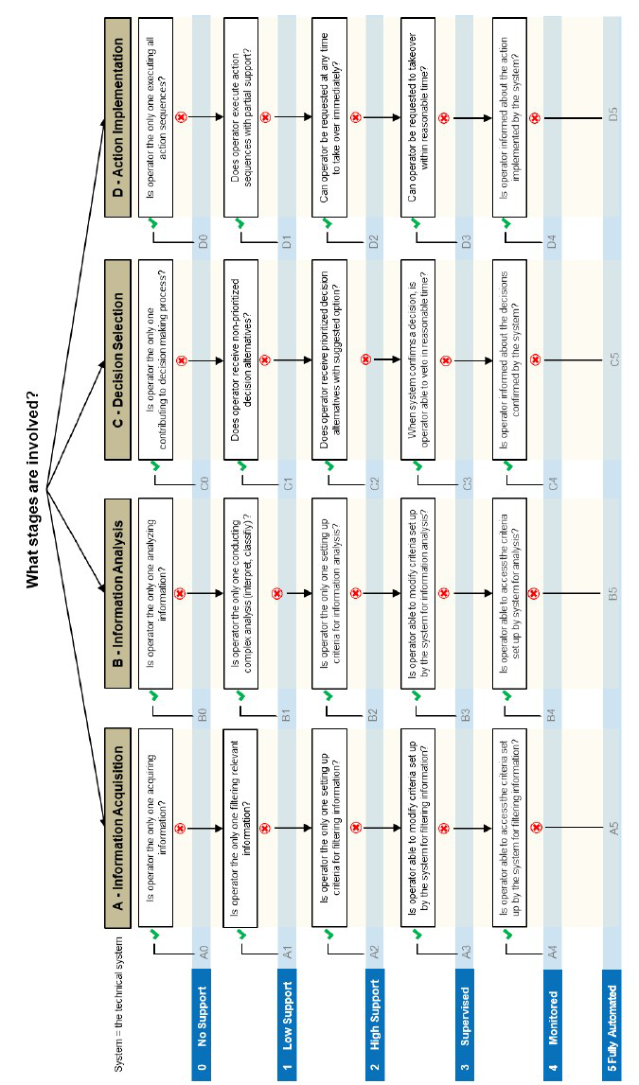
In the context of system design, the GALA framework provides means to assign automation levels for each pertinent task derived from a task analysis or for any function requiring design or assessment. Initially, the GALA frame- work mandates the identification of relevant information processing stages (A, B, C, D) associated with the task or function. Then, GALA requires the determination of appropriate levels or a range of levels of automation for each implicated stage (0, 1, 2, 3, 4, 5). To facilitate this process, GALA provides a decision tree complemented by triggering questions. These resources are designed to assist in allocating suitable automation levels for the respective information processing stages and enhance the understanding of implications on human-automation performance.
Table 1. Levels of automation according to the GALA framework.
Table available in the original PDF paper.
Level Type A Information Acquisition B Information Analysis C Decision Selection D Action Implementation
0 No Support No or only low-tech artefact support
Operator executes and controls all actions, might include usage of low-tech artefacts
Operator acquires relevant information directly (not mediated via display), might include usage of low-tech artefacts (e.g. binoculars)
Operator compares, combines and analyses different information items, might include usage of low-tech artefacts (e.g. pen & paper)
Operator generates decision alternative(s) and selects (chooses and confirms) the appropriate one, might include usage of low-tech artefacts
Sys acquires & provides information to operator
1 Low Support Simple function under control of operator
Sys conducts “simple” analysis operations corresponding to lower level of cognitive skill (e.g. comparing information to detect differences, making linear predictions) Support is based on user’s settings
Sys generates & provides feasible decision alternative(s) and/or assists operator by generating decision alternatives (e.g. by evaluating them) Operator can select one of those, modify it or can generate and select an alternative option
Operator initiates action implementation and is prime executor Sys executes part(s) of the action and/or provides execution support (e.g. by constraining action space) Operator is able to monitor, modify and/or interrupt at any time (Continued)
Table 1. Continued Level Type A Information Acquisition B Information Analysis C Decision Selection D Action Implementation
Table available in the original PDF paper.
2 High Support Complex function under control of operator
Sys acquires & provides information to operator Sys supports by integrating data, filtering and/or highlighting information Support is based on user’s settings
Sys generates & presents one or more feasible decision alternative(s) Sys preselects (chooses but doesn’t confirm) one decision alternative Operator can approve preselection or can generate and select a different decision alternative
Sys conducts “complex” analysis operations corresponding to higher level of cognitive skill (e.g. interpretation, classification, complex predictions) Sys might trigger alerts Support is based on user’s settings
Sys executes full action sequence Operator initiates action implementation or approves sys initiation proposal Operator is able to monitor, modify and/or interrupt at any time The operator must be ready to intervene (interrupt/adapt) immediately at any time 3 Supervised Automated function under supervision by operator
Sys conducts analysis operations corresponding to higher cognitive skill level (see above) Sys might trigger alerts Support is based on criteria set by sys or at design-time. Criteria are still modifiable by the operator
Sys acquires & provides information to operator Sys supports by integrating data, filtering and/or highlighting information Support is based on criteria set by sys or at design-time. Criteria are still modifiable by the operator
Sys generates & presents one or more feasible decision alternative(s) Sys preselects one decision alternative Operator has adequate time to veto before automatic decision implementation (in case of veto, the “fallback” should be specified) Operator or Sys initiates action implementation Sys executes full action sequence Operator can monitor and interrupt
Operator or Sys initiates action implementation Sys executes full action sequence The operator is able to monitor, modify and/or interrupt at any time The operator must intervene within a reasonable time, when prompted by the system 4 Monitorable by Operator Automated function sometimes checked by operator
Sys generates feasible decision alternative(s) Sys selects one of those autonomously (no further approval by operator needed) Operator is only informed about the decision
Sys conducts analysis operations corresponding to higher cognitive skill level (see above) Sys might trigger alerts Support is based on criteria set by sys or at design-time Criteria are visible/accessible but not modifiable by the operator
Sys acquires & provides information to operator Sys supports by integrating data, filtering and/or highlighting information Support is based on criteria which are set by sys or at design-time Criteria are visible/accessible but not modifiable by the operator
Sys initiates action implementation Sys executes full action sequence Operator cannot monitor or interrupt action
5 Fully Automated Fully Automated function completely decoupled from human
Sys generates feasible decision alternative(s) Sys selects one of those autonomously (no further approval by operator needed) Operator is not informed about decision
Sys acquires information Sys integrates and filters data Support is based on criteria which are set by sys or at design-time Criteria are neither visible nor modifiable by the operator
Sys conducts analysis operations corresponding to higher cognitive skill level (see above) Sys might trigger alerts Support is based on criteria set by sys or at design-time. Criteria are not visible/accessible and not modifiable by the operator
Classifying Concrete Automation Example With the GALA Framework Consider the AMAN (Arrival Manager) as an example for classifying dif- ferent automation levels. AMAN is a tool designed to automate sequencing arriving traffic at an airport by providing advices for air traffic controllers (ATCOs). It continuously calculates arrival sequences and times for flights, utilizing a combination of flight-plan information, radar data, weather details, local airspace, route information, and an aircraft performance model in trajectory prediction. This results in a ‘planned’ time for each individ- ual flight, provided to the ATCO and required time suggestions (e.g. Time to Lose/Gain information). The controller is then responsible for confirm- ing and applying an appropriate method (vectoring, path stretching, speed changes, or holding) for the aircraft to meet its advised time or position in the sequence. According to GALA framework, in nominal situations, it would be possible to assign high-level of automation to the information analysis tasks (e.g. level A3: system acquires information according to criteria that,
The General Automation Level Allocation (GALA) Framework 253
if/when needed are visible modifiable by the ATCO), and for the calcula- tion analysis tasks (e.g. B5: the system conducts complex analysis and the operator is informed of the results). At the same time, it could be possible to assign low-level of automation to the decision tasks (e.g. C2 for vector- ing: system can preselect some advisory to be approved e.g. “L2 - lose 2 minutes to fit position in the sequence”) and low levels to action implemen- tation tasks (e.g. D0 as the ATCO provides the actual vectoring instructions to the aircrew). In an increasingly complex traffic environment, to improve runway arrival throughput, while ensuring a safe separation of aircraft and avoid mental overload of the responsible ATCO, the relationship between human and automation may require a change, for instance by providing the controller with more tools for decision making and action implementation. Designing AMAN improvements and integrations could require to maintain the same automation levels for information acquisition (A3) and analysis (B5), but could dynamically increase (whether adaptive or adaptable) deci- sion making levels (e.g. up to C3 by pre-selected aircraft instructions for early delay absorption, vetoable by ATCO) and action implementation (e.g. D4: provide controlled time of arrival to the aircraft, monitorable by ATCO).
Future Directions The GALA framework, briefly introduced in this paragraph, repre- sents its initial version, and it is currently subject to ongoing val- idation and refinement process. This process aims to incorporate diverse perspectives and tools, resulting in more nuanced and com- prehensive taxonomies that capture the intricacies of automation in human-machine systems. The validation will: (1) refine and final- ize the framework, considering allocation to the so called “indivisi- ble tasks” or novel tasks arriving at uncertain times (Tsarouchi et al., 2017); (2) seek improvements in performance outcome predictions through empirical data; (3) develop modeling templates for human- automation cooperation and emerging tasks, applicable for safety assess- ments and the integration of other frameworks used in designing human- autonomy joint teaming activities; (4) Enables dynamic task allocation at the operator level, incorporating a dedicated GALA-O taxonomy; (5) Produce empirical data by applying the framework to technologies with various automation modalities and from in-depth discussions with subject experts in different domains, in order to infer task performance in reason- ably complex systems and construct knowledge and extract design principles for integration into models.
Figure 1: Decision tree to determine the LoA of a system or function according to GALA.
The General Automation Level Allocation (GALA) Framework 255
CONCLUSION
Levels of Automation frameworks are important and useful tools. The mapping and classification of tasks based on info processing stages and the allocation of LoA are required for the design of human-machine-interaction concepts. Once the range of functional distributions has been identified it could be possible to proceed to discuss how to optimize the joint human- machine performance, or assess trade-offs and risk of interactions with automation. Although this mapping may be complex, it does not necessary mean that using structured Levels of Automation frameworks is preventing “teamwork analysis”. On the contrary, it may be difficult to understand how to begin to identify the “things the human depends on the computer for” or “things the computer depends on the human for”if we do not consider before what things the human and computer (each) may be doing (Kaber, 2018). These insights collectively underline the necessity of considering a more dynamic, adaptable, and context-aware approach when applying LoA frame- works, recognizing the intricate interplay of psychological factors and the dynamic nature of real-world operational environments. Better taxonomies may be required, but still taxonomies are required for system design. Overall, the resulting GALA table and decision trees, provide an overview of automa- tion levels associated with the respective information processing stages. This overview can be useful for matter and non-matter experts for: assigning and discussing appropriate/required LoA, as it supports shared understanding of automation; during the design and evaluation of tasks and its implications (e.g. emerging tasks, workload and SA assessments, etc.); for the applica- tion of additional frameworks (e.g. in case of joint/shared human and high levels of automation activities); in ethical considerations; and for analyzing observability, directability and predictability of automation.
ACKNOWLEDGMENT
Research reported in this publication was supported by the Bundesamt für Ausrüstung, Informationstechnik und Nutzung der Bundeswehr under contract number E/L2FH/NA043/KF003.
REFERENCES
Ali, A., Azevedo-Sa, H., Tilbury, D. M. and Robert Jr, L. P., (2022). Heterogeneous human–robot task allocation based on artificial trust. Scientific Reports, 12(1), p. 15304. Barbieri, G., España, A. and Sanchez-Londoño, D., (2022). A Taxonomy for Levels
of Automation based on the Industrial Revolutions. IFAC-Papers OnLine, 55(17), pp. 368–373. Bradshaw, J. M., Hoffman, R. R., Woods, D. D. and Johnson, M., (2013). The seven deadly myths of “autonomous systems”. IEEE Intelligent Systems, 28(3), pp. 54–61. Endsley, M. R. and Kiris, E. O., 1995. The out-of-the-loop performance problem and
level of control in automation. Human factors, 37(2), pp. 381–394.
Endsley, M. R. and Kaber, D. B., (1999). Level of automation effects on performance, situation awareness and workload in a dynamic control task. Ergonomics, 42(3), pp. 462–492. Dekker, S. W. and Woods, D. D., (2002). MABA-MABA or abracadabra? Progress
on human–automation co-ordination. Cognition, Technology & Work, 4, pp. 240–244. Jamieson, G. A. and Skraaning Jr, G., (2018). Levels of automation in human factors models for automation design: Why we might consider throwing the baby out with the bathwater. Journal of Cognitive Engineering and Decision Making, 12(1), pp. 42–49. Johnson, M., Bradshaw, J. M., Feltovich, P. J., Jonker, C. M., Van Riemsdijk, M. B.
and Sierhuis, M., (2014). Coactive design: Designing support for interdependence in joint activity. Journal of Human-Robot Interaction, 3(1), pp. 43–69. Kaber, D. B., (2018). Issues in human–automation interaction modeling: Presumptive aspects of frameworks of types and levels of automation. Journal of Cognitive Engineering and Decision Making, 12(1), pp. 7–24. Miller, C. A., (2005). Levels of Automation in the Brave New World: Adaptive
Autonomy, Virtual Presence and Swarms-Oh My!. In Proceedings of the Human Factors and Ergonomics Society Annual Meeting (Vol. 49, No. 10, pp. 901–905). Sage CA: Los Angeles, CA: SAGE Publications. Parasuraman, R. and Riley, V., (1997). Humans and automation: Use, misuse, disuse, abuse. Human factors, 39(2), pp. 230–253. Parasuraman, R., Sheridan, T. B. and Wickens, C. D., (2000). A model for types and
levels of human interaction with automation. IEEE Transactions on systems, man, and cybernetics-Part A: Systems and Humans, 30(3), pp. 286–297. Proud, R. W., Hart, J. J. and Mrozinski, R. B., (2003). Methods for determining the level of autonomy to design into a human spaceflight vehicle: A function specific approach (No. JSC-CN-8129). Save, L., Feuerberg, B. and Avia, E., (2012). Designing human-automation interac-
tion: A new level of automation taxonomy. Proc. Human Factors of Systems and Technology, 2012. Shapiro, L., (2019). Embodied cognition. Routledge. Sheridan, T. B., Verplank, W. L. and Brooks, T. L., (1978). Human/computer control of undersea teleoperators. In NASA. Ames Res. Center The 14th Ann. Conf. on Manual Control. Taylor, R. M., (2002). Capability, cognition and autonomy. In Proceedings of RTO
Human Factors and Medicine Panel (HFM) Symposium. Tsarouchi, P., Matthaiakis, A. S., Makris, S. and Chryssolouris, G., (2017). On a human-robot collaboration in an assembly cell. International Journal of Computer Integrated Manufacturing, 30(6), pp. 580–589. Vagia, M., Transeth, A. A. and Fjerdingen, S. A., (2016). A literature review on the
levels of automation during the years. What are the different taxonomies that have been proposed?. Applied ergonomics, 53, pp. 190–202.
LISTED IN THE AHFE DIGITAL BOOKSTORE CATALOGUE
Explore the complete digital volume
Human Factors and Systems Interaction
Read this individual research paper free through the original publisher, or explore the full digital proceedings book.
ISBN 978-1-964867-30-4
Explore this ISBN in the AHFE Bookstore ↗Listed in the July 2026 bookstore catalogue; search by ISBN to confirm current availability · Digital book purchase optional