Emilia Visileanu, Razvan Radulescu, Marian-catalin Grosu, Adrian Salistean (2023). Electrical parameters of conductive structures for smart textiles. In: Artificial Intelligence, Social Computing and Wearable Technologies. AHFE Open Access, vol. 113, pp. 342–351. https://doi.org/10.54941/ahfe1004207
The growing need for supportive and performance-enhancing garments has led to the rapid induction of smart textiles in the military sector. Smart textiles aim to reduce the weight of battery packs, electronic gadgets, connecting cables, etc. If a soldier wearing a ‘Smart Shirt’ gets injured during a war, the information on the wound and the soldier’s condition would be immediately transmitted to a medical triage unit near the battlefield [1]. The increasing adoption of smart textiles for military applications and operations is saving lives and changing the ways that militaries worldwide operate. Military clothing plays an essential role in protecting soldiers from warfare and combat elements. Textile structures were designed and made by weaving and knitting technologies using conductive yarns (Shieldex, Statex, Filix, Agis, etc.) in order to integrate into the block diagram a primary haemostasis device intended for combatants on the battlefields. The surface resistance of the fabrics with metallic yarns was measured by means of a device, consisting of two parallel linear electrodes, placed at a distance of 30 mm.The device measured resistance in Ohm for a known surface of the tested material (sq = 6,45 cm2). As such, the results were expressed in Ohm / sq. We have the following physical relations for the electrical resistance RS (1) and the electrical resistivity of a certain material ρS(2) [2]:R_S= U/I_S (1)ρ_S= R_S (D∙g)/L (2)With the following notations: U – voltage applied, IS – measured electric current intensity, L – length of the fabric, placed between the two electrodes, D – width of the fabric and g thickness of the fabric.ρ= U/I∙(D∙g)/L=R∙ (D∙g)/L [Ω.m]The electrical conductivity of the fabrics was computed with relation (3).σ= 1/ρ (3)The results of the computations show that the textile structure with AGIS LIB 40 has the highest conductivity of 32808.16 S/m, followed by the structure with AGIS 100 D yarn, of 11233.33 S/m, Agis 200D – 6916 S/m and Statex with a conductivity of 5626 S/m, respectively Shieldex with 5390.14 S/m. The Lloyd material testing equipment coupled with a data acquisition unit-DAQ (white box) was used for the simultaneous variation of elasticity and electrical conductivity of textile structures. The lowest value of the electrical resistance was obtained by the knit structure made only of conductive (yarn 1). In this case, the min./max value at the strain 5% was: 2,72 Ω/m/12,18 Ω/m and at the strain 40%: 0,56 Ω/m/37,17 Ω/m. These values are in the limit of linear electrical resistance of the yarn (76 Ω/m) [3]. The prediction of the parameter values was estimated by determining the linear regression line with the regression coefficients, R2, and the calculated correlation coefficient. The cases resistivity=f(time), resistivity=f(load), resistivity=f(strain) is represented. The only case where it seems that there are no disturbing values (noise) is the one with 30% elongation, there is also a fairly good correlation between the values.References[1] Pradhan, Anuja & Nag, Swagata. (2019). Smart Textiles for Defence Applications. Conference: Texcreative 2019 By BIET, Davangere.[2] William A. Maryniak, Toshio Uehara, Maciej A. Noras / Advanced Energy – “Surface Resistivity and Surface Resistance Measurements”, Internet resource: https://www.advancedenergy.com/globalassets/resources-root/application-notes/en-esd-surface-resistivity-application-note.pdf [3] Emilia Visileanu, Constantin Jomir, Alexandra de Raeve, Sheilla Odhiambo, Razvan Radulescu, Evaluation of the relationship between elastic and electrical characteristics of conductive textiles,Annalis of the University of Oradea, Fascicle of Textiles, Leatherwork, ISSN 1843-813X, vol.1, 2023.
As an intrinsic property of materials, electrical conductivity is the measure of the amount of electric current a material is capable of carrying or its abil- ity to carry electric current or electric charges. It involves the movement of electrically charged particles through a transmission medium. Conductive materials exhibit high electron mobility or in other words many free electrons (Raji et al., 2017).
As technology becomes increasingly mobile, the next step is the integration of advanced devices and functionalities into flexible textile substrates, which, when combined with different solutions, e.g., the Internet of Things (IoT), big data analytics, and artificial intelligence (AI), offer a wide range of actions, in the field of virtual reality, inter-device communications and between cyber- physical systems with a strong impact on the fourth industrial revolution (Fernández-Caramés et al., 2018).
The generic term metal fiber, as adopted by the U.S. Code of Federal Regulations (CFR), is defined as “a fiber composed of metal, metal coated with plastic, plastic coated with metal, or a core coated entirely with metal.”
Electrical Parameters of Conductive Structures for Smart Textiles 343
Because of their conductivity, conductive metal yarns are typically used for carrying current between electrical sources and electronic devices, or for car- rying information from these devices to the processing part of the material (Choudhry et al., 2021, Cherston et al., 2019). The best electrical conductor, under normal temperature and pressure conditions, is metallic silver. Other conductive materials are copper, gold, aluminium, iron, steel, brass, bronze, mercury, and graphite (Cherston et al., 2019). Ensuring electrical conductiv- ity in textiles is surrounded by multiple exploitable effects, such as antistatic effect, antimicrobial, electromagnetic shielding, and thermal effect with a role in ensuring safety and comfort, and in some cases aesthetics. Electroconduc- tive textiles (fibers, yarns, or flat, tubular, or 3D textile surfaces), both for wearable and non-wearable purposes, thanks to attributes such as mechanical flexibility, long-term durability, stability and resilience under harsh condi- tions, are an essential component of flexible and stretchable electronics, so a multitude of techniques have been developed to integrate/apply conductive compounds, which significantly influence the electrical properties of textiles as well as the wash/wear durability of the final product (Zhu et al., 2021)
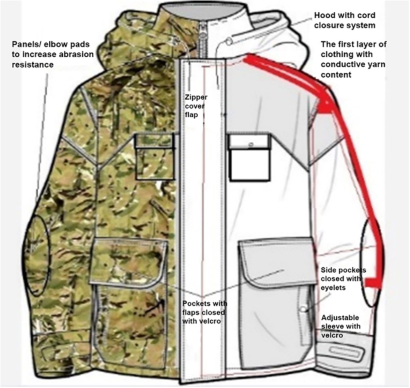
DESIGN AND DEVELOPMENT OF CONDUCTIVE TEXTILE STRUCTURES E-textiles have the great advantage of the flexibility of textiles. They can be tailored to the human body, allowing a person to effectively “wear”electronic devices. Ballistic protective equipment is designed and made to protect the upper part of the human body without including the upper/lower limbs which remain exposed to external stressors (shooting, cutting, etc.) that can lead to the death of the combatant due to blood loss. The solution addressed in this research consists of the detection of the wound employing a conductive textile structure containing metallic threads. When a metallic thread in the structure is punctured (bullet, knife, etc.), it will generate an electrical signal interpreted by the control unit to operate an air pumping system that activates a pneumatic tourniquet (Figure 1), which will stop the bleeding.
Figure 1: Jacket with the first layer having conductive yarns.
The experiments aimed to develop textiles with a sleeve-specific tubular geometry (arm, forearm, and elbow) to ensure continuity of the electrical circuit and avoid interlocking seams. The main characteristics of the metallic yarns are shown in Table 1.
Table 1. Characteristics of metallic yarns.
Table available in the original PDF paper.
No. Characteristics Yarns variants V2
Equations and mathematical formulas are available in the original paper PDF.
1. Composition,% PA6.6/ Ag- 99,9%
PA- core/Ag mantle
PES- core/Ag mantle
PA- core/Ag mantle
78% metallic yarn /22% PES yarn 2. Finesses Tex (Nm)
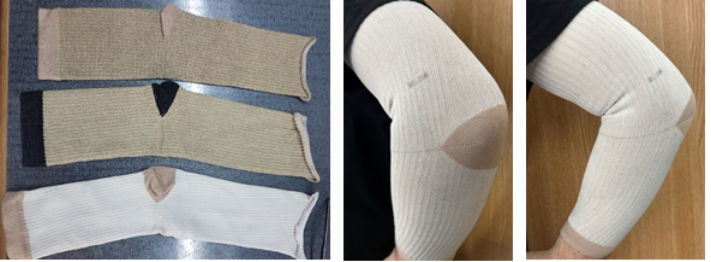
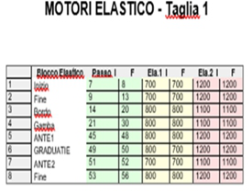
The yarn length density is in the range: of 12.6x2 (78.93/2) Tex (Nm)- 126.1x1 (7.93/1) Tex (Nm) and the linear electrical resistance is best for V2.2- 3/m and highest for V1 (<300 /m). Tubular textile structures (Figure 2) made of 100% metallic yarns and metallic yarns in combination with 100% elastane yarns were made on circular knitting machines type SANGIACOMO - HT1 with fineness 14, with 168 needles, 7mm needle tongue, hofa thick. Go302 303. The struc- ture of the main steps of the specialized program used for making tubu- lar knitwear on circular knitting machines included 68 steps (sequences Figures 3 a, b, c.).
Figure 2: Tubular conductive textile structure.
Electrical Parameters of Conductive Structures for Smart Textiles 345
Figure 3: Programme structure a) elastic shafts b) triangles c) lifting cylinder.
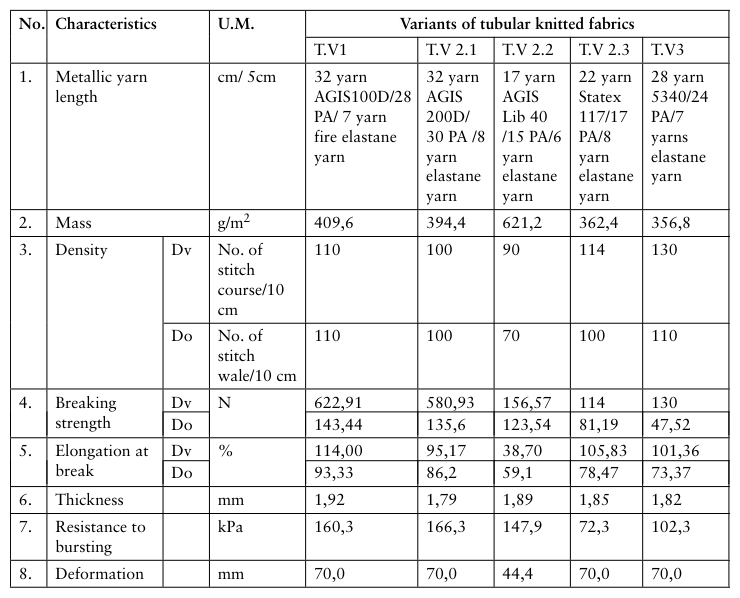
Table 2 shows the physical and mechanical characteristics of tubular knitted fabrics made on circular knitting machines.
Table 2. Characteristics of tubular conductive structures.
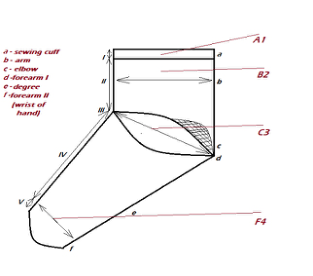
The level of elongation (deformation) of the different areas of the tubular structures (Figure 4) was determined with the CTME apparatus. The results for the T.V2.3 structure shown in Table 3 show no significant differences between the zones.
The length of the metallic thread in the knitted structure varies from 17 cm/5 cm in the T.V2.2 variant to 32 cm/5 cm in the T.V2.3 variant, which
is determined by the difference in thickness in the horizontal direction: respec- tively 70 wales/10 cm (T.V2.2) and 110 wales/10 cm (T.V2.3) and in the vertical direction: 90 wales/10 cm (T.V2.2) and 110 wales10 cm (T.V2.3).
Table 3. Deformation of structural areas.
Table available in the original PDF paper.
No. Area Dimensions (relaxed), ± cm Elongation, ± cm 1 a1 8,5±0,5 28,0±2,0 2 b2 8,0±1,0 27,0±2,0 3 d3 8,0±1,0 27,0±2,0 4 e graduation 25,0±3,0 5 f4 6,0 ±0,5 22,0±1,0
Figure 4: a) CETME; b) deformation zones.
The thickness of the tubular structures made on circular knitting machines is in a range with relatively close limits: 1.79 mm (T.V2.1) and 1.92 mm (T.V2.3).
The burst strength is highest for the T.V2.1 variant (166.3kPa) but with the lowest deformation value of 44.4 mm; the other variants show about twice as high deformation values (70 mm) at relatively close burst strength values (kPa).
The abrasion resistance test (40,000 cycles) showed no stitch breakage in all variants of tubular knitted structures made on the circular knitting machine.
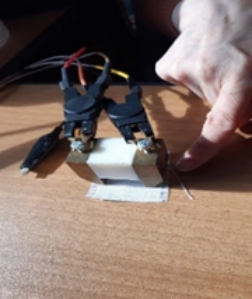
CONDUCTIVITY OF TEXTILE STRUCTURES The surface resistance (Rs) of textile structures containing metallic yarns was measured using the CROPICO 4000 Multimeter, consisting of two parallel linear electrodes placed 30 mm apart. The layout of the set-up is shown in Figure 5a and the image of the device in Figure 5b.
The size of the measurement sample: square with a side of 2.54 cm (area - 6.45 cm2). Measurements were made in two directions of the sample: in the direction parallel to the position of the conducting threads in the textile structures and the direction perpendicular to them.
Electrical Parameters of Conductive Structures for Smart Textiles 347
Figure 5: a) Layout of the setup; b) multimeter image.
The results were expressed in Ohm/m2. To calculate the resistivity of the material, geometrical parameters of the textile structures were also intro- duced. The physical relationship for the electrical resistance Rs and the electrical resistivity of a given material ρS are given in relation (1) and (2) [1]:
U
L IS D
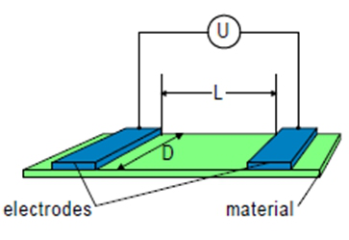
With the following notations: U – applied voltage; IS – the measured electric current; L – the length of the specimen placed between the two electrodes; D – fabric width. The electrical resistivity relation (2) was derived for the case of parallel electrodes and the rectangular shape of the sample from the general electrical resistivity relation expressed by equation (3).
I · D · g
L (3) Where g - thickness of the material. Thus, the thickness g of textile struc- tures was also included in the calculation of electrical conductivity, because it is considered a relevant parameter and to be able to express conductivity in [Siemens/m].
The general expression of electrical resistivity is thus expressed in [Ohm- metre]. The electrical resistance for 1 m2 of textile material was calcu- lated, with values expressed by the parameter R in [Ohm]. All geomet- rical parameters of the sample were measured (fig.6) [L= 0.03 m, D= 0.02 m, U-10V and g (see Table 2)], and the electrical resistivity was
calculated according to relation (3) in [Ohm-metre]. The electrical con- ductivity of textile structures with metallic yarns is given by equation 4 since the conductivity is calculated with the inverse relation of the resistivity: σ = 1 ρ (4)
Figure 6: Sample measurement parameters.
Tables 4 and 5 show the resistivity and conductivity values obtained for the variants of conductive knitwear with tubular geometry made on SANGIACOMO - HT1 knitting machines.
The analysis of the conductivity values shows that in the direction paral- lel to the conductive yarns of the tubular textile structures made on circular machines, the best values were achieved by the T.V2.2 variant (32. 808 S/m) made of yarns with linear resistance of 3 /m, followed by T.V2.3 (11,233.33 S/m), made of wires with linear resistance 135 /m and T.V2.1 (6,916.88 S/M) made of wires with the linear electrical resistance of 70 /m. In the direction perpendicular to the conductive yarns of the textile structures, the
Electrical Parameters of Conductive Structures for Smart Textiles 349
best electrical conductivity values were obtained for the textile structures T.V2.2 (9.071,20 S/m), T.V2.3 (7.987,26 S/m) and T.V2.1 (5.770,95 S/m). The thickness (mm) of the tubular textile structures with the best conductiv- ity values on both systems did not differ significantly (1,89 mm - 1,92mm) (see Table 4). The largest difference is found in the length of the metallic yarns in the textile structures: 17 wales/5cm in T.V2.2 and 32 wales/5m in T.V2.3 and T.V2.1.
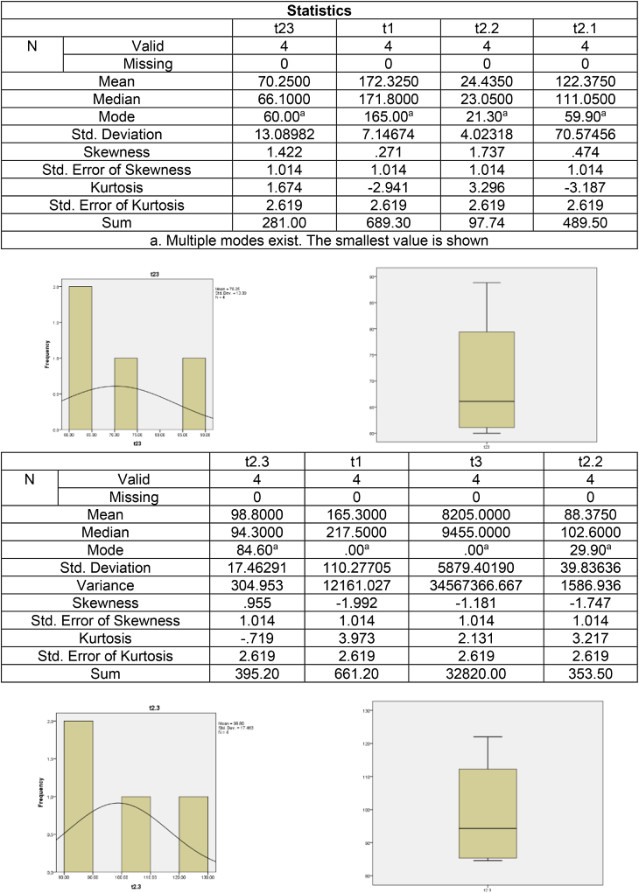
The descriptive statistical analysis was elaborated for variable resis- tivity (mOhm) for all 5 textile conductive structures in both direc- tions. The histograms and the boxplot graphs for the analysed vari- able are presented in Fig. 7 a) parallel direction and b) perpendicular direction.
Parallel Direction Skewness indicators have positive values for the resistivity of all textile tubular structures, the normal distribution curve moves away from the middle, moving to the right. The vault indicators (kurtosis) have neg- ative values for T.V1: −2,941 and T.V2.1: −3,187 the curves being platykurtic and positive T.V2.3: 2,619 and T.V2.2: 3,296 curves being of leptokurtic type.
Perpendicular Direction Skewness indicators have positive values for the resistivity of the variants: T.V2.3:0.955, and T.V2.3:1,941 the normal distribution curve moves away from the middle, moving to the right, and negative values for the variants: T.V1: −1.992, T.V3: −1,181 and T.V2.2: −1,747 the normal distribution curve moves away from the middle, moving to the left. The vault indicators (kurtosis) have negative values for T.V2.3: −0,719 the curves being platykur- tic and positive T.V1: 3,973, T.V3: 2,131 and T.V2.3:3,817 curves being of leptokurtic type.
Figure 7: Histogram and box plot-a) parallel direction b) perpendicular.
CONCLUSION
Shieldex, AgSIS and Filix type conductive yarns with fineness between: 126.1x1 dtex −748.0x1 dtex and electrical resistance in the range: 3 /m (AgSISLib40) -<340 /m (V1) were used to make tubular structures on knitting technology by using circular knitting machines of the type SANGIA- COMO - HT1. The surface resistance of textile structures with metal threads was measured using the CROPICO 4000 Multimeter device consisting of two parallel linear electrodes, placed at a distance of 30 mm. All the geo- metrical parameters of the sample were measured (L = 0.03 m, D = 0.02 m and g) and electrical resistivity was calculated in [Ohm-meter]. The electrical conductivity of the textile structures was calculated with the inverse relation of the resistivity.
Electrical Parameters of Conductive Structures for Smart Textiles 351
The conductivity values in the direction parallel to the conductive yarns in conductive, tubular textile structures made on circular knitting machines are about 70% higher than the values recorded in the direction perpendicular to the conductive yarns.
The parameter that decisively influences the conductivity level of textile structures is the linear resistance (/m) of the component yarns, followed by the length of the metallic yarn per unit area of the textile structure and the thickness of the material.
ACKNOWLEDGMENT
This work was carried out through the Core Program within the National Research Development and Innovation Plan 2022-2027, carried out with the support of MCID, project no. 6N/2023, PN 23 26 01 02 01/23001.1_23.
REFERENCES
Cherston, J. Paradiso, J. A. Wang, K.-W. Sohn, H. Huang, H. Lynch, J. P. (2019) SpaceSkin: Development of aerospace-grade electronic textile for simultaneous protection and high-velocity impact characterization. In Proceedings of the Sen- sors and Smart Structures Technologies for Civil, Mechanical, and Aerospace Systems, Denver, CO, USA, 4–7 March. Choudhry, N. A. Arnold, L. Rasheed, A. Khan, I. A. Wang, L. (2021) Textronics—A
Review of Textile-Based Wearable Electronics. Adv. Eng. Mater, 23, 2100469. Fernández-Caramés, T. Fraga-Lamas, P. (2018) Towards The Internet-of-Smart- Clothing: A Review on IoT Wearables and Garments for Creating Intelligent Connected E-Textiles. Electronics, 7, 405. Raji, R. K., Miao. X., Boakye, A. (2017), Electrical Conductivity in Textile
Fibers and Yarns—Review, AATCC Journal of Research, vol. 4, no. 3, 8–21, DOI: 10.14504/ajr.4.3.2. Zhu, S. Wang, M. Qiang, Z. Song, J. Wang, Y. Fan, Y. You, Z. Liao, Y. Zhu, M. Ye, C.
(2021) Multi-functional and highly conductive textiles with ultra-high durability through ‘green’ fabrication process. Chem. Eng. J., 406, 127140.
LISTED IN THE AHFE DIGITAL BOOKSTORE CATALOGUE
Explore the complete digital volume
Artificial Intelligence, Social Computing and Wearable Technologies
Read this individual research paper free through the original publisher, or explore the full digital proceedings book.
ISBN 978-1-958651-89-6
Explore this ISBN in the AHFE Bookstore ↗Listed in the July 2026 bookstore catalogue; search by ISBN to confirm current availability · Digital book purchase optional