Emilia Visileanu, Alexandra Gabriela Ene, Roxana Constantinescu, Viviana Roman, Alina Vladu, Felicia Dondea (2025). Development of Functional Textiles Through Micro-encapsulation. In: Ergonomics In Design and Kansai Engineering. AHFE Open Access, vol. 170, pp. 34–43. https://doi.org/10.54941/ahfe1006165
1 The National Research and Development Institute for Textiles and Leather, 16, Lucretia P˘atr˘a¸scanu Street, Sector 3, Zip Code 030508, Bucharest, Romania ↗
2 Stefan S. Nicolau Institute of Virology, 285, Mihai Bravu Street, District III, cod 030107, Bucharest, Romania ↗
Essential oils are used for medical and technical textiles' functionality, giving them new properties. The most commonly used method is encapsulation, which ensures greater functionality and durability. Microencapsulation protects small solid, liquid or gaseous particles by a coating system (1–1000 mm). The encapsulated material is called the core, and the material that forms the coating of the particles is the wall or encapsulating agent. The encapsulating material can be a natural, synthetic or semi-synthetic polymeric layer. Textiles made by knitting technology from fibrous mixtures with content of: Cotton/Elastane, Cotton/Polyester and 100% Polyester were treated by padding, to offer antibacterial properties. The impregnation module consists of a padding machine with 2 vertical/horizontal oscillating rollers, acquired from Roaches International LTD. The first treatment solution (R1) containing pine essential oil and collagen hydrolysate was obtained. 450 μL of pine essential oil was dissolved in 15 mL of ethyl alcohol. The pine essential oil solution was added over the 1.5% collagen solution together with zeolite and β-cyclodextrin (pine essential oil: zeolite: β-cyclodextrin ratio of 1:10:10). The second treatment solution (R2) containing doxycycline and collagen hydrolysate was obtained (doxycycline: β-cyclodextrin ratio of 1:10). After the treatment, the samples were dried at room temperature for 24 h. The treatment solutions were characterised by: DLS analysis (dynamic light scattering) with the Zetasizer nano NZ device from Malvern Instruments Limited UK used for the characterization of particles with sizes between 0.3 nm – 10 μm. The particle size in solution R1 was within the limits of 11-20 µm. The particle size in solution R2 was within the limits of 274.6 nm-1.169 µm. Optical microscopy using an Olympus BX43 microscope equipped with a WHN10x/22 eyepiece and a Plan N 40x/0.65 Ph2 objective, and scanning electron microscopy (drop-casting on copper slide) with magnifications of 4000X and 16000X and EDAX for compositional analysis were used for solutions analysis (R1 and R2). SEM images for R1 revealed granular formations with an average size of 516 µm (4000X) and 4.95 µm (8000X) and a density of granules of 365 granules per 128 µm×148 µm=18944 µm2 (area of the SEM image at 2000X magnification), resulting in a surface density of 1.92 granules/100 µm2. EDAX analyses reveal the elemental composition of the R2 solution consisting mainly of Oxygen-51.73%, silicon oxide-21.19% and Nitrogen-11.66%, Na, C, Al, Cl, K, Ca. GS-MS analysis for both the pine essential oil and the treated textile structures revealed the presence of specific chemical compounds. GS-MS analysis for both the pine essential oil and the treated textile structures revealed the presence of specific chemical compounds.The antibacterial activity, according to SR EN ISO 20645/2005, was evaluated on Staphylococcus aureus ATCC 6538 (gram-positive) and Escherichia coli ATCC10536 (gram-negative) strains and showed a satisfactory effect of treatments with R1 and R2 because no bacterial growth was observed.
Essential oils are utilized for the functionalization of medical and technical textiles. The technique employed in industrial processes is encapsulation.
Microencapsulation is a technique in which one or more compounds (core or internal phase) are surrounded or immobilized by one or more materials (shell, carrier or wall material) to be protected from external factors such as
Development of Functional Textiles Through Microencapsulation 35
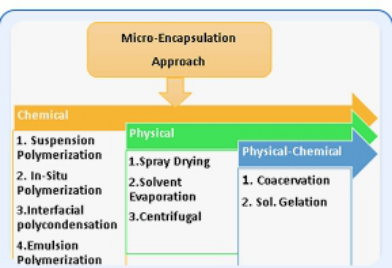
light, high concentrations of oxygen, heat, moisture, preventing evaporation of active volatiles compounds, masking unpleasant tastes and odours, and for development of value-added products (Talita et al., 2016). The encapsulated material is termed the core, while the material forming the particle’s covering is known as the wall or encapsulating agent. The wall material can be a natural, synthetic, or semi-synthetic polymeric layer. This technology leads to the formation of microparticles, which can be classified based on their size, morphology, encapsulating agent, and the microencapsulation method used. Microencapsulation technologies achieve several objectives and are primarily employed to protect the active agent from sensitivity to oxygen, light, and moisture, or to prevent interactions with other compounds. The primary reason for encapsulating an active agent is to enable controlled, sustained, or targeted release. Depending on the nature of the interaction of the encapsulated material, microencapsulation methods can be classified into chemical, physicochemical, and mechanical methods (see Figure 1).
Figure 1: The main microencapsulation methods (Patil et al., 2022).
The most commonly used microencapsulation techniques are spray drying and coacervation (the procedure of isolating particles from a solution and depositing them around a core material). Microencapsulation of essential oils for textile materials can serve several purposes, including controlled release, protection of the essential oils, functional properties of textiles, user comfort and benefits, as well as commercial and industrial applications, among others. As consumer awareness of the use of natural ingredients has increased recently, essential oils have gained significant popularity, as they represent a “green” alternative in the nutritional, pharmaceutical, and agricultural fields, owing to their antimicrobial, antifungal, insecticidal, and antioxidant properties.
Zeolites are a group of minerals that consist of hydrated aluminosilicates of calcium, strontium, sodium, potassium, barium, magnesium, etc. Zeolites are recognized for their unique properties: porous structure, ion-exchange capacity, thermal and chemical stability, molecular selectivity, absorption capacity, and availability. Their porous structure, with interconnected channels and pores, gives zeolites a large surface area, making them capable of absorbing molecules into their pores.
Pine essential oil consists of 50–90% monoterpenes, such as alpha-pinene, beta-pinene, D-limonene, alpha-terpinene, gamma-terpinene, beta-ocimene, myrcene, camphene, sabinene, and terpinolene, which contribute to its antiviral and antibacterial properties.
Doxycycline is a broad-spectrum antibiotic from the tetracycline class (Enna, 2008). The antibacterial activity of doxycycline is mediated by a variety of mechanisms. The anti-inflammatory effects of doxycycline have been studied, including inhibition of neutrophil activation and migration, activation and proliferation of T lymphocytes, inhibition of phospholipase, angiogenesis, nitric oxide synthesis, and granuloma formation, as well as suppression of the release of inflammatory cytokines (TNFα, IL-1β, IL-6, IL-8) and reduction of reactive oxygen species. Doxycycline has been described in scientific literature as an inhibitor of matrix metalloproteinase (MMP) activity, where it inhibits MMPs at sub-antimicrobial doses and is the only MMP inhibitor approved by the Food and Drug Administration (FDA) (Saliy et al., 2024).
Cyclodextrins (CDs) are cyclic oligosaccharides obtained from potatoes, corn, rice, etc., through starch degradation using enzymes. They are biocompatible, biodegradable, ecologically sustainable, and clean (Pereira et al., 2021) emphasize that cyclodextrins play a crucial role in textile processing and innovation; their use provides immediate opportunities for the development of eco-friendly and eco-textile products. Cyclodextrins can be applied in spinning, pretreatment, dyeing, finishing, and dye removal, with dyeing, finishing, and water treatment being the most widely applied areas in the textile industry to date (Bhaskara-Amrit, 2011).
TREATMENT OF TEXTILE SUPPORTS WITH ACTIVE SUBSTANCES AND ANTIBIOTICS Textile structures made using knitting technology with fiber blends of: 90% cotton/10% Elastane, 45% cotton/55% cotton, and 100% PES, with a mass ranging between 166.2–257.83 g/m2, thickness: 0.62–0.76 mm, resistance to deformation and bursting (140.5–518.0 KPa, respectively: 42.3– 70.0 mm), water vapor permeability: 27.0–28.5%, and air permeability in the range of 106.4–1401.0 l/m2/s have been treated using the fulling technology with the Impregnation Module consisting of: a fulling machine with 2 oscillating rollers (vertical/horizontal) model BVHP 500/100 from Roaches International LTD.
Treatment With Pine Essential Oil and Collagen Hydrolysate (R1) Sample Preparation The textile materials were washed for 30 minutes at a temperature of 30
C with a Kemapon PC/LF solution. After washing, they were rinsed twice with warm water (30
C) and once with cold water (20
C), then air-dried at room temperature.
Development of Functional Textiles Through Microencapsulation 37
Sample Treatment A 1.5% collagen solution was initially prepared. 450 µL of pine essential oil was dissolved in 15 mL of ethyl alcohol. The pine essential oil solution was then added to the collagen solution along with 4.5g of zeolite and 4.5g of β-cyclodextrin (in a 1:10:10 ratio of pine oil: zeolite: β-cyclodextrin). After completing the treatment (3 cycles), the textile structures were air-dried at room temperature for 24 hours.
Treatment With Doxycycline and Collagen (R2) Sample Preparation The textile materials were washed for 30 minutes at a temperature of 30
C with a Kemapon PC/LF solution. After washing, they were rinsed twice with warm water (30
C) and once with cold water (20
C), then air-dried at room temperature.
Sample Treatment A 1.5% collagen solution was initially prepared. 3g of doxycycline and 30g of β-cyclodextrin were added (in a 1:10 ratio of doxycycline: β-cyclodextrin). After completing the treatment (3 cycles), the samples were air-dried at room temperature for 24 hours.
Evaluation of Active Substance Loading of Textile Structures The evaluation of the active substance loading of the textile structures was carried out according to SR 7690/93 - Determination of the content of substances soluble in organic solvents. The results obtained are presented bellow (see Table 1).
Table 1: Degree of loading with active substances.
Table available in the original PDF paper.
2D PES 2D Cotton
Characteristic 1Z PES/Cotton
1Z PES 1Z Cotton 2D PES/Cotton
Degree of 1,2 1,0 1,23 2,33 2,16 2,3 loading, %
The loading degree of textile structures treated with doxycycline and collagen hydrolysate is approximately two times higher than that of the structures treated with pine essential oil and zeolite (exp. 2D-2.33% vs. 1Z-1.2%).
EVALUATION OF TREATMENT SOLUTIONS AND MICROCAPSULES The treatment solutions were characterised for both the initial phase and the phase containing β-cyclodextrin.
DLS Analysis Dynamic Light Scattering (DLS) is a technique in physics used to determine the size distribution profile of small particles in suspension or polymers in solution.
The instrument used: Zetasizer Nano NZ from Malvern Instruments Limited, UK, which incorporates DLS technology. Samples ranging from 3 µL to 20 µL were introduced into measurement cells of various types, depending on the characteristics being measured.
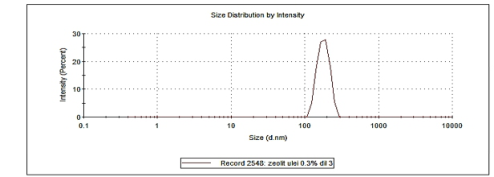
The determination of particle size in the initial dispersions of zeolite/pine essential oil revealed the presence of particles approximately 11 µm in size. For the 0.3% dilution, particles of 180.5 nm were detected, with an average of 907.7 nm due to the presence of large particles or potential impurities (see Figure 2). The average particle size of the initial solution after three measurements ranged between 11.71–20.98 µm, while for the 0.3% dispersion, Population 1 had particle sizes between 180.5–235.4 nm, representing 90–100% of the sample, and Population 2 consisted of particles measuring 3,190 nm, representing 10%.
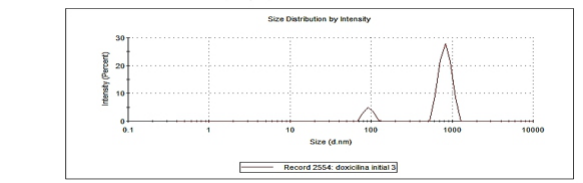
The determination of particle size in the initial doxycycline solution revealed the presence of particles sized 767.3 nm, accounting for 86.9%, and 91.64 nm, accounting for 13.1%. The average size recorded was 1.235 µm due to the presence of very large particles, potentially impurities (Figure 3). After three measurements, the average particle size of the initial solution ranged between 767.3 and 856.2 nm, with Population 1 accounting for 86.9–92.2%, and Population 2 ranging from 58.84 to 92.73 nm, accounting for 7.8–11.3%.
Figure 2: Particle sizes of initial zeolite/oil dispersion, 0.3% dilution.
For the zeolite/pine oil/β-cyclodextrin dispersion, the average particle size was 3.485–4.156 µm, with 100% distribution. For the doxycycline/β-cyclodextrin solution, the average particle size was 519.6–577.0 nm, also with 100% distribution.
Figure 3: Particle size of the initial doxycycline solution.
Development of Functional Textiles Through Microencapsulation 39
The zeolite/oil particles decreased in size from 11.71–20.98 µm to 3.485–4.156 µm upon formulation with β-cyclodextrin. The doxycycline particles, initially sized 767.3–856.2 nm (86.9–92.2%) and with nanometric populations ranging from 58.84–92.73 nm (7.8–11.3%) in the initial state, exhibited smaller unit populations after formulation, with particle sizes ranging from 519.6–577.0 nm.
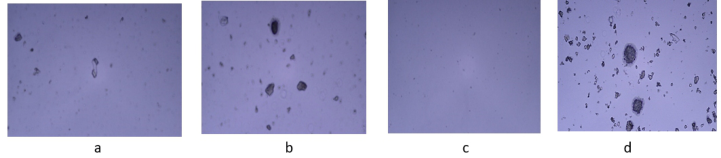
Characterization by Optical Microscopy of Antibacterial Treatment Solutions The preparation of microscopic slides was carried out by pipetting a drop of the prepared solutions in both the initial variant and the variant with added ß-Cyclodextrin (previously homogenized), onto a clean, degreased glass slide. Another glass coverslip was placed at a 45-degree angle to prevent the formation of air bubbles. The preparation was left undisturbed to allow the liquid to spread evenly across the surface of the slides. The sample was then analyzed under a microscope.The microscopic analysis of the samples was performed using optical microscopy with the Olympus BX43 microscope, equipped with a WHN10x/22 eyepiece and a Plan N 40x/0.65 Ph2 objective lens. During the analysis of the microscopic preparations, images were captured in the areas of interest using a Canon EOS1200D camera mounted on the optical microscope. The obtained images are presented bellow (see Figures 4 a, b, c, d).
Figure 4: a. Zeolite/initial oil; b. Zeolite/oil/ß; c. Zeolite/initial oil; d. Zeolite/oil/ß cyclodextrin.
SEM Analysis (Drop-Casting on Glass Slide) – Liquid Suspension R1 The glass slide was immersed in isopropanol and subjected to ultrasonic treatment for approximately 2 minutes to clean impurities, ensuring that only the particles from the suspension to be analyzed were visible under the microscope.
Using a Pasteur pipette, approximately 0.5 ml of the suspension to be analyzed was drop-cast onto the glass slide, followed by natural drying at room temperature. During the drying process, the sample was protected from atmospheric impurities by covering it with a Berzelius beaker positioned at an angle, ensuring a small lateral opening for natural ventilation.
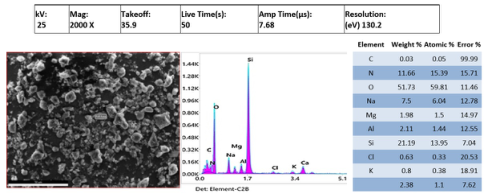
The SEM images for R1 revealed granular formations with an average size of 516 µm (4000X) and 4.95 µm (8000X). The granule density was calculated as 365 granules over 128 µm × 148 µm = 18,944 µm2 (the area
of the SEM image at 2000X magnification), resulting in a surface density of 1.92 granules/100 µm2 (see Figure 5). EDAX Analysis highlights the elemental composition of solution R1, which consists mainly of: Oxygen - 51.73%, Si - 21.19%, and Nitrogen - 11.66%, with Na, C, Al, Cl, K, Ca.
Figure 5: SEM-EDAX analysis.
GS-MS Analysis The identification of chemical compounds in the pine essential oil, both in the liquid solution and in the treated textile structures, was performed using the GC-MS method with the Gas Chromatography (GC) equipment and Mass Spectrometry (MS) detector manufactured by Agilent Technologies – model 6890N, serial number DE 10318091 (GC), FRB3300GDY (MS). Working parameters: Capillary column: ZB-5MSi, 30 m; 0.25 mm, 0.25 µm nominal, SN: 603858; Injector: splitless; Injector temperature: 260
C; Carrier gas: Helium; Temperature program: 100
C (2 minutes), from 100
C to 310
C (15
C/min), 310
C (2 minutes); Injection volume: 1.0 µl; Acquisition parameters: EI Positive Ion Mode, 70 eV.
GS-MS Analysis for Pine Essential Oil
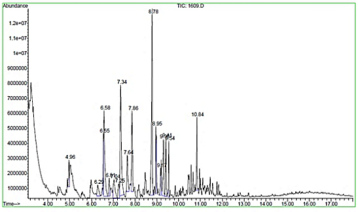
Figure 6 presents the GS-MS chromatogram for the pine essential oil, where the following compounds were identified: 1R-α-Pinene, Aromadendrene oxide-(2), Caryophyllene (see Figure 6).
Figure 6: Pine essential oil chromatogram.
Development of Functional Textiles Through Microencapsulation 41
Identification of Chemical Compounds in Textile Structures Extraction method: 5 g of textile material from each sample were cut into small pieces measuring 1 cm2, to which 10 mL of acetonitrile was added. The mixture was kept under mechanical agitation at a temperature of 50
C for 2 hours. Then, 2 mL of extract (filtered through a filter with a pore size of 0.2 µm) were taken from each sample and directly injected into the chromatographic column, following the method described above.
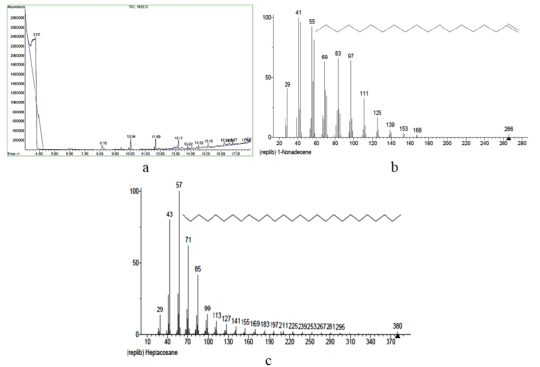
Figure 10 a. presents the chromatogram for the textile structure made of 100% cotton treated with Recipe 1, Figure 10 b. shows the textile structure made of 45% cotton/ 55% PES treated with R1, and Figure 10 c. presents the chromatogram of the textile structure made of 90% cotton/ 10% Elastane treated with R1 (see Figure 7).
The GC-MS analysis of the textile structures treated with volatile oils revealed the following phytochemicals:
Mono/sesquiterpenoids: tridecene, hexadecene, heptacosane, eicosene, nonadecene, which are decomposition radicals resulting from the specific ionization of mass spectrometry, originating from essential oils.
Evaluation of the Antibacterial Activity of Textile Structures Treated With Active Substances The determination of resistance to bacterial action was performed according to SR EN ISO 20645/2005, specifically resistance to Staphylococcus aureus ATCC 6538 (gram-positive) and Escherichia coli ATCC 10536 (gram- negative). A volume of agar was prepared for the lower layer of the test tube without bacteria. (10 ± 0.1) ml was added to each sterilized Petri dish and allowed to solidify. The agar for theupper layer was prepared and cooled to 45
C in a water bath. 150 ml of agar was inoculated with 1 ml of bacterial working solution (1–5 × 10⁸ CFU/ml). (5 ± 0.1) ml of the agar-bacterial solution was introduced into each Petri dish and left to solidify.
Figure 7: Chromatograms: a. 100% Cotton, b. 100% PES, c. 90% Cotton/ 10% Elastane.
The samples were placed on the surface of the nutrient medium and incubated at 37
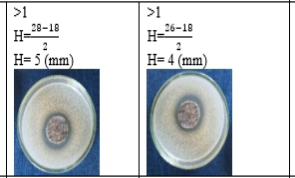
C for 18 to 24 hours. The width of the inhibition zone, i.e., the area without bacteria near the edge of the test tube, was calculated using the equation (1). The results are presented in Figure 8.
H = (D −d)/2 (1) Where: H = inhibition zone, in millimetres; D = total diameter of the test tube and the inhibition zone, in millimetres; d = diameter of the test tube, in millimetres.
Figure 8: Satisfcatory antibacterian effect.
The results of the antibacterial activity analysis of textile structures treated with Ri and R2 are considered to have a “satisfactory effect” as no bacterial growth was observed. The lack of an inhibition zone can be considered a positive effect, as the formation of such a zone might be hindered by a low diffusion of the active substance.
CONCLUSION
In this study, textiles produced via knitting technology from fiber blends containing Cotton/Polyester and 100% Polyester were subjected to a padding treatment to endow them with antibacterial properties.
The first treatment solution (R1) was composed of pine essential oil and collagen hydrolysate. Specifically, 450 µL of pine essential oil was dissolved in 15 mL of ethyl alcohol, and this solution was subsequently added to a 1.5% collagen solution, along with zeolite and β-cyclodextrin in a 1:10:10 ratio (pine essential oil: zeolite: β-cyclodextrin). The second treatment solution (R2) consisted of doxycycline and collagen hydrolysate, formulated at a ratio of doxycycline:β-cyclodextrin of 1:10. Following the treatment, the textiles were dried at room temperature for 24 hours.
Characterization of the treatment solutions was conducted using dynamic light scattering (DLS). The particle size distribution in solution R1 ranged from 11 to 20 µm, while that in solution R2 varied between 274.6 nm and 1.169 µm. SEM images of R1 revealed granular formations with an average size of 516 µm at 4000X magnification and 4.95 µm at 8000X magnification. The granule density was calculated to be 365 granules per 128 µm × 148 µm area (18944 µm2), resulting in a surface density of 1.92 granules per 100 µm2.
Development of Functional Textiles Through Microencapsulation 43
EDAX analysis of R2 indicated the solution was predominantly composed of oxygen (51.73%), silicon oxide (21.19%), and nitrogen (11.66%), with trace elements of Na, C, Al, Cl, K, and Ca.
Gas chromatography-mass spectrometry (GC-MS) analysis was conducted on both the pine essential oil and the treated textile structures, revealing the presence of specific chemical compounds that contributed to the materials’ antibacterial properties.
Both R1 and R2 treatments demonstrated a satisfactory antibacterial effect, as no bacterial growth was observed.
ACKNOWLEDGMENT
This work was carried out through the Nucleus Programme within the National Research Development and Innovation Plan 2022-2027, with the support of Ministry of Research, Innovation and Digitalization, project no. 6N/2023, PN 23 26 01 02, project title “Intelligent equipment to ensure the survival of combatants in operational conditions”, Acronym: IRHEM.
REFERENCES
Bhaskara-Amrit, U. R. Agrawal, P. B. and Warmoeskerken, M. M. C. G. (2011) Applications of ß -Cyclodextrins in Textiles. 11(4): pp. 94–101. Enna, S. J. and Bylund, D. B. (2008). xPharm: The Comprehensive Pharmacology
Reference. Editors. Elsevier: New York. pp. 1–8. Gonzalez Pereira, A. et al., (2021). Main Applications of Cyclodextrins in the Food Industry as the Compounds of Choice to Form Host-Guest Complexes. Int J Mol Sci. 22(3). Patil, Niraj Govinda. Chaudhari, Soham Sharad and Mahanwar, Prakash Anna.
(2023). Microencapsulation of polymeric phase change materials (MPCM) for thermal energy storage in industrial coating applications, Journal of Polymer Engineering. https://doi.org/10.1515/polyeng-2022-0291 Saliy, O. Popova, M. Tarasenko, H. and Getalo, O. (2024). Development strategy of novel drug formulations for the delivery of doxycycline in the treatment of wounds of various etiologies. European Journal of Pharmaceutical Sciences. 195: pp. 106636. Talita, A. Comunian and Carmen S. Favaro-Trindade. (2016). Microencapsulation
using biopolymers as an alternative to produce food enhanced with phytosterols and omega-3 fatty acids: A review, Food Hydrocolloids Vol. 61, Dec. 2016, pp. 442–457.
LISTED IN THE AHFE DIGITAL BOOKSTORE CATALOGUE
Explore the complete digital volume
Ergonomics In Design and Kansai Engineering
Read this individual research paper free through the original publisher, or explore the full digital proceedings book.
ISBN 978-1-964867-46-5
Explore this ISBN in the AHFE Bookstore ↗Listed in the July 2026 bookstore catalogue; search by ISBN to confirm current availability · Digital book purchase optional