Sara Buonocore, Francesca Massa, Giuseppe Di Gironimo (2023). Does the Embodiment Influence the Success of Visuo-haptic Learning?. In: Application of Emerging Technologies. AHFE Open Access, vol. 115, pp. 507–517. https://doi.org/10.54941/ahfe1004350
The purpose of this work is to demonstrate the influence of embodiment on the success of Visuo-haptic Learning, as it has not been yet investigated by current literature. With this aim, we conducted an experimental campaign to compare the users’ Sense of Embodiment (SoE) and learning success values obtained by experiencing the same simulated duty cycle within two different Visuo-haptic Learning environments. Interesting results have been found: the embodiment influenced the users’ completion time and mental workload, but it did not have particular incidence on the obtained learning level (intended as knowledge of the procedure). With this work, we aim to highlight the necessity of conducting wider and deeper studies about the influence of human factors and subjective perceptions on the success of Visuo-haptic Learning.
The success of VR-based Learning is generally measured on user performance within the virtual environment, meant as the sum of many factors such as time taken for completion of tasks, precision, accuracy, awareness, reaction time, error rate, etc. (Doolani, 2020). However, unsatisfactory performances do not necessarily mean that the main objectives have not been achieved. In fact, human performances in a virtual environment can also be significantly influenced by several human factors as situation awareness, physical and cognitive workload, motivation, technology acceptance, satisfaction, engage- ment, embodiment, stress and trust (Aromaa, 2022; Kaasinen, 2019; Kilteni, 2012; Easa, 2021). In light of this, it is crucial to understand how human factors may affect human performances in VR-based Learning, aiming to identify possible dis- turbing factors in the evaluation of the effectiveness and efficiency of such innovative learning systems. In addition, taking into account these subjective aspects is essential for a robust design of a VR-based Learning, in order to enhance (and not inhibit) the specific skills and abilities of the learners, fur- ther to boost the incredible potential and applications of VR technology. On the contrary, neglecting human factors and their influence on the outcome of the whole learning experience can lead to unnecessary repetitions of the
learning session, learners’ frustration or misevaluation of the adopted sys- tem; this could result in increasing costs and time associated to the learning process, as well as social implications for the learners (Stanney, 1998).
For instance, research has shown evidence of the importance of being embodied in the self-avatar within immersive virtual environments, meant as the ensemble of sensations that arise in conjunction with being can inside, having, and controlling a body, especially in relation to Virtual Reality appli- cations (Kilteni, 2012). SoE within immersive virtual environments is a highly powerful aspect, as being embodied in avatar dramatically change user’s experience in VR (Peck, 2013) Several experiments have demonstrated that SoE can increase user cognitive abilities (Steed, 2016) and sensorimotor abil- ities (McAnally, 2022), improve user immersion (Frohner, 2019) and haptic performance (Maselli et al., 2016; Gonzalez-Franco, 2019) increase self- recognition and identification through enfacement (Gonzalez-Franco, 2020). At the same time, it is a strongly subjective perception, since every user is unique and can have significantly different experiences, responses and performances in the same VR setup (Peck, 2021).
In light of this, our hypothesis is that there is an effective impact of the avatar embodiment on the success of Virtual Learning, but current literature has not yet proven it. For this reason, we have conducted an experimen- tal campaign to demonstrate the existence of a relationship between avatar hand embodiment and three parameters that determine the success of Vir- tual Learning: time taken to complete the learning session, learning level of the simulated duty cycle and cognitive workload. This was achieved by asking participants to test the same duty cycle with two different Visuo- haptic Learning systems, both characterized by a realistic human-like avatar and a first-perspective simulation, but differing for the induced users’ SoE. The obtained results have confirmed the importance of the embodiment perception in Visuo-haptic Learning.
BACKGROUND: VISUO-HAPTIC LEARNING Although visual feedback is still considered the main channel to stimulate learning, current literature offers many works about Visuo-haptic Learning (education and training), as the haptic system has proved to empower humans to interact with virtual environments by means of mechanical, sensory, motor, and cognitive abilities (Escobar-Castillejos, 2020; Kilteni, 2012; Dörr, 2022).
With reference to students’ education, haptic feedback has proved to boost students’ engagement within virtual environment and enjoyment of the innovative lesson, especially for subjects that can often be boring or too demanding for kids for as physics, maths and chemistry (Hamza-Lup, 2021; Hamza-Lup, 2019; Shaikh, 2017). For instance, in (Shaikh, 2017), 30 students tested in first person a visuo-haptic simulation guided activ- ity for conceptual learning about electric/magnetic fundamental principles. The results showed that the use of visuo- haptic simulation allowed stu- dents to improve their understanding of the concepts of electric fields for distributed charges, as demonstrated by the significant increase from the students’ pre-test to post-test questionnaires’ scores.
Does the Embodiment Influence the Success of Visuo-Haptic Learning? 509
In the medical field, the visuo-haptic simulators for training are mainly related to dentistry and surgery interventions, in which high motor skills and precision are required to the future specialist (Coles, 2011; Dörr, 2022; Rau, 2020; Escobar-Castillejos D. &., 2020). The presence of haptic feed- back (in particular kinaesthetic) allows users to perceive and understand the actual forces that they would apply to perform a real intervention (Coles, 2011). Even if the performance during visuo-haptic training seems to improve slowly rather than only visual training experience, it has been demonstrated that visuo-haptic stimuli have a positive influence on the learners’ long- term memory and retention. Furthermore, haptic elements may serve as additional retrieval cues, helping learners to understand abstract concepts (Rau, 2020).
In the industrial field, visuo-haptic training systems are mainly employed to simulate manufacturing processes and assembly procedures (Damian Gra- jewski, 2015; Gallegos-Nieto, 2017; Leino, 2019; Langley, 2016; Buonocore, 2022). The addition of haptic feedback has resulted to increase the simulation realism, allowing to detect more potential errors that the future worker could make on the job, identifying and correcting wrong behaviours in advance, during the Virtual Training session itself. To confirm this, in (Damian Gra- jewski, 2015), authors asked to experienced workers about stud welding to try in first person an immersive virtual simulation of the duty cycle with the additional haptic feedback, by using a well-known grounded hap-tic device (Phantom Premium 3.0). After the experience, workers confirmed that hap- tic feedback was an essential element of the simulation, in order to convey the highest consciousness of required movements to the novice workers. In (Gallegos-Nieto, 2017), the conducted experimental campaign highlighted the influence of haptic feedback on the training effectiveness. 15 users, aged between 19 and 30 years, were trained about 5 assembly tasks (a cube puzzle, a pyramid puzzle, an oil pump, a linear actuator and a compressor) interact- ing with the same virtual simulator in two different ways (with and without haptic feedback). The experiments have shown that the use of haptic feedback in Virtual Assembly Training has led to a greater effectiveness of training, assessed as number of steps correctly executed (without mistakes). The results also highlighted that the effectiveness of Virtual Assembly Training depended on assembly task complexity, i.e. the greater the task complexity, the greater the effectiveness.
Despite the widespread use of haptic technology in Virtual Learning, there are still significant technological limitations. It can be said that the “sense of touch” is not yet fully integrated with VR technology, making it difficult to perform natural human-computer interactions (Kilteni, 2012). Specifically, one of the main themes is the synchronization of visual and haptic feed- back during VR activities, which is crucial for user realism and immersion (Smith, 2019). This means that system-related aspects such as tracking issues or latency can hinder visual and tactile synchronization, with the risk of causing less user embodiment and affecting human performances within the virtual environment. In this work, we wanted to investigate the presence of such correlation.
METHODS AND MATERIALS
Methods
Design: This study examined the relation between users’ SoE within immer- sive virtual environment and their learning success.
The current experiment consisted in comparing the learning success val- ues of each user who experienced the same simulated duty cycle within two Visuo-haptic Learning environments that may seem apparently identical, but were characterized by different values of SoE.
Embodiment Measurement: According to (Kilteni, 2012), three factors can influence the users’ SoE within immersive virtual environment: Self-location (is a determinate volume in space where one feels to be physically located (Lenggenhager, 2006)), Sense of Agency (is the sense of having global motor control in active movements) and Sense of Body Ownership (refers to one’s self-attribution of a body, considered as the source of the experienced sen- sations (Gallagher, 2000; Tsakiris, 2006)). Although the interdependence between these subcomponents is not yet clear, it is known that acting on at least one of the three means causing a variation in the SoE (Kilteni, 2012).
Research in the embodiment field has showed that discrepancies (as a sig- nificant latency) between user’s actual movement and the respective visual feedback can induce a lower Sense of Agency (Yasuda, 2005; Kilteni, 2012). In the same way, it was demonstrated that unreasonable and unrealistic visuotactile correlations (as unreasonable and unrealistic haptic feedback) can reduce users’ Sense of Body Ownership (Tsakiris, 2006; Shimada, 2009). In light of this, the experimental campaign has been designed with the aim of acting on users’ Sense of Agency and Body Ownership, in order to induce different SoE during the two Visuo-haptic Learning experiences. Specifically, we exploited what has been discovered in (Buonocore, 2023) to investigate the correlation between SoE and Learning success. Although the two Visuo- haptic Learning systems appeared to be identical, one of the two systems showed significant tracking problems (lower Sense of Body Ownership) and non-neglectable communication latency by users (lower Sense of Agency).
Success of Visuo-Haptic Learning: As already mentioned, the success of VR-based Learning is a highly complex concept, dependent on both objective and subjective factors. In this work, it was decided to focus on two objec- tive measurements that contribute substantially to the success of Visuo-haptic Learning: time taken and learning level. Furthermore, users’ cognitive load subjective measurement has been introduced, with the aim of contributing to a broader understanding of its dependence from embodiment, as it is still not well understood (Peck, 2018; Peck, 2020).
Participants: 16 participants, all VR novices, were involved in the experi- mental campaign. At least a B2 level of knowledge of English was required to properly understand the given textual instructions within virtual environ- ment. The participants were selected through social platforms (Instagram, Linkedin, Facebook) as students and unemployed people with at least high school diploma, in order to faithfully represent unexperienced workers that may be potentially interested in such innovative learning techniques to acquire specific technical skills.
Does the Embodiment Influence the Success of Visuo-Haptic Learning? 511
Materials
Use Case: The selected use case is taken from (Buonocore, 2023), about employing prepreg components for the rear floor of a car. Specifically, the simulated 10-step layup phase involves the manual positioning of pre- engaged layers of Carbon Fiber Reinforced Plastic (CFRP) material in a specific lamination sequence and the removal of any trapped air. A VR-based training is proposed as a valid alternative to current as paper manuals and costly on-the-job sessions, allowing the future laminators to acquire the nec- essary skills and practice by repeating several times the virtual procedure, with no influence on the real items in case of mistakes. However, it is fun- damental that the VR session is as realistic as possible, giving multisensory feedback to the user during the immersion within the simulated work area. Further to visual feedback, vibrotactile and muscular feedback (especially on hands) may significantly improve the realism of the simulation and the comprehension of the simulated duty cycle.
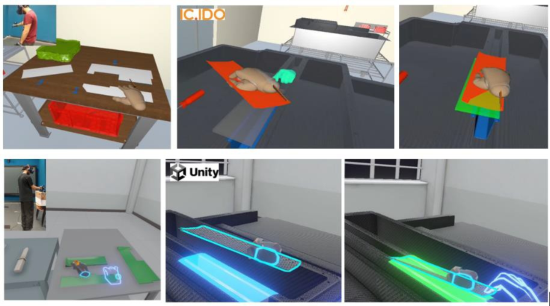
Software-Hardware Architecture: In this work, we have recalled the exper- iments conducted in (Buonocore, 2023), keeping the same software and hard- ware equipment: HTC Vive Pro Head Mounted Display (HMD), MANUS Prime II haptic gloves and two Vive trackers as common VR hardware, Unity and IC.IDO as the two different VR platforms. Although apparently equal, the two developed Visuo-haptic Learning systems (Fig. 1) have shown dif- ferent performance in the integration with the same hardware, in terms of quality of haptic system tracking and communication latency (Buonocore, 2023). In light of what has been said about Sense of Agency and Body Ownership (Sec. Methods), these technical differences have been exploited in this work to obtain different SoE in the two learning systems, in order to investigate the correlation between SoE and Learning success.
Figure 1: The implemented VR learning systems within IC.IDO (first row) and unity (second row).
Embodiment Measurement: The subjective measurement of each user’s SoE was made through the well-known questionnaire presented in (Peck, 2021). It consists of 16 sentences with responses on a 7-point Likert- scale, born from deep research in literature and a combination of previous
widespread questionnaires about SoE. The questionnaire outputs a numeric value of SoE for each user, calculated as the arithmetic mean between 4 subcomponents: Appearance, Response, Ownership, Multi-Sensory. As sug- gested in (Peck, 2021), the questionnaire’s items have been adapted to the specific use case, as the term “body” has been substituted with the only body part explored in this campaign (“hand”) and “prepreg components and tools” were introduced where necessary.
Success Measurement: Specifically, users’ time taken to complete the 10-step duty cycle have been recorded, and questionnaires were employed to assess users’ learning level and cognitive load (with NASA TLX ques- tionnaire (Hart, 2006)). The learning level questionnaire was necessarily custom-made, since questions were reasonably dependent on the specific use case. The designed questionnaire consisted of 8 multiple choice questions, with four possible answers: the right answer was awarded 1 point, one par- tially correct answer was awarded 0.5 points, and the other two were totally incorrect (0 points), with a range of finale scores from 0 (worst case) to 8 (best case). For each user, the order of the questions and answers was random. The questionnaire is given below:
1. What is the purpose of the simulated duty cycle? 2. Where are the adhesive protective films stored? 3. How many plates to place on the mold in the simulation? 4. Once positioned, how are the plates adhered? 5. How is the vacuum liner placed? 6. Which of these operations is not performed in the simulation performed? 7. Where is the vacuum hose located? 8. Indicates the correct sequence of operations to simulate.
Procedure: The participants were equally divided into two groups to try the two Visuo-haptic Learning systems in reverse order. Immediately after both the tests, users filled out the above questionnaires.
RESULTS AND DISCUSSION
Table 1 shows the results of the experimental campaign, in descending order of SoE values. For each user, SoE values of both Visuo-haptic Learning expe- riences are listed, as the respective values of time taken, learning level and cognitive load.
Overall, we can say that a considerable variability on the users’ SoE for the same VR software is clearly showed, confirming that it can be an extremely subjective perception even if the design of the virtual experience is quite identical. In fact, obtained SoE values are respectively 0,8 for Unity and 0,69 for IC.IDO on average, demonstrating a non-neglectable difference in the users’ embodiment perception between the two Visuo-haptic Learning experiences.
As expected, system-related aspects as tracking issues or latency have sig- nificantly influenced the user experience within virtual environment. How- ever, it is not easy to clearly describe the relationship between SoE and
Does the Embodiment Influence the Success of Visuo-Haptic Learning? 513
Visuo-haptic Learning success, due to the complexity of the concept of suc- cess itself. In fact, the results show a different influence of SoE on the three selected parameters to characterize Visuo-haptic Learning success.
Table 1. Experimental campaign results about users’ SoE, time taken, learning level and cognitive load obtained with both the visuo-haptic learning experiences.
Unexpectedly, the SoE was not decisive in terms of greater understanding of the simulated work cycle, as all users achieved excellent (or quite excel- lent) learning level results, confirming the validity of Visuo-haptic Learning as innovative learning technique. On the other side, SoE has resulted to signifi- cantly influence both users’ time taken and cognitive workload. In particular, for both the VR experiences, lower values of SoE corresponded to higher values of time taken and cognitive workload. With reference to cognitive workload, the results are quite different between the two experiences: respec- tively 4/16 users for Unity and 6/16 users for IC.IDO defined the system characterized by a "somewhat high" cognitive load, while 3/16 users have affirmed that the IC.IDO-based system has required a "high" cognitive load. This means that lower levels of SoE (lower Sense of Agency and Body Own- ership) provided by the Visuo-haptic Learning system developed in IC.IDO have negatively influenced the cognitive effort required to the users, leading some of them to judge it more severely. In the same way, lower SoE has led users to reach a maximum time of 9’28” in IC.IDO, compared to the max- imum time recorded in Unity (5’47”). On average, users took less between 3 and 4 minutes to complete the session in Unity, while the lower SoE per- ceived in the IC.IDO experience caused an average taken time higher than 5 minutes. What has been said so far is also reflected in the fact that the whole sam- ple of 16 users obtained worse results in IC.IDO than Unity, with lower SoE linked to higher time taken and cognitive load. This suggests the existence
of inverse relationship between SoE and both time taken and cognitive load (the higher is SoE, the lower time taken and cognitive load seem to be, and viceversa). However, our study did not aim to find and demonstrate the pre- cise mathematical relationship between these aspects, as it is a preliminary stage for future deeper studies.
CONCLUSION
In this work, we have discussed the influence of embodiment on the success of Visuo-haptic Learning, as it has not been yet investigated by current liter- ature. We have conducted an experimental campaign to compare the users’ Sense of Embodiment and learning success values obtained by experiencing the same simulated duty cycle within two different Visuo-haptic Learning environments.
Taking into account that Visuo-haptic Learning success is a strongly com- plex concept and depends on several factors, in this study we decided to focus on three main aspects: learning level, time taken and cognitive load. The experimental campaign has demonstrated that lower SoE can lead to higher time taken and cognitive load to complete the Visuo-haptic Learning expe- rience, while it does not seem to significantly influence the users’ learning level about the simulated duty cycle. Furthermore, the resulted significant variability in SoE values between different users, even within the same vir- tual environment, highlights and confirms the importance of considering human factors and subjective perceptions as SoE in Visuo-haptic Learning. With this regard, our aim is to inspire readers to include SoE since the design phase of Visuo-haptic Learning systems and consider it a crucial aspect, as it can significantly affect human performances in the virtual environment. On the contrary, neglecting SoE could lead to a misestimation of learners’ out- comes, causing loss of time and resources, further to social implications for the learners themselves (loss of self-esteem, insecurity, etc.).
REFERENCES
Abbasimoshaei, A., Reisinger, J., Neupert, C., Hatzfeld, C., Zhou, W. (2023). Evaluation of Haptic Systems. In: Kern, T. A., Hatzfeld, C., Abbasimoshaei, A. (eds) Engineering Haptic Devices. Springer Series on Touch and Haptic Systems. Springer, Cham. https://doi.org/10.1007/978-3-031-04536-3_13 Aromaa, S., Heikkilä, P. (2022). Design of a human factors questionnaire to eval-
uate digital solutions developed for industrial work. In: Francisco Rebelo (eds) Ergonomics In Design. AHFE (2022) International Conference. AHFE Open Access, vol. 47. AHFE International, USA. http://doi.org/10.54941/ahfe1001992 Blanke, Olaf, and Thomas Metzinger. “Full-Body Illusions and Minimal Phenomenal Selfhood.” Trends in Cognitive Sciences 13, no. 1 (2009): 7–13. https://doi.org/10.1016/j.tics.2008.10.003. Brazilian Portuguese.” Virtual Reality 20, no. 4 (2016): 237–42. https://doi.org/10.1007/s10055-016-0295-7 Buonocore, Sara, Pietro Giovannoli, and Giuseppe Di Gironimo. “From Virtual to
Augmented Reality Training System: An IC. IDO-Based Approach.” Advances on Mechanics, Design Engineering and Manufacturing IV, 2022, 1376–88. https://doi.org/10.1007/978-3-031-15928-2_120
Does the Embodiment Influence the Success of Visuo-Haptic Learning? 515
Buonocore, Sara. “Usability of Glove-Based Handling Devices in Virtual Training: Use Case in Automotive Sector.” Display Week Conference 2023, May 2023. https://doi.org/10.1002/sdtp.16807 Coles, Timothy R., Dwight Meglan, and Nigel W. John. “The Role of Haptics in
Medical Training Simulators: A Survey of the State of the Art.” IEEE Transactions on Haptics 4, no. 1 (2011): 51–66. https://doi.org/10.1109/toh.2010.19 Dörr, Bianka, Mareike Funk, Farzaneh Norouzinia, and Dirk Werth. “Haptic Learning and How It Can Enhance Digital Learning Expe- riences: An Innovative Approach.” INTED2022 Proceedings, 2022. https://doi.org/10.21125/inted.2022.1069 Damian Grajewski, Filip Górski, Adam Hamrol, Przemysław Zawadzki, Immersive and Haptic Educational Simulations of Assembly Workplace Conditions, Pro- cedia Computer Science, Volume 75, 2015, Pages 359–368, ISSN 1877-0509, https://doi.org/10.1016/j.procs.2015.12.258. Doolani, S., Wessels, C., Kanal, V., Sevastopoulos, C., Jaiswal, A., Nam-
biappan, H., & Makedon, F. (2020). A Review of Extended Reality (XR) Technologies for Manufacturing Training. Technologies, 8(4), 77. https://doi.org/10.3390/technologies8040077 Easa, Said. “Human Factor Considerations in Virtual Reality: Adequate or Inadequate?” Ergonomics International Journal 5, no. 2 (2021). https://doi.org/10.23880/eoij-16000267 Escobar-Castillejos, David, Julieta Noguez, Fernando Bello, Luis Neri, Alejandra J. Magana, and Bedrich Benes. “A Review of Training and Guid- ance Systems in Medical Surgery.” Applied Sciences 10, no. 17 (2020): 5752. https://doi.org/10.3390/app10175752 Escobar-Castillejos, David, Julieta Noguez, Roberto A. Cárdenas-Ovando, Luis Neri, Andres Gonzalez-Nucamendi, and Víctor Robledo-Rella. “Using Game Engines for Visuo-Haptic Learning Simulations.” Applied Sciences 10, no. 13 (2020): 4553. https://doi.org/10.3390/app10134553 Frohner, Jakob, Gionata Salvietti, Philipp Beckerle, and Domenico Prat- tichizzo. “Can Wearable Haptic Devices Foster the Embodiment of Vir- tual Limbs?” IEEE Transactions on Haptics 12, no. 3 (2019): 339–49. https://doi.org/10.1109/toh.2018.2889497 Gallagher, Shaun. “Philosophical Conceptions of the Self: Implications for Cognitive Science.” Trends in Cognitive Sciences 4, no. 1 (2000): 14–21. https://doi.org/10.1016/s1364-6613(99)01417-5. Gallegos-Nieto, E., Medellín-Castillo, H. I., González-Badillo, G. et al. The anal-
ysis and evaluation of the influence of haptic-enabled virtual assembly training on real assembly performance. Int J Adv Manuf Technol 89, 581–598 (2017). https://doi.org/10.1007/s00170-016-9120-4 Gonzalez-Franco, Mar, and Christopher C. Berger. “Avatar Embodiment Enhances Haptic Confidence on the Out-of-Body Touch Illusion.” IEEE Transactions on Haptics 12, no. 3 (2019): 319–26. https://doi.org/10.1109/toh.2019.2925038 Gonzalez-Franco, Mar, Anthony Steed, Steve Hoogendyk, and Eyal Ofek. “Using Facial Animation to Increase the Enfacement Illusion and Avatar Self- Identification.” IEEE Transactions on Visualization and Computer Graphics 26, no. 5 (2020): 2023–29. https://doi.org/10.1109/tvcg.2020.2973075 Hamza-Lup, F. G. Kinesthetic Learning—Haptic User Interfaces for Gyroscopic Pre-
cession Simulation. Rev. Romana Interactiune Om-Calc. 2019, 11, 185–204. https://doi.org/10.48550/arXiv.1908.09082
Hamza-Lup, F. G., Goldbach, I. R. Multimodal, visuo-haptic games for abstract theory instruction: grabbing charged particles. J Multimodal User Interfaces 15, 1–10 (2021). https://doi.org/10.1007/s12193-020-00327-x Hart, S. G. (2006). Nasa-Task Load Index (NASA-TLX); 20 Years Later. Proceedings
of the Human Factors and Ergonomics Society Annual Meeting, 50(9), 904–908. https://doi.org/10.1177/154193120605000909 Insook Han, John B. Black, Incorporating haptic feedback in simulation for learning physics, Computers & Education, Volume 57, Issue 4, 2011, Pages 2281–2290, ISSN 0360-1315, https://doi.org/10.1016/j.compedu.2011.06.012.ll. Kaasinen, E. et al. (2019). A Worker-Centric Design and Evaluation Framework
for Operator 4.0 Solutions that Support Work Well-Being. In:, et al. Human Work Interaction Design. Designing Engaging Automation. HWID 2018. IFIP Advances in Information and Communication Technology, vol. 544. Springer, Cham. https://doi.org/10.1007/978-3-030-05297-3_18 Kilteni, K., Groten, R. and Slater, M. (2012) The Sense of Embodiment in Virtual Reality. Presence: Teleoperators and Virtual Environments, 21, 373–387. https://doi.org/10.1162/PRES_a_00124 Langley, A., G. Lawson, S. Hermawati, M. D’Cruz, J. Apold, F. Arlt, and
K. Mura. “Establishing the Usability of a Virtual Training System for Assembly Operations within the Automotive Industry.” Human Factors and Ergonomics in Manufacturing & Service Industries 26, no. 6 (2016): 667–79. https://doi.org/10.1002/hfm.20406. Leino, SP. et al. (2009). Enhanced Industrial Maintenance Work Task Planning by Using Virtual Engineering Tools and Haptic User Interfaces. In: Shumaker, R. (eds) Virtual and Mixed Reality. VMR 2009. Lecture Notes in Computer Science, vol. 5622. Springer, Berlin, Heidelberg. https://doi.org/10.1007/978-3- 642-02771-0_39 Lenggenhager, B., Smith, S. T., & Blanke, O. (2006). Functional and neural mech-
anisms of embodiment: Importance of the vestibular system and the temporal parietal junction. Reviews in the Neurosciences, 17(6), 643–657. Maselli, Antonella, Konstantina Kilteni, Joan López-Moliner, and Mel Slater. “The Sense of Body Ownership Relaxes Temporal Constraints for Multisensory Inte- gration.” Scientific Reports 6, no. 1 (2016). https://doi.org/10.1038/srep30628 McAnally, Ken, and Guy Wallis. “Visual–Haptic Integration, Action and Embod-
iment in Virtual Reality.” Psychological Research 86, no. 6 (2021): 1847–57. https://doi.org/10.1007/s00426-021-01613-3 Peck, Tabitha C., and Altan Tutar. “The Impact of a Self-Avatar, Hand Collocation, and Hand Proximity on Embodiment and Stroop Interference.” IEEE Trans- actions on Visualization and Computer Graphics 26, no. 5 (2020): 1964–71. https://doi.org/10.1109/tvcg.2020.2973061. Peck, Tabitha C., and Mar Gonzalez-Franco. “Avatar Embodiment. A Standardized Questionnaire.” Frontiers in Virtual Reality 1 (2021). https://doi.org/10.3389/frvir.2020.575943 Peck, Tabitha C., My Doan, Kimberly A. Bourne, and Jessica J. Good. “The Effect of
Gender Body-Swap Illusions on Working Memory and Stereotype Threat.” IEEE Transactions on Visualization and Computer Graphics 24, no. 4 (2018): 1604–12. https://doi.org/10.1109/tvcg.2018.2793598. Peck, Tabitha C., Sofia Seinfeld, Salvatore M. Aglioti, and Mel Slater. “Putting Yourself in the Skin of a Black Avatar Reduces Implicit Racial Bias.” Consciousness and Cognition 22, no. 3 (2013): 779–87. https://doi.org/10.1016/j.concog.2013.04.016
Does the Embodiment Influence the Success of Visuo-Haptic Learning? 517
Rau, Martina A. “Comparing Multiple Theories about Learning with Physical and Virtual Representations: Conflicting or Complementary Effects?” Educational Psychology Review 32, no. 2 (2020): 297–325. https://doi.org/10.1007/s10648- 020-09517-1 Sato, Atsushi, and Asako Yasuda. “Illusion of Sense of Self-Agency: Discrepancy
between the Predicted and Actual Sensory Consequences of Actions Modulates the Sense of Self-Agency, but Not the Sense of Self-Ownership.” Cognition 94, no. 3 (2005): 241–55. https://doi.org/10.1016/j.cognition.2004.04.003. Schwind, Valentin, Pascal Knierim, Nico Haas, and Niels Henze. “Using Presence Questionnaires in Virtual Reality.” Proceedings of the 2019 CHI Conference on Human Factors in Computing Systems, 2019. https://doi.org/10.1145/3290605.3300590 Shaikh, U. A. S., Magana, A. J., Neri, L., Escobar-Castillejos, D., Noguez, J., & Benes, B. (2017). Undergraduate students’ conceptual interpretation and perceptions of haptic-enabled learning experiences - international journal of educational tech- nology in higher education. Retrieved from https://doi.org/10.1186/s41239-017- 0053-2. Shimada, Sotaro, Kensuke Fukuda, and Kazuo Hiraki. “Rubber Hand Illu-
sion under Delayed Visual Feedback.” PLoS ONE 4, no. 7 (2009). https://doi.org/10.1371/journal.pone.0006185 Silva, Gustavo R., Júlia C. Donat, Marcelo M. Rigoli, Fernando R. de Oliveira, and Christian H. Kristensen. “A Questionnaire for Measuring Presence in Virtual Environments: Factor Analysis of the Presence Questionnaire and Adaptation into Smith, F., “Measuring the perception of latency with a haptic glove” (2019).
https://tech.facebook.com/reality-labs/2019/7/measuring-the-perception-of-late ncy-with-a-haptic-glove/ Stanney, Kay M., Ronald R. Mourant, and Robert S. Kennedy. “Human Factors Issues in Virtual Environments: A Review of the Literature.” Pres- ence: Teleoperators and Virtual Environments 7, no. 4 (1998): 327–51. https://doi.org/10.1162/105474698565767 Steed, A., Pan, Y., Zisch, F., and Steptoe, W. (2016). “The impact of a self-avatar
on cognitive load in immersive virtual reality,” in 2016 IEEE virtual reality (VR), Greenville, SC, March 19–23, 2016 (Piscataway, NJ: IEEE), 67–76. Tsakiris, Manos, Gita Prabhu, and Patrick Haggard. “Having a Body versus Moving Your Body: How Agency Structures Body-Ownership.” Consciousness and Cog- nition 15, no. 2 (2006): 423–32. https://doi.org/10.1016/j.concog.2005.09.004 Xia, P., Lopes, AM, Restivo, MT et al. A new type haptics-based virtual environment
system for assembly training of complex products Int J Adv Manuf Technol 58, 379–396 (2012). https://doi.org/10.1007/s00170-011-3381-8
LISTED IN THE AHFE DIGITAL BOOKSTORE CATALOGUE
Explore the complete digital volume
Application of Emerging Technologies
Read this individual research paper free through the original publisher, or explore the full digital proceedings book.
ISBN 978-1-958651-91-9
Explore this ISBN in the AHFE Bookstore ↗Listed in the July 2026 bookstore catalogue; search by ISBN to confirm current availability · Digital book purchase optional