In this paper, we will focus on ACT (behavioral/physical experience) as a specific customer experience among the five strategic experiential modules (SEM) proposed by Schmidt. Like RELATE (relational experience), ACT (behavioral/physical experience) is said to be difficult to understand among the five strategic experiential modules (SEM), and it is difficult to understand whether it is possible to create it in the first place.Therefore, the authors redefined ACT (behavioral/physical experience) from the idea of embodied cognition, and then proposed ways to create that ACT (behavioral/physical experience) and realize differentiation. demonstrated the methodology.(1) ACT (behavioral/physical experience) by SchmittBernd H. Schmitt defines ACT (behavioral/physical experience) as `the experience that appeals to physical experience, lifestyle, and interaction with others.' Schmitt's definition of the behavioral/physical experience makes it difficult to understand the concept of `physical experience,' and that `interaction with others' is not related to the behavioral/physical experience. Therefore, it is easy to confuse it with RELATE (relational experience). This difficulty in understanding the concept of behavioral/physical experience is thought to be connected to the difficulty in its application.However, as mentioned in the previous chapter, according to Schmitt, ACT (behavioral/physical experience) is derived from the concept of Embodied Cognition (Schmitt, 1999, p.258). Therefore, in this paper, we reorganize the content of ACT (behavioral/physical experience) by reconfirming the concept of embodied cognition.(2) Redefining ACT (behavioral/physical experience)Schmitt developed the concept of embodied cognition into ACT (behavioral/physical experience). Embodied cognition is based on the concept of ecological psychology as described in the previous section. In ecological psychology, `body movement is determined by the interaction between the body and the environment,' and the characteristics of the environment in this interaction are called affordances.Therefore, we reorganized ACT (behavioral/physical experience) from this concept of embodied cognition and redefined it as follows. Physiological and psychological activities that occur along with the actions of consumers themselves during consumption activitiesBased on the concept of embodied cognition, which involves perceiving the environment through physical movement, both "behavior" and "physiological and psychological activities associated with behavior" can be said to be ACT (behavioral/physical experience). For example, physical movements such as running, sitting, and grasping, as well as the actions themselves such as studying, driving a car, and going to the park, as well as the feelings and emotions that come with these movements and actions, such as feeling good, refreshing, and having fun. Both are included in ACT (behavioral/physical experience).This definition of ACT (behavioral/physical experience) is an original proposal by the authors.(3) Interaction between ACT (behavioral/physical experience) and productsFrom the perspective of embodied cognition and ecological psychology, behavioral/physical experience is generated through interaction with the environment. Considering the process of consumer experience of acquiring, using, and disposing of products and services, the environment that is most affected is the product and service. In other words, the consumer's behavioral/physical experience is generated through the interaction between the product/service and the consumer. Movements and actions occur depending on how a product or service is used, and emotions such as pleasure and pleasure are also generated in the process of using the product or service.For example, it is the movement/behavior and feeling of use related to a product, such as the pleasantness of a moderate response when closing a car door or the comfort of opening a foldable cell phone, and this is behavioral/physical experience. The design of the product has a lot to do with this operation and usability. Nintendo's home game consoles Wii and Switch Sports are designed with new game controls such as `shaking,' `turning,' and `aiming' using the remote control.Donald A. Norman, called the design of products that convey the joy and utility of use in this way as behavioral design, and pointed out its importance (Norman, 2004). Furthermore, affordances are pointed out as an important element on the product side that influences and determines the usability (Norman, 1990). In the field of product design, Fukasawa et al. also refer to affordances and point out the importance of design that takes human behavior into consideration, using the expression `design that corresponds to behavior' (Fukasawa, Sasaki, and Goto, 2004, p.86).
INTRODUCTION: DISCUSSION ON ACT (BEHAVIOURAL/PHYSICAL EXPERIENCE) Since the concept of “experience” was proposed by Schmitt (1999, 2003), expressions such as “Harley experience,” “Starbucks experience,” and “ama- zon.com experience”have appeared on corporate websites and CEOs. As can be seen frequently in comments these days, it has been actively introduced into marketing practices.
For example, introducing initiatives related to experience or customer experience (CX), such as “Company A releases a new service that supports a comfortable life with the aim of providing a customer experience suitable for the digital age.” has become frequently reported in economic newspapers and magazines.
In addition, CX has come to refer to the overall value that customers receive through products and services, such as UX (user experience) and CS (customer satisfaction). Additionally, DX (digital transformation) is rapidly being incorporated into society. This will bring about changes in business pro- cesses and digital services, and as business changes, consumption behaviour and CX (customer experience) will inevitably change, so DX and CX are interrelated. Therefore, in order to improve CX in society in the future, DX promotion will be essential. For this reason, CX and DX are often used together as a set, such as “Company XX aims to improve CX by promoting DX.”
In these efforts, “experience” and “customer experience (CX)” are once again attracting attention.
In this paper, we will take up ACT (behavioural/physical experience) as a specific experience among the five strategic experiential modules (SEM) pro- posed by Schmidt. Like RELATE (relational experience), ACT (behavioural/ physical experience) is said to be difficult to understand among the five strate- gic experiential modules (SEM), and it is difficult to understand whether it is possible to create it in the first place (Nagasawa, 2007a, p. 4).
Therefore, the author redefined ACT (behavioural/physical experience) from the idea of embodied cognition, and then developed methods to cre- ate that ACT (behavioural/physical experience) and realize differentiation. demonstrated the methodology (Nagasawa and Otsu, 2011, 2015a, 2015b). This paper introduces this analysis and proposal.
PREVIOUS RESEARCH ON CUSTOMER EXPERIENCE (CX) Outline of Customer Experience (CX)
Based on the concepts of cognitive science, Bernd H. Schmitt pointed out and classified five types of experience (Strategic Experiential Modules, SEM) as shown in Table 1 (Schmitt, 1999). The purpose of the Strategic Experiential Modules (SEM) is to categorize experiences and make them easier to use as components of marketing goals and strategies.
Table 1. Strategic experiential modules (SEM).
Table available in the original PDF paper.
Strategic Experience Module Experience SENSE (sensory experience) Five senses I felt that the colour, shape, and material of the product were noticeable. FEEL (emotional experience) Emotion I felt that the product was luxurious and nice. THINK (intellectual experience) Curiosity and accumulation I was interested in the product’s “specialty” and the creator. ACT (behavioural/Physical experience) Behaviour/Lifestyle changed to using products RELATE (relational experience) Feeling of connection Participated in a product enthusiast community
Source: Created by the author based on Schmitt (1999) Experiential Marketing, keywords and examples added by the author.
Utilize these strategic experiential modules (SEM) to focus on the consumer experience. This is experiential marketing proposed by Schmitt.
These five strategic experiential modules (SEM) are SENSE (sensory expe- rience), FEEL (emotional experience), THINK (intellectual experience), and RELATE (relational experience). Inner experiences such as feelings of con- nection and connection, ACT (behavioural/physical experience value), can be classified as external experiences of actions.
Enbodied Cognition in Customer Experience (CX) 201
ACT (Behavioural/Physical Experience) by Schmitt Schmidt defines ACT (behavioural/physical experience) as “the experience that appeals to physical experience, lifestyle, and interaction with others.” Schmitt’s definition of the behavioural/physical experience makes it difficult to understand the concept of “physical experience,” and that “interaction with others” is not related to the behavioural/physical experience. Therefore, it is often confused with RELATE (relational experience). This difficulty in understanding the concept of behavioural/physical experience is thought to be connected to the difficulty in its application.
However, as mentioned in the previous paper (Nagasawa, 2023), accord- ing to Schmitt, ACT (behavioural/physical experience) is derived from the concept of Embodied Cognition (Schmitt, 1999, p. 258). Therefore, in this section, we reorganize the content of ACT (behavioural/physical experience) by reconfirming the idea of embodied cognition.
RE-CREATION OF ACT (BEHAVIOURAL/PHYSICAL EXPERIENCE) Redefining ACT (Behavioural/Physical Experience)
Schmitt developed the concept of embodied cognition into ACT (behavioural/physical experience). Embodied cognition is based on the con- cept of ecological psychology as described in the previous section. In ecolog- ical psychology, “body movement is determined by the interaction between the body and the environment,” and the characteristics of the environment in this interaction are called affordances.
Therefore, the author reorganized ACT (behavioural/physical experience) from this concept of embodied cognition and redefined it as follows: Physiological and psychological activities that occur along with the actions of consumers themselves during consumption activities.
Based on the concept of embodied cognition, which involves perceiving the environment through physical movement, both “behaviour”and “physiolog- ical and psychological activities associated with behaviour” can be said to be ACT (behavioural/physical experience). For example, physical movements such as running, sitting, and grasping, as well as the actions themselves such as studying, driving a car, and going to the park, as well as the feelings and emotions that come with these movements and actions, such as feeling good, refreshing, and having fun. Both are included in ACT (behavioural/physical experience).
This definition of ACT (behavioural/physical experience) is an original proposal by the author.
Interaction Between ACT (Behavioural/Physical Experience) and Products From the perspective of embodied cognition and ecological psychology, behavioural/physical experience is generated through interaction with the environment. Considering the process of consumer experience of acquir- ing, using, and disposing of products and services, the environment that is most affected is the product and service. In other words, the consumer’s
202 Nagasawa
behavioural/physical experience is generated through the interaction between the product/service and the consumer. Movements and actions occur depend- ing on how a product or service is used, and emotions such as pleasure and pleasure are also generated in the process of using the product or service.
For example, it is the movement/behaviour and feeling of use related to a product, such as the pleasantness of a moderate response when closing a car door or the comfort of opening a foldable cell phone, and these are behavioural/physical experiences. The design of the product has a lot to do with this operation and usability. Nintendo’s home game consoles Wii and Switch Sports are designed with new game controls such as “shaking,” “turning,” and “aiming” using the remote controller.
Donald A. Norman called the design of products that convey the joy and utility of use in this way as behavioural design, and pointed out its importance (Norman, 2004). Furthermore, affordances are pointed out as an impor- tant element on the product side that influences and determines the usability (Norman, 1990). In the field of product design, Fukasawa et al. also refer to affordances and point out the importance of design that takes human behaviour into consideration, using the expression “design that corresponds to behaviour” (Fukasawa, Sasaki, and Goto, 2004, p. 86).
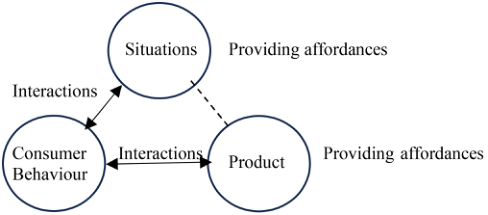
As mentioned above, it can be said that Norman and Fukasawa also point out the importance of designing affordances on the product side in order to create consumer behaviour (behavioural/physical experience) (Figure 1).
Figure 1: Interaction between consumer behaviour and products. Source: Nagasawa, S. Otsu, S. (2015b). Experience Differentiation Strategy (2): Focus on Embodied Cognition and ACT Module, Science Journal of Business and Manage- ment, Vol. 3, No. 2–1, p. 80, Figure 1.
Figure available in the original PDF paper.
Case: INAX’s SATIS The author takes up INAX’s space-saving toilet “SATIS” as an example of experience creation (Nagasawa, 2005). Let’s revisit this case as an example of product-behaviour interaction.
“SATIS”is a tankless toilet released by INAX (currently LIXIL) in 2001. By eliminating the tank, “SATIS” reduces the depth by 15 cm from the previous 80 cm to 65 cm, saving space and expanding the toilet space. Conventional tank-type toilets have a water supply function for washing hands as well as a function to replenish water in the tank. By making this a tankless toilet, a separate sink with a mirror was installed in the toilet space, separating the act of flushing the toilet from the act of dispensing water to wash hands. As a result, he was able to enter the bathroom just to wash his hands and touch up his makeup. For example, guests invited to a house party can now use the toilet as a space where they can be private and get ready. In
Enbodied Cognition in Customer Experience (CX) 203
addition, the host also expects to be used in this way, and their awareness of the toilet has changed from “the part of the house that I don’t want people to see” to “a space for hospitality.” The host went from shying away from guests to actively inviting them.
In this way, “SATIS” provided consumers with a new behavioural pat- tern. Consumers experience new behaviours while using “SATIS.” This can be said to be an example of creating behavioural/physical experience through products.
Interaction Between ACT (Behavioural/Physical Experience) and Situations In the previous section,we examined the interaction between products/services and behavioural/physical experience. If we consider the idea of embodied cognition that “ACT (behavioural/physical experience) is generated through interaction with the environment,” the environment that consumers are influ- enced by is not just products and services. There are also environments other than products and services. Here, the environment other than prod- ucts and services will be referred to as the “situation.” This “situation” is also considered to have an influence on consumer behaviour (Figure 2).
Figure 2: Interaction between consumer behaviour and situations. Source: Nagasawa, S. Otsu, S. (2015b). ibid., Vol. 3, No. 2–1, p. 81, Figure 2.
Examples of “situation” include products and services other than those directly consumed, consumers other than oneself, previous background, knowledge, timing, etc. All elements related to consumption activities other than products and services are applicable. It can be said that all elements other than products and services that consumers are aware of are included in the concept of situation. “Situation” also refers to “subjectivity (in situa- tions that occur around the consumer and are directly in contact with them),” which is one of the three characteristics of the concept of “experience”shown earlier. However, it is not only the behavioural/physical experience but also an important element of “experience” as a whole.
Specifically, the situation of being hungry may lead to the behaviour of eating, and the situation of being invited by a friend may lead to the behaviour of going to the movies. The difference between eating alone and eating with two people can lead to differences in emotions and feelings when eating.
A crowded train and a train with almost empty seats make a difference in how you feel when riding a train. Furthermore, even if the train has almost
204 Nagasawa
empty seats, the difference in time between riding during the day and during the night may bring about a difference in how one feels when riding.
As mentioned above, the “situation”when engaging in consumption activ- ities also influences the behaviour itself and the emotions and sensations experienced when performing the behaviour.
Case: Albirex Niigata The ACT (behavioural/physical experience value) of the audience at Albirex Niigata soccer team is the so-called festival experience of “cheering together in a stadium with 40,000 people.” Both the act of cheering with 40,000 peo- ple and the excitement I felt at the time made it a special experience. The point of creating this ACT (behavioural/physical experience) is that the sta- dium can hold 40,000 people. In this case, the key point is not the product itself, but the “situation.”
Albirex Niigata thought that if they had a stadium that could hold 40,000 people, they would start by mobilizing 40,000 people, so they created an exciting space for 40,000 people. In order to create an enthusiastic expe- rience for 40,000 people and gain understanding from local residents, we distributed a large number of free invitation tickets. Of course, there is no direct connection between handing out items for free and actually attend- ing the event. In the J League, it was even said that each team was failing with free invitation tickets. However, Albirex Niigata took various measures, such as distributing it through neighbourhood associations to people who actually wanted to go, and asking for cooperation from the board of educa- tion. As a result, we were able to create a situation from the beginning of a “40,000-capacity stadium.” In addition to the experience of simply going to a soccer game and cheering, we aim to create a special behavioural experience of watching soccer in a stadium full of 40,000 people with loud cheers and a sense of unity, making the experience of watching soccer more appealing. I made it into something.
As described above, the case of Albirex Niigata can be said to be an exam- ple of the behavioural/physical experience derived from the situation rather than the product (soccer match) itself.
PROPOSAL ON HOW TO CREATE ACT (BEHAVIOURAL/PHYSICAL EXPERIENCE) As mentioned above, in order to create ACT (behavioural/physical experi- ence), 1) design elements that lead to behavioural experience in the “produc- t/service” itself, and 2) elements that lead to behavioural experience in the “situation” during consumption activities. He pointed out that there are two points to consider when designing.
Designing behavioural experience elements directly into “products and ser- vices” has been proposed by Norman, Fukasawa, and others. This is one way to create ACT (behavioural/physical experience). However, until now, environmental factors (=situations) other than “products and services” have not been sufficiently mentioned. In order to create and differentiate ACT (behavioural/physical experience), it is considered desirable to create not only
Enbodied Cognition in Customer Experience (CX) 205
products and services but also the situation. In the Albirex example, the situ- ational element that differentiates the behavioural experience was “a stadium filled with 40,000 people.”
Creating a situation means creating a special situation. Experiences in spe- cial situations become special experiences. Examples of special situations include unusual situations and unusual situations.
One type of abnormal situation is a situation where accessibility decreases, or conversely, a situation where inaccessibility increases. Traditional mar- keting theory has focused on increasing the ease of reaching consumers. This means making products as easy to obtain as possible for consumers by expanding distribution channels. However, one way to create an unusual situ- ation is to place a product or service in a situation that makes it more difficult to reach. For example, restaurants in hard-to-reach places or ramen shops with long lines. For consumers, waiting in line means waiting, which reduces the ease of access. Special experiences are created in special situations where the accessibility is reduced. Situations that seem contrary to common sense, such as being “time-consuming” or “inconvenient,” can sometimes create valuable and special experiences.
Extraordinary situations are situations that cannot be experienced in nor- mal life. For example, the case of Albirex Niigata, which has a stadium that can hold 40,000 people, applies. Being placed in an environment different from everyday life is an extraordinary situation. Being unable to communi- cate in Japanese when traveling abroad is an unusual situation for Japanese people who are used to being able to communicate in Japanese. Depending on the situation, the need to communicate in a language other than Japanese arises, leading to the behavioural experience of communicating in a language other than Japanese. Also, for example, the luxury inn in Kyoto, “Hoshinoya Kyoto,” cannot be accessed by car; you must travel to the inn by boat from the Arashiyama pier. This creates an insane situation in which the accessibil- ity of the area is reduced by not being able to use a car, and also creates an extraordinary experience of going by Watashi-bune boat.
Special situations such as these lead to special behavioural experiences. In addition to designing elements that lead to behavioural experience in the product/service itself, we also consider how to make the “situation” during consumption activities into a special situation, and how to produce it as an element that leads to behavioural experience. It is thought that there is a point of differentiation based on experience).
CONCLUDING REMARKS The author has reorganized the “experience” and “strategic experiential module (SEM)” proposed by Schmitt from the theoretical background of what Schmitt was based on, and have explained that they are not neces- sarily sufficiently clear. The author has systematically organized the ACT (behavioural/physical experience value) that has not yet been established and made several proposals. In this paper, the author introduced these.
This paper examines the content and creation mechanism of ACT (behavioural/physical experience), which is said to be difficult to under- stand among the five strategic experiential modules (SEM) proposed by
206 Nagasawa
Schmidt, using embodied cognition and physical cognition. The author intro- duced the content explained and redefined from the perspective of ecological psychology and affordance.
After discussing the interaction between this and products and situations, the creation of ACT (behavioural/physical experience value) requires (1) designing elements that lead to behavioural experiences in the “product/ser- vice” itself, and (2) consumption activities. He pointed out that there are two important points: designing elements that lead to behavioural experience in the “situation” of the situation. The author also showed that creating situa- tions that lead to special behavioral experiences involves creating unusual or extraordinary situations.
The two points that guide the concept of strategic experiential module (SEM) and ACT (behavioural/physical experience) introduced in this paper are that marketers (marketing providers) should understand the experiential marketing and it is thought that this will help in understanding when creating something concrete.
REFERENCES
Fukasawa, N. Sasaki, M. Goto, T. (2004) Ecology of Design, Tokyo: Tokyo Shoseki (in Japanese). Nagasawa, S (ed.) (2005) Value Creation through Customer Experience That Enables
to Develop Hit Products – Fabrication That Influencing on Human Kansei –, Tokyo: JUSE Press (in Japanese). Nagasawa, S (ed.) (2007) Manufacturing and Fabrication by Creation through Customer Experience – Implementation of “Intangibles” That Produces Brand Value and Hit Products –, Tokyo: JUSE Press (in Japanese). Nagasawa, S. Irisawa, Y. (2023) Brand Design Based on Kansei Product Develop-
ment: Integration Among Customer Experience (CX), Kansei Value, and Emo- tional Design, In: Shuichi Fukuda (ed.), Affective and Pleasurable Design (Book Chapter), Vol. 71, pp. 129–139, AHFE Conference. Nagasawa, S. Otsu, S. (2011) Experience Differentiation Strategy–Concepts of Consumer Experiences–, Waseda Bulletin of International Management, No. 42, pp. 137–143 (in Japanese). Nagasawa, S. and Otsu, S. (2015a) Experience Differentiation Strategy (1): Concepts
of Consumer Experiences, Science Journal of Business and Management, Vol. 3, No. 2–1, pp. 73–77. Nagasawa, S. and Otsu, S. (2015b) Experience Differentiation Strategy (2): Focus on Embodied Cognition and ACT Module, Science Journal of Business and Management, Vol. 3, No. 2–1, pp. 78–82. Norman, D. A. (1990) Design of Everyday Things, Boston, MA: Doubleday Business. Norman, D. A. (2004) Emotional Design: Why we love (or hate) everyday things.
New York, NY: Basics Books. Schmitt, B. H. (1999) Experiential Marketing: How to Get Customers to Sense, Feel, Think, Act, and Relate to Your Company and Brands. Boston, MA: Free Press. Schmitt, B. H. (2003) Customer Experience Management: A Revolutionary Approach to Connecting with Your Customers, MA: John Wiley & Sons.
LISTED IN THE AHFE DIGITAL BOOKSTORE CATALOGUE
Explore the complete digital volume
Affective and Pleasurable Design
Read this individual research paper free through the original publisher, or explore the full digital proceedings book.
ISBN 978-1-958651-99-5
Explore this ISBN in the AHFE Bookstore ↗Listed in the July 2026 bookstore catalogue; search by ISBN to confirm current availability · Digital book purchase optional