Pilar Hernández Grageda, Ramiro Velázquez, Andrew Johnson (2024). Enhancing Quality of Care for Older Adults: A Participatory Design Approach for Assistive Devices in Caregiving. In: Human Factors in Aging and Special Needs. AHFE Open Access, vol. 133, pp. 34–40. https://doi.org/10.54941/ahfe1004891
As the proportion of the older adult population is increasing worldwide, so is the prevalence of disabilities such as dementia. Older adults living with dementia often need the help of a caregiver, and caregivers tend to have a higher prevalence of burnout.This research aims to address the pressing need to improve the quality of care for older adults by focusing on the development of assistive devices tailored to alleviate caregiver burnout. The objective is to propose a participatory design process, engaging caregivers as potential users, to create technology-based devices that fulfill the ideal design requirements. By mitigating symptoms of burnout among caregivers of older adults, this study seeks to elevate the standard of care provided to the elderly population.Three distinct design approaches, namely User-Centered Design, Total Design, and Participatory Design, are proposed as integral components of a comprehensive framework. Recognizing the inherent limitations of these methodologies when employed individually, this research advocates for their collective integration, harnessing their combined potential to yield an effective, functional, and valuable product. The workflow for merging these design approaches forms a crucial aspect of the findings, delineating a structured pathway toward the realization of the study's objectives. By combining the strengths of User-Centered Design, Total Design, and Participatory Design, this approach offers a holistic strategy to optimize the effectiveness of the proposed technology-based devices. Such an integration facilitates the creation of solutions that not only meet user needs but also address the complexities and challenges inherent in caregiving for older adults, particularly those with conditions such as dementia.This research contributes to a paradigm shift in the development of assistive devices, offering a novel framework that prioritizes the needs and experiences of caregivers. By advocating for a collaborative design process that transcends individual methodologies, this approach has the potential to herald a new era in caregiving practices for the aging population, fostering a culture of empathy, innovation, and improved quality of life for both caregivers and older adults.
Older adults living with dementia often require the assistance of a caregiver, who in turn, tend to experience a higher prevalence of burnout. Properly designed assistive devices could serve as a means of alleviating symptoms of burnout among caregivers of older adults, thereby enhancing the stan- dard of care provided to the elderly population. Design methods employed by technology developers in creating assistive devices have advantages when applied separately, however when used in isolation, these methods possess inherent limitations. This paper proposes three distinct design approaches— User-centered Design, Total Design, and Participatory Design—as integral components of a comprehensive framework. Acknowledging the inherent limitations of these methodologies when utilized independently, this presen- tation advocates for their collective integration, harnessing their combined potential to yield an effective, functional, and valuable product.
Enhancing Quality of Care for Older Adults: A Participatory Design Approach 35
Aging, Caregivers, and Burnout By 2050, one in six people in the world will be over age 65, up from one in 11 in 2019. The number of persons aged 80 years or over is projected to triple, from 143 million in 2019 to 426 million in 2050 (United Nations, 2022). As the proportion of the older adult population is increasing worldwide, so is the prevalence of disabilities such as dementia (Mihailidis, Carmichael, & Boger, 2004). Projections suggest that the actual number of people with dementia will triple by 2050, when the number of individuals with dementia is expected to reach 152 million (Barbarino & Patterson, 2018). Informal caregiving for older adults involves a variety of complex activities performed by non-professional caregivers (Oliva-Moreno et al., 2019). These caregivers can be family members, close relatives, friends, or even neighbors whose goal is to help older adults with limited autonomy and independence carry out activities of daily living (Alves et al., 2019). Compared to non-caregivers, research has suggested that caregivers tend to have a higher prevalence of overload from emotional stress, physical wear, restricted social activities, and poor appetite and sleep, as well as an increased risk of mortality and mental disorders (Alzheimer’s Disease International, 2018).
Older adults require favorable conditions for aging-in-place and technolo- gies designed to support this process must reflect the nature of the intended users’ capabilities and needs, which are often highly diverse and may change considerably over the short and long-term (Boger & Mihailidis, 2011). New technologies and devices designed for older adults who want to live indepen- dently and their caregivers, must not place any further cognitive load on the users by requiring input or effort from them, even if it is a simple effort such as remembering to wear the device or providing a response (Mihailidis & Fernie, 2002).
Design Process Gerontechnology is a term that joins gerontology and technology together, describing an interdisciplinary field of science related to the design of technol- ogy and environment for independent living and social participation of older people in good health and comfort (International Society for Gerontechnol- ogy, 2021). The gerontological design combines gerontology with strategies to conceive, develop, and customize models for older adults (Silva & Saray, 2018). Potential users of new technological devices for promoting aging-in-place are both complex and unique, so a highly complex co-design process is required as an approach that actively involves all stakeholders in the design process (Wang et al., 2019). Older adults and their caregivers are a hetero- geneous group with different preferences, needs, and lifestyle, and it has also been proposed that the culture of the country where users live influence the final users to prefer certain activities to be helped with at home. A co-design process may ensure that the outcomes meet the needs of a heterogeneous group and that is a desirable product that could be adopted by the users because of its usability (El Kamali et al., 2021), resulting in useful support that removes barriers from the environment or that adds value assistance (Choukou, Ripat, Mallory-Hill, & Urbanowski, 2021).
The involvement of older adults and other stakeholders in gerotechnolog- ical research ranges from informant to decision maker and involves the use of different design approaches, with the most common examples being User- centered Design and Participatory Design for understanding their needs and preferences (Grigorovich, Kontos, Jenkins, & Kirkland, 2021). The User- centered Design approach provides guidelines so that the product or system being designed reaches usability standards based on the understanding of the users, the context in which the product will be used, and the tasks that will promote interaction between the user and the product (Huang & Chiu, 2016). Participatory Design is the process by which end users, stakeholders, or future users have the opportunity to be involved in the whole innovation process (Gasteiger et al., 2022). Finally, the Total Design method is based on systematized activities that help identify market needs in order to transform them into required specifications that the new product must meet and seeks the greatest functional value to reach the manufacturing stage and delivery to the end user (Flaschner, 1997; Pugh, 1990).
Technological acceptance and perceptions of usability in older adults and their caregivers tend to be low, because they may not be comfortable operat- ing the required equipment, they lack the dexterity to operate the devices, they resent the intrusiveness of having devices in their home, they do not have the cognitive capacity or desire to take measurements on a reliable basis, and/or fail to report the results (Grace et al., 2017). Involving end-users in the design of new technology-based products is crucial to developing effective, useful, acceptable, and user-friendly products that meet their expectations, needs, and preferences (Gasteiger et al., 2022).
There is a lack of research studies that comprehensively examine the entire process of designing gerontechnology, rather than focusing only on isolated phases of the innovation process (Merkel & Kucharski, 2018). Recommen- dations have advocated for creating multidisciplinary teams that include engineers, health researchers, psychologists, and computer scientists, and for being open to applying specific methodologies while advancing the design and development process depending on the insights gained from earlier phases (Gasteiger et al., 2022). Among other things, this leads to more clar- ity about the design requirements for a new product: physical requirements, accessibility requirements, psychological requirements, and biomechanical requirements (Silva & Saray, 2018).
OBJECTIVE This presentation aims to address the pressing need to enhance the qual- ity of care for older adults by developing assistive devices that alleviate caregiver burnout. The primary objective is to propose a design frame- work that involves caregivers as potential users, facilitating the creation of technology-based devices that meet the ideal design requirements.
METHOD
A literature review was conducted to clarify the strengths and distinc- tions among the three chosen design methodologies: User-centered Design, Participatory Design, and Total Design. From this review, a hybrid model is proposed, integrating the technical and empirical aspects of each method into
Enhancing Quality of Care for Older Adults: A Participatory Design Approach 37
a comprehensive design framework with logical steps. This synthesis aims to optimize the development of assistive devices for caregivers, enhancing the quality of care for older adults.
RESULTS
Design Approach When Designing for Gerontechnology Two major categories were found when analysing best practices for designing for gerontechnology: structural implications and design implications (Mihai- lidis et al., 2010). Structural implications relate to the underlying capabilities of the device in its functioning, such as customizability or adaptivity. In con- trast, design implications relate to the perceived interface of the device, for example when considering simplicity in order to not overwhelm the user. The transition from user-centered design to co-design is affecting the roles of actors in the design process; it is a movement from designing product cat- egories to designing for people’s purposes. The evolution in design research from a user-centric approach to co-design is changing the roles of the designer, the researcher, and the user (Sanders & Stappers, 2008).
User-centered Design, Participatory Design, and Total Design User-centered Design has been commonly promoted in the USA, from an expert perspective, in which trained researchers observe and/or interview largely passive users whose contribution is to perform guided tasks and/or offer their opinions on product concepts generated by others (Sanders & Stappers, 2008), and having users involved to gather information from them (Grigorovich, Kontos, Jenkins, & Kirkland, 2021). This approach focuses on ensuring that products meet the user’s needs and are usable to them (Gasteiger et al., 2022), and it has a scope of designing for users while engaging them during certain stages of the research process (Grigorovich, Kontos, Jenkins, & Kirkland, 2021).
Participatory Design has been utilized more by Northern Europeans, who see the user as a partner (Sanders & Stappers, 2008). As a research method- ology, Participatory Design is theoretically based on constructivism, and tries to understand the implicit knowledge of users (Spinuzzi, 2005); this means that user knowledge is just as valuable in a collaborative design process as the expert knowledge of designers, developers, and/or researchers (Beimborn, Kadi, Köberer, Mühleck, & Spindler, 2016). Before applying a Participatory Design approach in the field of gerontechnology, it is necessary to clarify why participatory methods should be included, who will be targeted, and how and when future users will be involved (Merkel & Kucharski, 2018).
Finally, the Total Design approach relies on structured processes to dis- cern market requirements, translating them into essential specifications for a new product (Pugh, 1990). By formulating conceptual proposals, a myr- iad of alternatives is generated, each assessed using an evaluation matrix to pinpoint the one with the highest functional value. This selected option is then elaborated further, progressing through the manufacturing stage until ultimately reaching delivery to the end user (Flaschner, 1997).
Table 1. Design methods selected for this research, and their main outcome in a product.
Table available in the original PDF paper.
Design Approach Main Outcome User-centered Design Usability and perception of the product Participatory Design Relevance in the involvement of stakeholders Total Design Functional and manufacturing requirements
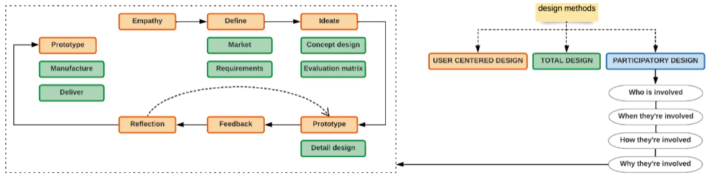
Proposed Approach for a Holistic Design Framework The User-centered Design process involves several steps that can be config- ured as needed: generating potential solutions, gathering feedback from users, and iterating to refine the final product.
The Total Design approach suggests a linear, sequential workflow for the design process, without any cyclical or iterative stages. The steps involve market research, generating a list of requirements based on benchmark- ing existing products, creating concept designs, using an evaluation matrix to prioritize the best conceptual design, finalizing the design, and then manufacturing and delivering the product.
Both User-centered Design and Total Design propose distinct stages that contribute unique value to the design process. The openness to incorporat- ing iterative sub-processes within the main design framework can potentially result in an outcome better accepted by end users and their caregivers. Conse- quently, we advocate for a holistic workflow in design processes integrating user perceptions regarding: details of the new product; tasks to be performed; possibilities of interaction with the product; and aspects of ideal functional- ity and manufacturing feasibility. It is recommended that this comprehensive approach be informed by the following considerations raised from the Partic- ipatory Design perspective: thoughtfully 1) defining who should be involved in each stage; 2) when their involvement is needed; 3) how they should be engaged; 4) and what the objectives are at each stage through the engagement of selected stakeholders.
Figure 1: Proposed integration of a holistic design framework that could be used with positive outcomes when designing assistive devices for older adults and their caregivers.
DISCUSSION
Three design approaches (User-centered Design, Total Design, and Partici- patory Design) are integral components of our comprehensive framework. Merging the User-centered Design, Total Design, and Participatory Design
Enhancing Quality of Care for Older Adults: A Participatory Design Approach 39
approaches is a critical aspect of our proposed approach. It outlines a struc- tured pathway for success and leverages the strengths of each design method- ology, providing a comprehensive strategy to maximize the effectiveness of the proposed technology-based devices. Such an integration facilitates the creation of solutions that not only meet user needs, but also address the com- plexities and challenges inherent in caregiving for older adults, particularly those with conditions such as dementia.
CONCLUSION
Our proposal for a holistic approach seeks to contribute to a paradigm shift in the development of assistive devices, offering a novel framework that prioritizes the needs and experiences of caregivers. By advocating for a collab- orative design process that transcends isolated methodologies, this approach may have the potential to herald a new era in caregiving practices for the aging population, fostering a culture of empathy, innovation, and improved quality of life for both caregivers and older adults.
REFERENCES
Alves, L., Monteiro, D., Bento, S., Hayashi, V., Pelegrini, L., & Vale, F. (2019).
Burnout syndrome in informal caregivers of older adults with dementia: A systematic review. Dementia & Neuropsychologia, 13, 415–421. Alzheimer’s Disease International. (2018). World Alzheimer report 2018. The state of the art of dementia research: new frontiers. London: Alzheimer’s Disease International. Barbarino, P., & Patterson, C. (2018). The state of the art of dementia research: new
frontiers. London: Alzheimer’s Disease International. Beimborn, M., Kadi, S., Köberer, N., Mühleck, M., & Spindler, M. (2016). Focusing on the human: Interdisciplinary reflections on ageing and technology. Ageing and technology, 311–333. Boger, J., & Mihailidis, A. (2011). The future of intelligent assistive technologies for
cognition: Devices under development to support independent living and aging- with-choice. NeuroRehabilitation, 28(3), 271–280. Choukou, M., Ripat, J., Mallory-Hill, S., & Urbanowski, R. (2021). Designing the University of Manitoba Technology for Assisted Living Project (TALP): A collab- orative approach to supporting aging in place. Proceedings of the 21st Congress of the International Ergonomics Association (IEA 2021), 223–228. El Kamali, M., Angelini, L., Caon, M., Carrino, F., Standoli, C., Perego, P.,...
Mugellini, E. (2021). Inclusion design and functionalities of a personalized virtual coach for wellbeing to facilitate a universal access for older adults. Proceedings of the 21st Congress of the International Ergonomics Association (IEA 2021), 239–246. Flaschner, A. (1997). Creating innovative products using total design: The living legacy of Stuart Pugh. Journal of Product Innovation Management, 3, 233–235. Gasteiger, N., Ahn, H., Lee, C., Lim, J., MacDonald, B., Kim, G., & Broad-
bent, E. (2022). Participatory design, development, and testing of assistive health robots with older adults: An international Four-year project. ACM Transactions on Human-Robot Interaction, 11(4), 1–19.
Grace, S., Taherzadeh, G., Jae Chang, I., Boger, J., Arcelus, A., Mak, S.,... Mihailidis, A. (2017). Perceptions of seniors with heart failure regarding autonomous zero- effort monitoring of physiological parameters in the smart-home environment. Heart & Lung, 46(4), 313–319. Grigorovich, A., Kontos, P., Jenkins, A., & Kirkland, S. (2021). Moving toward
the promise of participatory engagement of older adults in Gerotechnology. The Gerontologist, 62(3), 324–331. Huang, P., & Chiu, M. (2016). Integrating user centered design, universal design and goal, operation, method and selection rules to improve the usability of DAISY player for persons with visual impairments. Applied Ergonomics, 52, 29–42. International Society for Gerontechnology. (2021, June). ISG. Retrieved from Inter-
national Society for Gerontechnology: https://www.gerontechnology.info/index.p hp/journal/pages/view/isghome. Merkel, S., & Kucharski, A. (2018). Participatory design in Gerontech- nology: A systematic literature review. The Gerontologist, 59, 1–10. https://doi:10.1093/geront/gny034. Mihailidis, A., & Fernie, G. (2002). Context-aware assistive devices for older adults with dementia. Gerontechnology, 2, 173–189. Mihailidis, A., Blunsden, S., Boger, J., Richards, B., Zutis, K., Young, L., & Hoey,
J. (2010). Towards the development of a technology for art therapy and demen- tia: Definition of needs and design constraints. The Arts in Psychotherapy, 37(3), 292–300. Mihailidis, A., Carmichael, B., & Boger, J. (2004). The use of computer vision in an intelligent environment to support aging-in-place, safety, and independence in the home. IEEE Transactions on Information Technology in Biomedicine, 8(3), 238–247. Oliva-Moreno, J., Peña-Longobardo, L., García-Mochón, L., del Río Lozano, M.,
Mosquera Metcalfe, I., & García-Calvente, M. (2019). The economic value of time of informal care and its determinants (The CUIDARSE Study). PLoS one, 14(5), e0217016. Pugh, S. (1990). Integrated methods for successful product engineering. New Jersey: Addison-Wesley. Sanders, E., & Stappers, P. (2008). Co-creation and the new landscapes of Design.
CoDesign, 4(1), 5–18. Silva, E., & Saray, G. (2018). The gerontological design: A practice to improve life quality of the elderly. Nursing & Care Open Access Journal, 5(4), 205–209. Spinuzzi, C. (2005). The methodology of participatory design. Technical Communi-
cation, 52, 163–174. United Nations. (2022, December). Population Division. Retrieved from Population Division: https://population.un.org/wpp/ Wang, S., Bolling, K., Mao, W., Reichstadt, J., Jeste, D., Kim, H., & Nebeker, C.
(2019). Technology to support aging in place: Older adults’ perspective. Health- care, 7(2), 60.
LISTED IN THE AHFE DIGITAL BOOKSTORE CATALOGUE
Explore the complete digital volume
Human Factors in Aging and Special Needs
Read this individual research paper free through the original publisher, or explore the full digital proceedings book.
ISBN 978-1-964867-09-0
Explore this ISBN in the AHFE Bookstore ↗Listed in the July 2026 bookstore catalogue; search by ISBN to confirm current availability · Digital book purchase optional