Vesa Salminen, Jyrki Peltomaa, Juha Varis (2024). Creative and Effective Human Artificial Intelligence Co-Evolution -Interactive Front-End Content Generation. In: Human Factors, Business Management and Society. AHFE Open Access, vol. 135, pp. 209–217. https://doi.org/10.54941/ahfe1004947
Artificial Intelligence, AI, as technology has been already a long time a great innovative opportunity to develop our functions and operations. Recently generative AI (e.g. Open AI, ChatGPT) has been in the focus. Artificial intelligence will change many things in working life and significantly increase the efficiency of knowledge work. The main assumption is that it does not in itself immediately replace humans. Instead, a human who skillfully utilizes artificial intelligence will replace a human who does not use artificial intelligence.This article introduces a study of combining Human Intelligence (HI) and Artificial Intelligence (AI) into successful outcomes. The main goal of this article is to discover a balance between AI and human intelligence interaction in novel solution generation. The article is constructed in a way to defines human intelligence-related definitions (human intelligence, cognition, and cognitive skills). On the other hand, data is becoming an essential asset for AI, algorithms, and Machine Learning (ML). We consider the pitfalls, limitations, beliefs, and risks of AI. We try to solve an optimal and simultaneous use of working utilizing both AI and human intelligence into solutions for the future. Meaningful individual- and team-level psychological processes are in the focus in creative problem-solving solving, understanding complexity, ambiguity, and uncertainty. Social skills play an important role in synergistic communication in finding creative third alternatives which is new for everyone. Finally, we present a formula to organizational performance including IQ (individual intelligence) + CQ (collaborative and cultural) + EQ (emotional) + SQ (social intelligence) and generative AI combined with ML to be able to create an effective Human-Machine (HM) interaction.
INTRODUCTION AND THEORETICAL CONSIDERATION Artificial Intelligence, AI, as technology has been already a long time a great innovative opportunity to develop our functions and operations. Recently generative AI- opportunities, e.g. ChatGPT, have been pushed into the focus. It is important as an introduction and from the theoretical point of view to define human intelligence and artificial intelligence and analyze and under- stand the differences and opportunities of their interrelationship. That is essential to understand how to integrate AI into human-related processes successfully.
Human intelligence and artificial intelligence (AI) are distinct but inter- connected concepts that revolve around cognitive abilities, problem-solving, learning, and adaptation. To analyze the relationship between human intel- ligence (HI) and artificial intelligence (AI) it is important to determine the terminology.
Despite a long history of research and debate, there is no exact standard definition of human intelligence. Human intelligence refers in this study to the mental capability that enables humans to learn from experience, feel emo- tions, make assumptions, adapt to different situations, innovate and make intuitions, justify reasoning, and solve problems. The overall explanation in this study is, that AI can be used in an assistive role to simulate cognitive func- tions such as learning, reasoning, problem-solving, perception, and language understanding.
Human intelligence (HI) is a very general mental capability that, among other things, involves the ability to reason, plan, solve problems, think abstractly, comprehend complex ideas, learn quickly, and learn from expe- rience. It reflects a broader and deeper capability for comprehending our surroundings-“catching on,” “making sense” of things, or “figuring out” what to do (Gottfredson, 1997). Human intelligence is “the ability to com- prehend; to understand and profit from experience”(WordNetSearch, 2024). Human intelligence can be an “ability to invent solutions to new problems” (creative intelligence), “to dissect problems into component parts, perform analysis”(analytic intelligence), and “developing a solution, and the ability to apply everyday knowledge and experience to develop solutions to problems” (practical intelligence) (Sternberg, 1985). In addition to previous definitions, ‘mental capabilities as a prerequisite to intelligence include human cognition such as perceiving, conceiving, remembering, reasoning, imagining, think- ing, and problem-solving’ (APA Dictionary of Psychology, 2024). ‘Cognitive ability is defined as a general mental capability involving reasoning, plan- ning, abstract thinking, complex problem comprehension, and learning from experience (Gottfredson, 1997). The mental capabilities stem from cognitive skills including attention, observation, awareness, reflection, questioning, perception, and comprehension.’
‘Artificial intelligence (AI) is explained in literature that it applies for advanced analysis and logic-based techniques, including machine learning, to interpret events, support and automate decisions, and take actions Advanced machine learning algorithms are composed of many technologies (such as deep learning, neural network, and natural language processing), used in unsupervised and supervised learning, that operate guided by lessons from existing information (Gartner, 2024/1)’. Machine learning algorithms is a subset of AI answering from clear parameters defined by people. ‘AI is best suited for handling repetitive data-driven tasks and collecting relevant data from big data. Human intelligence consists of the abilities to learn from expe- rience, adapt to new situations, understand and handle abstract concepts, and use knowledge to manipulate one’s environment’ (Britannica 2023).
‘The human cognitive part must be framed together with intelligent arti- facts requiring a systematic approach in the domain of joint cognitive systems. The emerging technologies in the Artificial Intelligence of Things are allowing
Creative and Effective Human Artificial Intelligence Co-Evolution 211
cyber–physical systems (CPS) focused on human-machine interaction to move from a physical interaction paradigm to a cognitive one’ (Angulo et al., 2022). Chat-GPT performs worse than healthcare professionals in terms of clinical outcomes (Zaboli et al., 2024). The current level of Chat-GPT reliability is insufficient for it to serve as a viable substitute for triage nurse expertise in the context of patient prioritization within an emergency department set- ting. Humans and AI may not be able to configure and understand what the other entity is meaning to do or achieve, leading to miscommunications, errors, and mistrust (Memarian et al., 2024). Generative AI is a valuable assistant in the creative process and it is crucial in creative tasks when we fully understand this technology’s potential benefits and drawbacks in shap- ing the future of creativity (Hope & Hanel., 2024). ‘AI differs fundamentally from human intelligence, lacking essential qualities such as comprehension, self-awareness, emotions, embodiment, ethics, values, and culture’ (Cao & Dede, 2023).
AI can support, augment, and automate human activities. ML involves learning from data which can be assisted with human interaction and fine- tuning – ML algorithms can help identify patterns for predicting outcomes. There are also some risks with AI: factual inaccuracies, understanding content, obsolete knowledge, copyright and IPR violations, and lack of originality leading to incorrect decision-making.
This article analyzes, how to combine human intelligence (HI) and artificial intelligence (AI) into successful outcomes. The main goal of this article is to discover a balance between AI and human intelligence interaction in novel solution generation.
RESEARCH QUESTIONS AND RESEARCH APPROACH During this research has been analyzed the way of combining Human Intel- ligence (HI) and Artificial Intelligence (AI) into successful outcomes. The main goal of this article is to discover the balance between AI and human intelligence interaction in novel solution generation. The main research questions are:
How could we in the best way utilize AI-assistive human-machine inter- action?
What are the pitfalls, limitations, risks, and even beliefs behind technology-related innovation?
How could we harness AI-related technology opportunities as strategy- based innovation?
What is the balance between human intelligence and artificial intelligence in novel solution generation?
The collection of data and research approach has been partially con- structive, conceptual, and analytical because it introduce some suggestions of balance between artificial intelligence and human intelligence interac- tion. The article presents background experiences and results from various development initiatives and these works.
HUMAN-CENTERED ARTIFICIAL INTELLIGENCE Human intelligence has been presented as practical, analytic, and creative intelligences (Sternberg, 1985). Practical intelligence (common sense) is an ability to find a fit between themselves and the demands of the environ- ment (i.e. monitoring the environment). Analytical intelligence, also referred to as componential intelligence refers to an ability to analyze and evaluate problems (traditional measures of IQ tests). Analytical intelligence needs ana- lytical and critical thinking examining problems from various perspectives. Creative intelligence is utilizing knowledge and skills to effectively handle new and unusual situations by using past experiences. Creative intelligence is the ability to go beyond what is given to create novel and interest- ing ideas. This type of intelligence involves imagination, innovation, and problem-solving (Sternberg, 1985).
In conclusion, integrating practical, analytical, and creative intelligences has a lot of potential to adapt and shape environmental change and evolution by creating novel solutions. Human intelligence is a summary of cognitive abilities and skills to be able to adapt to new circumstances.
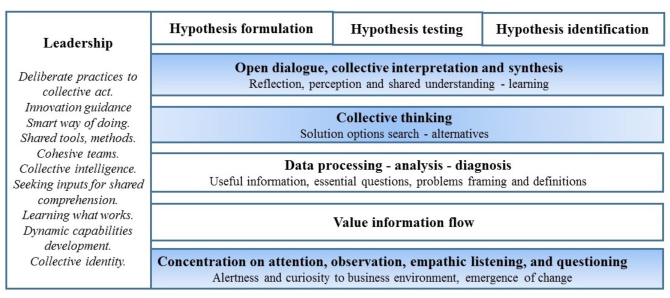
Practical intelligence identifies and selects problems and collects relevant information whereas analytical intelligence leads to analysis (dividing the problem into separate parts) and diagnosis (reasons finding).
Creative intelligence has options to add creative features, elements, and functions during the different phases of the development process. Finally, collective interpretation and synthesis create a holistic and consistent view utilizing systems thinking in a creative synthesis generation. This kind of synthesizing intelligence is identifying and collecting relevant information, questioning disparate components from analyses, pulling elements together in a coherent way - integrating all elements into a holistic and novel solu- tion. Synthesizing intelligence in this context means the capacity to collect relevant elements of value information flow, reflect on their meaningfulness, and organize by interpretation and synthesis into a holistic new structure and solution. Emotional intelligence means the capacity to be aware of, control, and express one’s emotions, and handle interpersonal relationships.
Human intelligence has an essential social perspective – commu- nication skills with others including an ecosystem of wisdom of crowds. Team intelligence surpasses individual intelligence – cohesive group members having the ability of open dialogue and interpreta- tion deepen mutual understanding - social intelligence (SQ). Collabo- ration and collective acts create added value by utilizing team mem- ber’s diversity, expertise, experiences, and tacit knowledge in a smart way of doing. This is a foundation to performance as depicted in Figure 2.
Creative and Effective Human Artificial Intelligence Co-Evolution 213
Figure 1: Cognitive skills into novel solution – from data acquisition to hypothesis formulation.
HUMAN INTELLIGENCE AUGMENTING AND ASSISTING ARTIFICIAL INTELLIGENCE How can we profit from combining human intelligence and judgments assisted and augmented by AI? What can possibly to go wrong? How to control AI activities? With the fast development of AI, it may be appar- ent that automated processes can assist human involvement in automated data collection, Data Mining (DM), and useful content creation in – strategic data-driven innovation where data mining needs to extract and identify new patterns. Various algorithms and techniques: classification, clustering, and AI with neural networks are used to discover information, patterns, trends, or knowledge from large datasets. Through data gathering and screening, processing, and decision-making, AI can support faster solutions to complex problems. ‘Decisions must often be made under obvious uncertainties with incomplete and uncertain knowledge’ (Chowdhury and Sadek, 2012). Deci- sions can face also complexity and ambiguity which need hybrid intelligence. AI depends solely on data, algorithms, and special instructions to generate results whereas humans have cognitive abilities – multiple creative thinking styles (associative, creative vs. critical, divergent, reasoning from different perspectives etc.), imagination, insights generation, and intuition which sup- port AI. It is obvious, that artificial intelligence cannot completely replace human intelligence.
Artificial intelligence can boost our analytic and decision-making abilities by providing the right information at the right time – by harvesting and pro- viding employees with tailored data, and information from different sources. ‘AI can help the reach better decisions (Argawal et al., 2018) – enhancing creativity.’ AI tools extracting large datasets open possibility to find even unknowns, to develop learning capabilities and make additional foundation for creativity – offering broad input space for analysis and synthesis cycles. AI tools reduce time spent on data analytics by access to large datasets of digital information and knowledge. New relevant data creates additional questions for novel alternatives specific questions to specific answers. Integrated HI and AI leverage strengths from each other. AI promotes better exploitation of R&D results and scientific articles collection. AI is best suited for handling repetitive data-driven tasks and collecting from big data the relevant data. Human intelligence exploits external ecosystems, experts, and partners.
Table 1. Major differences between human intelligence and AI in creating novel solution, knowledge, concepts, and solving problems.
Table available in the original PDF paper.
AI Human Intelligence DIK collection, productivity in New DIK creation, value information Data,
data, and information
flow creation.
information, and collection.
knowledge (DIK)
Analysis, diagnosis, interpretation, and
Data-analytics Automation in design, deployment, and management
synthesis chain in understanding
of data delivery.
uncertainty, complexity, and ambiguity.
Repetitive data-driven tasks
Value information flow.
Data-driven and supporting decision actions
making, lack of transparency.
Identification and framing problems,
Problem solving Supporting information search for analysis.
creative and complex problem-solving.
New knowledge creation. Tacit
Knowledge Background knowledge (available).
knowledge based on experiences as possibility to original solutions.
Knowledge from experiences.
Information of available
Abstract concepts understanding and
Concept concepts.
creation.
development
Novel solution creation, Innovative
Creativity Available novel solution search, augmentative.
thinking and reasoning skills: creative vs. critical, divergent vs. convergent,
imagination, associative thinking, abductive reasoning, and abstractive
thinking.
Past evolution factors. Adapting to new situations, events, or Business problems. Manipulating environment.
environment evolution
Processing unknowns, creation new
Foresight Past and current information, path-dependence.
future opportunities. Trend spotting.
Innovation eco-system partner, contacts
R&D Exploitation R&D, scientific articles.
to universities, partners, consults, building new and original theories.
Intelligence Artificial. IQ, EQ, SQ, and CQ (cultural and collective), and communication,
collective interpretation with others.
Creative and Effective Human Artificial Intelligence Co-Evolution 215
HI AND GENERATIVE AI CO-EVOLUTION-INTERACTIVE LEARNING AND DEVELOPMENT ‘This kind of hybrid collaborative intelligence is defined as the ability to achieve complex goals by combining human and artificial intelligence, thereby reaching superior results to which each of them could have accom- plished separately’ (Dellerman et al., 2019). Hybrid intelligence means continuous learning from each other and evolving together – reciprocal inter- active collaboration and co-evolution. HI and generative AI complementing each other optimize and maximize exploitation HM-intelligence performance potential. Integration of human intelligence (practical, analytical, creative, and synthesizing) intelligence with AI and machine learning (ML) can bring many benefits, such as harvesting data from multiple sources, storing, and transforming – automated and intelligent systems start to help companies automate certain tasks, identify value for better outcomes. Generative AI and ML map intelligently data from large datasets by automated data collec- tion (Automated ETL), restructuring unstructured data, and DM for analysis. These concepts combined create additional value for actual BI (Business Intel- ligence) concepts – benefitting hybrid intelligence. Exploiting human creative intelligence, tacit knowledge, experiences, expertise, and synergistic commu- nication gives a possibility to third alternatives which are new and novel for all – unique novel solutions. The final BI system has a creative element to get novel solutions. The best optimal solution can be generated by the HI, AI, and BI interaction – optimized, collaborative, and hybrid intelligence.
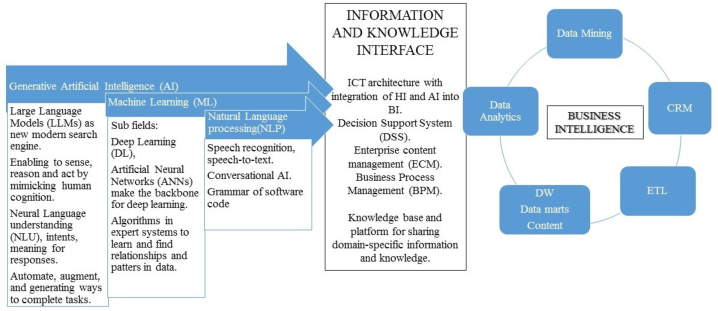
Generative AI opens up transformation in data analytics and BI. Data is becoming an essential asset for AI algorithms and machine learning – a fuel of AI enabling data-driven organizations into knowledge-centric. The optimiz- ing process stems from connecting human-centric strengths and generative AI – a mix of suitable intelligences for different purposes for an intelligent enterprise – a new BI paradigm with AI-based ICT architecture (Figure 2).
Figure 2: ICT-architecture combining BI (business intelligence) and AI intelligences. Machine learning is a different approach to create software – learning from training data to be able to automate tasks.
This architecture augments the traditional infrastructure of collecting and processing (DM), storing (DW), analyzing data (data analytics), and managing customer relationships (CRM) – an intelligent enterprise content management system. The challenge is to integrate HI and AI-based soft- ware into a useful mix of firm-specific decision-supporting systems. Future opens up multitasking with connected AI-based software of LLMs (Large Language Models), ANNs (Artificial Neural Networks), Language Models for Dialogue Applications, and deep learning algorithms in understanding and generating new concepts for new business models. Even the next steps of automated MLs (AutoML) are presented for experimenting with automated training data generation for training ML This is a major step forward leading into data processing and preparation (gathering, combining, structuring, and organizing data).
Human assistance is needed so that AI-based systems function with respon- sible, reliable, proper, and safe way – machines do not understand biases that training data may reveal. Is the future of generative AI-based systems automatically collecting internet content as a background for training data, problem-solving, and decision-making?
CONCLUSION
In this article are analysed differences between human and artificial intelli- gence. It is also introduced the way of combining them and understand the differences and opportunities to create successful outcomes. The main goal is to discover the balance between human intelligence and artificial intelligence when creating interaction in novel solution generation.
For future direction on the use of technological opportunities, finding the balance between HI-AI and focusing development, Gartner has defined the concept of “Artificial Intelligence for IT operations, AIOps”. ‘It refers to the strategic use of AI, machine learning and machine reasoning technologies to automate processes of IT operations, including event correlation, anomaly detection, and causality determination’ (Gartner, 2024/2).
It is essential to develop data-driven processes in which human-centric strengths, assistive generative AI, and AI-based multivariable analysis can be integrated to form an intelligent enterprise.
REFERENCES
Angulo, C., Chacón, A., Ponsa, P. (2022) Towards a cognitive assistant supporting human operators in the Artificial Intelligence of Things. Science Direct, Internet of Things 21 (2023) 100673 Journal homepage: www.elsevier.com/locate/io, https: //doi.org/10.1016/j.iot.2022.100673. Agrawal, A., Gans, J., Goldfarb, A. (2018) A Simple Tool to Start Making Decisions
with the Help of AI. Harward Business Review, April 17, 2018. APA Dictionary of Psychology, https://dictionary.apa.org (read 11.2.2024). Britannica (2024). https://sv.wikipedia.org/wiki/Encyclopedia_Britannica (read 11.02.2024)
Creative and Effective Human Artificial Intelligence Co-Evolution 217
Cao, L., & Dede, C. (2023) Navigating A World of Generative AI: Suggestions for Educators. The Next Level Lab at Harvard Graduate School of Education. President and Fellows of Harvard College: Cambridge, MA. Chowdhury, M., Sadek, A. W. (2012) “Advantages and limitations of artificial intel-
ligence”. Artificial Intelligence Applications to Critical Transportation Issues, 6, Transportation Research Circular E-C168. Dellermann, D., Ebel, P., Söllner, M., & Leimeister, J. M. (2019) Hybrid intelligence.
Business & Information Systems Engineering, 61, 637–643. Gartner (2024/1) AI Dictionary (2024) What is Artificial Intelligence https://www.
gartner.com/en/topics/artificial-intelligence (read 11.02.2024). Gartner, (2024/2) Artificial intelligence for IT operations AIOps. https: //www.gartner.com/en/information-technology/ glossary/aiops-artificial- intelligence-operations. https://doi.org/10.48550/arXiv.2304.04661. Gottfredson, L. S. (1997) Mainstream science on intelligence: An editorial with 52 signatories, history, and bibliography. Intelligence, 24(1): 13–23. Leslie, A. (2024) AI Ethics and Governance in Practice: AI Fairness in Practice. Alan
Turing Institute. https://www.turing.ac.uk/research/research-projects/ai-ethics-an d-governance-practice (read 11.02.2024). Memarian, B., Doleck, T. (2024) Human-in-the-loop in artificial intel- ligence in education: A review and entity-relationship (ER) analysis. Computers in Human Behavior: Artificial Humans, CHBAH 100053. https://doi.org/10.1016/j.chbah.2024.100053 Sternberg, R. J. (1985) Beyond IQ, A Triarchic Theory of Human Intelligence.
CUP Archive. https://www.oxfordlearnersdictionaries.com/definition/english/em otional-intelligence (read 11.02.2024). WordNetSearch. Princeton University. https://wordnet.princeton.edu (read 11.02.2024). Zaboli, A., Brigo, F., Sibilio, S., Mian, M., Turcato, G. (2024) Human intelligence versus artificial intelligence: Who performs better in correctly classifying patients in triage? American Journal of Emergency Medicine, YAJEM 161988. https://doi.org/10.1016/j.ajem.2024.02.008
LISTED IN THE AHFE DIGITAL BOOKSTORE CATALOGUE
Explore the complete digital volume
Human Factors, Business Management and Society
Read this individual research paper free through the original publisher, or explore the full digital proceedings book.
ISBN 978-1-964867-11-3
Explore this ISBN in the AHFE Bookstore ↗Listed in the July 2026 bookstore catalogue; search by ISBN to confirm current availability · Digital book purchase optional