Alena Labanava, Marina Weck (2024). Technology for Social Change: Unpacking the Impact of GovTech solutions on the achievement of SDGs. In: Human Factors, Business Management and Society. AHFE Open Access, vol. 135, pp. 43–52. https://doi.org/10.54941/ahfe1004929
Sustainable Development Goals (SDGs) are unlikely to be achieved without the active role of governments and the effective utilization of modern technologies by public administration. However, the alignment between government technology (GovTech) and SDGs is not well established in academic literature. Accordingly, the objective of this paper is to conduct a literature review of the current state of the art related to the impact of GovTech on achieving SDGs. Following the literature review methodology, the search returned over 140 publications, of which 17 were selected as relevant. Upon further research of the selected publications, several results were discovered. One result is that the existing literature employs different methods and establishes the link between GovTech and SDGs in different ways, sometimes very briefly and sometimes more in depth. There is also unevenness in the research that covers the connection between GovTech and various SDGs. Moreover, a list of the most mentioned technologies that correspond with assorted SDGs has been drafted. The outcomes of the literature review help highlight research gaps and serve as a guideline for public administrators and entrepreneurs regarding what technologies can be incentivized for greater use.
The achievement of goals set by the 2030 Sustainable Development Agenda requires joint efforts from individuals, businesses, and governments. Despite the intention to make SDGs collaborative among multiple actors, the actual implementation often takes place at the national level (Baumgart et al., 2021). Digitalization initiatives related to the government are perceived as a potential tool to align with various parts of sustainable development (UN e-Government survey, 2020).
The role that technology is expected to play in achieving SDGs cannot be understated (Assey, 2020,; Adenle et al., 2020). Considering the important role of the government, combined with the potential impact of technology, it is essential to understand the role of GovTech solutions in the achievement of SDGs.
The SDGs are split into 169 targets and 231 indicators, which are expected to ensure the clarity of the desired results and an easier understanding of what actions can be taken toward sustainability. However, the inherent interlinkage between SDGs and the multiplicity of targets and indicators makes prioritization unavoidable. The connections between goals are uneven (McGowan et al., 2019). The interconnectedness and mutual impact of SDGs and targets have been studied by Nilsson, Griggs, and Visbeck (2016); Le Blanc (2015); and Bennich, Weitz, and Carlsen (2020). Clearly, it is impossible to complete 169 targets and 231 indicators simultaneously.
GovTech initiatives can contribute to the achievement of the SDGs not only by delivering value for the SDGs but also by generating new data and evidence for SDG monitoring and policy making (CAF Development Bank of Latin America, 2024) Continued collaboration across all sectors, includ- ing governments, is essential for leveraging technology to create impact and systemic change at scale for the wider community (World Economic Forum, 2021). The research contributes to the academic literature by using the literature review methodology to answer the following questions:
What digital government technologies contribute to achieving SDGs?
How is the potential impact of digital government technologies distributed across SDGs?
BACKGROUND
To establish a cohesive approach to the research objective, the definition of GovTech must be clearly defined. The definition of GovTech is still debatable, with two main approaches:
GovTech is a whole-of-government approach to public sector modern- ization that promotes simple, efficient, and transparent government with citizens at the center of reforms (Dener et al., 2021).
GovTech represents socio-technical solutions—developed and operated by private organizations—are intertwined with public sector components for facilitation (Bharosa, 2022).
Other existing definitions of GovTech are similar to Bharosa’s approach and tend to highlight the role of the private sector in solving challenges inher- ent to the public sector (GovTech Sweden, n.d.; Bennett Institute for Public Policy, 2022; Accenture and Public, 2018; Kuziemski et al., 2022).
For the purposes of this study the authors use a broader approach to the definition of GovTech, meaning that the research is not limited only to the contributions of private enterprises that develop solutions intertwined with public sector components. Exploring GovTech in the sense suggested by Dener et al. (2021) as the most recent phase of digital transformation in the public sector also implies the interchangeable use of e-governance, e-government, digital government and GovTech in our research.
The existing scientific literature does not provide insight into the role of GovTech in achieving SDGs; rather, it focuses on the role of informa- tion and communication technologies in general. Technology is expected
Technology for Social Change: Unpacking the Impact of GovTech Solutions 45
to enable many SDGs (Assey, 2020). Indeed, 48 out of 169 SDG targets are connected to science, technology, and innovation, while many remain- ing SDG targets can be somewhat impacted by technology (Adenle et al., 2020). Artificial intelligence (AI) is estimated to positively impact 79% of SDG targets (Vinuesa et al., 2020). Delving into GovTech specifically gives a more nuanced understanding of how technology combined with governance frameworks can contribute to achieving SDGs.
The interconnected nature of governments, governance, and technology platforms, especially those utilized in the management, implementation, and governing of public sector functions clearly will have an impact on the SDGs though what that will be has yet to be determined.
METHODOLOGY
This research utilizes Kitchenham’s systematic literature methodology (2009). The primary objective of this research is to gain an understanding of the current literature related to the use of GovTech in various initiatives related to SDGs. The research questions were designed broadly to provide an overview of the existing literature without excluding any topics. To achieve this, the research mapped SDGs with corresponding technological solutions using keywords to represent the intersection of SDGs and technologies and then honed the number of articles based on relevance and quality. From the remaining articles, insights were analyzed and presented.
Keywords and Search Process The researchers used the SCOPUS database to gain a broad understanding of the research available on the topic in an interdisciplinary fashion. The key- words were chosen to target the specific intersection of the topics of SDGs and their attainment with technologies in government. The specific keyword set utilized is as follows: (TITLE-ABS-KEY [“Sustainable Development” OR “Sustainable Development Goals” OR “Sustainable Development Agenda” OR “SDG”] AND TITLE-ABS-KEY [“target” OR “indicator” OR “mea- surement” OR “attain” OR “achieve”] AND TITLE-ABS-KEY [“GovTech” OR “government technology” OR “public sector technology” OR “egov- ernance” OR “egovernment” OR “e-Government” OR “e-governance” OR “digital government”]).The initial search returned 147 documents.
Inclusion and Exclusion Criteria The inclusion and exclusion criteria were chosen to obtain an idea of all kinds of technologies and solutions used in the public sector to achieve any of the 17 SDGs. From the initial 147 documents, a title and abstract reading was used to apply the inclusion and exclusion criteria, with articles marked as “yes,” “no,” or “maybe.”
Entries in which the title and abstract were judged as “maybe” were brought into the full read step, after which their inclusion was determined.
46 Labanava and Weck
Inclusion Criteria
Literature explicitly discussing the alignment of GovTech with specific SDGs or providing evidence of contributions to SDGs.
Studies with diverse research methods, including qualitative and quanti- tative approaches, case studies, and impact assessments. This ensures a comprehensive understanding of GovTech’s contributions.
Publications from 2015 (the year of adoption of the Sustainable Develop- ment Agenda) to ensure the relevance of information.
Exclusion Criteria
Publications that do not specifically address GovTech and their contribu- tions to SDGs.
Publications that use the word sustainable to mean continual or feasible.
Publications that use the words sustainable and sustainability incidentally.
Publications that state the importance of technologies for the public sec- tor in achieving SDGs without further explanation and reasoning for that statement.
Publications that primarily focus on comparison of indices.
Publications that describe the contributions of ICTs in general to the achievement of SDGs.
Data Collection and Analysis The papers that fit the inclusion and exclusion criteria based on the abstracts read, in addition to those considered not clearly determined, were fully read. The further determination of unclear articles was defined on the full paper read. The author conducted a quality check. However, no papers were disqualified from inclusion in this review due to quality concerns and the exploratory nature of the research questions. The author then qualitatively coded the accepted literature for the review to find the references and topic matter regarding SDGs and the specific technologies included.
RESULTS
Search Results As stated above, the search yielded 17 articles, which were found from 147 records after the initial application of the timeliness criteria. After the title and abstract review, n = 31. Upon a further review and quality check, the number was 17. The list of publications selected for the study is presented in Table 1.
Table 1. Publications selected for the study (author).
Table available in the original PDF paper.
Sarker, M.N.I., Wu, M., Liu, R. and Ma, C. (2019)
Regional Cooperation in Dealing with Environmental Protection. E-Government and Sustainable Development in Andean Countries
Challenges and Opportunities for Information Resource Management for E-Governance in Bangladesh Aniscenko, Z., Robalino-López, A., Rodríguez, T.E. and Pérez, B.E. (2017) (Continued)
Technology for Social Change: Unpacking the Impact of GovTech Solutions 47
Table 1. Continued Misra, H. (2020) Managing Poverty Fad Toward Sustainable Development: Will Rural E-Governance Help? Choi, H., Park, M.J. and Rho, J.J. (2017)
Table available in the original PDF paper.
Two-dimensional Approach to Governmental Excellence for Human Development in Developing Countries: Combining Policies and Institutions with e-Government Miskiewicz, R. (2022) Clean and Affordable Energy Within Sustainable Development Goals: The Role of Governance Digitalization Ramadan, I.M.M. and Abdel-Fattah, M.A. (2022)
A Proposed Model for Enhancing E-Government Services to Achieve the Sustainable Development Goals in Egypt: Case Study Choi, H.-S. and Lee, G.-S. (2016) How Do e-Governance and e-Business Drive Sustainable Development Goals?
Planning Support Systems (PSS)-Based Spatial Plan Alternatives and Environmental Assessment Lyulyov, O., Pimonenko, T., Saura, J.R. and Barbosa, B. (2024) Malhotra, C., Anand, R. and Singh, S. (2018) Applying Big Data Analytics in Governance to Achieve Sustainable Development Goals (SDGs) in India Paptsov, A.G. and Popova, K.Y. (2021)
E-Government as a Tool in Controlling Corruption
Management of the Quality of Water Resources for Sustainable Development Based on Industrial and Manufacturing Engineering Castro, C. and Lopes, I.C. (2023) Constraint-Driven IoT-Based Smart Agriculture for Better e-Governance Dalela, P.K., Basu, S., Majumdar, S., Sachdev, S., Kushwaha, N.K., Yadav, A. and Tyagi, V. (2020)
Blockchain-Based Sensitive Document Storage to Mitigate Corruptions
Mahlaba, J., Mishra, A.K., Puthal, D. and Sharma, P.K. (2022)
Digital Government and Sustainable Development
Castro, C. and Lopes, C. (2022) Levinskaya, E.V. and Shirkin, A.A. (2021) State Administration of Sustainable Development Through Big Data: Current Opportunities and Future Perspectives Neuwirth, B., Novotna, V., Skapa, S (2017).
E-Government and Corruption in East European Countries Lin, R. (2022) Recommender System for Government Service in Smart Cities
Answers to Research Questions As stated earlier, the aim of this study was to understand what government technologies can contribute to achieving SDGs and what SDGs are affected by these technologies.
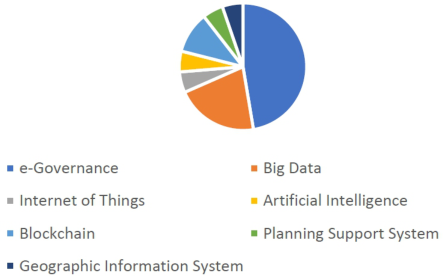
Regarding the technologies mentioned in the publications, the most men- tioned is e-governance or e-government in general, followed by big data and blockchain (see Figure 1).
48 Labanava and Weck
Figure 1: Technologies mentioned in the literature (authors).
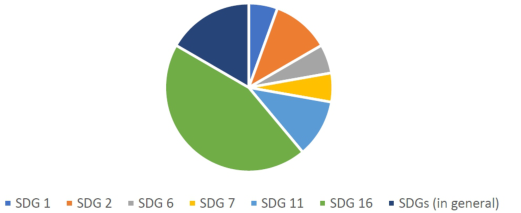
The most-mentioned SDG across publications was predictably SDG 16 (Peace, Justice, and Strong Institutions), followed by mentioning SDGs in general and SDG 11 (Sustainable Cities and Communities) See Figure 2.
Figure 2: SDGs mentioned in the literature (authors).
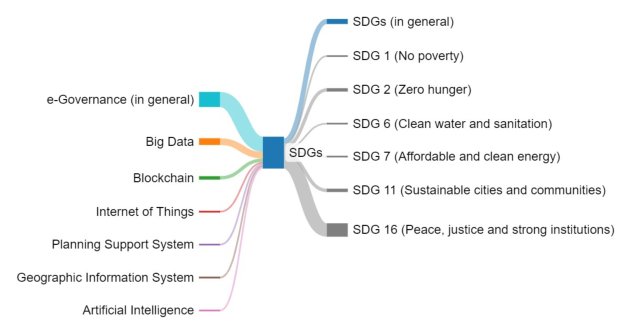
Figure 3 illustrates the uneven coverage of technologies and SDGs in aca- demic literature at the intersection of digital government and the Sustainable Development Agenda.
Figure 3: Quantitative interrelation between technologies and SDGs mentioned in the literature (authors).
Technology for Social Change: Unpacking the Impact of GovTech Solutions 49
A noteworthy observation is the “generalization” tendency in the exist- ing literature. Most papers mention e-governance, e-government or digital government as broad terms, which imply the usage of an unlimited and unspecified set of technologies. Mentioning the impact of technologies on SDGs in general instead of specifying concrete SDGs is also common. This result confirms that the area of GovTech impact on SDGs is being under- researched and lacking an in-depth understanding of the connection between more concrete e-governance technologies and specific SDGs, to say nothing about specific SDG targets.
The broader mention of e-governance, e-government or digital government in the literature compared to listing specific technologies can be explained by several reasons. Researchers may use the terms broadly in order 1) to encompass a holistic approach to leveraging technology for governance across sectors, 2) to capture the interconnectedness of these technologies in contributing to SDGs, 3) to cover a wide range of technological advance- ments, 4) to highlight the overarching impact rather than delving into specific technologies in each sector.
Another remark should be made about the fact that 44% of the papers that investigate the contribution of e-governance to sustainable develop- ment focus on SDG 16 (Peace, Justice, and Strong Institutions). Four other SDGs were mentioned as being influenced by e-governance as a general term (SDG 1, SDG 2, SDG 7, and SDG 11). Although this disproportion is, to some extent, a predictable and understandable result, it highlights the igno- rance of the potential impact e-governance could have on other SDGs among researchers.
Among the papers that aim to explore the connection between e-governance and SDGs, an outstanding work is Misra (2020), who explains the link between each SDG and what the author calls rural e-governance. Another study of particular interest in our context is Malhotra’s explo- ration of the connection between big data and its contribution to each of the SDGs, in which the author also maps SDGs with the so-called “mission- mode projects” of the Digital India program (2018). Both papers are country specific (India) and can set an example for similar studies in other countries or regions.
DISCUSSION AND CONCLUSION Much of the literature uses key terms, such as e-governance. This is a general term that encompasses many technologies without specifying them. This can be ICT in general. Approximately half of papers contribute to SDG 16 (Peace, Justice, and Strong Institutions). However, this makes it seem that all these technologies are meant to improve the government only; the ignoring of many other SDGs is also a concern. The UN highlights the role of e-governance in achieving SDGs, so one would think that it would have a longer track record in the academic literature of the SDGs other than number 16. This result may serve as an inspiration for further research and as an indication that more work must be done.
50 Labanava and Weck
The result of technologies can indicate the hype cycle or fashion of specific technologies. Although the research did not find many papers related to AI in the achievement of the SDGs, this could be more of an indicator of the long publishing cycle related to academic works and the relative recency of the explosion of AI papers rather than the non-existence of such works.
Because the authors focused on keywords related to the specific SDGs in general, there may have been different results than if one were to have input the entire list of targets and indicators. Because so few SDGs and specific technologies were mentioned, the network diagram of specific tech- nologies mapped to specific SDGs was not a tenable solution, even though the hypotheses of the authors originally indicated that this would be an insight- ful analysis. Future work could include a further definition of GovTech or a more complete mapping of technologies to specific SDGs.
REFERENCES
Accenture, & Public. (2018). GovTech: Europe’s next opportunity. [Online] Available at: https://www.accenture.com/content/dam/accenture/final/a-com- migration/manual/r3/pdf/pdf-90/Accenture-GovTech-POV.pdf. Adenle, Ademola A. et al. (2020). What Can Science, Technology, and Innovation
Offer in the Achievement of Sustainable Development Goals? Science, Technology, and Innovation for Sustainable Development Goals: Insights from Agriculture, Health, Environment, and Energy, edited by Ademola A. Adenle et al., Oxford University Press, 2020, pp. 3–20. https://doi.org/10.1093/oso/9780190949501. 003.0001 Allen, P. (2022) The rise of GovTech: Why startups should work with governments (sponsored): EU-Startups, EU. Available at: https://www.eu- startups.com/2022/08/the-rise-of-govtech-why-startups-should-work-with- governments-sponsored/ (Accessed: January 30, 2023). Aniscenko, Zanna. Robalino-López, Andrés. Rodríguez, Tomás Escobar. & Pérez, Bernabé Escobar (2017). Regional cooperation in dealing with environmental protection. E-government and sustainable development in Andean countries. Environment. Technology. Resources, Rezekne, LatviaProceedings of the 11th International Scientific and Practical Conference. Volume I, 13–19 [Online] Available at: https://journals.rta.lv/index.php/ETR/article/view/2578/2484. Assey. Gervas E. (2020). The Role of Science, Technology and Innovation in Imple-
mentation of Sustainable Development Goals. The Cradle of Knowledge: African Journal of Educational and Social Science Research 8, 1. 2304–2885. Baumgart, A., Vlachopoulou, E. I., Vera, J. D. R. et al. (2021). Space for the Sustainable Development Goals: mapping the contributions of space-based projects and technologies to the achievement of the 2030 Agenda for Sustainable Development. Sustain Earth, 4(6). https://doi.org/10.1186/s42055-021-00045-6 Bennett Institute for Public Policy. (2022) Thinking about GovTech: A Brief Guide for
Policymakers. Available at: https://www.bennettinstitute.cam.ac.uk/publications/ thinking-about-govtech-brief-guide-policymakers/ (Accessed: January 30, 2023). Bennich, Therese, Weitz, Nina and Carlsen, Henrik. (2020). Deciphering the scientific literature on SDG interactions: A review and reading guide. Science of The Total Environment 728, 138405, https://doi.org/10.1016/j.scitotenv.2020. 138405.
Technology for Social Change: Unpacking the Impact of GovTech Solutions 51
Bharosa, Nitesh. (2022). ‘The rise of GovTech: Trojan horse or bless- ing in disguise? A research agenda’, Government Information Quarterly, doi: 10.1016/j.giq.2022.101692. CAF Development Bank of Latin America. (2024). The role of the govtech in the achievement of the Sustainable Development Goals. [Online] Available at: https://scioteca.caf.com/bitstream/handle/123456789/1962/The%20role%20 of%20the%20govtech%20in%20the%20achievement%20of%20the%20Sustai nable%20Development%20Goals.pdf?isAllowed=y&sequence=4. Castro, Conceição & Lopes, Isabel Cristina (2023) E-Government as a Tool in Controlling Corruption, International Journal of Public Administra- tion, 46:16, 1137–1150, doi: 10.1080/01900692.2022.2076695. Castro, Conceição. Lopes, Cristina. (2022) Digital Government and Sustain-
able Development. J Knowl Econ 13, 880–903 (2022). https://doi.org/10.1007/ s13132-021-00749-2 Choi, Hee-Sun, and Gil-Sang Lee. (2016). “Planning Support Systems (PSS)-Based Spatial Plan Alternatives and Environmental Assessment” Sustainability 8, no. 3, 286. https://doi.org/10.3390/su8030286 Choi, Hyeri. Park, Min Jae, Rho, Jae Jeung. (2017). Two-dimensional approach
to governmental excellence for human development in developing countries: Combining policies and institutions with e-government, Government Informa- tion Quarterly, Volume 34, Issue 2, 2017, Pages 340–353, ISSN 0740-624X, https://doi.org/10.1016/j.giq.2017.03.002. Dalela, Pankaj Kumar.et al. (2020). Constraint-Driven IoT-Based Smart Agriculture for Better e-Governance. In: Tuba, M., Akashe, S., Joshi, A. (eds) ICT Systems and Sustainability. Advances in Intelligent Systems and Computing, vol. 1077. Springer, Singapore. https://doi.org/10.1007/978-981-15-0936-0_18 Dener, Cem. et al. (2021) GovTech Maturity index, Open Knowledge Repository.
Washington, DC: World Bank. Available at: https://openknowledge.worldbank. org/handle/10986/36233 (Accessed: January 30, 2023). GovTech Sweden. (n.d.). Home. [Online] Available at: https://govtechsweden.se. Kitchenham, B. O., Brereton, P. Budgen, D., Turner, M., Bailey, J., and Linkman, S..: Systematic literature reviews in software engineering–a systematic literature review. Information and software technology 51, no. 1, 7–15, (2009). Kuziemski, M. et al. (2022) GovTech practices in the EU, JRC Publications
Repository. Available at: https://publications.jrc.ec.europa.eu/repository/handle/ JRC128247 (Accessed: January 30, 2023). Le Blanc, David. (2015). Towards Integration at Last? The Sustainable Development Goals as a Network of Targets. Sust. Dev. 23, 176–187 (2015), https://doi.org/10. 1002/sd.1582. Levinskaya, Elena V., Shirkin, Anton A. (2021). State Administration of Sustainable
Development Through Big Data: Current Opportunities and Future Perspectives. In: Ragulina, J. V., Khachaturyan, A. A., Abdulkadyrov, A. S., Babaeva, Z. S. (eds) Sustainable Development of Modern Digital Economy. Research for Development. Springer, Cham. https://doi.org/10.1007/978-3-030-70194-9_30 Lin, Rui. (2022). Recommender System for Government Service in Smart Cities,”2022 IEEE/WIC/ACM International Joint Conference on Web Intelligence and Intelligent Agent Technology (WI-IAT), Niagara Falls, ON, Canada, 2022, pp. 771–774, doi: 10.1109/WI-IAT55865.2022.00126. Lyulyov, Oleksii. Pimonenko, Tetyana. Saura, Jose Ramon and Barbosa, Belem.
(2024) How do e-governance and e-business drive sustainable development goals?, Technological Forecasting and Social Change, Volume 199, 2024, 123082, ISSN 0040–1625, https://doi.org/10.1016/j.techfore.2023.123082.
52 Labanava and Weck
Mahlaba, James et al. (2022) “Blockchain-Based Sensitive Document Storage to Mitigate Corruptions,” in IEEE Transactions on Engineering Management, doi: 10.1109/TEM.2022.3183867. Malhotra, Charry. Anand, Rashmi. Singh, Shauryavir. (2018). Apply- ing Big Data Analytics in Governance to Achieve Sustainable Develop- ment Goals (SDGs) in India. In: Munshi, U., Verma, N. (eds) Data Science Landscape. Studies in Big Data, vol. 38. Springer, Singapore. https://doi.org/10.1007/978-981-10-7515-5_19 McGowan, Philip et al. (2019). An imperfect vision of indivisibility in the Sustain-
able Development Goals. Nature Sustainability 2 (2019), 43-45, https://doi.org/ 10.1038/s41893-018-0190-1. Miskiewicz, Radoslaw. 2022. “Clean and Affordable Energy within Sustainable Development Goals: The Role of Governance Digitalization” Energies 15, no. 24, 9571. https://doi.org/10.3390/en15249571 Misra, Harekrishna. (2020) Managing Poverty Fad towards Sustainable Devel-
opment: Will Rural E-Governance Help? Seventh International Conference on e-Democracy & e-Government (ICEDEG), Buenos Aires, Argentina, 2020, pp. 297–301, doi: 10.1109/ICEDEG48599.2020.909667. Neuwirth, Bernard. Novotna, Veronika and Skapa, Stanislav. (2017). E-government and corruption in East European countries. Proceedings of the 30th Inter- national Business Information Management Association Conference (IBIMA); Vision 2020: Sustainable Economic development, Innovation Management, and Global Growth. Nilsson, Måns, Griggs, David and Visbeck. Martin. (2016). Policy: Map the inter-
actions between Sustainable Development Goals. Nature 534, 320–322 (2016), https://doi.org/10.1038/534320a. Paptsov, Andrey G. Popova Karolina Yu. (2021). Management Of The Quality Of Water Resources For Sustainable Development Based On Industrial And Manufacturing Engineering. International Journal for Quality Research 16(2) 311–328. Ramadan, Ibrahem. Abdel-Fattah Manal A. (2022). A Proposed Model For Enhanc-
ing E-Government Services To Achieve The Sustainable Development Goals In Egypt “Case Study”. doi: 10.13140/RG.2.2.25771.31523. Sarker, Md Nazirul Islam. Wu, Min. Liu, Runqiu. Ma, Chenwei. (2019). Challenges and Opportunities for Information Resource Management for E-Governance in Bangladesh. In: Xu, J., Cooke, F., Gen, M., Ahmed, S. (eds) Proceedings of the Twelfth International Conference on Management Science and Engineering Management. ICMSEM 2018. Lecture Notes on Multidisciplinary Industrial Engineering. Springer, Cham. https://doi.org/10.1007/978-3-319-93351-1_53 UN E-Government Survey 2020. Digital Government in the Decade of Action for
Sustainable Development. New York: United Nations Department of Economic and Social Affairs. Vinuesa, Ricardo et al. (2020). The role of artificial intelligence in achieving the Sustainable Development Goals. Nat Commun 11, 233 (2020), https://doi.org/ 10.1038/s41467-019-14108-y. World Economic Forum. (2021). Here’s how governments can mobilize technology for the SDGs. [Online] Available at: https://www.weforum.org/agenda/2021/01/here-s-how-governments-can- mobilize-technology-for-the-sdgs/.
LISTED IN THE AHFE DIGITAL BOOKSTORE CATALOGUE
Explore the complete digital volume
Human Factors, Business Management and Society
Read this individual research paper free through the original publisher, or explore the full digital proceedings book.
ISBN 978-1-964867-11-3
Explore this ISBN in the AHFE Bookstore ↗Listed in the July 2026 bookstore catalogue; search by ISBN to confirm current availability · Digital book purchase optional