Amjad Hussain, Amjad Mehmood, Mohammed Khurrum Bhutta (2024). A Systematic Framework for the Integration of Lean, Green, and Human Factors for Sustainable Production. In: Human Aspects of Advanced Manufacturing, Production Management and Process Control. AHFE Open Access, vol. 146, pp. 50–59. https://doi.org/10.54941/ahfe1005150
In response to environmental and social impact challenges and the need for enhanced operational efficiency, this study focuses on integrating Lean, Green, and Human Factors and Ergonomics (HFE) in production systems. The paper introduces a novel conceptual model named Ergo-Green Lean, providing a comprehensive framework for integrating these paradigms. The study identifies successful integration strategies through a brief literature review, highlighting the potential benefits and implementation challenges. The proposed model and novel framework, developed through focus group discussions with relevant stakeholders, aims to enhance triple-bottom-line sustainability in a production environment to achieve a competitive edge in the market. The study concludes by emphasizing the need for further empirical validation and exploration of deeper integration possibilities, positioning Ergo-Green Lean as a promising path toward sustainable development in diverse industrial settings.
In today’s world, industrial development has positively and negatively impacted human beings. Pollution, greenhouse gas emissions, and exces- sive use of resources are some of the negative impacts of this development (Imran et al., 2023). The concept of sustainability has emerged to address these issues. Sustainable development seeks to improve the triple-bottom- line impact of organizations, including social, economic, and environmental impacts. Green manufacturing is a crucial aspect of sustainability that pro- motes responsible production and consumption of goods and services. Green is being integrated with other strategies such as green and lean, green supply chain, and green construction to reduce environmental impacts of processes (Chen et al., 2023; Kaswan et al., 2023; Owusu-Manu et al., 2023; Silva and Gomes, 2023).
In addition to environmental impacts, organizations’ other big challenge is staying competitive. Many business organizations implement lean, a
A Systematic Framework for the Integration of Lean, Green, and Human Factors 51
multi-faceted socio-technical philosophy focusing on continuous improve- ment and waste reduction, to enhance operational efficiency, organizational performance, and competitiveness (Manfredsson, 2016). Research suggests that successful implementation of lean requires extensive focus on the social aspects of lean in addition to technical aspects (Bortolotti, Boscari and Danese, 2015). With the undoubted success of lean in improving operational efficiency and waste reduction, it has mixed effects on workers’ quality of life. The negative impacts reported in the literature include increased job stress and demand, low skill utilization, mild depression, job dissatisfaction, job strain, and awkward working posture (Bouville and Alis, 2014; Sakthi Nagaraj and Jeyapaul, 2018). The negative impacts of the workers lead to an overall decline in operational efficiency and organizational performance (Sobhani, Wahab and Neumann, 2015). Studies show that organizational performance can be improved by integrating lean manufacturing with human factors and ergonomics (HFE) (Jarebrant et al., 2016; Tortorella, Vergara and Ferreira, 2017; Sakthi Nagaraj et al., 2019).
Integration of two paradigms (i.e., lean and green, lean and HFE, green and HFE) has been proven a successful strategy to improve key performance indicators (KPIs) for both of the philosophies (Garza-Reyes et al., 2014; Saravia-Pinilla, Daza-Beltrán and García-Acosta, 2016; Sakthi Nagaraj et al., 2019). However, there is a dearth of research studies on integrating lean, green, and HFE (Kanan et al., 2023). Keeping in view this research gap, the current study answers the following research question: How can lean, green, and HFE be integrated to provide the benefits of all three paradigms and improve the overall sustainability of the production systems?
This study provides the conceptual model for integrating lean, green, and HFE and a comprehensive framework for implementing this integrated approach, named Ergo-Green Lean (Mehmood, 2021). The rest of the paper is organized as follows. The next sections provide a brief literature survey on integrating lean-green, lean-HFE, and green-HFE. Then, the methodology for developing the conceptual model and implementation framework is pre- sented. The next section provides the conceptual model for Ergo-Green Lean, followed by its implementation framework. Conclusions are provided at the end.
LITERATURE REVIEW
The literature review is split into three sections, each discussing the integra- tion of green, lean and HFE paradigms in the light of existing literature.
Green and Lean Although Lean and Green philosophies were developed based on differ- ent dimensions, they share common goals. Lean focuses on reducing the seven deadly wastes or Muda (Womack and Jones, 1997), reducing energy and raw material consumption (Baumer-Cardoso et al., 2020), a significant objective of Green. Similarly, Green identifies seven wastes, and minimizing them can reduce waste, as defined by Lean (Kurdve and Bellgran, 2021).
Besides their focus on waste reduction, Lean and Green maintain synergies in product design and reducing lead time (Larson and Greenwood, 2004). However, some studies suggest that Lean and Green may sometimes diverge depending on the sector, implemented practices, and measured KPIs (Dües, Tan and Lim, 2013; Carvalho et al., 2017). For example, the Kanban sys- tem requires frequent deliveries, which may cause greater fuel consumption and increase carbon footprint (Cusumano, 1994). Negative impacts include higher carbon footprints while implementing just-in-time (JIT) (Venkat and Wakeland, 2006) and increased consumption of water while implementing quick changeover (Baumer-Cardoso et al., 2020). Detailed analysis of the research literature reveals that most studies conclude that “Lean works as a catalyst for Green,” and implementation tools and techniques of Lean go beyond economic benefits and improve triple-bottom-line sustainabil- ity (Weingarten, Fynes and Onofrei, 2013; Johansson and Sundin, 2014; Garza-Reyes, 2015a).
Lean and HFE Integrating lean and ergonomics results in waste reduction, lead time reduc- tion, work-in-process inventory reduction, and increased employee satisfac- tion and productivity (Botti, Mora,and Regattieri, 2017; Brito et al., 2020). Fraser et al. (2006) created a model to examine the implementation of cellular manufacturing, which found that an integrated approach provided a bet- ter understanding of the implementation phases and allowed workers to be value-added links in product and process improvement. Lean and Ergo-VSM have been reported to improve role clarity, physical factors, and lead time by combining ergonomics with VSM (Jarebrant et al., 2016; Sakthi Nagaraj et al., 2019).
Green and HFE Since the 1990s, there has been a growing interest in expanding the scope of ergonomics to include environmental considerations (Nickerson, 1992). This interest has gained significant momentum in recent years, with the emer- gence of themes such as Eco-Ergonomic (Brown, 2007), Green Ergonomics (Thatcher, 2013), HFE and Sustainability (Zink and Fischer, 2013), and Ergoecology (García-Acosta et al., 2014). Green Ergonomics, as conceptu- alized by Thatcher (2013), specifically focuses on ergonomic interventions prioritizing nature. It emphasizes the bi-directional connections between nature and human systems and seeks to answer two major questions: how can ecosystem services be enhanced to benefit human well-being, and how can ergonomic design and evaluation be used to preserve, conserve, and restore nature? Empirical studies conclude that integrated implementation of Green and HFE can improve environmental performance, workers’ well-being, psy- chological factors at work, and employee productivity (Norton, Ayoko, and Ashkanasy, 2021; Rahmat et al., 2023).
In the light of the above discussion, it’s important to integrate lean, green and HFE philosophies to implement and sustain triple-bottom-line (TBL) sus- tainability. Very recently, due to changing climate conditions, the integration
A Systematic Framework for the Integration of Lean, Green, and Human Factors 53
of environmental sustainability in line with economic and social sustainabil- ity has grasped the attention of researchers, practitioners, and policy makers. Hence, this research is mainly focused on establishing the need for the inte- gration and development of a framework that can help attain sustainability in the manufacturing production environment.
Integration of Lean, Green, and HFE The integration of lean, green, and HFE, named Ergo-Green Lean, is a novel concept that was firstly developed by our team in 2021 (Mehmood, 2021). Later, the team developed an empirical case study to capture practical insights about its usefulness and implementation challenges. It was concluded that Ergo-Green Lean approach can improve the KPIs of all three paradigms, e.g. in the given case these were: lead time, process time, carbon footprint, energy efficiency, job satisfaction, and job stress (Kanan et al., 2023). In continuation with the previous work, this study contributes by providing a comprehensive integration based conceptual model and the development of an implementation framework for Ergo-Green Lean approach.
METHODOLOGY
To achieve the objectives of this research study, five focus group discus- sions were conducted with relevant experts from academia and industry. The expert profiles are given in Table 1. The conceptual model and implemen- tation framework were developed in two and three focus group discussions, respectively.
Table 1. Participants in focus group discussions.
Table available in the original PDF paper.
Position Number Areas of Expertise Senior academician and researchers 6 ergonomics, technology road mapping, lean manufacturing, HFE, process safety and risk analysis, energy engineering, engineering entrepreneurship, lean start-ups, operations management, environmental management Mid-level academicians and researchers
8 sustainability, innovation management, technology road mapping, SME clusters, HFE, environmental management systems, supply chain management Industry representatives (middle management)
10 environmental management system, energy efficiency, business development, cleaner production, social compliance, lean manufacturing, HFE
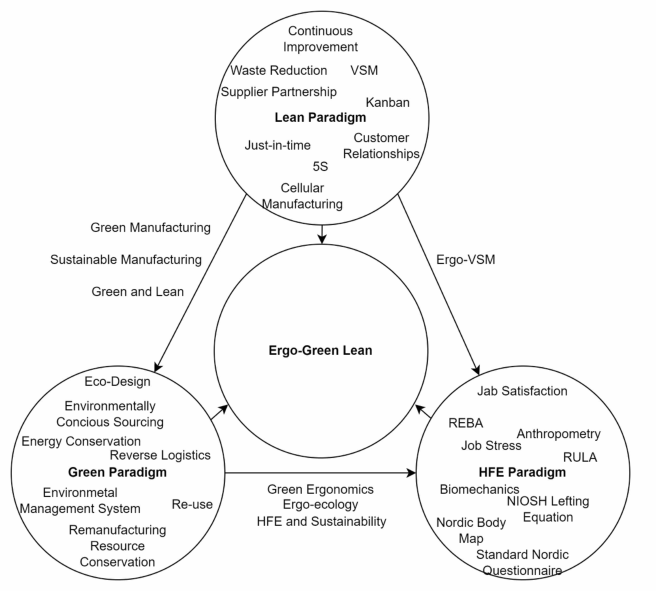
CONCEPTUAL MODEL FOR LEAN, GREEN AND HFE INTEGRATION The conceptual model for Ergo-Green Lean, the integration of lean, green, and HFE, is given in Figure 1. Ergo-Green Lean is conceptualized to achieve triple-bottom-line sustainability by integrating the principles of ergonomics, green, and lean. This model was created through focus group discussions and incorporates tools and techniques from all three paradigms to improve productivity, reduce resource usage, lower costs, and enhance quality and customer satisfaction. Implementing ergonomics, green, and lean production systems separately may result in incompatibilities and inefficient resource usage (McDonald, Mors, and Phillips, 2003). By integrating all three princi- ples, organizations can gain a competitive edge in the market. Additionally, integrating these paradigms can help implement an integrated management system. An integrated management system can provide a better infrastruc- ture for managing multiple stakeholders and meeting conflicting require- ments, such as top management, functional managers, employees, customers, suppliers, regulatory authorities, and the community (Wright, 2000).
Figure 1: Conceptual model for Ergo-Green Lean.
IMPLEMENTATION FRAMEWORK FOR ERGO-GREEN LEAN The Ergo-Green Lean implementation framework is based on a plan-do- check-act (PDCA) cycle. The initial version of the framework was developed
A Systematic Framework for the Integration of Lean, Green, and Human Factors 55
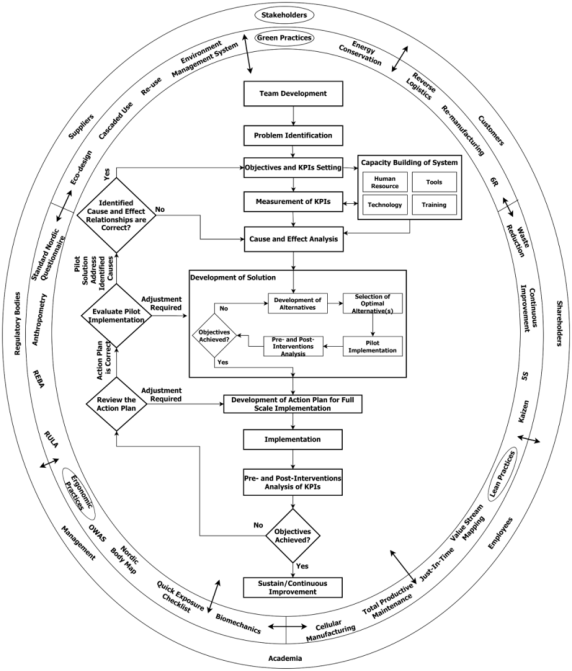
through multiple brainstorming sessions, and after preparing an initial ver- sion, three focus group discussions were conducted to finalize it. The frame- work has three parts: stakeholder representation, practices, and procedures. Figure 2 shows the complete implementation framework for Ergo-green Lean. Organizations have various stakeholders, including employees, sup- pliers, customers, government, shareholders, NGOs, and the community (Sarkis, Gonzalez-Torre and Adenso-Diaz, 2010). High-quality employees are the most important stakeholders, as they are essential for better value cre- ation and organizational performance. Involving employees in new initiatives empowers them to learn and develop innovative ideas, making implement- ing new technologies and solving problems easier (Govindan et al., 2016; Malviya, Kant, and Gupta, 2018). For the successful implementation of Ergo-Green Lean, involving all stakeholders is vital. Each stakeholder has a specific role, with management providing resources and required support and academia providing technical support. Effective communication and cooperation among stakeholders are crucial.
Figure 2: Implementation framework for Ergo-Green Lean.
Lean, green, and HFE concepts represent different approaches with dis- tinct sets of practices. While the framework includes important practices from all three paradigms, the specific practices may vary depending on the local problems and constraints encountered during the planning phase.
Implementing the Ergo-Green Lean approach starts by forming a team with representatives of all stakeholders to identify the problem and set objec- tives and KPIs. Capacity building begins with technology acquisition training and KPI measurement. Root cause analysis follows, after which solutions are developed and tested at a small scale. If successful, an action plan is made for full-scale implementation; otherwise, the process is repeated. Finally, the solution is implemented at the system level, with pre-and post-intervention KPIs measured. Best practices are documented for future reference, and the process is repeated until objectives are achieved.
CONCLUSION
This study proposes a comprehensive model and framework to integrate Lean, Green, and HFE to achieve triple-bottom-line sustainability. The goal is to offer organizations a holistic strategy to deal with the challenges of industrial development while promoting sustainability in its true spirit. The approach, Ergo-Green Lean, aims to achieve operational efficiency, waste reduction, and social well-being at work simultaneously. Further research is being conducted to validate this approach empirically in different industrial settings. Real-world case studies and longitudinal analyses can provide valu- able insights into the long-term impact and effectiveness of the Ergo-Green Lean approach. The framework could be enhanced by exploring deeper inte- gration possibilities, such as incorporating Industry 4.0 technologies and investigating emerging trends and technologies, which would contribute to the continuous evolution of sustainable production systems. Ergo-Green Lean represents a path toward sustainable development by synergizing lean, green, and HFE principles.
ACKNOWLEDGMENT
The authors would like to acknowledge the contributions of academicians, researchers, practitioners, policymakers from relevant institutions, and indus- trial representatives for participating in the focus group discussions. Their contributions helped us to understand and integrate more practical insights while developing the Ergo-Green Lean implementation framework.
REFERENCES
Baumer-Cardoso, M. I. et al. (2020) ‘Simulation-based analysis of catalyzers and trade-offs in Lean & Green manufacturing’, Journal of Cleaner Production, 242, p. 118411. Available at: https://doi.org/10.1016/j.jclepro.2019.118411. Bortolotti, T., Boscari, S. and Danese, P. (2015) ‘Successful lean implementation:
Organizational culture and soft lean practices’, International Journal of Produc- tion Economics, 160, pp. 182–201. Available at: https://doi.org/10.1016/j.ijpe .2014.10.013.
A Systematic Framework for the Integration of Lean, Green, and Human Factors 57
Botti, L., Mora, C. and Regattieri, A. (2017) ‘Application of a mathematical model for ergonomics in lean manufacturing’, Data in Brief, 14, pp. 360–365. Available at: https://doi.org/10.1016/j.dib.2017.06.050. Bouville, G. and Alis, D. (2014) ‘The effects of lean organizational practices on
employees’ attitudes and workers’ health: Evidence from France’, International Journal of Human Resource Management, 25(21), pp. 3016–3037. Available at: https://doi.org/10.1080/09585192.2014.951950. Brito, M. et al. (2020) ‘Lean and Ergonomics decision support tool assessment in a plastic packaging company’, in Procedia Manufacturing. Elsevier B. V., pp. 613–619. Available at: https://doi.org/10.1016/j.promfg.2020.10.086. Brown, C. (2007) ‘Eco-ergonomics’, in Proceedings of the New Zealand Ergonomics
Society Conference, pp. 7–9. Carvalho, H. et al. (2017) ‘Modelling green and lean supply chains: An eco-efficiency perspective’, Resources, Conservation and Recycling, 120, pp. 75–87. Available at: https://doi.org/10.1016/j.resconrec.2016.09.025. Chen, L. et al. (2023) ‘Green construction for low-carbon cities: a review’, Environ-
mental Chemistry Letters, 21(3), pp. 1627–1657. Available at: https://doi.org/10. 1007/s10311-022-01544-4. Cusumano, M. A. (1994) ‘The limits of Lean’, Sloan management review, 35, p. 27. Dües, C. M., Tan, K. H. and Lim, M. (2013) ‘Green as the new Lean: How to use Lean practices as a catalyst to greening your supply chain’, Journal of Cleaner Production, 40, pp. 93–100. Available at: https://doi.org/10.1016/j.jclepro.2011. 12.023. Fraser, K., Harris, H. and Luong, L. (2006) ‘Improving the implementation effec-
tiveness of cellular manufacturing: A comprehensive framework for practition- ers’, 36th International Conference on Computers and Industrial Engineering, ICC and IE 2006, 7543, pp. 2726–2739. Available at: https://doi.org/10.1080/ 00207540601159516. García-Acosta, G. et al. (2014) ‘Ergoecology: Fundamentals of a new multidisciplinary field’, Theoretical Issues in Ergonomics Science, 15(2), pp. 111–133. Available at: https://doi.org/10.1080/1463922X.2012.678909. Garza-Reyes, J. A. et al. (2014) ‘Lean and green--synergies, differences, limitations,
and the need for Six Sigma’, in IFIP international conference on advances in production management systems, pp. 71–81. Govindan, K. et al. (2016) ‘Investigation of the influential strength of factors on adoption of green supply chain management practices: An Indian mining sce- nario’, Resources, Conservation and Recycling, 107, pp. 185–194. Available at: https://doi.org/10.1016/j.resconrec.2015.05.022. Imran, S. et al. (2023) ‘Assessing the potential of GHG emissions for the textile sector:
A baseline study’, Heliyon, 9(11). Available at: https://doi.org/10.1016/j.heliyon. 2023.e22404. Jarebrant, C. et al. (2016) ‘ErgoVSM: A Tool for Integrating Value Stream Mapping and Ergonomics in Manufacturing’, Human Factors and Ergonomics in Manufacturing, 26(2), pp. 191–204. Available at: https://doi.org/10.1002/hfm. 20622. Kanan, M. et al. (2023) ‘An Empirical Study of the Implementation of an Integrated
Ergo-Green-Lean Framework: A Case Study’, Sustainability (Switzerland), 15(13). Available at: https://doi.org/10.3390/su151310138.
Kaswan, M. S. et al. (2023) ‘Integrated Green Lean Six Sigma-Industry 4.0 approach to combat COVID-19: From literature review to framework development’, Inter- national Journal of Lean Six Sigma [Preprint]. Available at: https://doi.org/10. 1108/IJLSS-11-2022-0227. Kurdve, M. and Bellgran, M. (2021) ‘Green lean operationalisation of the circular
economy concept on production shop floor level’, Journal of Cleaner Production, 278, p. 123223. Available at: https://doi.org/10.1016/j.jclepro.2020.123223. Larson, T. and Greenwood, R. (2004) ‘Perfect complements: Synergies between lean production and eco-sustainability initiatives’, Environmental Quality Manage- ment, 13(4), pp. 27–36. Available at: https://doi.org/10.1002/tqem.20013. Malviya, R. K., Kant, R. and Gupta, A. D. (2018) ‘Evaluation and Selection of
Sustainable Strategy for Green Supply Chain Management Implementation’, Busi- ness Strategy and the Environment, 27(4), pp. 475–502. Available at: https: //doi.org/10.1002/bse.2016. Manfredsson, P.(2016) ‘Textile management enabled by lean thinking: a case study of textile SMEs’, Production Planning and Control, 27(7–8), pp. 541–549. Available at: https://doi.org/10.1080/09537287.2016.1165299. McDonald, M., Mors, T. A. and Phillips, A. (2003) ‘Management system integration:
can it be done?’, Quality progress, 36(10), pp. 67–73. Mehmood, A. (2021) Ergo-Green Lean: Integrating Ergonomics and Green Thinking into Lean Production System. University of Engineering and Technology, Lahore, Pakistan. Nickerson, R. S. (1992) ‘What does human factors research have to do with envi-
ronmental management?’, in Proceedings of the Human Factors and Ergonomics Society Annual Meeting, pp. 636–639. Norton, T. A., Ayoko, O. B. and Ashkanasy, N. M. (2021) ‘A socio-technical perspective on the application of green ergonomics to open-plan offices: A review of the literature and recommendations for future research’, Sustainability (Switzerland). MDPI. Available at: https://doi.org/10.3390/su13158236. Owusu-Manu, D. G. et al. (2023) ‘Green construction and environmental perfor-
mance: An assessment framework’, Smart and Sustainable Built Environment, 12(3), pp. 565–583. Available at: https://doi.org/10.1108/SASBE-07-2021-0120. Rahmat, A. K. et al. (2023) ‘The conceptual framework of green ergonomic awareness and employee performance’, Russian Law Journal, 11(5S), pp. 318–325. Sakthi Nagaraj, T. et al. (2019) ‘Integration of human factors and ergonomics into
lean implementation: ergonomic-value stream map approach in the textile indus- try’, Production Planning and Control, 30(15), pp. 1265–1282. Available at: https://doi.org/10.1080/09537287.2019.1612109. Sakthi Nagaraj, T. and Jeyapaul, R. (2018) ‘Ergonomic Study on Work Postures of Sewing Machine Operators in Government Industry: A Case in Lean Environment Garment Industry’, in P. K. Ray and J. Maiti (eds) Ergonomic Design of Prod- ucts and Worksystems—21st Century Perspectives of Asia. Singapore: Springer, pp. 83–101. Available at: https://doi.org/10.1007/978-981-10-5457-0. Saravia-Pinilla, M. H., Daza-Beltrán, C. and García-Acosta, G. (2016) ‘A comprehen-
sive approach to environmental and human factors into product/service design and development. A review from an ergoecological perspective’, Applied Ergonomics, 57, pp. 62–71. Available at: https://doi.org/10.1016/j.apergo.2015.11.007. Sarkis, J., Gonzalez-Torre, P. and Adenso-Diaz, B. (2010) ‘Stakeholder pressure and the adoption of environmental practices: The mediating effect of training’, Journal of Operations Management, 28(2), pp. 163–176. Available at: https://doi.org/10. 1016/j.jom.2009.10.001.
A Systematic Framework for the Integration of Lean, Green, and Human Factors 59
Silva, G. M. and Gomes, P. J. (2023) ‘Lean production, green supply chain management and environmental performance: A configurational perspective based on the Portuguese context’, International Journal of Lean Six Sigma [Preprint]. Available at: https://doi.org/10.1108/IJLSS-02-2023-0036. Sobhani, A., Wahab, M. I. M. and Neumann, W. P. (2015) ‘Investigating work-
related ill health effects in optimizing the performance of manufacturing systems’, European Journal of Operational Research, 241(3), pp. 708–718. Available at: https://doi.org/10.1016/j.ejor.2014.09.032. Thatcher, A. (2013) ‘Green ergonomics: Definition and scope’, Ergonomics, 56(3), pp. 389–398. Available at: https://doi.org/10.1080/00140139.2012.718371. Tortorella, G. L., Vergara, L. G. L. and Ferreira, E. P. (2017) ‘Lean manufactur-
ing implementation: an assessment method with regards to socio-technical and ergonomics practices adoption’, International Journal of Advanced Manufactur- ing Technology, 89(9–12), pp. 3407–3418. Available at: https://doi.org/10.1007/ s00170-016-9227-7. Venkat, K. and Wakeland, W. (2006) ‘Is lean necessarily green?’, in Proceeding of the 50th Annual Meeting of the ISSS. Sonoma, CA, USA. Womack, J. P. and Jones, D. T. (1997) ‘Lean thinking—banish waste and create
wealth in your corporation’, Journal of the Operational Research Society, 48(11), p. 1148. Wright, T. (2000) ‘IMS - Three into one will go!: The advantages of a single integrated quality, health and safety, and environmental management system’, Quality Assurance Journal, 4(3), pp. 137–142. Available at: https://doi.org/10.1002/1099- 1786(200009)4:3<137:: AID-QAJ110>3.0. CO;2-C. Zink, K. J. and Fischer, K. (2013) ‘Do we need sustainability as a new approach in
human factors and ergonomics?’, Ergonomics, 56(3), pp. 348–356. Available at: https://doi.org/10.1080/00140139.2012.751456.
LISTED IN THE AHFE DIGITAL BOOKSTORE CATALOGUE
Explore the complete digital volume
Human Aspects of Advanced Manufacturing, Production Management and Process Control
Read this individual research paper free through the original publisher, or explore the full digital proceedings book.
ISBN 978-1-964867-22-9
Explore this ISBN in the AHFE Bookstore ↗Listed in the July 2026 bookstore catalogue; search by ISBN to confirm current availability · Digital book purchase optional