Wu Jinliang, Yuqian Fu, Xintong Du, Xiaoyan Ma, Wenxiu Yang (2024). Exploring the Correlation Between Seat Backrest Angles and Motion Sickness Response in Ship Rocking Conditions. In: Physical Ergonomics and Human Factors. AHFE Open Access, vol. 147, pp. 80–88. https://doi.org/10.54941/ahfe1005180
The purpose of this study is to investigate the relationship between seasickness induced by ship motion and the angle of seat backrest, aiming to guide the redesign of ship seats to enhance passengers' comfort during voyages. With a focus on sitting posture, participants rated the severity of motion sickness symptoms under different seat backrest angles on a six-degree-of-freedom platform simulating ship motion. The relationship between seat backrest angle and motion sickness response was explored. The experimental results indicate that variations in seat backrest angle under ship motion conditions have a certain impact on participants' motion sickness response. The symptoms of motion sickness in participants are mildest when the seat backrest is tilted back approximately 22.5°, while they become significantly exacerbated when the tilt angle exceeds 45°. Additionally, there is no significant difference between males and females. This study proposes an effective measure to alleviate seasickness that is free of side effects, low-cost, and easy to implement, which could help alleviate the suffering caused by seasickness and hold significant implications for the redesign of ship seats. Moreover, it expands the possibilities for the application of industrial design in the field of ship and ocean engineering.
Motion sickness, also known as vestibular motion sickness, is a common condition characterized by symptoms such as dizziness, upper abdominal discomfort, nausea, vomiting, and a series of autonomic nervous system responses, typically stemming from problems within the inner ear or vestibu- lar system (Jiang et al., 2020). Motion sickness experienced while on a boat, colloquially known as seasickness, is exacerbated by the rocking motion and movement during navigation, intensifying passengers’ discomfort. Sea- sickness not only affects patients’ travel experiences but can also seriously impact their physical health and mental well-being. Therefore, it is crucial to effectively treat and alleviate seasickness for patients’ health and quality of life.
Exploring the Correlation Between Seat Backrest Angles and Motion Sickness Response 81
There are currently various treatment methods and interventions for pre- venting and alleviating motion sickness, including pharmacotherapy, physical therapy, and behavioral therapy. Pharmacotherapy commonly involves West- ern medicine formulations, some of which may not be compatible with other medications and may even contain allergenic ingredients, thus limiting their use and potentially causing side effects. Physical and behavioral therapies require long-term adherence and may not be effective for some patients. Find- ing an effective, side-effect-free, low-cost, and easily implementable measure to alleviate motion sickness is an urgent issue.
The widely accepted theory regarding the etiology of motion sickness is the sensory conflict theory (Reason et al., 1975), which suggests that motion sick- ness arises from conflicts in information between the visual, vestibular, and proprioceptive systems. However, research by Graybiel indicated that blind individuals also experience acute motion sickness, suggesting that vision is not a necessary factor in triggering motion sickness (Graybiel, 1970). Sub- sequently, Riccio et al proposed the postural instability theory, linking the occurrence of motion sickness to factors influencing postural stability. This theory emphasizes the effect of postural changes on the vestibular system, establishing a logical connection between motion sickness and postural sta- bility (Riccio and Stoffregen, 1991). Stoffregen et al found that exposure to a moving room significantly increased scores on standard motion sickness questionnaires. Analysis of participants’ postural movements exposed to the moving room showed an increase in postural sway before the onset of sub- jective motion sickness symptoms, confirming the hypothesis that postural instability precedes motion sickness onset (Stoffregen and Smart, 1998). Bon- net et al discovered that participants experiencing motion sickness symptoms while standing (with fixed foot position) in a moving room exhibited unsta- ble pressure centers on a pressure platform before subjective motion sickness symptoms appeared (Bonnet et al., 2006). Several experiments concluded that postural instability occurs before motion sickness onset, indicating a connection between posture and motion sickness response.
Sitting posture is the most common posture during travel, and seats have the most direct influence on sitting posture, making seat comfort crucial for most people’s travel experiences and motion sickness responses. Cur- rent research predominantly focuses on the comfort of car seats and office chairs. For instance, Harrison et al studied the design factors for optimal car seats and mentioned that the ideal seat should have an adjustable backrest tilt of 100
relative to the horizontal plane (Harrison et al., 2000). Reed et al demonstrated that increasing seat tilt effectively reduces lumbar flex- ion, with a 30
backrest tilt reducing lumbar flexion angle by 17
(Reed et al., 2019). Paddan et al. found that discomfort experienced by individu- als exposed to whole-body vibration was mostly induced in supine positions, with relatively milder symptoms in semi-supine positions (Reed et al., 2019). Through research on the backrest tilt angle of car seats, Chen et al discovered that moderately increasing the backrest tilt angle can reduce seat vibration transmission rate, while excessive tilt angle increases irregularly, reducing comfort (Chen et al., 2023). Li et al. mentioned in their study that setting
the backrest angle at 115
(tilted 25
backward) approximates the natural curvature of the spine, providing comfort (Li and Yu, 2021).
The above studies strongly demonstrate the influence of seat back angle on seat comfort. However, there is currently no research confirming the rela- tionship between seat back angle and motion sickness response. Furthermore, most studies focus on car seat research, with limited research on ship seat design. Compared to cars, ships experience more complex motion involving six degrees of freedom, raising questions about whether passengers in the more complex rocking environment of ships have different demands for seat back angles. This necessitates further experiments for validation.
Subjective measurement methods for motion sickness are widely used due to their convenience, low cost, and high effectiveness. There are many subjective questionnaires for assessing motion sickness, including the Simu- lator Sickness Questionnaire (SSQ), Motion Sickness Susceptibility Question- naire (MSSQ), and Visual Vertigo Analog Scale (VVAS). For example, Jang et al. investigated motion sickness susceptibility using electroencephalogra- phy (EEG), SSQ, and simple virtual reality (VR) content, finding significant increases in SSQ scores after subjects viewed VR content. The experiment uti- lized EEG and SSQ to identify objective physiological changes and subjective manifestations associated with motion sickness(Jang et al., 2022). Although subjective questionnaire assessments may exhibit individual differences, the overall assessment results are highly reliable and widely used measurement tools. Therefore, this study adopts items from the SSQ subjective question- naire and proposes a new scoring method to measure participants’ motion sickness symptoms.
MATERIAL AND METHODS Apparatus
The six-degree-of-freedom platform used in the experiment was provided by Jiangsu Wotai Intelligent Technology Co., Ltd. The platform has a maximum pitch and roll angle variation of 30
, with a speed of 10
/s and an acceler- ation of 30
/s2. The vertical displacement can reach up to 180 mm, with a speed of 150 mm/s and an acceleration of 3 m/s2. This platform achieves remote control of six degrees of freedom through custom computer soft- ware developed by the company, enabling combined motions including heave, sway, surge, roll, pitch, and yaw. The settings for motion parameters mainly include three variables: amplitude (angle or displacement), frequency, and phase.
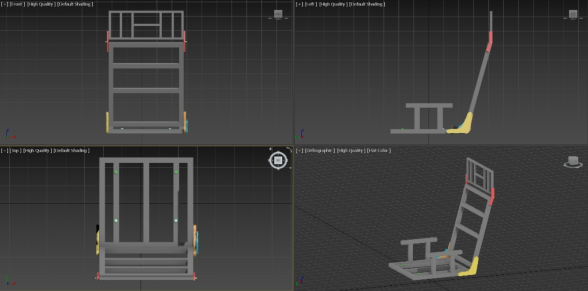
The adjustable seat installed on the six-degree-of-freedom platform is a specially designed and manufactured backrest-adjustable seat tailored for the experiment conducted on the six-degree-of-freedom platform this time. The backrest of the seat can be freely adjusted forwards and backwards by 180
. The framework of the seat is welded using 30mm × 30mm square steel tubes with a thickness of 1.5mm. The seat framework is fixed on a seat base of the six-degree-of-freedom platform (see Figure 1). For safety reasons, armrests with a height of 18cm are welded on both sides of the seat, and a 50mm thick sponge cushion is installed on the seat surface.
Exploring the Correlation Between Seat Backrest Angles and Motion Sickness Response 83
The dizziness scale used in this experiment was designed based on the SSQ questionnaire, with simplified scoring strategies. There were a total of 16 dizziness symptoms included in the scale, and each symptom was graded as follows: none (0), mild (1), moderate (2), severe (3). Participants rated each dizziness symptom directly after each experimental session. After all experi- ments were completed, the scores for each group were calculated uniformly to determine the severity of dizziness experienced by participants in different conditions.
Figure 1: 3D effect of adjustable backrest seat.
Participants The experiment recruited a total of 10 participants, including 6 males, with a BMI range of 18.0–26.0, an average height of 175cm (standard deviation of 5.8, ranging from 167cm to 184cm), and an average weight of 65kg (stan- dard deviation of 8.94); and 4 females, with a BMI range of 19.0–22.0, an average height of 164.5cm (standard deviation of 5.02, ranging from 157cm to 170cm), an average weight of 56kg (standard deviation of 3.02), and an average age of 23 years (ranging from 22 to 24 years). All participants were in good health with a history of previous episodes of dizziness.
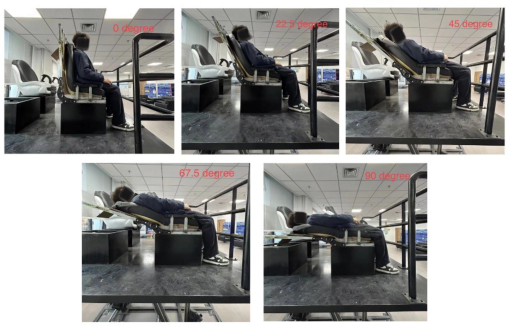
Procedure The main content of the experiment is to simulate the six-degree-of-freedom oscillatory motion of ships. The relationship between the angle of the seat backrest and motion sickness response is investigated by adjusting the angle of the seat backrest to control the posture of the subjects. During the experi- ment, subjects are required to keep their bodies relaxed and their eyes tightly closed (the body needs to rely on the seat backrest throughout the exper- iment). The angle settings of the seat backrest include five angles, with each adjustment increment of 22.5
, starting from vertical to the backrest (upright) and then sequentially adjusting to 22.5
, 45
, 67.5
, and 90
(lying position) (see Figure 2).
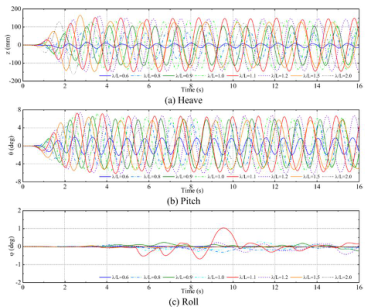
The simulation motion parameters of the six-degree-of-freedom platform mainly refer to the motion data simulated by CFD under the conditions of
symmetric transverse waves (wave heading −45
/45
) with a wavelength ratio of λ/L = 1.1 when the ship speed Fn = 0.25, based on the S175 container ship (Jiao et al., 2021) (see Figure 3). The parameter settings of the six-degree- of-freedom platform are obtained according to the motion curve of the S175 ship type (see Table 1).
Before the start of each experimental session, it is essential to ensure that the participants are in good physical condition. Each individual’s participa- tion lasts for 10 minutes, followed by a mandatory 30-minute rest period to prevent potential interference between sessions and to mitigate the risk of dizziness that may arise. Any participant experiencing intolerable discomfort during the experiment may request to terminate the session at any point. Fol- lowing the conclusion of each experimental session, participants are required to promptly complete a questionnaire to subjectively assess the severity of any dizziness or discomfort experienced.
Figure 2: Shows the change of seat angle.Figure 3: Motion of S175 container ship type at different wavelengths (adapted from Jiao et al., 2021).
Exploring the Correlation Between Seat Backrest Angles and Motion Sickness Response 85
Table 1. Parameter settings of 6-DOF platform.
Table available in the original PDF paper.
Heave Pitch Roll Amplitude 100mm Amplitude 8
Amplitude 1
Frequency 1Hz Frequency 1Hz Frequency 1Hz Phase 90
Phase 45
Phase 90
Result
Ten participants were involved in the experiment and eventually completed it as required. The summarized subjective questionnaire scores of each participant are shown in the table below (see Table 2).
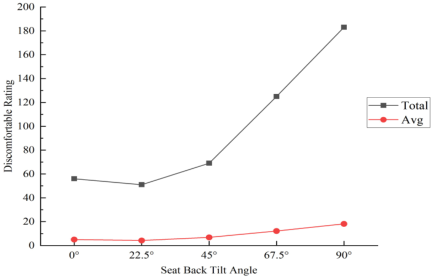
According to the experimental results recorded in Table 2, it was evident that all participants felt significantly uncomfortable when the seat back- rest was tilted 90
, with symptoms of nausea and dizziness being the most severe. Both Total and Average data exhibited similar patterns of change (see Figure 4). The participants reported the lowest scores on the motion sick- ness questionnaire at a backward tilt angle of 22.5
, indicating the least occurrence of motion sickness symptoms and a relatively comfortable state. Beyond a tilt angle of 45
, there was a noticeable trend of exacerbation in motion sickness symptoms.
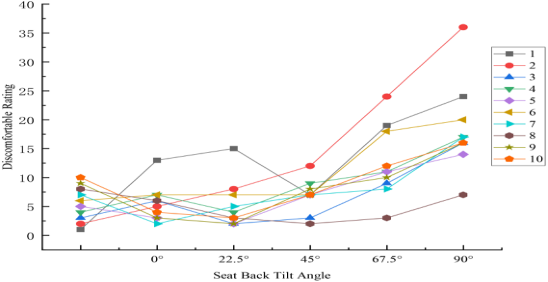
The questionnaire scores of each participant at different backrest angles are illustrated in Figure below (see Figure 5). The relatively comfortable range was observed between backrest angles of 0
to 45
, wherein the results for 6 out of 10 participants showed relatively minor differences in discomfort between backrest angles of 0
to 22.5
, while for 3 out of 10 participants, the differences were minor between backrest angles of 22.5
to 45
. Consid- ering the results of Total and Average scores, it can be inferred that the most comfortable backrest angle during ship rocking motion is approximately 22.5
backward, and the relatively comfortable range is between 0
to 22.5
backward. However, it is yet to be determined whether there exists a more comfortable angle between 22.5
to 45
backward, necessitating further in-depth research in subsequent studies.
Figure 4: The total score and the average score of the motion sickness score at different angles.Figure 5: Motion sickness score trend chart for each subject under different angles.
CONCLUSION
The aim of this study is to investigate the relationship between the angle of the seat backrest and motion sickness response in ship rocking conditions. The experimental results indicate that the discomfort perceived by partici- pants is minimal when the seat backrest is tilted at approximately 22.5
backward, which is consistent with the findings of Li et al regarding the most comfortable backrest angle of 115
in office chairs (Li and Yu, 2021).
Paddan et al. examined the influence of backrest angle variation on per- ceived comfort during vertical whole-body vibration at 8 Hz. In each trial, participants experienced vertical whole-body vibration stimuli while seated at five different backrest angles: 0
(reclined), 22.5
, 45
, 67.5
, and 90
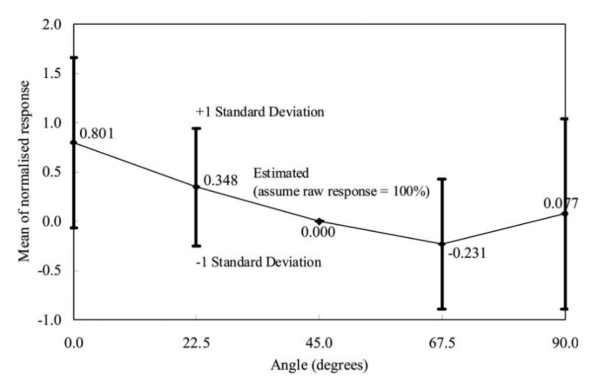
(upright), with the stimulus frequency constant at 8 Hz and only the backrest angle changing (Paddan et al., 2012). The normalized results of this exper- iment, as shown in Figure below (see Figure 6), with 45
backrest angle chosen as the reference position, hence the value corresponding to 45
in Figure 6 is 0. From 0
to 67.5
, there is a monotonic trend at 8 Hz, consistent with the normalized results of this experiment and the variations presented by the Total and Avg data obtained. The ship rocking condition employed
Exploring the Correlation Between Seat Backrest Angles and Motion Sickness Response 87
in this study differs from the constant frequency vertical whole-body vibra- tion stimulus studied by Paddan et al., yet the ultimate conclusion is largely consistent with the aforementioned study, indicating that most discomfort occurs in the reclined position, while symptoms of discomfort are mildest in the semi-reclined position.
Figure 6: The effect of backrest angle on the average standardized discomfort rating of 20 participants tested at 8 Hz frequency, with higher ratings corresponding to more discomfort (adapted from Paddan et al., 2012).
In previous research, Zhang et al. demonstrated that the resonant fre- quency measured at the seat pan and backrest increases with an increase in backrest inclination, with backrest inclination having a more significant impact on resonant frequency (Zhang et al., 2022). Chen et al. also concluded through their study of the incination angle of car seat backrests that moderate increases in backrest inclination can reduce seat vibration transmission rate, but excessive increases can lead to irregular increases in vibration transmis- sion rate, thereby reducing comfort (Chen et al., 2023). Li et al. mentioned that when the backrest angle is set to 115
(tilted 25
backward), the spinal morphology of the human body approaches a natural curved state, which is more comfortable (Li and Yu, 2021). The experimental results of this study indicate that participants experience the mildest motion sickness symptoms when the backrest is tilted 22.5
backward. Considering the conclusions of the aforementioned studies, it can be inferred that at this angle, the spinal morphology of participants remains relatively natural, the muscles of the lower back are more relaxed, and participants feel more comfortable. Addi- tionally, at this angle, the transmission rate of unstable vibrations through the seat is lower, particularly the unstable frequencies felt by the body, espe- cially the head, are lower, making it less likely for motion sickness symptoms to occur at this angle.
The experimental results demonstrate that variations in the angle of the seat back have a certain effect on passengers’ motion sickness response dur- ing ship swaying. The mildest symptoms of motion sickness occur when the seat back is tilted at approximately 22.5
backwards, a finding consistent with previous research on car seats and office chairs. Adjusting the angle of the seat back to alleviate passengers’ motion sickness response during travel is relatively easy to implement and does not require excessive time or cost. Moreover, unlike pharmaceutical treatments, it does not induce any side effects on individuals’ health.
ACKNOWLEDGMENT
Acknowledgments to Harbin Engineering University Yantai Institute and Yantai Beihai Marine Engineering Technology Co., Ltd. for their assistance.
REFERENCES
Bonnet, C. T. et al. (2006). ‘Motion Sickness Preceded by Unstable Displacements of the Center of Pressure’. Human Movement Science, 25(6): 800–820. Chen, M., Zhao, Q. H. & Yang, J. Z. ‘Study on Response of Seat Back Tilt Angle to
Human Body Vibration’. Journal of Mechanical Design, 40(02): 77–83. Graybiel, A. (1970). ‘Susceptibility to acute motion sickness in blind persons’. Aerosp Med, 41(6): 650–3. Harrison, D. D. et al. (2000). ‘Sitting Biomechanics, Part II: Optimal Car Driver’s Seat
and Optimal Driver’s Spinal Model’. Journal of Manipulative and Physiological Therapeutics, 23(1). Jang, K. M. et al. (2022). ‘Estimating Objective (EEG) and Subjective (SSQ) Cybersickness in People with Susceptibility to Motion Sickness’. Applied Ergonomics, 102: 103731. Jiang, S. F., Meng Z. G., Shan S. Q. (2020). ’Research Progress on Investigation and
Prevention of Seasickness in China’, Journal of Naval Medicine, 41(02): 235–238. Jiao, J., Huang, S. & Guedes, S. C. (2021). ‘Numerical investigation of ship motions in cross waves using CFD’. Ocean Engineering, 223: 108711. Li, H. & Yu, N. (2021). ‘Comfort Design of Office Chair based on Ergonomics’.
Forestry and Grassland Machinery, 2(06): 77–80. Paddan, G. S. et al. (2012). ‘The Influence of Seat Backrest Angle on Perceived Discomfort During Exposure to Vertical Whole-Body Vibration’. Ergonomics, 55(8): 923–936. Pan, L. L. et al. (2021). ‘Predictive Ability of Motion Sickness Susceptibility Question-
naire for Motion Sickness Individual Difference in Chinese Young Males’. Ocean & Coastal Management, 203: 105505. Reason, J. T, Brand, J. J. (1975). ‘Motion Sickness’, Academic Press, London, pp: 83–101. Reed, M. P., Ebert, S. M. & Jones, M. L. H. (2019). ‘Posture and belt fit in reclined
passenger seats’. Traffic Injury Prevention, 20(sup1): S38–S42. Riccio, G. E., STOFFREGEN T A. (1991). ‘An Ecological Theory of Motion Sickness and Postural Instability’. Ecological Psychology, 3(3): 195–240. Stoffregen, T. A., Smart, L. J. (1998). ‘Postural instability precedes motion sickness’,
Brain Research Bulletin, 47(5): 437–448. Zhang, X. et al. (2022). ‘Dynamic Interaction between the Human Body and the Seat during Vertical Vibration: Effect of Inclination of the Seat Pan and the Backrest on Seat Transmissibilities’. Ergonomics, 65(5): 691–703.
LISTED IN THE AHFE DIGITAL BOOKSTORE CATALOGUE
Explore the complete digital volume
Physical Ergonomics and Human Factors
Read this individual research paper free through the original publisher, or explore the full digital proceedings book.
ISBN 978-1-964867-23-6
Explore this ISBN in the AHFE Bookstore ↗Listed in the July 2026 bookstore catalogue; search by ISBN to confirm current availability · Digital book purchase optional