Madlen Günther, Bettina Kämpfe, Josef Krems (2024). The role of users' privacy concerns in the decision for smart battery electric vehicle charging. In: Advances in Human Factors of Transportation. AHFE Open Access, vol. 148, pp. 270–277. https://doi.org/10.54941/ahfe1005217
As the availability of electricity from renewable sources in the power grid can fluctuate greatly, smart charging of battery electric vehicles (BEVs) is an effective approach to balance the grid. However, user centred smart BEV charging requires detailed settings of the BEV drivers’ mobility and consumption needs as well as the collection and processing of personal data. This may lead to privacy concerns among users and reduce their willingness to use smart BEV charging. Thus, the aim of the present study was to investigate the role of users’ privacy concerns in the decision for smart BEV charging. To this end, an online questionnaire study with N = 103 participants was conducted in Germany in 2023. The sample consisted of 62 women and 41 men, with an average age of 31 years (SD = 15.52; Min = 18 years; Max = 67 years). Participants were well educated and had on average 3,625 km driving experience with BEVs (SD = 7,397.13; Min = 0 km; Max = 38,000 km) within the last 12 months. Results revealed that smart BEV charging was perceived as significantly more critical in terms of data disclosure as conventional charging (p ≤ .043). The possibility of unauthorized persons gaining access to personal data was rated as the highest risk followed by the identity of possible data recipients compared to the possibility of data loss (p < .01). Further, participants’ perceived criticality of data disclosure significantly predicted their willingness to participate in smart BEV charging when controlling for participants BEV driving and charging experience (Radj2 = .075, F(3,102) = 3.8, p = .013). Within this study, we provided first empirical evidence that participants’ concerns regarding privacy emerged as a potential obstacle to their willingness to engage in smart BEV charging practices. Finally, we show strategies for reducing privacy concerns and increasing the willingness to participate in smart BEV charging.
The Role of Users’ Privacy Concerns in the Decision 271
on the initiative, but the goal is an efficient energy distribution, taking into account grid conditions and avoiding congestion (Huber et al., 2019; Kämpfe et al., 2022). We understand smart BEV charging as dynamically supplier- managed charging that benefits the grid, the use of renewable energy, the market, and the BEV users. Smart charging is based on grid status, renew- able energy generation, as well as user demands and refers to coordinated charging systems that manage the charging process to optimize it for collec- tive needs (e.g., maintaining grid stability) and/or individual user preferences (e.g., charging when electricity prices are low).
However, smart BEV charging requires detailed settings of the BEV drivers’ mobility and consumption demand and the capture and processing of per- sonal data (e.g., kilometres to be driven, location of the BEV and the charging station, account information for payment). Thus, advanced algorithms and smart data processing make it possible to identify precise indicators of activ- ity patterns, ranging from energy consumption and charging information to movement profiles and daily routines. This may lead to users’ privacy con- cerns and reduce their willingness to use smart BEV charging (Döbelt et al., 2023; Kämpfe et al., 2022). The privacy concerns expressed by the users mainly relate to the risk of data misuse and hacking, and thus, an attack on their privacy. Potential users fear that private data could be transmitted and traced back as well as that involved energy companies could gain access to private household data (Döbelt, Kämpfe & Krems, 2014; Geske & Schumann, 2018; Noel et al., 2019). Further, users also fear that unauthorized persons could take control of energy use and the charging process and thereby, could gain unauthorized access to the vehicle and its location (Geske & Schumann, 2018; Milchram et al., 2018; Sovacool et al., 2018).
PRESENT RESEARCH The aim of the present research was to investigate the role of users’ privacy concerns in the decision for, and thus participants’ willingness to participate in smart BEV charging. To this end, the following research questions were addressed (RQ):
RQ1: How critical do users evaluate the disclosure of user data in the context of smart BEV charging compared to conventional charging?
RQ2: What risks of data disclosure do users perceive in the context of smart BEV charging?
RQ3: What influence do users’ privacy concerns have on their willingness to use smart BEV charging?
With this study, we aim to close the existing research gap providing first empirical evidence regarding the link between users’ privacy concerns and their willingness to participate in smart BEV charging.
METHODOLOGY
To investigate users’ intention to participate in smart BEV charging and the associated privacy concerns, an online questionnaire study was conducted. The study adopted a cross-sectional design, employing a single test condition
completed by each participant. Data collection was carried out in Germany from March 30 to May 21, 2023, and all measures were taken to ensure con- fidentiality and protect participant identities through anonymization. This study was carried out in accordance with the American Psychological Asso- ciation Code of Ethics, as well as recommendations, regulations and consent templates of the Chemnitz University of Technology ethics commission. All participants gave written informed consent.
Participants The study included a total sample of 103 participants, of which 62 self- identified as female (60%) and 41 as male (40%). The participants’ average age was 31 years (SD = 15.52; Min = 18 years; Max = 67 years). In terms of educational attainment, the majority of the participants reported to have completed high school education (n = 61; 60%). 35 participants (34%) reported to hold a university degree, while the remaining 6% fell into the cat- egory “other educational background” (e.g., still in education). Almost half of the participants (n = 49; 48%) already had previous BEV and charging experience. Participants’ reported total distance travelled with a BEV within the last 12 months was on average 3,625 km (SD = 7,397.13; Min = 0 km; Max = 38,000 km). The number of conducted charging processes within the last 12 months was on average 42 (SD = 86.70; Min = 0; Max = 455).
Procedure The online questionnaire study was implemented using the online survey tool “LimeSurvey” and published via the university’s internal e-mail distribution list for interested study participants as well as via “electrive today” – an established German newsletter for electro mobility.
Emphasizing the paramount importance of privacy, a clear statement regarding the survey’s privacy policy was incorporated. The introduction sec- tion provided a comprehensive description of smart charging, its function and concepts. Among other things, participants were requested to indicate their willingness to use smart BEV charging, their perceived privacy concerns in terms of perceived criticality of data disclosure as well as potential risks associated with data sharing. Participants rated their perceived criticality of data disclosure between smart and conventional as well as public and private BEV charging. Finally, participants were invited to furnish general informa- tion about themselves, encompassing details concerning their experience with BEVs and demographic variables. Concluding the survey, participants were thanked for their invaluable contributions, recognizing their essential role in enriching the study’s insights.
Measurements Criticality of data disclosure. Participants evaluated the criticality of data disclosure using a 7-point rating scale, ranging from 1 not critical at all to 7 totally critical, for smart and conventional charging as well as for public and private BEV charging.
The Role of Users’ Privacy Concerns in the Decision 273
Perceived risks of data disclosure. To assess participants’ perceived risks of data disclosure in the context of smart BEV charging five items answering on a 5-point rating scale, ranging from 1 no risk at all to 5 very high risk were constructed. The items encompassed concerns regarding the possibility that unauthorized individuals could gain access to personal data, the identity of data recipients, the data storage location, the possibility of profiling, and the risk of data loss.
Willingness to use smart BEV charging. Participants’ willingness to use smart BEV charging was assessed with a two item scale answering on a 6-point Likert scale, ranging from 1 completely disagree to 6 completely agree. The two items were “I would like to use smart charging as often as possible.” and “I would use smart charging in preference to conventional charging.”
RESULTS
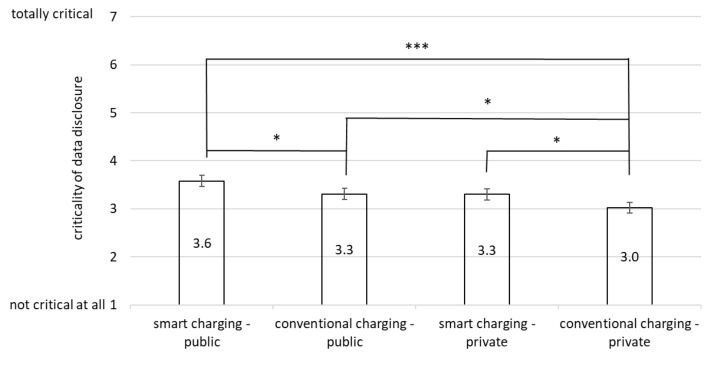
Regarding RQ1 (How critical do users evaluate the disclosure of user data in the context of smart BEV charging compared to conventional charging?) we first analyzed the difference in participants’ perceived criticality of data disclosure between smart and conventional charging in a public and private BEV charging scenario. Results revealed significant differences between smart and conventional BEV charging as well as between the both charging scenar- ios (F(2.5,257.37) = 8.68, p < 0.001, η2p = 0.08; see Figure 1). Even when including participants’ BEV driving and charging experience as covariates, this effect remains significant (p = 0.006). Results showed that smart BEV charging was perceived as significantly more critical in terms of data disclo- sure than conventional charging, in both, the public (p = 0.033) and the private charging scenario (p = 0.043).
Figure 1: Participants’ perceived criticality of data disclosure between smart and con- ventional as well as public and private BEV charging. Note. N = 103. *p < 0.05, ***p < 0.001. The scale ranged from 1 not critical at all to 7 totally critical. Error bars represent standard errors.
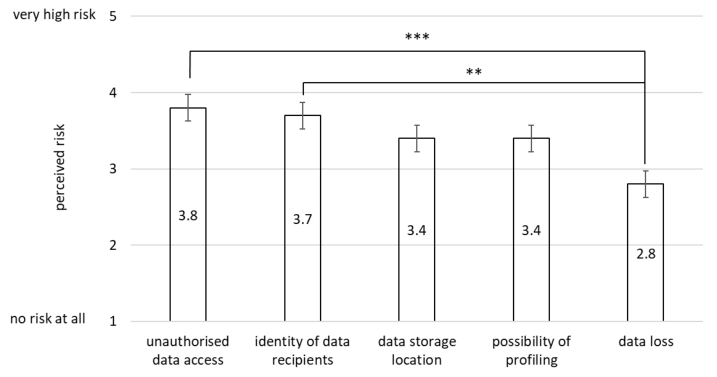
Answering RQ2 (What risks of data disclosure do users perceive in the con- text of smart BEV charging?) participants who expressed smart BEV charging as critical (evaluated the criticality of data disclosure with 5, 6 or 7) rated in both charging scenarios what kind of risks they perceive. A mean score between public and private smart BEV charging was conducted to obtain a robust indicator for the perceived risks of data disclosure. The results are presented in Figure 2 showing that the possibility of unauthorized individ- uals gaining access to personal data was rated as the highest risk followed by the identity of possible data recipients, the data storage location and the possibility of profiling as well as data loss. The possibility of data loss was rated as the smallest risk with a mean score of M = 2.8, indicating still a medium risk based on the used rating scale. An ANOVA revealed significant differences between the five risk categories (F(3.02,96.65) = 8.12; p < 0.001, η2p = 0.20). Again, when the BEV driving and charging experience of the par- ticipants are included as covariates, this effect remains significant (p < 0.001). Pairwise comparisons showed that the possibility of unauthorized individu- als gaining access to personal data and the identity of possible data recipients was related to a significantly higher percieved risk compared to the possibility of data loss (p’s < 0.01).
Figure 2: Participants’ perceived risks of data disclosure in the context of smart BEV charging. Note. N = 33. **p < 0.01, ***p < 0.001. The scale ranged from 1 no risk at all, 2 low risk, 3 medium risk, 4 increased risk to 5 very high risk. Error bars represent standard errors.
To examine RQ 3 (What influence do users’ privacy concerns have on their willingness to use smart BEV charging?) we conducted a linear regres- sion analysis aiming to predict participants’ willingness to participate in smart BEV charging. Participants’ perceived criticality of data disclosure significantly predicted their willingness to use smart BEV charging when con- trolling for participants BEV driving and charging experience (Radj2 = 0.075,
The Role of Users’ Privacy Concerns in the Decision 275
F(3,102) = 3.8, p = 0.013). The standardized regression coefficient for criti- cality of data disclosure was negative, indicating that participants’ perceived criticality reduces their willingness to participate in smart BEV charging. For the detailed regression coefficients see Table 1.
Table 1. Participants’ perceived criticality of data disclosure as predictor of their willingness to use smart BEV charging.
Table available in the original PDF paper.
Predictor b SE T p Criticality of data disclosure −0.21 0.08 −2.30 0.030 BEV driving experience −0.14 0.00 −0.86 0.393 BEV charging experience 0.32 0.00 1.89 0.062
Note. N = 103.
DISCUSSION
Summary of Results Within the present research, we investigated the role of users’ privacy concerns for their willingness to participate in smart BEV charging.
Results revealed that smart BEV charging in a public as well as in a private charging context was perceived as significantly more critical in terms of data disclosure as conventional charging. Important privacy concerns among par- ticipants were the possibility of unauthorized individuals gaining access to their personal data, the identity of data recipients, data storage location and profiling as well as the possibility of data loss. The possibility of unautho- rized individuals gaining access to personal data was rated as the highest risk followed by the identity of possible data recipients compared to the possibil- ity of data loss. We also found that participants’ perceived criticality of data disclosure significantly predicted their willingness to use smart BEV charg- ing indicating that participants’ perceived criticality reduces their willingness to participate in smart BEV charging. All results were independent of the participants’ level of BEV driving and charging experience.
Implication This is one of the first attempts to empirically prove the significance of privacy concerns for the willingness to participate in smart BEV charging. Previ- ous research focused on users’ willingness to share personal information in the context of smart BEV charging and revealed that users reject providing information including threat potential deduced from personal data (Döbelt, Kämpfe & Krems, 2014; Döbelt et al., 2023). It is now possible to show the extent to which privacy concerns reduce users’ willingness to participate in smart BEV charging if they are not taken seriously and are not countered with appropriate protection mechanisms.
Energy companies and suppliers, grid operators as well as vehicle manufac- turer are well advised to treat their customers’ data and privacy as a valuable asset worth protecting. To this end, data protection measures regulated in the GDPR should be prioritized and their implementation consistently adhered
to and constantly updated. In addition to a user-friendly and transparent contract design, measures to promote trust in the stakeholders involved have also proven to be useful in encouraging the willingness to share personal data in the context of smart BEV charging (Döbelt et al., 2023; Yang, Lee & Zo, 2017).
Limitation and Future Research Because our sample consisted of individuals from similar professional and social backgrounds, it was not representative for the general population. There are also possible confounding variables associated with conducting an online questionnaire study, such as not being able to control the survey situation. Finally, although control questions were asked that encouraged participants to carefully read the provided description of smart BEV charg- ing, it is not guaranteed that all participants had the same understanding of this concept.
Nevertheless, in the light of the rather hypothesis-generating character of this study, which was conducted at the beginning of this relatively new field of research, the study has generated new empirical insights and thus contributes to further research questions that may be investigated in controlled studies. For future research, it would be interesting to investigate the influence of real world smart BEV charging experience and participants’ individual character- istics, such as their general willingness to share personal information, affinity for technology and cultural differences, for their willingness to participate in smart BEV charging.
CONCLUSION
With this study, we provided first empirical evidence that participants’ con- cerns regarding privacy emerged as a potential obstacle to their willingness to engage in smart BEV charging practices.
In order to reduce possible barriers in smart BEV charging, we argue that the initial decision for users’ privacy prevention should be anchored top- down from system designers from the very beginning; e.g., by considering Privacy by Design guidelines (Cavoukian, Polonetsky & Wolf, 2010). Subse- quently and bottom-up, users should be able to clarify to what extent they want to be informed or control data sharing, which is crucial for the will- ingness to share personal information and the reduction of privacy concerns and finally for taking part in smart BEV charging.
ACKNOWLEDGMENT
This study was part of the research project “FLOW” - Flexible energy sys- tem Leveraging the Optimal integration of EVs deployment Wave (Grant Agreement No.: 101056730; HORIZON-CL5-2021-D5-01-03) funded by the European Union. The authors wish to thank Lana Mohr and all study participants.
The Role of Users’ Privacy Concerns in the Decision 277
REFERENCES
Cavoukian, A., Polonetsky, J., & Wolf, C. (2010). Smart Privacy for the Smart Grid: embedding privacy into the design of electricity conservation. Identity in the Information Society, 3, 275–294. doi: 10.1007/s12394-010-0046-y. Döbelt, S., Günther. M., Kämpfe, B. & Krems, J. F. (2023). Examining BEV Drivers’
Willingness to Share Personal Information in the Context of Smart Charging: Results of a Five-Month BEV Field Trail. Transportation Research Procedia 70, (2023) 330–337. https://doi.org/10.1016/j.trpro.2023.11.037 Döbelt, S., Kämpfe, B. & Krems, J. F. (2014). Smart Grid, Smart Charging, Smart Privacy? An Empirical Investigation of Consumers’ Willingness to Provide Smart Charging Information, Tagungsband ComForEn, 5, 29–37. Duarte, G., Rolim, C., & Baptista, P. (2016). How battery electric vehicles
can contribute to sustainable urban logistics: a real-world application in Lis- bon, Portugal. Sustainable Energy Technologies and Assessments, 15, 71–78. doi.org/10.1016/j.seta.2016.03.006. Geske, J., Schumann, D. (2018). Willing to participate in vehicle-to-grid (V2G)? Why not! Energy Policy, 120, 392–401. https://doi.org/10.1016/j.enpol.2018.05.004 Huber, J., Schaule, E., Jung, D., & Weinhardt, C. (2019). Quo vadis smart charg-
ing? A literature review and expert survey on technical potentials and user acceptance of smart charging systems. World Electric Vehicle Journal, 10(4), 85. doi: 10.3390/wevj10040085. Kämpfe, B., Zimmermann, J., Dreisbusch, M., Grimm, A. L., Schumann, J. H., Naujoks, F., Keinath, A., & Krems, J. F. (2022). Preferences and perceptions of bidirectional charging from a customer’s perspective–a literature review and quali- tative approach. In: Liebl, J. (eds) Electrified Mobility 2019. Proceedings. Springer Vieweg, Wiesbaden. https://doi.org/10.1007/978-3-658-32471-1_16 Milchram, C., Van de Kaa, G., Doorn, N., Künneke, R. (2018). Moral values as
factors for social acceptance of Smart Grid Technologies. Sustainability 10(8), 2703. https://doi.org/10.3390/su10082703 Noel, L., Zarazua de Rubens, G., Kester, J., Sovacool, B. K. (2019). Vehicle-to-Grid: A sociotechnical transition beyond electric mobility. In Elliott, D., Wood, G. (eds.) Energy, Climate and the Environment. Palgrave Macmillan, Cham. Schmalfuß, F., Kreußlein, M., Mair, C., Döbelt, S., Heller, C., Wüstemann, R.,
Kämpfe, B., Krems, J. F. (2017). Smart charging in daily routine – Expectations, experiences, and preferences of potential users. In: Liebl, J. (Hrsg.) Grid Integra- tion of Electric Mobility: 1st International ATZ Conference 2016 (pp. 33–47). Springer Fachmedien Wiesbaden. Sovacool, B. K., Kester, J., Noel, L., Zarazua de Rubens, G. (2018). Contested visions and sociotechnical expectations of electric mobility and vehicle-to-grid innovation in five Nordic countries. Environmental Innovation and Societal Transition. 31, 170–183. https://doi.org/10.1016/j.eist.2018.11.006 Yang, H., Lee, H., & Zo, H. (2017). User acceptance of smart home services: an
extension of the theory of planned behavior. Industrial Management & Data Systems 117(1), 68–89. https://doi.org/10.1108/IMDS-01-2016-0017
LISTED IN THE AHFE DIGITAL BOOKSTORE CATALOGUE
Explore the complete digital volume
Advances in Human Factors of Transportation
Read this individual research paper free through the original publisher, or explore the full digital proceedings book.
ISBN 978-1-964867-24-3
Explore this ISBN in the AHFE Bookstore ↗Listed in the July 2026 bookstore catalogue; search by ISBN to confirm current availability · Digital book purchase optional