Lintong Xie, Xiao Fang Yuan (2024). The Impact of Autonomous Driving Takeover Assistance Information Design on Driver Takeover Performance and Situational Awareness. In: Advances in Human Factors of Transportation. AHFE Open Access, vol. 148, pp. 408–417. https://doi.org/10.54941/ahfe1005232
When the L3 autonomous driving system reaches the system boundary and is no longer able to perform operations safely, the system may still help the driver return to the driving task in a safe manner by providing takeover assistance information. This research explores the impact of HMI presenting different levels of takeover assistance information on driver takeover performance and situational awareness in autonomous driving scenarios. Experimental results show that for drivers with rich driving experience, HMI should focus on providing (SA1) situation awareness and (SA2) scene understanding; while for drivers with little driving experience, HMI should provide a combination of (SA1) situation awareness, (SA2) scene understanding (SA2) HMI for scene understanding and (SA3) behavior prediction. Based on this, a takeover auxiliary information model based on situational awareness was constructed. Which can better assist drivers with different driving experience to quickly establish situational awareness and make correct decisions during autonomous driving takeover, thereby achieving safe takeover. The research results provide certain guidance for the information design in the takeover process of future autonomous vehicles, and also emphasize the necessity of considering driving experience as an influencing factor in the design of auxiliary information for takeover.
With the rapid development of autonomous driving technology, the next generation of autonomous vehicles will reach the L3 level of ‘conditional automation’, at which time the driver can break away from the control and supervision of the vehicle and perform non-driving tasks. This also brings new human factors problems, that is, the driver’s situational awareness is reduced, which affects takeover safety (Dillmann, 2021). Driving experience is an important factor influencing takeover. At present, in the process of L3 autonomous driving takeover, the relationship between driving experience and driver situational awareness is not yet clear, and most research focuses on the situation during takeover, ignoring the information of the situation before and after takeover. Research on needs and specific content. Therefore,
The Impact of Autonomous Driving Takeover Assistance Information Design 409
this research starts from the user’s takeover process, analyzes the presenta- tion content of the takeover auxiliary information, and then constructs a takeover auxiliary information model based on situational awareness in the autonomous driving takeover process to improve the situational awareness level and takeover performance of users with different driving experience, and optimize the takeover experience while ensuring driving safety.
RELATED WORK
Information Design in the Process of Autonomous Driving Takeover Currently, researchers are conducting research on what type of information should be presented under different emergency conditions in a takeover situ- ation. Koo et al. (Koo, 2015) emphasized that in important safety situations, providing both ‘how’ and ‘why’ information describing actions and reasons for actions can improve safety performance even though it will bring negative emotions to the driver. In unimportant security situations, just ‘why’ infor- mation is a better choice. Du et al. (Du, 2021) studied how the display mode and information content affect drivers’ acceptance of in-vehicle warning systems in different critical situations. The results showed that considering the driver’s perceived usefulness and ease of use, only ‘why’ ‘information leads to a decrease in perceived usefulness’, and ‘why+what will’ infor- mation has the highest perceived usefulness. Some researchers have also explored drivers’ visualization preferences for different information types in takeover situations. Eriksson et al. (Eriksson, 2018) use different visu- alization forms for different information: objects are highlighted by spheres (information acquisition); lane availability is represented by carpets of differ- ent colors (information analysis); action suggestions are represented by arrow symbols of different colors (decision selection). The results show that sim- ply illuminating obstacles with a sphere (information acquisition) does not improve decision-making and instead increases unnecessary braking. Other researchers have explored takeover situations, categorizing information by level of abstraction. Colley et al. (Colley, 2021) evaluated the impact of four different levels of abstraction of information (high, medium-high, medium, low) and mode of use (visual vs. visual + auditory) on situational aware- ness and accompanying usability scores. The study found that, although Subjective measurements are higher, with caveats, but providing abstract information does not improve objective situational awareness, and providing only visual information is preferred.
To sum up, existing research mostly focuses on takeover reminder infor- mation in the context of takeover, while relatively neglecting the information needs in pre-takeover and post-takeover situations. There is currently a lack of unified standards for the classification of takeover auxiliary infor- mation, and in-depth research on the specific content of different cate- gories of information is also lacking. In addition, few studies have corre- lated information content with drivers’ situational awareness and driving experience.
410 Xie and Yuan
Situational Awareness and Takeover Assistance Information Design Situational awareness (SA) refers to a person’s ability to perceive changes in the surrounding environment, that is, what is happening currently, what it means and what to do (Endsley, 1995). According to the definition of End- sley (Endsley, 1988), it is divided into three levels: SA1 is the individual’s perception of task-related elements in the surrounding environment; SA2 involves the interpretation of data in the SA1 level, which helps the individual understand the current tasks and goals understanding; SA3 involves predic- tion of the future state of elements in the system or environment. Currently, researchers have classified takeover auxiliary information based on the level of situational awareness. For example, Chen et al. (Chen, 2016) used Ends- ley’s SA model to develop a situational awareness-based transparency (SAT) model. Among them, the information of SAT1 is mainly used to help the driver perceive the current actions and plans of the system; the information of SAT2 is used It helps the driver better understand the current behavior of the system; the information from SAT3 is used by the driver to predict future results. However, the information content of each level only covers system information. According to the five types of situational factors proposed by Belk (Belk, 1975), namely physical environment, social environment, time perspective, task definition and previous status, this research believes that environmental information and Consider the driver’s own factors.
To sum up, this research will take over the design of auxiliary information based on the definition of three levels of situational awareness. Each level of information includes system information, traffic information and navigation information. Explore what information drivers with different driving experi- ences need to perceive, understand and even predict at each task stage during the takeover process to achieve the task goal and ensure driving safety.
METHODOLOGY
First, the information content of typical HMI cases in the current L2 level autonomous vehicle takeover process is summarized and clustered, and the key information in the takeover task is clarified through a questionnaire sur- vey. Then, combined with user interviews, the task objectives, pain points and needs of users with different driving experience in L3 autonomous driv- ing takeover were explored, and the takeover auxiliary information content was extracted based on user needs and situational awareness theory. Finally, through usability experiments, we explore the impact of different levels of takeover auxiliary information on the situational awareness level and takeover performance of users with different driving experience, and further screen the information to build a takeover auxiliary information model based on situational awareness during the autonomous driving takeover process.
Build a Prototype First of all, based on the results of the questionnaire survey, it was determined that the three types of information, system information, traffic information, and navigation information, are closely related to the current takeover situ- ation tasks, and their importance in the entire takeover process decreases in
The Impact of Autonomous Driving Takeover Assistance Information Design 411
order. In addition, user interviews further revealed the differences in needs of users with different driving experience in taking over tasks. Specifically, users with rich driving experience believe that only obtaining comprehen- sible information can successfully complete tasks at each stage, while users with less driving experience need to obtain additional predictive information on the basis of obtaining comprehensible information to satisfy their needs. Finally, based on the research conclusions, the takeover auxiliary information content summarized in the previous case analysis was further expanded and improved, and based on Endsley’s definition of the three levels of situational awareness, the takeover auxiliary information content was divided and an experimental prototype was built (see Table 1).
Table 1. Self-driving car takeover auxiliary information content application set.
Table available in the original PDF paper.
Mission phase Information type Information Pre-takeover situation (SA1) Situation awareness System information Driving system activation feedback Driving system usable time/road section Travel information Nearby traffic conditions Traffic information Navigation information
Navigation map Current location Remaining/arrival time Remaining distance (SA2) Scene understanding System information Predict if a takeover is imminent
System information Explanation of driving system behavior Travel information Potential hazard analysis (SA3) Behavior prediction Takeover situation (SA1) Situation awareness System information Take over reminder The control status of the vehicle by the driving system Travel information Nearby traffic conditions Traffic information Navigation information
Navigation map Current location Remaining/arrival time Remaining distance (SA2) Scene understanding System information Takeover action recommendations
System information Explanation of driving system behavior Travel information Forward hazard analysis (SA3) Behavior prediction Post-takeover situation (SA1) Situation awareness System information Driving system exit information When/where the driving system is turned on again Travel information Nearby traffic conditions Traffic information Navigation information
Travel information Potential hazard analysis
Navigation map Current location Remaining/arrival time Remaining distance (SA2) Scene understanding (SA3) Behavior prediction System information Manual driving action recommendations
412 Xie and Yuan
Experimental Design There were 20 participants in the experiment, including 10 users who lacked driving experience and 10 users who had rich driving experience (this research classified users with less than 5 years of driving experience as lacking driving experience, and users with more than 5 years of driving experience as having rich driving experience). The average age is 29.2 years (SD is 4.602), and the average driving experience is 6.2 years (SD is 4.765).
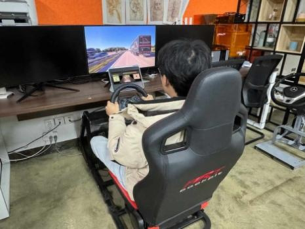
Takeover situations can be divided into planned takeovers (that is, it is known in advance that driving rights will be handed over at a certain point in time) and unplanned takeovers (that is, the transfer of driving rights is not planned in advance, but occurs unplanned). The latter can be It is divided into system initiated and user initiated (McCall, 2019). This research focuses on the takeover situation where the driver’s situational awareness is the low- est. It selects the unplanned takeover scenario initiated by the system due to maintenance sections on the highway and uses a driving simulator for testing (see Figure 1).
Figure 1: Lab environment.
Based on the results of the questionnaire survey, it was found that users prefer to use the instrument panel as a carrier to obtain takeover auxil- iary information. Therefore, the contents of Table 1 are presented on the instrument panel HMI, and the following three levels of takeover auxil- iary information combination solutions are evaluated and provided to the driver in turn. Presenting Plan 1: (SA1) situation awareness, Plan 2: (SA1) situation awareness + (SA2) scene understanding, Plan 3: (SA1) situation awareness + (SA2) scene understanding + (SA3) behavior prediction.
Before the test, participants need to fill in basic personal information, including name, age, driving experience, etc., and understand the goals, tasks, and operation methods of the experiment. In the driving training stage, participants are allowed to understand the meaning of HMI icons and the takeover process, and conduct a 5-minute test drive on the simulator. Dur- ing the test phase, participants were required to complete three rounds of simulated driving tasks, with each round lasting 5 minutes of autonomous driving. When the collision time is less than 6 seconds, the system issues a ‘please take over immediately’ voice alert and a takeover request com- bined with the dashboard HMI. After receiving the request, the participant
The Impact of Autonomous Driving Takeover Assistance Information Design 413
performs obstacle avoidance operations and then continues to drive the car manually for 10 minutes. The task is paused at three assessment points before takeover, during takeover, and after takeover, with the purpose of freezing sit- uational information and assessing the individual’s situational awareness at a specific moment. Participants are required to fill out a SAGAT question- naire at these three assessment nodes, and these data will be used to evaluate the situational awareness of users with different driving experience during the takeover process that is affected by the three levels of takeover auxiliary information.
RESULTS
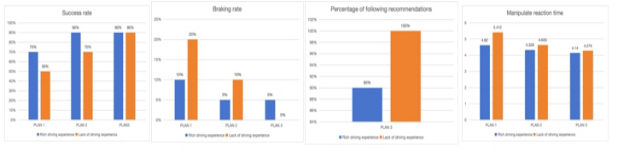
Objective Data This research used four objective measurement indicators, including success rate, braking rate, proportion of following recommendations, and manipula- tion reaction time, to obtain participants’ takeover performance (Du, 2020). Statistics of measurement index results under combination Plans of different information types (see Table 2). Participants with different driving experience also differed in their takeover performance under the three information plans (see Figure 2). Experimental data shows that for participants with rich driv- ing experience, providing (SA3) behavior prediction does not significantly optimize their takeover success rate, braking rate and reaction time, and 10% of members of this group are unwilling to follow the auxiliary infor- mation. However, for participants with less driving experience, providing (SA3) behavioral predictions showed significant positive effects on multiple key indicators, and they were more inclined to accept auxiliary information.
Table 2. Measurement index results under different information type combination plans.
Table available in the original PDF paper.
Plan 1 Plan 2 Plan 3 Success rate 60% 80% 90% Braking rate pressure 30% 15% 5% Percentage of following recommendations \ \ 95% Manipulate reaction time (s) 5.016 4.481 4.207
Figure 2: Comparison chart of measurement indicators displayed by participants with different driving experience under different levels of information combination plans.
414 Xie and Yuan
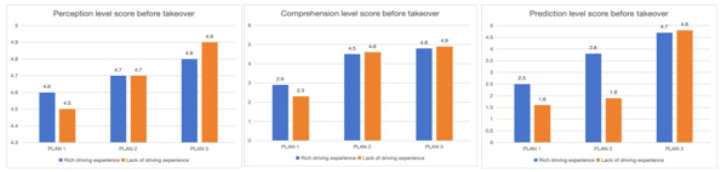
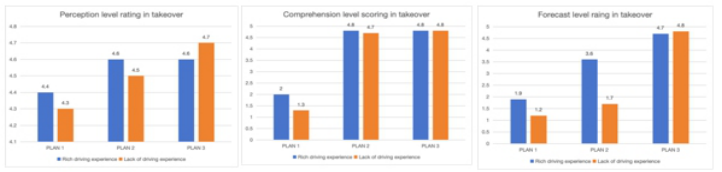
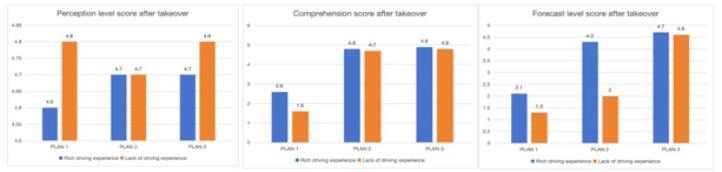
Subjective Data The SAGAT questionnaire can reflect the driver’s situational awareness dur- ing the takeover task and is one of the effective methods used to assess individual situational awareness (SA) (Endsley, 1988). This research divided the driver’s situational awareness into three stages of measurement: before, during, and after the takeover. Each stage was set with three SA level ques- tions and scored using a 5-point Likert scale. The data shows that among these three stages, Plan 3 is better than Plan 1 and Plan 2 in terms of under- standing and prediction levels, especially in the prediction level. This shows that (SA3) behavioral prediction helps drivers predict future situations and prepare for safe takeover. In addition, although (SA3) behavioral prediction has no significant effect on experienced drivers, it has a significant effect on inexperienced drivers, helping to improve their situational awareness levels (see Figure 3–5).
Figure 3: Comparison of situational awareness scores of participants with differ- ent driving experience before taking over under the display of different levels of information combination plans.Figure 4: Comparison of situational awareness scores of participants with different driving experience during takeover under the display of different levels of information combination plans.Figure 5: Comparison of situational awareness scores of participants with different driving experience after taking over under the display of different levels of information combination plans.
The Impact of Autonomous Driving Takeover Assistance Information Design 415
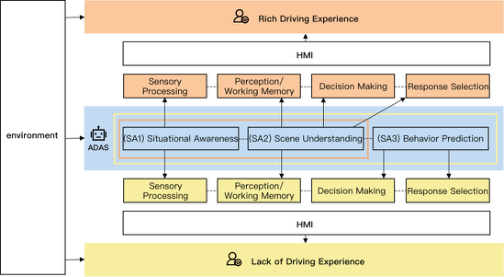
Build Model Through in-depth analysis of experimental data, this research constructed a takeover auxiliary information model based on situational awareness during the autonomous driving takeover process (see Figure 6). This model divides the takeover auxiliary information into three levels. Each level represents the information that needs to be conveyed when the HMI interacts with the driver. Based on the difference in driving experience, a takeover auxiliary information solution composed of different levels of information is provided. To improve the efficiency of information processing, thereby promoting the driver’s perception, understanding and prediction of current tasks. (SA1) Sit- uation awareness corresponds to the sensory processing stage of users with rich driving experience and those with little driving experience. It is mainly used to help drivers filter out irrelevant information and focus on display- ing the most effective information content for the current driving takeover behavior. (SA2) Scene understanding. For users who lack driving experience, this level corresponds to the perception/working memory stage. The system analyzes the important perceptual information content involved in the cur- rent task and completes the processing of the information, thereby assisting the driver to better understand the situation. Efficiently understand the cur- rent scenario. However, for experienced driving users, such information not only supports their perception/working memory, but also directly partici- pates in the decision-making and response selection stages, helping them to make accurate driving decisions and actions quickly. (SA3) Behavior predic- tion is mainly aimed at users who lack driving experience and assists such users to complete the decision-making and reaction selection stages. At this stage, the system provides behavioral decision-making suggestions and oper- ational guidance based on information analysis results to improve takeover efficiency and reduce the occurrence of operational errors. When the driver turns on the ADAS function, the surrounding environment is monitored at all times through sensors, and these three levels of takeover assistance infor- mation are transmitted to the driver through the HMI to achieve the purpose of completing each takeover situation task.
Figure 6: Takeover auxiliary information model based on situational awareness.
416 Xie and Yuan
DISCUSSION
Experiments show that driving experience has a significant impact on the driver’s information needs during L3 autonomous driving takeover. For users with rich driving experience, providing intelligible information can meet their core needs for taking over tasks, so they should focus on (SA1) situation awareness and (SA2) scene understanding. For users with insufficient driving experience, more detailed takeover assistance information needs to be pro- vided, including (SA1) situation awareness, (SA2) scene understanding and (SA3) behavior prediction, to meet their core needs for predictive informa- tion to ensure that they Sufficient information support can be obtained during takeover to improve the safety and efficiency of takeover. It can be seen that personalized information design strategies can better meet user needs and optimize the experience of the takeover process.
This research focuses on the takeover scenario in which the driver’s situ- ational awareness is lowest, that is, an unplanned takeover initiated by the system. In the future, it should be expanded to more takeover scenarios and comprehensively assess the driver’s needs for auxiliary information in dif- ferent takeover scenarios. In addition, this experiment was conducted in a simulator. Most participants recognized the immersive experience, but some believed that it lacked real risk perception, affecting alertness and concen- tration. Therefore, the effectiveness of the design needs to be verified in real environments in the future to more accurately evaluate the driver’s situational awareness and takeover performance.
CONCLUSION
This research is based on the user’s takeover process, and deeply analyzes the presentation content of the takeover auxiliary information through usability experiments. On this basis, an autonomous driving takeover auxiliary infor- mation model based on situational awareness was constructed, aiming to improve the situational awareness level and takeover performance of users with different driving experience. This model connects the takeover assistance information with the driver’s situational awareness and driving experience, expanding the theoretical field of situational awareness; it broadens the research scope of the driver’s information content needs from the takeover situation to the pre-takeover and post-takeover situations and clarified the specific information content. It provides solutions and design reference for enterprises and designers to create a good L3 autonomous vehicle takeover experience.
ACKNOWLEDGMENT
The authors thanks all study participants. This work was conducted within the project the Key Research and Development Project of Hubei Province.
REFERENCES
Alexander Eriksson, Sebastiaan M Petermeijer, Markus Zimmermann, Joost CF De Winter, Klaus J Bengler, and Neville A Stanton. 2018. Rolling out the red (and green) carpet: supporting driver decision making in automation-to-manual transitions. IEEE Transactions on Human-Machine Systems 49, 1 (2018), 20–31.
The Impact of Autonomous Driving Takeover Assistance Information Design 417
Belk R W. Situational variables and consumer behavior[J]. Journal of Consumer research, 1975, 2(3): 157–164. Chen J Y C, Barnes M J, Selkowitz A R, et al. Human-autonomy teaming and agent
transparency[C]//Companion Publication of the 21st International Conference on Intelligent User Interfaces. 2016: 28–31. Colley M, Gruler L, Woide M, et al. Investigating the design of information presentation in take-over requests in automated vehicles[C]//Proceedings of the 23rd International Conference on Mobile Human-Computer Interaction. 2021: 1–15. Dillmann J, den Hartigh R J R, Kurpiers C M, et al. Keeping the driver in the
loop through semi-automated or manual lane changes in conditionally automated driving[J]. Accident Analysis & Prevention, 2021, 162: 106397. Du N, Yang X J, Zhou F. Psychophysiological responses to takeover requests in conditionally automated driving[J]. Accident Analysis & Prevention, 2020, 148: 105804. Du N, Zhou F, Tilbury D, et al. Designing alert systems in takeover transitions:
The effects of display information and modality[C]//13th International Confer- ence on Automotive User Interfaces and Interactive Vehicular Applications. 2021: 173–180. Endsley M R. Situation awareness global assessment technique (SAGAT) [C]//Proceedings of the IEEE 1988 national aerospace and electronics conference. IEEE, 1988: 789–795. Endsley M R. Toward a theory of situation awareness in dynamic systems[J]. Human factors, 1995, 37(1): 32–64. Koo, J., Kwac, J., Ju, W., Steinert, M., Leifer, L., & Nass, C. (2015). Why did my car
just do that? Explaining semi-autonomous drivingactions to improve driver under- standing, trust, and performance. International Journal on Interactive Design and Manufacturing, 9(4), 269275. McCall R, McGee F, Mirnig A, et al. A taxonomy of autonomous vehicle handover situations[J]. Transportation research part A: policy and practice, 2019, 124: 507–522.
LISTED IN THE AHFE DIGITAL BOOKSTORE CATALOGUE
Explore the complete digital volume
Advances in Human Factors of Transportation
Read this individual research paper free through the original publisher, or explore the full digital proceedings book.
ISBN 978-1-964867-24-3
Explore this ISBN in the AHFE Bookstore ↗Listed in the July 2026 bookstore catalogue; search by ISBN to confirm current availability · Digital book purchase optional