Yan Shi, Shuhao Zhang, Yiwei Xiong, Na Liu (2024). Influence of Intelligent Agent Anthropomorphic Image and Role on User Acceptance. In: Usability and User Experience. AHFE Open Access, vol. 156, pp. 38–47. https://doi.org/10.54941/ahfe1005413
Recently intelligent agents have emerged as integral components facilitating the seamless utilization of smart devices in daily life. They serve as instrumental tools for enhancing the precision and efficiency of command execution in human-machine interaction. Despite the prevalence of intelligent agents, their anthropomorphic attributes need a better design to meet user expectations. Thus, investigating the influence of intelligent agent anthropomorphism in terms of user acceptance becomes a necessity.This study designed a mixed-design experiment with anthropomorphic image and role as independent variables and perceived usefulness, perceived ease of use, attitude, intention to use, and trust as dependent variables. The intelligent agent anthropomorphic image had two levels, namely virtual image and simplified image. The intelligent agent designed in this study had three roles, namely steward, assistant, and companion. The task was to plan a travel itinerary with the help of an intelligent agent.The findings reveal that significant differences exist among anthropomorphic images concerning users' perceived usefulness, perceived ease of use, attitude, intention to use, and trust, with users expressing higher acceptance for anthropomorphic agents with simplified images. In the context of travel itinerary planning, no significant differences are observed in all dependent variables regarding anthropomorphic roles. There is no significant interaction effect between intelligent agent anthropomorphic image and role on user acceptance. These findings provide insights for the design of intelligent agent anthropomorphic images and roles.
Intelligent Agents In the early 1990s, the widespread acceptance of computer technology for solving simple daily tasks marked a significant milestone. With the evolution of technology, this approach gradually gave rise to a distinct technological branch known as Intelligent Agents (IAs). Wooldridge (1999) posits that an Intelligent Agent is not merely a passive entity executing predefined instruc- tions; it possesses the capability for dynamic and adaptive behavior. It can perceive the environment and changes, make decisions based on its objec- tives, take proactive actions, and collaborate with humans when necessary
Influence of Intelligent Agent Anthropomorphic Image and Role on User Acceptance 39
(Wooldridge, 1999). A Personal Intelligent Agent (PIA) is a software system that employs natural language to assist users and exhibits intelligent behavior (Moussaw et al., 2021). IAs can perform tasks or provide relevant services based on user inputs, location sensing, and other information.
Anthropomorphism Anthropomorphism is the attribution of distinctively human-like feelings, mental states, intentions, and behavioral characteristics to non-human enti- ties, including inanimate objects, animals, and natural or supernatural phe- nomena, thereby perceiving them as living and sentient beings (Airenti, 2015; Epley et al., 2007; Wang, 2021). The developers of IAs effectively enhance user acceptance and usage frequency through the anthropomorphism of IAs.
The co-creation of Hybrid Intelligence services between humans and IAs might create a sense of psychological ownership and, thus, increase acceptance and trust (Dellermann et al., 2019). Therefore, the degree of anthropomorphism of the intelligent agent role determines the efficiency of information exchange between users and IAs.
Anthropomorphism relates to the user’s attribution of human capacities to a non-human agent. Objects are generally perceived to be human-like when they possess features or characteristics that reflect emotions, cog- nition, or intention (Moussawi et al., 2019). Anthropomorphism of IPAs indirectly induce user trust (Chen et al., 2021). Increasing the level of anthro- pomorphism can enhance user acceptance to a certain extent, and different aesthetic designs also impact user acceptance. However, the presence of the “uncanny valley” effect suggests that user satisfaction may exhibit negative growth when the degree of anthropomorphism surpasses a certain threshold (Rietz et al., 2019).
According to the Communication Privacy Management Theory (CPMT), which conceptualizes privacy management through the division between pri- vate and public information, individuals manage their privacy by opening or closing this boundary to others (Petronio, 2002). The anthropomorphism of the role of IAs poses challenges to this privacy boundary. Highly anthro- pomorphized virtual IAs, regardless of whether they explicitly request highly sensitive privacy information, can lead to heightened privacy concerns among users. After establishing roles such as partners and servants, even though ser- vants are perceived to work under the user’s instructions and control, users still harbor suspicions about the potential motives of the servant when it requests sensitive information and the skepticism deepens privacy concerns (Hua et al., 2021).
Anthropomorphic Role Social Cognitive Theory (SCT) posits that individual behavior depends on users’ cognition and learning about the social environment (Bandura, 2005). Social robots can essentially be seen to be human simulacra in that they are being designed in our image, so as to facilitate the possibility for us to have human-like relations with them (Friedman, 2020). Overly realistic human appearances and interaction styles may be deceptive and suggestive, as they
may imply unattainable functional promises (Norman, 1994). Therefore, the extent to which authenticity and anthropomorphism align user expectations with the functionality of IAs is an open question worthy of in-depth research (Baylor and Kim, 2004).
Social Role Theory (SRT) suggests that a shared set of normative expecta- tions can explain an individual’s behavior in their social status within society (Lopata, 1991). If IAs have specific social or interpersonal role assignments, users can set appropriate expectations and corresponding behaviors, thereby enhancing interaction effectiveness and overall user satisfaction with IAs (Rhee, 2020).
Role Design Theory (RDT) suggested that in the educational context of IAs, the role of an expert involved possessing advanced knowledge in a spe- cific professional domain and mentors, serving as ideal guides, provided motivational support and guidance to establish trust and form social rela- tionships with users (Baylor and Kim, 2005). In terms of agent role design, IAs’ possibility of making ambiguous expression is considered more trustwor- thy, capable, and warm. Emotional IAs are also more easily accepted (Koda, 1996; Demeure et al., 2011). Solving complex problems requires the collab- oration of different intelligent agents, each with different roles (Hong et al., 2023). Employing program-defined anthropomorphism in IAs for ambiguous emotional expressions can more effectively enhance users’ subjective accep- tance of anthropomorphized IAs (Baylor and Kim, 2005). High levels of machine intelligence allow virtual AI to enact more immediacy behaviors that increase trust, such as social responsiveness and personalization of the virtual AI agent’s reactions (Glikson et al., 2020).
Therefore, considering the key theories and conclusions mentioned above, this study primarily confined its experimental design to the context of travel itinerary planning. Based on the social roles involved in this scenario, three roles—steward, companion, and assistant—were designed.
HYPOTHESES According to the Technology Acceptance Model (TAM), the perceived ease of use and perceived usefulness of a technology influence users’ attitudes towards that technology, either positively or negatively, thereby affect- ing their intention to use it (Chuttur, 2009). Therefore, concerning the anthropomorphic images and roles of IAs, the following hypotheses can be proposed:
H1. In the scenario of using IAs for itinerary planning, there is a significant positive correlation between perceived ease of use and perceived usefulness on users’ intention to use.
H1a. Perceived ease of use can indirectly influence users’ intention to use by affecting perceived usefulness, indicating a significant positive correlation between perceived ease of use and perceived usefulness.
H1b. Both perceived ease of use and perceived usefulness have a direct significant positive correlation with users’ intention to use.
Furthermore, the CPMT demonstrates that the anthropomorphism of intelligent agent image challenges users’ privacy boundaries, potentially
Influence of Intelligent Agent Anthropomorphic Image and Role on User Acceptance 41
leading to concerns about the leakage of highly sensitive privacy information. Thus, the following hypotheses can be derived: H2. The anthropomorphic image of IAs has a significant impact on users’ acceptance.
H2a. The anthropomorphic image of IAs significantly influences user’ intention to use.
H2b. Trust has a significant positive correlation with intention to use. Regarding the different anthropomorphic roles of IAs, the Role Design Theory (RDT) proposes that IAs capability of making ambiguous expres- sions are considered more trustworthy, capable, and warm than other types of agents. Emotional IAs are also more easily accepted. Therefore, differ- ent role designs may significantly influence user acceptance, leading to the following hypothesis: H3. The anthropomorphized roles of IAs have a significant impact on users’ acceptance.
METHOD
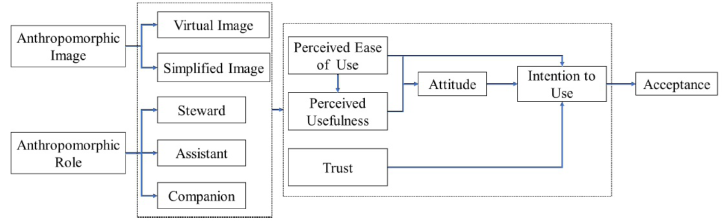
Experimental Design This study employed a mixed experimental design, with anthropomorphic image of IAs as a between-subject variable and role of intelligent agent as a within-subject variable. Anthropomorphic image had two levels: virtual image and simplified image. The role of the intelligent agent had three levels: butler, assistant, and companion. Both variables resulted in six combinations (Figure 1).
In the experimental scenario where participants engage in travel plan- ning, each intelligent agent is responsible for itinerary planning before the departure and return trips of the users. Feedback on the processing results is provided to the participants in the form of voice communication. Each participant is randomly assigned to either the “virtual image” or “simpli- fied image” group. Within the same group, different intelligent agent roles offer distinct voice feedback. Therefore, each participant encounters six sce- nario dialogues, comprising three roles for both pre-departure and return trip planning stages.
Figure 1: Experimental design framework.
Independent Variable Design Based on the considerations of Role Design Theory (RDT), Social Cognitive Theory (SCT), and Social-Role Theory (SRT) for the multidimensional design of anthropomorphized virtual images of IAs, the level of anthropomorphism was divided into virtual image and simplified image while maintaining a bal- ance between familiarity and role-specific characteristics, without excessive anthropomorphism. This was done to analyze the impact of different levels of anthropomorphism on user acceptance across the three distinct roles of IAs: steward, companion, and assistant. To minimize subjective cognitive differ- ences among users, six different images with consistent core artistic styles were selected (Table 1).
During the participants’ engagement in the experiment, each role pro- vides identical processing results through feedback styles that align with their respective role identities. For instance, in a scenario where itinerary planning is completed, the steward would emphasize ensuring all affairs are well- arranged for the participant. The assistant, on the other hand, tends to offer solutions to the participant, leaving room for the user to confirm choices. Meanwhile, the companion, while downplaying the processing results, would emphasize a sense of emotional companionship.
Table 1. Design of independent variables.
Table available in the original PDF paper.
Steward Assistant Companion Virtual Image
Simplified Image
Influence of Intelligent Agent Anthropomorphic Image and Role on User Acceptance 43
Dependent Variable Design After completing each experimental task, participants were asked to fill out a questionnaire based on a literature-reviewed 1–7 Likert scale. The scale for perceived usefulness, perceived ease of use, and intention to use was adapted from Davis (1989) et al., primarily designed to gather users’ subjective accep- tance with the specific intelligent agent in that scenario post-use. Another scale, proposed by Petronio (2002), was employed to assess users’ trust in the intelligent agent.
Participants The participants for this study were sourced from 242 users on the Credamo platform. After screening there were a total of 240 valid rsamples: 115 par- ticipants in the virtual image group and 125 participants in the simplified image group, with a balanced number of participants between the groups. Among all participants, there were 97 male participants and 145 female par- ticipants, resulting in a nearly equal gender ratio. Additionally, they had a certain frequency of intelligent assistant usage and experience.
RESULTS
The experimental data will be analyzed using SPSS,which will encompass var- ious statistical methods, including one-way analysis of variance (ANOVA), factorial ANOVA, and correlation analysis.
ANOVA Results The results of one-way analysis of variance (ANOVA)regarding anthro- pomorphic images (Table 2) show that anthropomorphic images of IAs significantly influence users’ subjective acceptance.
Table 2. ANOVA for anthropomorphic image.
Table available in the original PDF paper.
variable image type N M SD F P Perceived Ease of Use Virtual 696 5.752 0.881 6.430 0.011** Simplified 756 5.840 0.829 Perceived Usefulness Virtual 696 5.809 0.820 3.164 0.075* Simplified 756 5.856 0.846 Attitude Virtual 696 5.716 1.014 5.884 0.015** Simplified 756 5.749 0.908 Intention to Use Virtual 696 5.724 1.111 13.449 0.000*** Simplified 756 5.736 0.945 Trust Virtual 696 5.515 0.907 4.734 0.030** Simplified 756 5.567 0.863
Users exhibit higher acceptance with IAs that employ simplified anthropo- morphic image. Compared to agents with virtual anthropomorphic image, agents with simplified image consistently scored higher in all dependent variable. This suggests that, given the same outcomes, agents with sim- plified image are more likely to gain user acceptance. The conclusions
drawn from this study are consistent with the findings: a higher degree of anthropomorphism tends to diminish users’ trust in IAs (Ha and Chen, 2021).
The ANOVA results of anthropomorphic role shows that anthropomor- phic role does not show significant effects on user acceptance (Table 3).
Table 3. ANOVA for anthropomorphic image.
Table available in the original PDF paper.
variable role type N M SD F P Perceived Ease of Use Steward 484 5.814 0.829 0.18 0.835 Assistant 484 5.781 0.915 Companion 484 5.799 0.827 Perceived Usefulness Steward 484 5.845 0.833 1.147 0.318 Assistant 484 5.868 0.894 Companion 484 5.788 0.807 Attitude Steward 484 5.711 0.970 0.305 0.737 Assistant 484 5.758 0.966 Companion 484 5.726 0.959 Intention to Use Steward 484 5.714 0.981 0.243 0.784 Assistant 484 5.756 1.067 Companion 484 5.718 1.055 Trust Steward 484 5.560 0.892 0.696 0.499 Assistant 484 5.558 0.913 Companion 484 5.501 0.854
Based on the results of the multifactorial analysis of variance (MANOVA), the interaction effect between anthropomorphic image and role does not achieve a significance level (Table 4). Thus, there is no significant interac- tion effect between anthropomorphic image and the role of IAs on user acceptance.
Table 4. MANOVA for anthropomorphic image * role.
Table available in the original PDF paper.
variable role type F P Anthropomorphic Image Perceived Ease of Use 3.801 0.051 Perceived Usefulness 1.135 0.287 Attitude 0.405 0.524 Intention to Use 0.052 0.819 Trust 1.246 0.265 Anthropomorphic Role Perceived Ease of Use 0.182 0.834 Perceived Usefulness 1.108 0.330 Attitude 0.29 0.748 Intention to Use 0.244 0.784 Trust 0.672 0.511 Anthropomorphic Image * Role Perceived Ease of Use 0.588 0.556 Perceived Usefulness 0.203 0.816 Attitude 0.18 0.835 Intention to Use 0.849 0.428 Trust 0.161‘ 0.852
Influence of Intelligent Agent Anthropomorphic Image and Role on User Acceptance 45
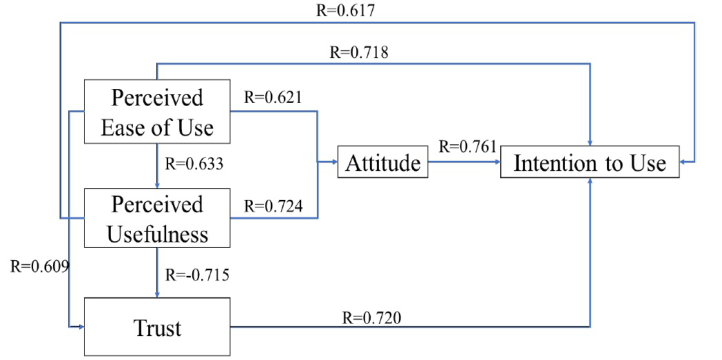
Correlation Analysis In this study, the correlations among dependent variables were analyzed using the Pearson correlation coefficient method. The findings indicate that there is a significant strong correlation (R > 0.6, p < 0.001) among the variables of perceived ease of use, perceived usefulness, attitude, intention to use, and trust. Based on the correlation coefficient analysis results, the relationships among the dependent variables are shown in Figure 2.
Figure 2: Correlation coefficients among dependent variables.
DISCUSSION AND CONCLUSION Hypothesis Testing
Based on the correlation analysis results, there is a significant positive corre- lation between perceived ease of use and perceived usefulness (R = 0.633), supporting hypothesis H1a. Moreover, there is a strong correlation between perceived ease of use and intention to use (R = 0.617), and a strong corre- lation between perceived usefulness and intention to use (R = 0.718). Thus, hypothesis H1b is also supported. Overall, under the application scenario set in this study, hypothesis H1 is supported.
The present study showed that the anthropomorphic image has a signifi- cant impact on perceived usefulness. For perceived ease of use, attitude, trust, and intention to use, whether the anthropomorphic image adopts a simpli- fied or virtual image significantly affects these variables. This indicates that hypotheses H2a and H2 are valid.
Based on the results of the correlation coefficient analysis, there exists a positive correlation between trust and intention to use (R = 0.720), and this relationship is extremely strong. Therefore, hypothesis H2b is also supported.
According to the ANOVA results for different anthropomorphic roles of IAs, anthropomorphic roles do not have a significant impact on dependent variables. Hypothesis H3 is not supported, meaning that the anthropomor- phic roles of IAs do not significantly influence user acceptance.
The Impact of Anthropomorphic Images on User Acceptance The experimental results indicate that different anthropomorphic image adopted by IAs significantly influence users’ acceptance, with users show- ing a higher acceptance rate for agents with simplified image. Furthermore, this study provided substantial evidence supporting the Uncanny Valley effect and the CPMT.
In the experiment, a strong positive correlation (R = 0.720) was observed between user trust and intention to use. This finding confirms that irre- spective of the type of anthropomorphic role an IA assumes, an overly personified state could potentially challenge users’ privacy boundaries. This challenge might instigate user concerns regarding privacy, subsequently indi- rectly impacting their subjective acceptance with highly anthropomorphic IAs.
The Impact of Anthropomorphic Roles on User Acceptance From the results, the impact of any form of intelligent agent anthropomorphic role on user acceptance appears to be quite limited. This is directly reflected in the non-significant differences observed in the ANOVA.
However, the conclusions drawn from this experiment differ from previ- ous studies in the same domain. According to the Role Design Theory (RDT) proposed by Baylor and Kim in 2005, within educational applications of IAs, the influence of different agent roles on user acceptance is significantly varied. Comparing to the educational applications, this study focuses on the user acceptance of anthropomorphic IAs within the context of dynamic travel itinerary planning. Based on this, the inference drawn from this study sug- gests that the impact of different intelligent agent personification roles on user subjective acceptance may vary significantly depending on the specific application scenario.
The Association Between Anthropomorphic Images and Roles From the results, there is no significant correlation observed between the image of intelligent agent anthropomorphic and its role on user acceptance. Therefore, in conjunction with the aforementioned conclusion, the related findings on anthropomorphic image apply universally across different intel- ligent agent roles. Specifically, regardless of the specific role adopted by an intelligent agent, adopting a more subtle degree of anthropomorphic tends to enhance user acceptance with the agent.
REFERENCES
Bandura A. The evolution of social cognitive theory[J]. Great minds in management, 2005: 9–35. Baylor A L, Kim Y. Pedagogical agent design: The impact of agent realism, gen-
der, ethnicity, and instructional role[C]//International conference on intelligent tutoring systems. Springer, Berlin, Heidelberg, 2004: 592–603. Baylor A L, Kim Y. Simulating instructional roles through pedagogical agents[J].
International Journal of Artificial Intelligence in Education, 2005, 15(1): 95.
Influence of Intelligent Agent Anthropomorphic Image and Role on User Acceptance 47
Chen Q Q, Park H J. How anthropomorphism affects trust in intelligent personal assistants[J]. Industrial Management & Data Systems, 2021, 121(12): 2722–2737. Chuttur M. Overview of the technology acceptance model: Origins, developments
and future directions[J]. 2009. Davis F D. Perceived usefulness, perceived ease of use, and user acceptance of information technology[J]. MIS quarterly, 1989: 319–340. Dellermann D, Ebel P, Söllner M, et al. Hybrid intelligence[J]. Business & Information
Systems Engineering, 2019, 61: 637–643. Demeure V, Niewiadomski R, Pelachaud C. How is believability of a virtual agent related to warmth, competence, personification, and embodiment?[J]. Presence, 2011, 20(5): 431–448. Dunn J. Social interaction, relationships, and the development of causal discourse
and conflict management[J]. European Journal of Psychology of Education, 1993, 8(4): 391–401. Friedman C. Human-robot moral relations: Human interactants as moral patients of their own agential moral actions towards robots[C]//Artificial Intelligence Research: First Southern African Conference for AI Research, SACAIR 2020, Muldersdrift, South Africa, February 22–26, 2021, Proceedings 1. Springer International Publishing, 2020: 3–20. Glikson E, Woolley A W. Human trust in artificial intelligence: Review of empirical
research[J]. Academy of Management Annals, 2020, 14(2): 627–660. Ha Q A, Chen J V, Uy H U, et al. Exploring the privacy concerns in using intelligent virtual assistants under perspectives of information sensitivity and anthropomor- phism[J]. International Journal of Human–Computer Interaction, 2021, 37(6): 512–527. Hong S, Zheng X, Chen J, et al. Metagpt: Meta programming for multi-agent
collaborative framework[J]. arXiv preprint arXiv:2308.00352, 2023. Huang H H, Mitchell V W. The role of imagination and brand personification in brand relationships[J]. Psychology & Marketing, 2014, 31(1): 38–47. Koda T. Agents with faces: A study on the effects of personification of software
agents[D]. Massachusetts Institute of Technology, 1996. Lopata H Z. Role theory[J]. Social roles and social institutions: Essays in honor of Rose Laub Coser, 1991: 1–11. Moussawi S, Koufaris M, Benbunan-Fich R. How perceptions of intelligence and
anthropomorphism affect adoption of personal intelligent agents[J]. Electronic Markets, 2021, 31: 343–364. Moussawi S, Koufaris M. Perceived intelligence and perceived anthropomorphism of personal intelligent agents: Scale development and validation[J]. 2019. Norman D A. How might people interact with agents[J]. Communications of the
ACM, 1994, 37(7): 68–71. Petronio S. Boundaries of privacy: Dialectics of disclosure[M]. Suny Press, 2002. Rhee C E, Choi J. Effects of personalization and social role in voice shopping: An experimental study on product recommendation by a conversational voice agent[J]. Computers in Human Behavior, 2020, 109: 106359. Rietz T, Benke I, Maedche A. The impact of anthropomorphic and functional chatbot
design features in enterprise collaboration systems on user acceptance[J]. 2019. Whang C, Im H. “I Like Your Suggestion!” the role of humanlikeness and parasocial relationship on the website versus voice shopper’s perception of recommenda- tions[J]. Psychology & Marketing, 2021, 38(4): 581–595. Wooldridge M. Intelligent agents[J]. Multiagent systems: A modern approach to
Read this individual research paper free through the original publisher, or explore the full digital proceedings book.
ISBN 978-1-964867-32-8
Explore this ISBN in the AHFE Bookstore ↗Listed in the July 2026 bookstore catalogue; search by ISBN to confirm current availability · Digital book purchase optional