Qichao Zhao, Han Li, Qingju Wang, Lin Shen, Ping Wu (2024). Impact of Virtual Reality Technology-Based Marketing Strategies on Consumer Shopping Decisions. In: Usability and User Experience. AHFE Open Access, vol. 156, pp. 423–434. https://doi.org/10.54941/ahfe1005453
The development of new technologies has brought forth novel modes of user shopping experiences and consumer behaviors, fostering the emergence of diverse consumption patterns. The new shopping paradigm, based on Virtual Reality technology and human-computer interaction, introduces immersive and interactive three-dimensional shopping environments, influencing consumer behavior. This study aims to explore the impact of marketing strategies on consumer shopping decisions within the context of Virtual Reality shopping technology. Through the design of virtual reality shopping tasks for 34 participants and employing intelligent wearable physiological measurement methods, coupled with subjective and behavioral performance results, we analyze the physiological experiential response characteristics and consumer decision-making behavior patterns in virtual environments. The results indicate that, in virtual shopping, shoppers' eye-tracking behavior early focuses on the lower and left areas of product shelves. Additionally, physiological data exhibit variations across different shopping stages, particularly during the transition from searching for products to selecting items, where participants show a decrease in heart rate variability and an increase in alpha power in EEG, indicating a progressively relaxed state during the shopping process. Subjective evaluations further reveal that 68% of participants express satisfaction with the shopping experience in VR supermarket scenarios. This study suggests that Virtual Reality technology, as a marketing strategy, coupled with traditional marketing features, has a significant impact on consumer shopping decisions. The findings contribute to the essential understanding of the mechanisms underlying the influence of new consumption patterns on consumer shopping decisions and their behavioral characteristics, holding significance for future in-depth exploration.
With the rapid development of computer technology, internet technology, artificial intelligence, big data analysis, and digital technology, the market’s consumption patterns are undergoing a profound transformation. The shift is
moving from traditional offline physical transactions towards a more diverse, efficient, convenient, and real-time new consumption paradigm. The primary focus of this transformation is on internet shopping, reflecting consumers’ new requirements for shopping experiences, including immediacy, interac- tivity, and a sense of participation. Internet shopping provides users with a convenient, efficient, authentic, and vivid consumption experience, expand- ing the diversity of market choices. However, this diversity also leads to the problem of product homogeneity, shifting user purchase decisions from merely based on product functionality to emphasizing the user experience during online shopping. In the context of online shopping, user experience has become a crucial factor in determining purchasing intentions. In the sit- uation of product homogeneity, the user’s experience during the shopping process becomes increasingly important. Therefore, effectively showcasing product features and providing users with a convenient product experi- ence during browsing to stimulate purchasing desires become significant challenges in product marketing in the online environment (Hua, 2014).
In the backdrop of the widespread adoption of mobile internet shop- ping, researchers have proposed characteristics such as resistance, univer- sality, scarcity, optimization, continuity, and variability in consumer online shopping behavior. These characteristics provide guiding principles for mar- keting strategies, suggesting the implementation of personalized, simplified, and comprehensive measures. Such customized strategies can better adapt to the online shopping environment, meet consumer needs, enhance user experience, and consequently foster purchasing decisions (Hua, 2014).
With the rapid development of virtual reality (VR) and augmented real- ity (AR) technologies (Liu, 2006), a new form of consumption is intro- duced to internet shopping, involving the widespread application of novel human-computer interaction technologies. This transformation profoundly changes consumers’ shopping experiences. VR/AR-based shopping intro- duces a unique consumer experience (Liao, 2022; Xi & Hamari, 2021), characterized by novelty, interactivity, and immersion, resulting in distinctive changes in consumer behavior (Liu, 2017). In a virtual supermarket, con- sumers can simulate a real supermarket shopping experience, observe and try real products, and make selections. Unlike traditional physical supermar- kets, virtual supermarkets interact with consumers through various means, satisfying their needs for novel and diversified shopping experiences, thereby enhancing the economic benefits of virtual supermarkets (Zhang, 2018). This difference has a significant impact on the final purchasing decision, mak- ing the design and selection of marketing strategies based on VR shopping supermarkets crucial.
As VR technology gains widespread application, especially in the shop- ping domain, research on VR shopping marketing strategies is garnering increased attention. Studies on college student consumers indicate that in VR consumption, perceived enjoyment, social norms, and usability signifi- cantly influence purchasing intentions, while credit preference and attention preference also contribute to facilitating purchases (Gao, 2021). In different genders, flow experience is a crucial factor influencing female users’ shop- ping intentions, while male users find it less significant (Lu & Hsiao, 2022).
Impact of Virtual Reality Technology-Based Marketing Strategies 425
The experience of interaction methods is vital for purchasing intentions, with touch simulation in VR stores positively impacting satisfaction, where self- efficacy and pleasure play mediating roles (Lee et al., 2022). Additionally, consumer evaluations of product packaging in VR align with real-world sce- narios, supporting the design of product packaging in virtual environments (Branca et al., 2022). VR-based experiential shopping, by integrating arti- ficial intelligence, big data, and cloud computing, merges the virtual world with the physical economy, boosting the desire to purchase and injecting new vitality into the consumer economy (Chen et al., 2021). However, VR shop- ping still faces challenges such as high technological development costs, issues with interactive experiences, an incomplete VR industry ecosystem, a thin industry chain, and the absence of industry standards. Particularly, there are problems with content scarcity, visual fatigue, and insufficient interaction with consumers (Gu & Yuan, 2018; Sui et al., 2022). The development of 5G and augmented reality technologies provides new possibilities to address these challenges (Yang et al., 2020; Chen et al., 2019).
Differences exist in the VR shopping experience for middle-aged and elderly individuals, where the development of navigation systems provides efficient product navigation experiences for older consumers, alleviating dizziness (Liu & Uang, 2022). The application of electroencephalograms provides an in-depth understanding of consumer decision-making informa- tion when purchasing fast-moving consumer goods (Biercewicz et al., 2022). Explorations into evaluation methods for VR shopping experiences reveal that interactivity, fun, and remote presentation are critical factors influenc- ing user experiences in immersive VR (Kim & Ha, 2021). The application of innovation diffusion theory reveals that satisfaction and flow experiences enhance user purchasing intentions, with factors related to technical features significantly influencing satisfaction (Hong & Han, 2020). These studies provide in-depth insights into the development and challenges of the new modality of VR shopping, offering valuable references for future research and practical guidance.
In this context, optimizing marketing strategies becomes a critical issue. Traditional evaluation methods primarily rely on subjective assessments, whereas in the VR-based evaluation system, multimodal evaluation methods such as physiological, eye-tracking, and electroencephalogram assessments become essential tools. The goal of this study is to leverage these multimodal evaluation methods to conduct a comprehensive assessment of marketing strategies for shelf placement in VR-based shopping supermarkets. This research aims to explore the impact of these strategies on consumer behav- ior and purchasing decisions using a more scientific and objective approach, providing robust theoretical support for VR-based shopping experiences and substantial guidance for corresponding marketing decisions.
METHODOLOGY
Participants Thirty-five participants took part in the experiment, consisting of 23 males and 12 females, with ages ranging from 18 to 35 (mean age = 27, SD = 3.35).
Participants were in good physical health conditions, including normal or corrected-to-normal vision, and without eye disorders such as astigmatism, color blindness, or color weakness. Additionally, participants were required to be right-handed. It was ensured that each participant was unaware of the research purpose before the experiment to reflect their perceptions more authentically during task execution. All participants signed informed consent forms before the experiment and received rewards after completing the study.
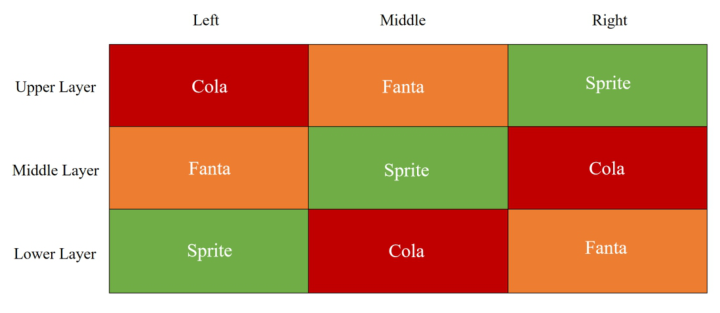
Procedure Firstly, in the experimental design, we selected shelf placement and brand of products as independent variables. By stratifying positions both vertically and horizontally and choosing three popular soda brands, we created a prototype of the target shelf. The prototype is divided into nine regions, each designated for displaying Cola, Sprite, and Fanta. Each brand occupies three regions on the shelf, as shown in Figure 1. This design is based on actual supermarket displays and a survey of relevant literature, aiming to simulate a real shopping scenario.
Figure 1: Shelf layout.
Next, in terms of the experimental setting, we utilized Unity 3D to con- struct a virtual supermarket scene. The supermarket is divided into multiple zones, with products placed on shelves or in containers within each zone, accompanied by labels displaying product names and prices. The target shelf is located on the left side of the supermarket, and participants start from the entrance, moving at a speed of 1.2m/s. The supermarket includes three soda products: Cola, Sprite, and Fanta, each displayed in different regions on the target shelf.
Finally, concerning the experimental tasks, participants were instructed to quickly locate the soda shelf in the supermarket, choose a bottle of their preferred soda for purchase, and proceed to the checkout counter. Physi- ological signal data, including electroencephalogram (EEG), electrodermal activity, electrocardiogram (ECG), and respiration, were collected during the experiment to understand participants’ physiological reactions in the virtual
Impact of Virtual Reality Technology-Based Marketing Strategies 427
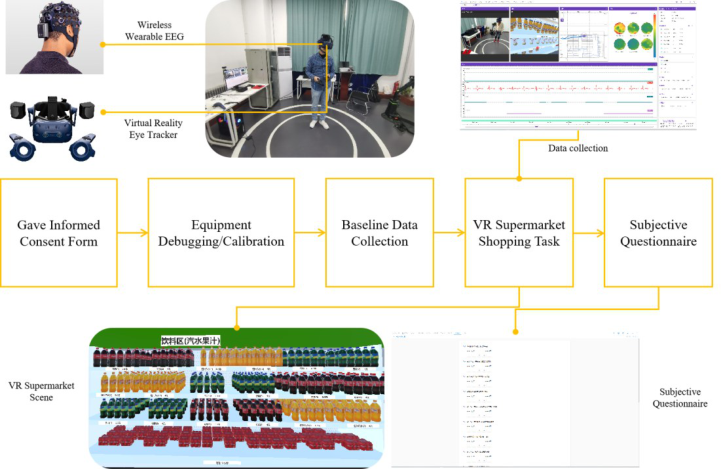
shopping environment. Before the commencement of each task, participants were asked to close their eyes and rest for 5 minutes to collect baseline phys- iological data. Upon completing the shopping, participants were required to fill out a subjective questionnaire to assess satisfaction in virtual reality shopping, The experimental procedure is illustrated in Figure 2.
Figure 2: Experiment process.
Data Recording This experiment was conducted at the Human Factors Engineering Labo- ratory of JinFa Technology Company, using the HTC Vive virtual reality headset. The headset is equipped with the HTC Vive Pro Eye virtual reality eye tracker, with a sampling frequency of 60Hz. Participants simultane- ously wore the Bitbrain EEG wearable brainwave sensor to obtain real-time EEG data at a sampling rate of 256Hz. Additionally, the ErgoLAB Chest Biosensing smart wearable chest strap sensor was worn to capture real-time electrocardiogram (ECG) and respiratory data. The experiment also utilized a Stimulus PC image display monitor for presenting stimuli to participants and included a camera to record participants’ behaviors. Software pack- ages related to stimulus presentation included Unity3D and ErgoLAB. In the experiment, the ErgoVR prototype synchronization module and ErgoVR human factors analysis engine from ErgoLAB were integrated with Unity 3D. This integration was employed to present stimuli to participants and to real-time record participants’ interaction data with the virtual environ- ment. Multimodal data collection was synchronized in real-time through the ErgoLAB synchronization module.
Data Processing and Analysis For the subjective user experience evaluation data obtained in the experi- ment, Excel software was used to perform statistical summarization of the evaluation results, excluding missing or abnormal values. The user experi- ence questionnaire used a Likert 5-point scale, scoring from strongly disagree to strongly agree, with scores ranging from 1 to 5 points. The total score was obtained by summing the scores for all questions. Ratings were assigned based on the user experience scale, as shown in Table 1. Subsequently, SPSS 22.0 software was used to conduct one-way analysis of variance (ANOVA) on the processed user experience evaluation results to investigate the relation- ship between participants’ shelf placement strategies in VR virtual shopping and subjective user experience.
For the eye-tracking, physiological, and purchase behavior data obtained in the experiment, Excel software was used for statistical summarization, excluding missing or abnormal values. Eye-tracking data utilized Areas of Interest (AOIs) to reflect participants’ attention to various products. AOIs were defined for all positions of products on the shelf using the ErgoLAB VR Plugin. The shelf was divided into nine AOIs, as shown in Figure 3. Physiological data collected included skin conductance (SC) and peak height, average heart rate variability (AVHR), average inter-beat interval (IBI), and inter-beat interval standard deviation (SDNN). SPSS 22.0 software was used to perform one-way ANOVA on participants’ eye-tracking and physiological results during different shopping stages.
For the EEG data obtained in the experiment, the ErgoLAB EEG analysis module, Matlab 2021a, and the EEGLAB toolbox were primarily used to pro- cess EEG signals, including handling artifacts and interference. In EEGLAB, electrode location information was imported, and high-pass (0.5Hz) and low- pass (45Hz) filtering were applied. EEG signals were segmented into three stages based on buying behavior, using real-time eye-tracking and VR inter- action data as indicators. The three stages were defined as follows: the first stage, from the start to the time participants found the target shelf; the sec- ond stage, from selecting a product from the target shelf; and the third stage, from picking up the selected product to reaching the checkout counter. EEG indicators, including δ, θ, α, β, and γ waves, were extracted using the Pwelch method to calculate power spectral density. Relative power values for each electrode and each rhythmic wave were obtained for each stage. SPSS 22.0 was used for one-way ANOVA. Two participants were excluded from EEG data processing due to data quality issues during the experiment.
Table 1. User experience scale rating criteria.
Table available in the original PDF paper.
Score Rating 16∼20 Very Dissatisfied 31∼44 Dissatisfied 45∼56 Neutral 57∼69 Satisfied 69∼80 Very Satisfied
Impact of Virtual Reality Technology-Based Marketing Strategies 429
RESULTS
Consumer Emotional Experience Analysis The general psychological process of consumers purchasing goods includes the process of product recognition, emotional and affective processes, as well as the process of will and decision-making. Whether consumers make purchasing decisions is influenced by the product experience process. There is a certain relationship between consumer emotional experience and their physiology. This study collected physiological data changes such as skin con- ductance, electrocardiogram, electroencephalogram, eye movement, etc., in a virtual reality environment, and analyzed consumer experience perceptions and their decision-making behavior characteristics. The consumer experience process is divided into three stages: the product area search process (from departure to finding the target shelf), the product selection process (from selecting a product from the target shelf to picking it up), and the product purchase process (from picking up the target product to checkout).
Skin Conductance Analysis Single-factor analysis of variance was conducted on the average skin con- ductance (SC) and peak height (Polar Distance) during the three stages of the shopping task. The results, as shown in the figure, indicate that there were no significant differences in SC and peak height among the three stages (F(8,15)=2.12, p=0.132).
Electrocardiogram Analysis Single-factor analysis of variance was performed on the average heart rate (AVHR), average inter-beat interval (IBI), and inter-beat interval standard deviation (SDNN) during the three stages of the shopping task. The results, as shown in Table 3, indicate that there were significant differences in AVHR (F(8,15)=3.19, p=0.023), IBI (F(8,15)=3.42, p=0.013), and SDNN (F(8,15)=3.01, p=0.036) among the three stages. Specifically, as the shop- ping process progressed, the participants’ heart rate gradually decreased, average IBI increased, and SDNN increased.
Electroencephalogram Analysis Single-factor analysis of variance was conducted on the average power data of different frequency bands of the whole-brain EEG signal during differ- ent stages, and further statistical analysis was performed on the differences in multiple EEG indicators among the three stages. The results, as shown in Table 4, indicate that the average power of δ waves in stage two was significantly lower than in stages one and three (F(8,15)=3.27, p=0.023). Significant differences were observed in the average power of θ waves and α waves between stages two and three (θ: F(8,15)=3.58, p=0.021; α: F(8,15)=2.95, p=0.032). Among multiple EEG indicators, there were no sig- nificant differences among the three stages, and the difference in θ/α between stages two and three was marginally significant (F(8,15)=2.64, p=0.049).
Consumer Attractiveness Analysis Eye movement data is an important measurement tool in consumer shopping research. By recording the subjects’ eye movements, we can gain insights into their focus, attention allocation, and decision-making processes in the shopping environment, thereby analyzing issues related to attractiveness dur- ing the shopping process. Statistical analysis was conducted on the first gaze position after participants arrived at the target shelf, which may reflect the attractiveness of specific areas. Results, as shown in Table 2, indicate that there were significant differences in the first gaze positions, with the lower left area of the shelf significantly higher than other areas. 36.3% of participants chose this area.
Table 2. Shelf first Gaze position statistics.
Table available in the original PDF paper.
Position Area Selection Percentage Left Upper Level 12.1% Left Middle Level 30.3% Left Lower Level 24.2% Middle Upper Level 6% Middle Middle Level 18.1% Middle Lower Level 3.03% Right Upper Level 0% Right Middle Level 0% Right Lower Level 0%
Consumer Subjective Satisfaction Analysis A statistical analysis was conducted on the scores of participants on the subjective user experience scale, according to the rating criteria of the user experience scale. The results, as shown in Table 3, indicate a significant dif- ference in satisfaction levels (F(8,15)=2.88, p=0.031). Specifically, 25% of participants reported a very satisfied level, 43% reported a satisfied level, 28% reported a neutral level, and 3% reported a dissatisfied level.
Table 3. Participants’ satisfaction with VR shopping experience.
In this study, a comprehensive analysis of consumers’ emotional experiences in virtual reality shopping environments was conducted using physiological
Impact of Virtual Reality Technology-Based Marketing Strategies 431
indicators such as skin conductance, electrocardiography (ECG), and electroencephalography (EEG). Although no significant differences were observed in skin conductance physiological indicators, ECG physiological indicators showed significant changes in heart rate, interbeat interval, and interbeat interval standard deviation during the shopping process. This sug- gests that consumers undergo physiological fluctuations in emotions during the shopping process, consistent with previous research on the relationship between consumer emotions and physiology (Wu et al., 2020). Previous stud- ies have shown that consumers’ emotional experiences are closely related to their satisfaction with products and purchasing decisions. Specific physiolog- ical indicators such as heart rate and skin conductance responses can reflect consumers’ preferences and emotional experiences with products. If con- sumers experience higher levels of pleasure or excitement at specific stages during the shopping process, they may be more likely to make positive purchasing decisions.
Specifically, during the product area search process, there were no sig- nificant differences observed in skin conductance average and peak height. This may indicate that in virtual reality environments, consumers do not experience significant emotional fluctuations at the skin conductance level when searching for product areas. This aligns with the idea that consumers may have more complex and individualized emotional experiences when faced with a variety of products during actual shopping. In the product selection process, significant changes were observed in ECG physiological indicators, including average heart rate (AVHR), average interbeat inter- val (IBI), and interbeat interval standard deviation (SDNN). This indicates that consumers undergo physiological fluctuations in emotions when making product selections in virtual reality shopping environments. In comparison, actual shopping may involve more sensory stimuli, leading to more complex fluctuations in physiological indicators such as heart rate and interbeat inter- val. In the product purchase process, EEG physiological indicators showed differences in the average power of different frequency bands of whole- brain EEG signals during different stages (Wu et al., 2020). This further emphasizes the diversity of consumer emotional experiences in virtual real- ity shopping environments (Smith et al., 2019). In contrast, actual shopping environments may involve more social interactions, cultural backgrounds, tactile factors, etc., leading to more complex changes in EEG physiological indicators (Wang et al., 2020).
Comparing emotional experiences at different stages can help understand which aspects of virtual shopping are more likely to trigger consumers’ excite- ment, anxiety, or satisfaction. This is crucial for the design and improvement of virtual shopping platforms. For example, if consumers have a more posi- tive emotional experience during the product selection process, the platform can enhance the overall shopping experience by strengthening interactivity and personalized recommendations during that stage. Additionally, under- standing differences in emotional experiences also helps better understand the needs and preferences of consumers in different environments, leading to more targeted sales strategies. Virtual shopping may offer more personalized and convenient shopping experiences in some aspects, and these advantages
need to be reflected and strengthened at the emotional and experiential levels. Therefore, comparing emotional experiences between virtual reality shop- ping and actual shopping is essential for substantial advancements in the virtual shopping market.
The analysis of eye-tracking data shows significant differences in the first gaze positions of participants on the target shelf, reflecting the pre- ferred browsing path of shoppers in virtual supermarkets. This is consistent with previous research results on shoppers’ preferred attention positions (Pecher & Zijlstra, 2018), indicating that in virtual reality shopping environ- ments, specific areas have a significant impact on consumer attractiveness. Consumer gaze positions and eye movement trajectories can reflect their interests and focal points on products. In actual shopping, businesses can optimize product displays to make specific areas more attractive, increasing consumers’ attention to products and promoting purchase decisions.
Consumer shopping decision analysis shows significant differences in par- ticipants’ choices regarding product brands and shelf locations, especially the Fanta area on the left-middle shelf. This indicates that the location and placement of products affect shoppers’ choices, and consumers’ preferences for specific product brands also influence their final shopping decisions. Con- sumers tend to choose positions and products from specific brands that are conspicuous and easy to pick up during the shopping process.
Previous research has emphasized the importance of environmental fac- tors in influencing shopping behavior. The layout and design of shopping environments can directly affect consumers’ shopping experiences and pur- chasing decisions. Therefore, businesses can guide consumers’ shopping paths, enhance the attractiveness of specific products, and increase the like- lihood of purchase decisions by reasonably designing shelf displays and optimizing brand displays.
The significant differences in subjective user experience suggest that shelf placement strategies have a positive impact on overall satisfaction. This aligns with previous research findings that the design of virtual shopping envi- ronments has a significant impact on user satisfaction (Szocs et al., 2023). Well-designed shelves can not only direct shoppers’ attention and behaviors but also improve the overall quality of their shopping experience. This pro- vides important insights for the design and optimization of future virtual shopping scenarios.
CONCLUSION
This study employed a within-subject experimental design, comprehensively investigating the impact of different shelf placement strategies in virtual shop- ping scenes on consumer experiences through eye-tracking, physiological, EEG data, and user subjective ratings. The experimental results revealed significant differences in emotional experiences at different shopping stages, suggesting that the virtual environment is more likely to evoke consumers’ emotional experiences when selecting products. Eye-tracking data analysis indicated that consumers in virtual shopping environments tend to focus on
Impact of Virtual Reality Technology-Based Marketing Strategies 433
the lower-left area of the shelf, revealing the unique effect of virtual shop- ping platforms in guiding attention. Consumer subjective satisfaction was also validated in virtual shopping, with a high level of satisfaction. Look- ing ahead to future research directions, in-depth exploration of the influence of different factors on emotional experiences in virtual shopping environ- ments is suggested for the design and optimization of personalized virtual shopping experiences. Future research could also compare different types of virtual shopping experiences, such as those based on head-mounted devices and desktop-based virtual shopping experiences, to investigate the impact of different technological forms on emotional experiences. Overall, this study provides profound insights into virtual shopping experiences, supporting the perspective that emerging VR marketing technologies are changing consumer shopping efficiency (Park & Park, 2009). Future research can further explore and provide more robust theoretical and practical support for the optimiza- tion and development of virtual shopping platforms (Huang et al., 2019; Chen & Zhao, 2018) based on this foundation.
ACKNOWLEDGMENT
This study was supported by the “Scientific Research Support” project pro- vided by Kingfar International Inc. Thanks for the research technical and ErgoLAB V3.0 Man-Machine-Environment Testing Cloud Platform related scientific research equipment support of Kingfar project team.
REFERENCES
Biercewicz, K., Chra˛chol-Barczyk, U., Duda, J., & Wi´scicka-Fernando, M. (2022).
Modern Methods of Sustainable Behaviour Analysis—The Case of Purchasing FMCG. Sustainability, 14, 13387. Chen, D. Z., Zheng, S. J., Wu, J. W., Chen, Z. M., Wu, K. X., & Lin, J. H. (2019).
Market development prospects and strategies for “VR+ shopping”. Science and Technology Wind, 33, 200–201. Chen, M. J., Du, J. Y., & Chen, B. Y. (2021). Analysis of the current situation and challenges of VR shopping. Today’s Fortune (China Intellectual Property), 5, 135–136. Chen, Y., & Zhao, S. (2018). An Integrated Study of Shopping Experience in Physical
Stores: The Role of Mixed Reality Technology. Journal of Interactive Marketing, 43, 1–16. Gao, X. Q. (2021). Factors influencing purchasing intentions of college students in the “VR+ online shopping” mode. Forum on Knowledge Management, 6(04), 181–192. Gu, G. S., & Yuan, Y. X. (2018). Issues and solutions in Alibaba’s use of VR
marketing. China Market, 15, 127–130. Hong, S., & Han, S. L. (2020). A Study of the Effect of Shopping Experience in Virtual Reality and Augmented Reality on Consumer Decision Making: Analysis of Mediating Effect of Perceived Value. Korea Business Review, 24, 173–187. Hua, Z. C. (2014). Analysis of consumer online shopping behavior in the era of
mobile internet. [Doctoral dissertation, University of International Business and Economics].
Huang, L., Lin, Y., & Yang, C. (2019). The Impact of Social Factors on Consumers’ E-Shopping Effectiveness: A Contemporary Analysis. Cyberpsychology, Behavior, and Social Networking, 22(9), 606–613. Kim, J., & Ha, J. (2021). User Experience in VR Fashion Product Shopping: Focusing
on Tangible Interactions. Applied Sciences, 11, 6170. Lee, H. K., Yoon, N., & Choi, D. (2022). The effect of touch simulation in virtual reality shopping. Fashion Text, 9, 34. Liao, F. (2022). A comparison of consumer experiences in VR shopping and
traditional e-commerce scenarios. China Quality Supervision, 05, 84–85. Liu, C. L., & Uang, S. T. (2022). The Cross-Zone Navigation and Signage Systems for Combatting Cybersickness and Disorientation in Middle-Aged and Older People within a 3D Virtual Store. Applied Sciences, 12, 9821. Liu, Q. Y. (2017). Reflections on the measures of introducing VR technology on
internet shopping platforms. Electronic World, 24, 156+158. Liu, Y. Z. (2006). A brief analysis of virtual reality technology. Journal of Liaoning University of Science and Technology, 4, 5–6. Lu, X., & Hsiao, K. L. (2022). Effects of diffusion of innovations, spatial presence,
and flow on virtual reality shopping. Frontiers in Psychology, 13, 941248. Luo, Y., Li, Q., & Zhang, M. (2021). EEG alpha and theta oscillations in cognitive control and task switching: A review. Brain Research, 1749(C), 146–163. Park, M., & Park, J. (2009). Exploring the influences of perceived interactivity
on consumers’ e-shopping effectiveness. Journal of Customer Behaviour, 8(4), 361–379. Pecher, D., & Zijlstra, W. (2018). The influence of advertisement originality and familiarity on brand attention and memory. Journal of Marketing Research, 55(5), 667–685. Smith, M. E., Gevins, A., & McEvoy, L. (2019). Using high-resolution EEG mapping
to understand cognitive and affective processing. Brain Topography, 32(1), 54–75. Sommer, R. (2019). Social facilitation effects in shopping behavior: The role of social influence and self-image congruity. Environment and Behavior, 51(6), 690–710. Sui, Q., Sui, L., Dong, Z., & Lu, K. (2022). Research on the Design of VR Tourism
Service System Based on Deep Learning and Emotional Experience. Mathematical Problems in Engineering, 2022, 1–8. Szocs, C., Kim, Y., Lim, M., Arroyo Mera, C., & Biswas, D. (2023). The store of the future: Engaging customers through sensory elements, personalized atmospherics, and interpersonal interaction. Journal of Retailing, 2023, ISSN 0022–4359. Viberg, O., & Gronlund, A. (2013). Cross-cultural analysis of users’ attitudes toward
the use of mobile devices in second and foreign language learning in higher education: A case from Sweden and China. Computers & Education, 69, 169–180. Wang, P., Zhou, T., & Chen, D. (2020). Mapping cortical activation related to working memory: Benefits of high-resolution EEG. Brain Imaging and Behavior, 14(2), 369–385. Wu, J., Zhang, H., & Zhou, X. (2020). The role of the autonomic nervous system in
emotion regulation: A review. Biological Psychology, 116(1), 107–132. Xi, N., & Hamari, J. (2021). Shopping in virtual reality: A literature review and future agenda. Journal of Business Research, 134, 37–58. Yang, Y. Z., Wen, F. X., Yang, S. Y., Zheng, Y., & Tang, S. Y. (2020). New experiences
in online shopping: A study on the innovative development of AR+VR shopping. Henan Science and Technology, 14, 24–26. Zhang, S. D. (2018). Study on the disruptive impact of VR virtual reality technology on internet shopping. Science and Technology Wind, 13, 54. Zheng, Y., Sui, L., Dong, Z., & Lu, K. (2022). Research on the Design of VR Tourism
Service System Based on Deep Learning and Emotional Experience. Mathematical Problems in Engineering, 2022, 1–8.
LISTED IN THE AHFE DIGITAL BOOKSTORE CATALOGUE
Explore the complete digital volume
Usability and User Experience
Read this individual research paper free through the original publisher, or explore the full digital proceedings book.
ISBN 978-1-964867-32-8
Explore this ISBN in the AHFE Bookstore ↗Listed in the July 2026 bookstore catalogue; search by ISBN to confirm current availability · Digital book purchase optional