It is known that emotional maturity and its features are closely integrated with various properties, processes, states, and qualities in the human psyche, performing an important evaluative and regulatory functions. Such functions acquire a special role when a person is experiencing war related stresse. This work investigates how emotional maturity is manifested in civilians suffering from various military operations related stresses. The following tasks were solved: first, to generalize and clarify data on emotional maturity and the characteristics of stress perception; second, to empirically investigate the characteristics of emotional maturity, including its features and the manifestation of stress in people suffering from war related conditions. Our hypothesis was that there are complexes of various properties of emotional maturity, among which there are leading ones that can characterize specifics of a person's perception of certain levels of stress. Determining and taking into account the latter can contribute to an adequate approach to finding means of prevention and psychocorrection of stress, as well as conditions for the development of emotional maturity.It was shown that an integral assessment of the content of emotional maturity can be carried out on the basis of such features as: first, introextensiveness, extraexpressiveness and general expressiveness; second, introself-regulation, extraself-regulation and general self-regulation; third, introempathy, extraempathy and general empathy. When understanding stress, assessments of its perception, overexertion, resistance, stress resistance can be important. When solving the second task, based on a survey of 69 people aged 21 to 45, two groups were distinguished: those who had a high level of stress (52.3%) and those who had mainly an average level of its manifestation (47.5%). The difference in all stress indicators between the groups was statistically significant (P<0.05). Similar differences in emotional maturity indicators according to its full features were also found.Based on the correlation analysis in the group of people with a high level of stress, the complex included indicators characterizing the connections are: stress resistance with perception, overexertion and resistance at the level of (P <0.05); extraso-regulation, as well as self-regulation with the perception of stress (P < 0.01). Based on the above, it can be assumed that in people with a high level of stress, the complex of properties that can characterize their emotional maturity includes a high level of extra-self-regulation and average self-regulation, where the latter is the leading one in this complex. In the group with a predominantly average level of stress, relationship was found between stress resistance and intro-self-regulation, self-regulation, and the integral indicator of emotional maturity at the level ((P< 0.01). There were also relationships at the level (P <0.01) of the indicator of stress perception with intro-empathy, empathy, and general emotional maturity, which is the leading one in this complex (P<0.05). Taking into account the specifics of the described complexes and the leading ones among them that characterize emotional maturity can serve as the basis for an adequate selection of means of prevention and psychocorrection of stress in people suffering from war related conditions.
Understanding of specific manifestation of emotional properties in people who have experienced various stresses is a highly relevant issue in modern psychology. That is why in our research we aimed to investigate how different stresses are perceived by civilians in war related conditions, taking into account levels of their emotional maturity.
To achieve this goal, we set the following tasks: first, to summarize the state of knowledge regarding the features of emotional maturity of the individual and the specifics of stress perception; second, to empirically investigate the characteristics of emotional maturity and its main traits, as well as the specifics of stress that civilians are suffering when their country is in war.
In this regard, we proceeded from the hypothesis that there is a complex of various properties of individual emotional maturity, among which there are leading ones that can characterize the specifics of a person’s perception of certain levels of stress. Defining and considering these can contribute to a more adequate approach in the search for means of prevention and psychocorrection of stresses, as well as conditions for the development of emotional maturity (Chebykin and Balashenko, 2024).
Solving the first task, it was established that emotional maturity integrates with all processes, states, and properties of a person and is a relatively stable property of personality. In most studies, this property is predominantly accompanied by a description of typical traits inherent in a mature person. However, the definition and structure of this phenomenon remain controversial (Chebykin and Pavlova, 2009; Chudina, 2003). In addition to the above, some works provide separate characteristics or components related to emotional maturity, which can be attributed to other manifestations (Lazurenko, 2014; Shtepa, 2005).
Summarizing these and other studies, in this work we will adhere to the definition of emotional maturity within the personal and interpersonal levels of manifestation, relating it to a purely emotional phenomenon, where the key components are expressiveness, self-regulation, and empathy within the traits of intro- and extra-effects by directionality (Chebykin, 2023; Chebykin and Kosyanova, 2024).
This paper concentrates on a more complex problem in modern psychology which is the numerous methodological approaches to understanding the content of stress, its levels, and the signs (Hans Selye 2016; Baburak, Hutsman, 2017). Summarizing these and other approaches, in our work we will rely on the key features of stress. Namely, its perception, overstrain, resistance, and the degree of ability to resist stress.
RESULTS AND DISCUSSION
The appropriate methodologies were chosen for the study: the stress perception scales (Cohen, Kamarck, Mermelstein, 1983); the emotional maturity methodology (Chebykina, 2023); the stress resistance assessment methodology (Holmes, Rahe, 1967). The proposed methodologies allowed for the identification and quantitative assessment of 14 indicators: stress perception (P1), overstrain (P2), stress resistance (P3), stress
resilience (P4); the overall emotional maturity indicator (P14) and its main traits: introexpressiveness (P5), extroexpressiveness (P6), overall expressiveness (P7); introself-regulation (P8), extraself-regulation (P9), overall self-regulation (P10); introempathy (P11), extroempathy (P12), overall empathy (P13).
The preliminary analysis of primary and secondary data, based on the diagnosed indicators among 69 examined individuals 19 to 40 years old suffering from the state of war, allowed us to conditionally distinguish two groups. The first group consists of individuals who predominantly exhibited an elevated level of stress (52.5%) and the second group predominantly exhibited a moderate level of stress (47.5%).
As a result of the statistical analysis of the obtained results, statistically significant differences were established based on stress indicators, namely: perception of stress (P1), overstrain (P2), stress resistance (P3), and the ability to resist stress (P4) at a level (p < 0.01) between the specified groups (see Table 1).
Furthermore, analyzing the provided data comparing the characteristics of emotional maturity, significant discrepancies were also recorded at the level of statistically significant difference (p < 0.05 and p < 0.01). Predominantly, in this case, the indicators of emotional maturity were found to have elevated stress levels at lower manifestation compared to the group with moderate stress levels (see Table 1). Such results may indicate that individuals with elevated stress levels exhibit lower level of emotional maturity than those with moderate stress levels.
Table 1: Statistically significant differences in diagnosed indicators of emotional maturity between groups of subjects with a predominance of elevated and average stress manifestation.
Table available in the original PDF paper.
Indicators Group A Group B Significance of Differences M Sigma P25 P50 P75 M Sigma P25 P50 P75 U p
P1 18,48 3,88 16 73 21 10,79 2,92 9 11 14 0 p < 0.01 P2 12,81 2,64 11 13 15 6,95 2,84 5 7 10 17 p < 0.01 P3 5,71 1,71 4 6 6 3,84 1,21 3 4 5 75 p < 0.01 P4 444,33 195,92 332 416 532 253,68 155,54 132 241 300 86,5 p < 0.01 P5 4,71 0,96 4 5 5 5,37 0,76 5 5 6 118,5 p < 0.05 P6 3,67 1,24 3 4 5 4,11 1,15 3 4 5 158,5 p < 0.05 P7 8,38 1,72 8 9 10 9,47 1,47 9 10 11 124,5 p < 0.05 P8 3,57 1,21 3 4 5 3,95 1,27 3 4 5 172,5 p < 0.05 P9 4,86 1,28 4 5 6 5,05 1,51 5 6 6 164,5 p < 0.05 P10 8,43 1,99 8 8 10 9,05 2,07 8 9 11 156 p < 0.05 P11 4,24 1,30 3 4 6 5,26 0,73 5 5 6 106,5 p < 0.05 P12 3,95 1,50 3 4 5 4,63 1,12 4 5 6 148,5 p < 0.05 P13 8,19 2,02 7 8 10 9,89 1,59 8 10 11 100,5 p < 0.01 P14 24,95 3,61 24 26 27 28,37 4,21 28 30 31 81,5 p < 0.01 Notes. M – Mean value — the arithmetic average of the indicator in the respective group; σ – Standard deviation — a measure of the spread of values around the mean; P25 – 25th percentile — the value below which 25% of the data falls (lower quartile); P50 – 50th percentile or median — the value that divides the sample in half; P75 – 75th percentile — the value below which 75% of the data falls (upper quartile). U – Mann–Whitney U value — used to statistically compare two independent samples. p – Level of statistical significance — indicates the probability that the difference between groups is not due to chance; U criterion (19; 21; 0.05) = 138; U criterion (19; 21; 0.01) = 113.
Emotional Maturity and War-Related Stress 57
Group A, in which stress indicators were predominantly recorded at a high level of manifestation. Group B, in which stress indicators were predominantly recorded within the average levels of manifestation.
In order to determine the extent to which emotional maturity indicators are related to stress data, a correlation analysis was conducted. Its results confirmed that there are quite strong correlation between the data and stress indicators among the overall sample of subjects. Notably, the ability to resist stress correlates with almost all of its other indicators. Specifically: with the characteristics of stress perception (P1), overstrain (P2), and stress resistance (P3) at the level of (p < 0.05). In turn, stress perception (P1) has negative correlations with: introexpressiveness (P5), expressiveness (P7), self- regulation (P10), intro-empathy (P11), extra-empathy (P12), empathy (P13), and the overall indicator of emotional maturity (P14) at the levels of (p < 0.05 and p < 0.01). Overstrain (P2) has similar connections to a somewhat lesser extent (see Table 2). Explaining the latest results regarding the mentioned interconnections, it can be said that such data on emotional maturity are quite sensitive to changes. And in the event of their occurrence, their position in the correlation structure may change.
Table 2: Correlation of the studied indicators in the overall sample.
Note: This table presents only statistically significant estimates of Spearman’s rank correlation coefficient; the correlation is statistically significant at the level of *p < 0.05; at the level of **p < 0.01. *** - There was no statistically significant correlation between those pairs of indicators.
Interestingly, in the group with a high level of stress, the leading emotional characteristics are the relationship of the ability to resist stress (P4) with perception (P1), overstrain (P2), and resistance (P3) at the level of (p < 0.05), extrastress regulation (P9) with overstrain (P2) (p < 0.01), as well as self-regulation (P10) with stress perception (P1) (p < 0.01) (see Table 3).
Table 3: Correlational of the studied indicators in a group with predominantly elevated stress levels.
Based on the above, it can be assumed that individuals with high levels of stress possess a set of characteristics that may define their emotional maturity, which includes a high level of extraself-regulation and average self-regulation.
Considering the correlation in a group with predominantly average stress levels, relationships were found between stress resistance (P3) and intro self- regulation (P8), self-regulation (P10), and the overall indicator of emotional maturity (P14) at the level of (p < 0.01). Correlation of the stress perception indicator (P1) with introempathy (P11), empathy (P13), and the overall indicator of emotional maturity (P14) were also noted at levels (p < 0.01 and p < 0.05) (see Table 4).
Table 4: Correlation of the studied indicators in a group with predominantly average stress levels.
Based on the above results, it should be noted that both stress indicators and emotional maturity indicators allow for the differentiation of individuals with various levels of stress. The identified correlation, both in the overall sample and separately in groups with predominantly high and medium levels of stress, allow for the highlighting of certain data on emotional maturity and its traits, including the leading ones that can significantly identify the specifics of the personal characteristics of the examined subjects. The consideration of the latter indicates that among the identified complexes inherent to the examined groups, there are both common and distinct positions regarding emotional maturity. The common ones are the values of self-regulation indicators.
Distinctively, in the group with predominantly high levels of stress, this complex includes data from two emotional maturity indicators that characterize such traits as extra self-regulation and self-regulation, where the latter is the leading one.
While in the group with predominantly average levels of stress manifestation, this complex includes five indicators, namely: high values of extra self-regulation, intro-empathy, empathy, and average values of intro- self-regulation. The overall indicator of emotional maturity is the leading one in this complex.
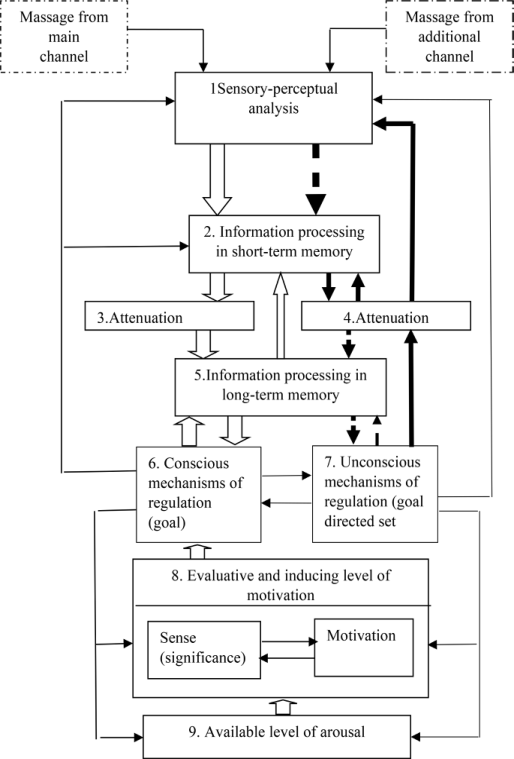
The self-regulation model of attention below (see Figure 1) describes the mechanisms of information processing, and how they affect allocation of attention and conscious and unconscious mechanisms of self-regulation. Blocks 2 through 7 reflect how these processes interact. Knowledge of these processes and their relationship allow to help the individuals affected by the war-related conditions and to understand their emotional reactions (Block 8).
Emotional Maturity and War-Related Stress 59
The presented model reflects how information is received, processed and stored in memory. Study of the cognitive processes in the framework of the Systemic Structural Activity Theory (SSAT) is important for the understanding of the war-related experiences of the individuals and their cognitive and emotional issues in developing the mechanisms that regulate the allocation of their psychic resources.
Figure 1: Self-regulation model of attention (Bedny and Bedny, 2019).
Considering these and other results may contribute to a more adequate approach for selecting the necessary techniques or methods, both for prevention and psychological correction of stress states in civilians suffering from wartime conditions and for the development of their emotional maturity.
CONCLUSION
Based on the conducted research, the following conclusions can be drawn.
Emotional maturity and its traits play an important evaluative and regulatory function in human activity. Understanding the mechanisms and levels of stress manifestations in people suffering from military actions can be particularly significant.
The overall assessment of emotional maturity can be carried out based on such traits as: first, introextensiveness, extraversion, and overall expressiveness; second, introspective self-regulation, extrinsic self-regulation, and overall self-regulation; third, intro-empathy, extra-empathy, and overall empathy.
When recognizing stress, it is important to assess its perception, overstrain, resistance, as well as stress resilience.
It has been established that among most civilians suffering from martial law, stress is recorded at high (52.5%) and medium levels (47.5%).
It has been established that the specific set of properties of emotional maturity that can characterize individuals with a high level of stress manifestation such as extrinsic self-regulation and self-regulation, where the latter is predominant. In individuals with predominantly medium stress manifestation, the set of properties of emotional maturity includes introspective self-regulation, self-regulation, intro-empathy, empathy, and the overall indicator of emotional maturity, which is predominant in this set.
Relying on such characteristics of the manifestation of the mentioned properties of emotional maturity, taking into account the specifics of stress expression, can be an important step in selecting adequate approaches for its prevention and correction for the civilian population in war related conditions.
REFERENCES
Ananyev B. H. (1980) Selected Psychological Works: Pedagogy, p. 232. Bamburak N. M., Hutsman M. S. (2017) Dynamics of Subjective Experience of Stress by the Individual. Scientific Bulletin of the Lviv State University of Internal Affairs. Psychological Series, Issue 1. pp. 143–151. Bedny, G., Bedny, I. (2019) Work Activity Studies Within the Farmwork of
Ergonomics, Psychology, and Ergonomics, CRC Press, pp. 154–155. Chebykin O. (2009) The Formation of Emotional Maturity of the Individual: Monograph: SVD Cherkasov, pp. 230. Chebykin O. (2023) Experimental Study of the Emotional Sphere of Children,
Adolescents and Early Adulthood in Ukraine. Routledge. Taylor & Francis Group. London and New York. p. 278. https://doi.org/10.4324/9781003330943 Chebykin, O., Zhuravlova L. (2021). The Development of Empathy: Phenomenology, Structure and Human Nature. Routledge; 1st edition (June 29, 2021). p. 264. https://doi.org/10.4324/9781003145370. Chebykin, O., Kosyanova, O. (2024) Emotional Development and Youths’ predisposition an experimental study the polygraph method. Taylor & Francis Group. London and New York. p. 165. https://doi.org/10.4324/9781003483830 Chebykin, O., Balashenko, Ya. (2024) Individual-oriented system of laughter therapy for the emotional health of military personnel using electronic gadgets. Science and Education. No. 2, pp. 80–91.
Emotional Maturity and War-Related Stress 61
Chudina O. A. (2003) Emotional maturity of the individual: definition of the concept and highlighting criteria: Collection of works by young scientists / ed. O. A. Chudina. – Moscow: Institute of Psychology of the Russian Academy of Sciences, pp. 112–116. Cohen S., Kamarck T., (1983) Mermelstein R. A global measure of perceived
stress. J Health Soc Behave. Dec; 24(4): 385–96. PMID: 6668417. https://doi.org/10.24195/2414-4665-2024-2-11://doi.org/10.24195/2414-4665- 2024-2-11 Holmes, T. H., Rahe, R. H. (1967) The social readjustment rating scale, Journal of Psychosomatic Research, Volume 11, Issue 2. Lazurenko O. (2014) On the Problem of Defining the Content of Emotional
Competence: Youth and the Market, No. 2. pp. 124–130. Pavlova I. H. (2003) Emotional maturity and its main components: Scientific Bulletin of K. D. Ushinsky University. No. 5–6. pp. 107–116. Shtepa O. S. (2005) The Phenomenon of Personal Maturity: Social Psychology.
No. 1(9). pp. 62–77.
LISTED IN THE AHFE DIGITAL BOOKSTORE CATALOGUE
Explore the complete digital volume
Neuroergonomics and Cognitive Engineering
Read this individual research paper free through the original publisher, or explore the full digital proceedings book.
ISBN 978-1-964867-43-4
Explore this ISBN in the AHFE Bookstore ↗Listed in the July 2026 bookstore catalogue; search by ISBN to confirm current availability · Digital book purchase optional