Lydia Petersen, Joe Bible, Abhijit Kshirsagar, Lee Sierad, Ravikiran Singapogu (2025). Examining the Efficacy of an Improved CanSim for Quantifying Hemodialysis Cannulation Skills. In: Healthcare and Medical Devices. AHFE Open Access, vol. 171, pp. 32–38. https://doi.org/10.54941/ahfe1006188
Cannulation of a patient’s vascular access is a daily requisite procedure for initiating hemodialysis for those with End-Stage-Kidney Disease. Skills training and assessment for hemodialysis cannulation needs attention; currently, trainees lack effective teaching tools and practice on patients—leading to stress for the cannulator and potentially multiple attempts with pain and infiltration (extravasation of blood into soft tissue) for the patient. We created a cannulation simulator (CanSim) with the goal of measuring cannulation skill and tested the hypothesis that the simulator’s process metrics are able to predict cannulation outcomes on the simulator. Data collected on CanSim from a recent study with improved simulation technology was compared with a previous dataset collected on an earlier prototype. Multiple sensors were used to measure different aspects of cannulation behavior and outcome on the simulator. The infiltration rate on the improved system was less than half that of the previous prototype (20% v 53%). Additionally, only one trial included an extra attempt (1.4%) in the new group, with 15% requiring more than one attempt on the older simulator. Analysis of performance metrics revealed key predictors of successful cannulation, specifically shallower insertion angles. These results could inform design of objective, reproducible cannulation training for providers in a safe, simulated environment.
Hemodialysis, a life-sustaining treatment for patients with End-Stage- Kidney-Disease (ESKD), relies heavily on being able to reliably access a patient’s vascular system. Cannulation, the process of inserting two large- bore needles into a vascular access, is a critical and technically demanding procedure that must be performed at every dialysis treatment. Successful cannulation requires a high level of skill to minimize patients’ pain and complications like infiltrations (puncturing through the vessel), bleeding, aneurysms, infection, and thrombosis (Lok et al., 2020; Lee et al., 2006) that ultimately reduce the life of the vascular access.
Cannulation training has traditionally used hands-on experience with patients. This approach presents several significant drawbacks. Firstly,
trainees practicing on patients inevitably encounter steep learning curves, leading to potential complications and increased patient discomfort. Secondly, performing cannulation on a human subject for the first time is inherently stressful, potentially impacting performance and increasing the risk of errors. Finally, traditional skills assessments for trainees rely on subjective evaluations by experienced clinicians, leading to potential biases and variability of skill assessment. To address these limitations, there is a critical need for effective training tools that allow for safe and controlled skill development with objective performance assessment that minimizes variability.
This study uses CanSim, a novel cannulation simulator designed to replicate the key aspects of the cannulation procedure. CanSim aims to provide a safe and realistic environment that allows cannulators to assess and train their skills without the risk of patient harm. One goal of CanSim is to enable objective performance measurement by capturing key outcome and process metrics.
An early prototype of CanSim was used to demonstrate the utility of the simulator to accurately distinguish between high and low-performing cannulators. Since that time, the simulator has gone through a series of improvements to increase the reliability and accuracy of the system. A new research version of the simulator was used to collect a recent dataset.
This research demonstrates the new methods that have been developed to increase accuracy of CanSim and investigates the hypothesis that CanSim’s process metrics can predict outcome performance on the improved simulator. The findings of this study have the potential to significantly impact cannulation training for hemodialysis by providing an instrument for skill development with objective and reproducible metrics assessment. Ultimately, by reducing variability in training, we could see improved patient safety and health outcomes.
MATERIALS AND METHODS
All participants provided informed consent prior to participation. The study protocol was reviewed and approved by the Clemson University institutional review board (IRB).
Data were collected on a novel cannulation simulator, CanSim. A group of 14 active cannulators in dialysis clinics performed cannulation on the advanced system for a total of 71 trials. Metrics and performance on this new system were compared to metrics calculated from 51 users on a previous prototype (Liu et al., 2021).
CanSim Simulator CanSim incorporates simulated arteriovenous fistulas (sAVFs) on a realistic arm-shaped bed, which are fabricated using custom-designed molds and tissue-mimicking silicone (EcoFlex-20, SmoothOn Inc.).
An early prototype of CanSim included a flat round bed with the fistulas embedded in foam (Petersen et al., 2022). However, to enhance realism and reliability, significant advancements have been made to both the simulator
bed and fistula modules. The new arm-shaped bed facilitates more natural needle placement compared to the previous flat-bed design. Furthermore, new fistula geometries were created based on three-dimensional ultrasound scans of an actual patient fistula. These data were used to create a range of modeled geometries with varying shapes, sizes, and depths, encompassing a wider spectrum of typical fistula characteristics. From these designs, new molds were printed to create the sAVFs which also incorporated an improved infiltration detection method for back-wall infiltrations, featuring improved cross-sectional geometries to ensure accurate detection of the needle within the fistula.
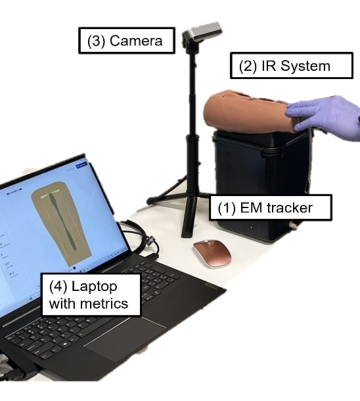
To assess cannulation performance, the research CanSim device integrated multiple sensors. A trakSTAR motion tracker embedded within the needle captured real-time trajectory data in three-dimensional space. A custom infrared (IR) emitter-detector system was created to provide real-time feedback and was the basis for determining outcome on the simulator. Finally, a camera recorded each cannulation attempt for later review. Custom software was used for sensor fusion from the various data sources in near real-time, calculating key performance metrics for each trial (Liu et al., 2021; Singh et al., 2021; Zhang et al., 2023).
Figure 1: Advanced CanSim with (1) an electromagnetic (EM) tracking system, (2) a custom IR system, (3) a camera, and (4) a laptop to display the outcome to the user.
Experimental Protocol On the improved simulator, each user performed a minimum of four cannulation trials on two fistula geometries (one straight and one curved geometry). Users were instructed to insert the needle as they would in the clinic. After a user completed a cannulation trial, the software calculated the process and outcome metrics for the trial to be displayed on a custom graphical user interface (GUI), which the user could observe before the next cannulation trial.
Examining the Efficacy of an Improved CanSim 35
Table 1: Select CanSim metrics.
Table available in the original PDF paper.
Metric Explanation PL1 The total path length traveled by the needle tip ldljPL1 Log Dimensionless Jerk is a measure of motion smoothness Angle02 The initial angle of insertion at the beginning of needle insertion Angleu2 The average angle of the needle during cannulation ocScore1 A composite outcome metric measuring a trial on CanSim infil1 A binary outcome of whether infiltration was detected num_att1 A count of the number of needle insertion attempts in one trial ME The ratio between the start and end points and the PL
1Defined in Liu et al., 2020 2Defined in Zhang et al., 2023 Data Analysis
To identify what process metrics are useful for predicting outcome performance, two regression models were created. Before creating the models, the metrics were standardized to a mean of 0 and a standard deviation of 1. The first was a linear regression model to predict the aggregate outcome score ocScore (Liu et al., 2021), while the second was a logistic regression model with the target of inference being the probability of the occurrence of infiltration. Stepwise AIC was used for feature selection in order to avoid overfitting of the data. The adjusted R-square was used to assess the accuracy of the model.
RESULTS AND DISCUSSION
To verify that the physical changes to the simulator created a more realistic and reliable system, we first observed outcomes on the simulator from two different datasets on the two simulators and compared the infiltration rate and need for multiple attempts to what is found in literature. The infiltration rate on the new simulator was less than half that on the previous prototype (20% vs. 53%, respectively). Additionally, only one trial from the recent group included an additional attempt (1.4%), while 15% of the previous group’s trials required more than one attempt. Therefore, not only did the new simulator allow users to accurately identify and cannulate the simulated fistulas, they were able to do so with fewer errors. It is to be noted that 20% of the trials from the recent dataset resulted in infiltration, which is higher than one might expect from practicing cannulators. However, this aligns with research that states that up to 50% of cannulations result in minor infiltration (Lee et al., 2006). The previous dataset falls outside even the upper limit of this range with 53% of the trials detecting infiltration. It is also expected that the rate of needing more than one attempt would be low on the simulator since at this time the fistulas used are relatively simple to cannulate.
The results of fitting a linear regression model to predict ocScore using simulator metrics are shown in Table 2. These results were obtained by Backward selection (threshold of p-value <0.05). The final selected model includes four metrics and has an R2 of 0.3.
For the infiltration as an outcome investigation, univariate logistic regressions were fitted for each metric using an indicator of infiltration as the outcome. These results, presented in Table 3, indicate that two of the simulator metrics significantly impact the probability of infiltration, i.e., Angle0 and Angleu. Both of the fitted coefficients are positive and significantly different than zero, indicating that as these angles increase, the probability of infiltration increases.
Note: Significant results are bolded Better outcomes on the simulator are correlated with shallower angles (average angle, Angleu) when inserting the needle. By using a shallow angle, the cannulator may be less likely to infiltrate through the vessel since they have more space to advance the needle without hitting the back wall. While not demonstrating significance in this study, the time the needle is under the skin (Timeu) and total path length traveled by the needle tip (PLu) are potentially valuable metrics for identifying skill, since a high path length or time could mean that the cannulator was not able to immediately locate the fistula, requiring digging in the skin (which is painful for a patient) or that they inserted the needle deep into the fistula, increasing the likelihood of infiltrating. The #AngleChanges metric calculates the number of times that the needle changes direction in a trial. This may be a measure of identifying needle digging (Zhang et al., 2023). Other statistical velocity measures:
Examining the Efficacy of an Improved CanSim 37
standard deviation (sdV), average absolute difference (aadV), average root square (arsV), and average root difference (ardV), can be seen as different ways to measure the variability of velocity during a trial. Finally, motion smoothness metrics include the log-dimensionless-jerk of path length (ldljPL) and spectral arc length of velocity (sparcV) (Singh et al., 2021).
Overall, these results demonstrate the effectiveness of the simulator enhancements in improving realism and simulator usefulness. The identified performance metrics provide valuable insights for developing targeted training strategies and assessing individual cannulation skills.
CONCLUSION
Our findings demonstrate that the enhancements to CanSim significantly improved its realism and utility as a skill assessment tool. The infiltration rate decreased substantially compared to the previous prototypes, aligning more closely with real-world cannulation data. Preliminary analysis of performance metrics revealed key predictors of successful cannulation, including shallower insertion angles. These findings provide valuable insights for developing targeted training strategies and assessing individual cannulation skills.
A limitation of this investigation is that data collected for this study using the new simulator were collected on a relatively small number of clinicians while they were actively working in a clinical setting, thus are expected to exhibit relatively high cannulation skills. With a larger dataset on the new simulator, including a wider variety of skill represented, we expect that more of the metrics would demonstrate predictive capabilities in these models.
By quantifying performance metrics, CanSim overcomes the limitations of subjective evaluations by clinicians, that can be prone to bias and variability. The simulator has potential to significantly improve training programs by providing an objective assessment to cannulation skills. These results could inform objective human factors-informed training in a safe, simulated environment for a skill critical for initiating hemodialysis.
Improving cannulation skills may lead to measurable improvements in patient-reported symptoms and outcomes. For example, decreased access- related pain can lead to improved compliance with treatments, leading subsequently to reduced morbidity and mortality. The financial implications of prolonging vascular access durability may also be great, with less frequent procedures, revisions, and new surgeries.
ACKNOWLEDGMENT
The authors would like to acknowledge all individuals previously involved in CanSim research.
REFERENCES
Coventry, L. L. et al. (2019) ‘Variables associated with successful vascular access cannulation in hemodialysis patients: A prospective cohort study’, BMC Nephrology, 20(1), p. 197. Available at: https://doi.org/10.1186/s12882-019- 1373-3.
Lee, T., Barker, J. and Allon, M. (2006) ‘Needle Infiltration of Arteriovenous Fistulae in Hemodialysis: Risk Factors and Consequences’, American Journal of Kidney Diseases, 47(6), pp. 1020–1026. Available at: https://doi.org/10.1053/j.aj kd.2006.02.181. Liu, Z. et al. (2021) ‘Measuring Cannulation Skills for Hemodialysis: Objective
Versus Subjective Assessment’, Frontiers in Medicine, 8, p. 2291. Available at: https://doi.org/10.3389/fmed.2021.777186. Lok, C. E. et al. (2020) ‘KDOQI Clinical Practice Guideline for Vascular Access: 2019 Update’, American Journal of Kidney Diseases, 75(4), pp. S1–S164. Available at: https://doi.org/10.1053/j.ajkd.2019.12.001. Petersen, L. et al. (2022) ‘Simulator-Based Metrics for Quantifying Vascular
Palpation Skill for Cannulation’, IEEE Access, 10, pp. 66862–66873. Available at: https://doi.org/10.1109/ACCESS.2022.3184303. Singh, S. et al. (2021) ‘Motion Smoothness Metrics for Cannulation Skill Assessment: What Factors Matter?’, Frontiers in Robotics and AI, 8, p. 625003. Available at: https://doi.org/10.3389/frobt.2021.625003. Zhang, Z. et al. (2023) ‘Needle Angle Matters: An Investigation of the Effect of
Needle Angle on Hemodialysis Cannulation Skill’, Kidney360, 4(7), pp. 962–970. Available at: https://doi.org/10.34067/KID.0000000000000163.
LISTED IN THE AHFE DIGITAL BOOKSTORE CATALOGUE
Explore the complete digital volume
Healthcare and Medical Devices
Read this individual research paper free through the original publisher, or explore the full digital proceedings book.
ISBN 978-1-964867-47-2
Explore this ISBN in the AHFE Bookstore ↗Listed in the July 2026 bookstore catalogue; search by ISBN to confirm current availability · Digital book purchase optional