Marguerite Dreyer (2025). Artifacts, Artifictions: Material Narratives in Design. In: Interdisciplinary Practice in Industrial Design. AHFE Open Access, vol. 183, pp. 89–98. https://doi.org/10.54941/ahfe1006430
Matter is plastic. It assumes form yet remains mutable, yielding to external forces. Events impact and disrupt its structure. Processes degrade and erode its surfaces. A physicality accumulates, evidence of its lived experience. This paper presents material narratives and discusses how they contribute to design.The paper begins by considering the human object and its materiality, viewing its corporeality through the lens of clinical medicine. It then considers designed objects and the narratives of lived experience they record in their materials. To define and demonstrate the concept of material narratives, the paper relates an enactment in which accumulated histories are recorded in the wooden form of a small wheel. The object passes through a series of owners and is impacted and marked by the ways it is used. Its resulting physicality is evidence of its experience.The paper next considers the intentional inclusion of material narratives in designed objects. It presents a project that introduces organic processes of erosion and deterioration to design production. It considers the narratives that result in the products and how these narratives contribute to the design communication.The paper finally looks at physical making and the utilization of primitive tools and mechanical production methods to introduce material narratives to designed objects. It acknowledges the inevitable inconsistency and fallibility of human making and that human factors–divided attention, unsteadiness of hand and mood, and vagaries of planning and preparation–affect handling of materials. It discusses the destruction inherent in mechanical production and how this impacts materials. To illustrate, it presents two design projects. The first uses the pinhole camera to introduce narratives of accident and chaos to photographs documenting a deteriorating lighthouse. The second uses the letterpress to introduce narratives of accident and chaos to a run of posters commemorating cicada replication. The results of both projects demonstrate a physicality that communicates narratives of impermanence, fragility and imminent loss. Imperfect, they speak to our own materiality, prompting universal recognition and understanding.
Matter is plastic. It assumes form yet remains mutable, yielding to external forces. Events impact and disrupt its structure. Processes degrade and erode its surfaces. A physicality accumulates, evidence of its lived experience. This
paper presents material narratives and discusses how they contribute to design.
The paper begins by considering the human object and its materiality, viewing its corporeality through the lens of clinical medicine. It then considers designed objects and the narratives of lived experience they record in their materials. To define and demonstrate the concept of material narratives, the paper relates an enactment in which accumulated histories are recorded in the wooden form of a small wheel. The object passes through a series of owners and is impacted and marked by the ways it is used. Its resulting physicality is evidence of its experience.
The paper next considers the intentional inclusion of material narratives in designed objects. It presents a project that introduces organic processes of erosion and deterioration to design production. It considers the narratives that result in the products and how these narratives contribute to the design communication.
The paper finally looks at physical making and the utilization of primitive tools and mechanical production methods to introduce material narratives to designed objects. It acknowledges the inevitable inconsistency and fallibility of human making and that human factors–divided attention, unsteadiness of hand and mood, and vagaries of planning and preparation–affect handling of materials. It discusses the destruction inherent in mechanical production and how this impacts materials. To illustrate, it presents two design projects. The first uses the pinhole camera to introduce narratives of accident and chaos to photographs documenting a deteriorating lighthouse. The second uses the letterpress to introduce narratives of accident and chaos to a run of posters commemorating cicada replication. The results of both projects demonstrate a physicality that communicates narratives of impermanence, fragility and imminent loss. Imperfect, they speak to our own materiality, prompting universal recognition and understanding.
MATERIAL NARRATIVES The techniques of physical examination and history-taking embody time-honored skills of healing and patient care. Your ability to gather a sensitive and nuanced history and to perform a sensitive and accurate physical examination…will reveal the multifaceted profile of the patient before you... (Bates, 1991)
The practice of clinical medicine rests on the premise that history and appearance are inextricably linked. Physical diagnosis develops from the patient’s history and physical examination. Information from the patient is used to construct a chronology of events leading to the immediate moment, an account of where the patient has been, what he has done, what he has experienced and lived. This is correlated to findings in the physical examination. Things recounted in the history will be visible on the body, and things discovered on the body will be explained by the history. The one informs the other, and together the two create a layered and nuanced picture of a unique human being at a given moment in time. Medicine assumes that accumulated lived events and experiences coalesce in a time-specific physical presentation in humans. Objects are no different.
Artifacts, Artifictions: Material Narratives in Design 91
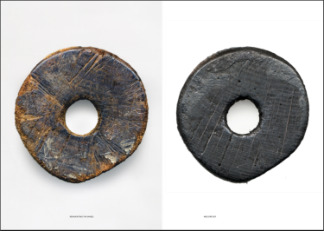
Figure 1: The accumulation of material narrative demonstrated through an object in circulation.
Human or not, matter is physical, deformable and plastic. Its substance bears the imprint of lived events and processes that deform, score, flatten or otherwise alter its form, creating changes in color, texture and structure. The accumulated dings and dents and deterioration over time that comes from existing in this world are evidence of its lived experience. You can trace these stories in its form. Its physicality records its experience. The very trajectory of its life is marked and witnessed in its physical decline.
To explore this idea and realize it in concrete form, I undertook an enactment to consider an individual within a system of circulation and the
92 Dreyer
forces the system exerted on that individual. In Reinventing the Wheel an accumulation of histories was layered and imprinted in matter as physical use marked the surface of a designed object. A single found object cycled through 14 people over 14 days. With each change of hands, the circulating object was reinvented, realizing 14 different incarnations through its relationships with 14 different people. Each new relationship redefined it. With each use the object was put to, its surface took on the marks of that use, successively adding new marks to the marks of its past. So when one person used it as a pushpin cushion, the next received it bearing the marks of the pins; and when another later inked it and used it to make prints on paper, the next received it stained with the ink. A layering of marked experience took place. The accumulation of marks over time recorded the serial incarnations of the object.
By the end of the 14 cycles the object was black in color and weighed 2g less than when it began its circulation. The ways it was used resulted in accumulated changes that dramatically altered its physical form (Figure 1).
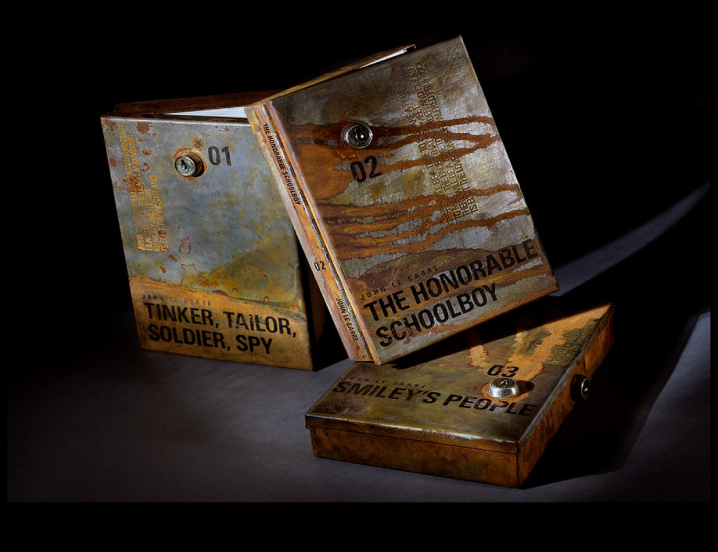
LAYERING COMMUNICATION What can material narratives contribute to design communication? I considered this in designing a trilogy of Cold War spy novels, investigating materials as a platform for elaborating content, layering message and building emotional resonance. I designed each book in the trilogy as a closed- case file, locked in a metal box, forgotten in the basement of some abandoned government warehouse. Standard government-issue locks stud the surfaces of the boxes. Their metal alludes to stainless steel autopsy tables, faceless institutions. The books tell a story of monolithic bureaucracy where humans are dispensable; the subtext is the corrosive nature of secrets and the slow erosion of humanity that comes from living with prolonged deception and sustained evasion. For the solitary agent in the field, betrayal is imminent, intimacy fatal; impending exposure and quiet catastrophe are an unrelieved condition of existence. The human deterioration and decay that ensues over time is communicated in the layer of corrosion I introduced to the metal of the boxes. This layer becomes a design element that elaborates and extends the primary message.
To achieve the corrosion, I applied an oxidizing solution to the steel of the boxes. I couldn’t direct or control the process, and I didn’t know what the result would be once I unleashed it on the metal. The accident and chaos I introduced to the design process produced physical change in the metal that communicated instability, disruption and impending loss, evoking the human experience of the agent in the field. Created entirely through changes to materials, this narrative expanded the basic concept of the spy novel to something more nuanced and emotionally complex (Figure 2).
PRIMITIVE TOOLS, PERFORMATIVE ACTS A human operator plies a primitive tool in an act of physical making. What results is an artifact that records human performance as much as production.
Artifacts, Artifictions: Material Narratives in Design 93
To engage in the physical performance of making is to relinquish some degree of technical control, embracing image- or form-making as practice. Making becomes a means of exploration, discovery, even improvisation, inviting randomness, accident and chaos into the process. These are evident in the artifacts produced. In them we trace the evidence of human inconsistency and imperfection: the unequal weight of divided attention, the all-but- imperceptible unsteadiness of hand, vagaries of mood, judgement, planning and preparation. In encompassing the capriciousness and inconsistency of the human operator and in accommodating imperfection, primitive production methods incorporate material narratives of impermanence, fragility and loss.
The Pinhole Camera There have been vigorous theoretical discussions on the materiality of image and the photograph as object. Jean Baudrillard (1994) and Roland Barthes (1982) both considered the photographic image as matter in time. Both discussed the materiality of image as defined largely by its plasticity: its chemistry, the paper on which it is printed and all its attendant surface tonalities. They discussed the image as object, emphasizing its corporeality, its body.
The pinhole camera is the most literal example of the deformation of matter in time in relation to the formation of image. Purely mechanical, the device holds chaos at its core. There is no viewfinder, and thus no certainty in framing the shot. There is no means of focus, no adjustment to aperture, no
94 Dreyer
mediating lens. The camera’s exposure times are determined wholly through repeated trial and error. Its mechanism of action invites randomness and accident into the production of image; there is no control, only accident and luck. Light enters a dark chamber through a small passage, crossing an expanse of darkness to a medium (paper or film) chemically prepared and waiting to receive it. The intensity of the image formed depends on the patience of the camera, on how long its eye remains open on the scene unfolding before it. What is captured on the paper depends on how long objects remain in the camera’s field of vision. The more traffic passing before the eye of the camera obscura, the more the paper is marked and the richer the accumulated experience it records. The layers of events in time are visible in the paper for us to see. Similarly, marks of time and experience accumulate on the surfaces of objects to speak of past lives we cannot know.
To engage this process of image-making is to relinquish technical control and embrace improvisation as a medium for exploration and discovery. The result may be far more compelling than anything achieved through sterile technique. With the pinhole camera it is the imperfections of the process, the opportune accidents, that give its images their resonance. The randomness of the process precipitates a moment in which matter is marked by experience as light entering the camera through the pinhole burns an image onto the paper inside the dark box. The results are difficult to predict, even more difficult to control, the variables myriad. But these very qualities of accident and precipitation are what make the images so successful. As the paper’s surface is branded with its experience of the moment passing before the camera’s eye, paper is made flesh. The images materialize, quivering with corporeality, silent, fragile. The subjects are poised on the threshold of disintegration, the everyday transformed into the otherworldly. In this world time stands still, breath is suspended.
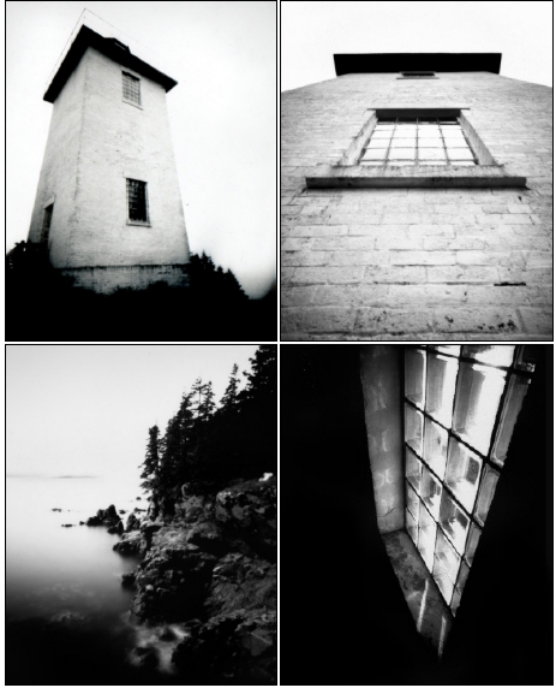
On a remote island, I used a pinhole camera to photographically document a 19th century lighthouse surrendering to weather and wear. I wanted to suspend the natural decay of the structure brought about by organic processes of deterioration; I wanted to crystallize its fragility, arrest its loss. I selected the pinhole camera specifically for the subject. The destruction inherent in the camera’s mechanism of action parallels the destruction of the lighthouse. Light destroys the paper to form the pinhole camera’s images; the images record the destruction the lighthouse is undergoing. The physical damage to the paper is a mirror, creating an image of damage. The decay that is central to the process is superimposed on the decay the subject undergoes, compounding it. The images, fragile themselves, elaborate and attenuate the fragility of the subject.
Lighthouse and pinhole camera, primitive tools both. In both, light is the emissary, crossing darkness to something waiting. In the case of the pinhole camera, the photosensitized paper is waiting to react; in the case of the lighthouse, the sailor is waiting for direction and deliverance. There is symmetry in the function and purpose of the two devices; in the accident and randomness of their operation; and in the precariousness and unpredictability of their results. The two share a story of materiality, of fragility, of loss and
Artifacts, Artifictions: Material Narratives in Design 95
of what survives as a testament. Organic processes over time deform the lighthouse just as experience over time marks the paper waiting in the dark box. Time passes; the lighthouse is etched by weather, the paper by light. Both record accumulated experience (Figure 3).
The Letterpress Summer 2024 witnessed two distinct populations of periodical cicadas emerge from deep below ground, as billions of cicadas ascended to the light to propagate and fulfill their evolutionary destiny. Broods XIII (the Northern Illinois Brood) and XIX (the Great Southern Brood) appeared simultaneously in a natural phenomenon known as dual emergence, an occurrence that takes place only every 221 years. To commemorate this remarkable event, I designed and printed an edition of letterpress posters.
How do they find one another, these cicadas? How do they maximize the odds of replicating to ensure their survival as a species? They sing!
96 Dreyer
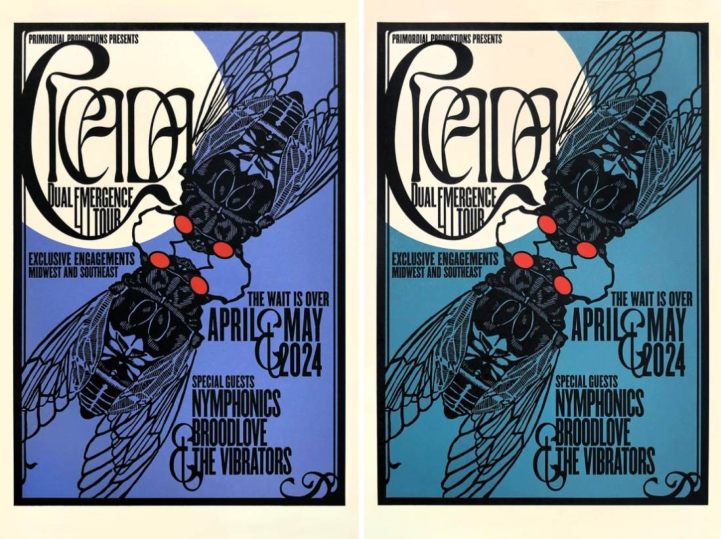
Dual emergence is noisy. For this reason I designed the posters in the style of rock concert promotion posters dating from the San Francisco Bay area in late 1960s and early 70s. As did the poster artists of that genre, I referenced Art Nouveau design for composition and typography. I introduced Art Nouveau-inspired framing to support the composition. I created titling lettering by updating, adapting and re-drawing early 20th- century Art Nouveau typography; then I introduced Jonathan Hoefler’s Champion Gothic Featherweight as the secondary typeface and married the two with a titling ampersand across the posters. I sourced the antiquarian cicada illustration from the public domain. The blue and green color fields seen in the posters represent the two cicada broods across the edition. Finally, I determined the number of prints in the edition (32) by adding the numbers 13 (from Brood XIII) and 19 (from Brood XIX).
The posters were printed on a Vandercook letterpress. Letterpress is a relief printing process that subjects paper to immense physical force. The weight of the drum rolling the paper across the plates on the press creates a depression in the paper’s surface, leaving marks of impact in each print. This aspect of production introduced a narrative of raw contact and change that was important to communicating dual emergence and cicada replication. Letterpress production is physically analogous to cicada propagation in other ways. It is noisy, as the press hums and the rollers hiss and spin with each pass. It is wet, leaving a residue of ink on paper. It is intensely physical, requiring contact between plate and paper on the press. And it yields multiples.
Artifacts, Artifictions: Material Narratives in Design 97
Collectively the prints are replicas; individually each is unique and precipitates a moment in time. The press operator must maintain vigilance throughout the printing process, continually checking aspects of the press to ensure that sufficient ink coats the rollers, artifacts are not appearing in the prints, each sheet of paper is properly fixed to the drum by the grippers, shifts in registration are not occurring. Still, the operator’s attention is not perfect; she is momentarily distracted, grows hungry, tires. The prints record these lapses: color fields vary in density as the ink thins on the rollers, demanding re-application; artifacts appear on the rollers or the plates, marring the inked fields and showing up in the prints; registration shifts as the prints undergo a second pass on the press. The physicality of the prints records the singular events of production. The narrative of birth and the process of replication is recorded in the prints. Its randomness and accident is superimposed on the randomness and accident of the cicadas finding one another to propagate and ensure their survival (Figure 4).
CONCLUSION
Materials assume a physicality through their lived experience. Forces impact and disrupt structure; processes degrade and erode surfaces. Retaining evidence of unseen events, materials become a platform for incorporating narrative into design.
To understand the contribution of material narratives to design communication, we considered three design projects. The first utilizes organic processes to produce narratives of erosion and deterioration. The remaining two undertake physical making and the utilization of primitive tools and mechanical production methods to produce narratives of accident and chaos. Of these, one uses the pinhole camera to introduce narratives of damage and deterioration to images documenting a decaying lighthouse; the other uses the letterpress to introduce narratives of accident and impact to a run of posters commemorating cicada replication. The resulting products or artifacts demonstrate a physicality in the design that expresses narratives of impermanence, fragility and imminent loss.
To engage in physical making is to embrace image- or form-making as a means of exploration and discovery, even improvisation, along the way to mastery. The performance of such making almost guarantees production will never be replicated with precision. In it we witness the randomness and accident, even chaos, of human agency. The results may be far more compelling than anything achieved through automated and digitized production methods. The anomalies and imperfections in what is produced record moments of chaos and accident. Their narratives of impermanence, fragility and imminent loss speak to our own materiality, prompting universal recognition and understanding.
ACKNOWLEDGMENT
The author thanks Joyce Thomas, Associate Professor of Industrial Design at the School of Industrial and Graphic Design at Auburn University, for
98 Dreyer
the invitation to participate in this session of AHFE and for guidance and mentoring throughout the writing of this paper. The author thanks Friends of the Swan’s Island Lighthouse (FOSIL) for access to Burnt Coat Harbor Light, which made the pinhole camera documentation of the lighthouse possible. The author thanks Bryan Christopher Baker, letterpress printmaker extraordinaire, for advising production of the Cicada: Dual Emergence poster edition. Finally, the author thanks Cicada Broods XIII and XIX for rocking on.
REFERENCES
Barthes, R. (1982) Camera Lucida. 5245th edition. Hill & Wang. Bates, B. (1991) A Guide to Physical Examination and History Taking. 5th edition.
Lippincott, Williams & Wilkins. Baudrillard, J. (1994) Simulacra and Simulation (The Body, in Theory: Histories of Cultural Materialism). University of Michigan Press. Later prt. edition. Dreyer, M. (2008) ‘Reinventing the Wheel’, 14, limited publication. Rhode Island
School of Design. Dreyer, M. (2024) Cicada: Dual Emergence. Creative Showcase 2025, Jule Collins Smith Museum of Fine Arts, January – July 2025.
LISTED IN THE AHFE DIGITAL BOOKSTORE CATALOGUE
Explore the complete digital volume
Interdisciplinary Practice in Industrial Design
Read this individual research paper free through the original publisher, or explore the full digital proceedings book.
ISBN 978-1-964867-59-5
Explore this ISBN in the AHFE Bookstore ↗Listed in the July 2026 bookstore catalogue; search by ISBN to confirm current availability · Digital book purchase optional