Hiroyuki Yanase (2026). Career Design for Discovering Meaningful Work: A Narrative and Meaning Innovation Approach. In: Intelligent Human Systems Integration (IHSI 2026): Disruptive and Innovative Technologies. AHFE Open Access, vol. 200, pp. 258–265. https://doi.org/10.54941/ahfe1007085
The advent of generative AI is expected to reduce human working hours, requiring a transformation in the meaning of work. According to a survey in Japan, approximately 64.5% of workers cited “earning income” as their primary reason for working, while only about 20% cited “to utilize my abilities” or “to find purpose.” However, in the author’s career counseling practice, many clients express a desire for meaningful work and fulfillment. This suggests that while they may not currently experience intrinsic value in their work, they fundamentally seek meaning in employment. Against this backdrop, this study aims to establish a career design methodology that redefines the meaning of work.This study employed a qualitative approach. First, an integrated framework was constructed, leading to a hypothesis for a career design process focused on meaningful work. Drawing on Mark L. Savickas’s narrative career counseling and Roberto Verganti’s innovation of meaning, a hypothetical career design process was proposed to reveal both the inner sense of meaning in work and the creation of new societal value for the same individual. Three key processes were emphasized: (1) creating a personal history to discover new narratives, (2) uncovering value through dialogue with a career designer, and (3) receiving insights from industry experts (interpreters). The hypothesis was then analyzed and examined through text-based online chat communications and one-on-one online coaching sessions conducted over several months with five Japanese business professionals.As a result of engaging in the hypothesized career design process, three of the five participants were able to clarify their personal meaning of work and build new careers. Analysis of the success factors revealed that the three emphasized processes were effective. For example:Participant A discovered (1) narratives such as “the confident self” and “the self who loves making things” from his personal history; (2) “the artisan-like self” with the career designer; and (3) the career of “tatami craftsman” with the interpreter.Participant B discovered (1) the narrative of “the self interested in human behavior” from his personal history; (2) “the self who enjoys experiencing nature” with the career designer; and (3) the career of “nature school instructor” with the interpreter.Participant C discovered (1) the narrative of “the self who loves hospitality” from his personal history; (2) “the self who helps the socially vulnerable” with the career designer; and (3) the career of “coaching students at a free school” with the interpreter.These findings highlight the importance of balancing coaching with critical dialogue. While traditional counseling emphasizes drawing meaning from the client, career designers must also encourage the questioning of assumptions and critical reflection. To reinforce extrinsic meaning, it is essential to propose specific occupations or work styles that align with both intrinsic and extrinsic dimensions and demonstrate their significance.This research provides a career design process that addresses the challenge of lost meaning in work caused by technological advancement. By employing two design methodologies—narrative and meaning innovation—this process demonstrates the potential to generate both individual fulfillment and new societal value.
The rapid advancement of generative AI and automation technologies is expected to substantially reduce human working hours, reshape traditional occupations, and transform the meaning of work in contemporary societies. Historically, work has functioned not only as a means of economic survival but also as a central domain for personal identity and social participation. However, recent surveys in Japan indicate that approximately 64.5% of workers identify “earning income” as their primary motivation for working, while only about 20% cite reasons such as “utilizing abilities” or “finding purpose.” This suggests a dominant reliance on extrinsic motivations, while intrinsic sources of fulfillment remain underdeveloped in the mainstream labor force.
Yet, in practical career counseling, many clients articulate an underlying desire for meaningful work, emotional fulfillment, and purpose. Against this backdrop, it has become urgent to develop methodologies that enable indi viduals to redefine the meaning of work in alignment with both personal values and evolving societal needs.
Career Design for Discovering Meaningful Work 259 To address this challenge, the present study proposes a career design process that integrates two distinct but complementary approaches: (1) narrative career counseling (Savickas, 2012), which emphasizes constructing personal meaning through storytelling, and (2) innovation of meaning (Verganti, 2009), which focuses on reinterpreting societal value. The aim is to sup port individuals in discovering new work narratives that align with intrinsic meaning while simultaneously generating extrinsic value for society.
LITERATURE REVIEW
Meaningful Work in the 21st Century Scholarly interest in “meaningful work” has increased alongside grow ing concerns about disengagement, burnout, and precarious employment. Meaningful work is commonly described as work that is personally signifi cant, socially contributive, and aligned with one’s values. Rosso et al. (2010) identified four major pathways to meaningful work: authenticity, self-effi cacy, purpose, and belongingness. However, with technological disruption, the risk of “meaningless work” has also grown, particularly where jobs are reduced to repetitive or automated tasks.
Narrative Career Counseling Savickas’s narrative career counseling emphasizes that individuals are not passive recipients of labor market opportunities but active authors of their own career stories. By reconstructing past experiences and identifying recur ring themes, clients can generate new narratives that clarify vocational iden tity and future direction. While this process strengthens internal coherence, it often remains limited to individual meaning-making.
Innovation of Meaning Verganti (2009) introduced “innovation of meaning” as a design methodol ogy in which organizations do not merely improve products but reframe the symbolic and cultural value of their offerings. Applied to career design, this perspective suggests that individuals can reinterpret their careers in ways that fulfill personal aspirations while simultaneously creating new forms of value for society.
Integrating Narrative and Meaning Innovation While narrative counseling emphasizes introspection, innovation of meaning emphasizes societal contribution. Integrating the two provides a dual-lens approach in which individuals not only reauthor their personal stories but also align them with evolving social contexts, thereby generating both intrin sic meaning and extrinsic value.
METHODOLOGY
This study employed a qualitative research design that combined text-based online chat communications with one-on-one coaching sessions conducted over several months. The process was applied to five Japanese business pro fessionals undergoing mid-career transitions, with the aim of testing a hypo thetical career design framework based on the integration of narrative career counseling and meaning innovation. The participants, aged between their thirties and forties, represented diverse professional backgrounds includ ing business consulting, restaurant service, and systems engineering. All expressed dissatisfaction with their current work and a desire to pursue more meaningful directions.
Data were collected through approximately 6–8 hours of conversation with each participant. These sessions included narrative exploration, reflec tive exercises, and dialogues with external experts, referred to as Interpreters. All conversations were transcribed, coded, and thematically analyzed. The analytical framework emphasized three key processes: constructing a per sonal history to discover new narratives, uncovering value through dialogue with a career designer, and receiving insights from Interpreters to connect individual meaning with broader occupational possibilities.
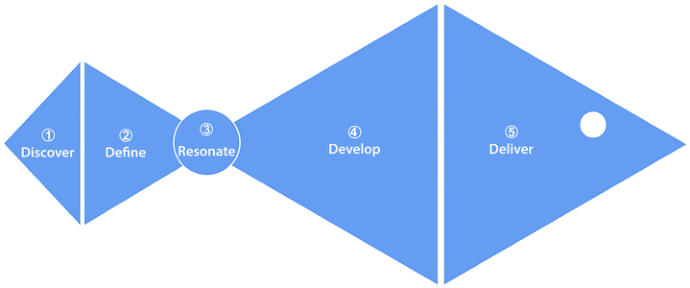
In addition, this study situates these processes within a broader model of career development, referred to as the Shusseuo Career Model (Evolving Identity Model), which adapts the double diamond framework to career support. The model consists of five stages: (1) Discover—identifying one’s current state and existing resources; (2) Define—clarifying personal identity and aspirations; (3) Resonate—exploring unfamiliar domains and aligning them with labor market opportunities; (4) Develop—generating new possi bilities and concretizing future directions; and (5) Deliver—testing whether the value can be reproduced in real contexts such as recruitment, contracting, and workplace settings. The three key processes analyzed in this study corre spond to different stages of this model: constructing a personal history aligns with Discover, dialogue with a career designer spans Define to Resonate, and Interpreter insights link Resonate to Develop. A diagram of the model is pre sented to visualize the overall process.
Figure 1: “Shusseuo career model (evolving identity model), developed with reference to the double diamond.”
FINDINGS Participant Outcomes
Among the five participants, three successfully redefined the meaning of their work and made concrete career transitions. The remaining two, however, were unable to psychologically accept the suggestions offered by the career designer and therefore remained in the exploratory stage.
Participant A A man in his forties, formerly employed at a fisheries cooperative, was forced to resign due to workplace harassment. He felt that he lacked sufficient expe rience and skills for a career change, which resulted in diminished confi dence regarding his future career. He was also uncertain about which path to pursue next. In revisiting his personal history, he recalled “the self who constantly asked ‘why’ to understand how things work” and “the self who loved making things so much that he once repaired and assembled a broken bicycle as a child.” Through this recollection, he discovered new narratives: “a confident self with strengths” and “the self who loves making things.”
Through dialogue with the career designer, these selves were reconstructed into “the artisan-like self,” leading him to realize that engaging in crafts manship could bring fulfillment to his work. Subsequently, in a conversation with an Interpreter—an experienced craftsman—the idea of becoming a tat ami craftsman emerged. This occupation strongly resonated with him, as it bridged his childhood passion with a socially recognized form of value.
Participant B A man in his thirties, working as a restaurant staff member, had once aspired to be a screenwriter but had abandoned that dream several years earlier. After moving from job to job, he became uncertain about what he truly wanted to pursue. From his personal history, he rediscovered “the self interested in human behavior,” a theme that had also been connected to his aspiration of becoming a screenwriter. Through dialogue with the career designer, he further identified “the self who enjoys experiencing nature.” Later, with the support of an Interpreter who was a nature school instructor, he explored the possibility of becoming a nature school instructor and staff member. This process helped him discover a type of work in which he could find both meaning and engagement.
Participant C A woman in her forties was working as an accounting manager at a for eign-owned manufacturing company. Having built her career as an account ing specialist, she began searching for a new direction as she found it difficult to imagine continuing in the same role beyond the age of fifty. From her per sonal history, she discovered the narrative of “the self who loves hospitality.” Through dialogue with the career designer, she articulated a strong desire “to support socially vulnerable people.” Furthermore, in a conversation with an Interpreter—the founder of a free school—she identified the possibility of pursuing a career in teaching and coaching students at a free school.
A man in his thirties working as a systems engineer had chosen his pro fession without strong motivation and found little fulfillment in it, which led him to explore alternative paths. From his personal history, he discov ered the narrative of “the self who wants to live in accordance with his sensitivity and sensibility.” Through dialogue with the career designer, he identified “the self who performs tasks with accuracy.” With the support of an Interpreter—another engineer—the possibility of becoming a QA engineer was suggested. However, the discoveries from his personal his tory and dialogue were largely shaped by the career designer’s suggestions rather than emerging from his own internal reflections. As a result, he failed to establish a strong connection to his inner self, leaving him with weak conviction. In particular, he was unable to link the process to a sense of self-efficacy.
Participant E A man in his thirties working as a newspaper journalist had chosen his pro fession primarily because it suited his abilities, but he did not find it fulfilling and began exploring alternative possibilities. From his personal history, he discovered the narrative of “the self who has the will to decide everything independently.” Through dialogue with the career designer, he identified “the self who enjoys discovering and conveying the charm of small worlds.” Subsequently, with the support of an Interpreter who was a freelance writer, he considered the possibility of becoming a freelance field reporter. However, he continued to struggle with a lack of self-efficacy, and the process con cluded while he remained in the exploratory stage.
Analysis of the five participants revealed two distinct patterns: those who achieved clear career transitions and those who remained in the exploration stage. The former group began by rediscovering personal nar ratives, then integrated insights from dialogues with the career designer and Interpreters, ultimately strengthening their self-efficacy and realizing new career directions. In contrast, the latter group, despite identifying per sonal narratives, struggled to connect these insights to action due to weak self-efficacy and limited ownership. A summary of these outcomes is pre sented in Table 1.
Table 1: Participant outcomes (summary).
Table available in the original PDF paper.
Group Participants Key Characteristics Outcome Successful Transitions Redefined meaning of work and achieved concrete career transitions A, B, C Rediscovered authentic narratives; integrated insights from career designer and Interpreter; strengthened self-efficacy
Exploration Only
Remained in exploration phase, without concrete career shift
D, E Narratives identified but weak ownership or self- efficacy; limited ability to act on insights
Career Design for Discovering Meaningful Work 263 Cross-case Analysis: Commonalities and Contrasts
Commonalities Across Participants All participants rediscovered latent narratives from their personal histo ries—such as childhood passions, past aspirations, or overlooked disposi tions—which served as seeds for reframing career directions. Dialogue with the career designer consistently helped reinterpret these narratives into new vocational identities, while Interpreters played a catalytic role in linking intrinsic meaning with concrete occupational possibilities.
Contrasts Between Participants Three participants (A, B, C) successfully integrated personal narratives, designer dialogues, and Interpreter insights into coherent new career paths, achieving both intrinsic meaning and societal value. In contrast, two partici pants (D, E) remained in exploration. For them, the process relied too heavily on external suggestions or was hindered by persistent doubts about self- efficacy, preventing convergence into actionable transitions.
Summary of Findings The analysis highlights three key components for successful career design: excavation of personal narratives, dialogical reframing, and Interpreter engagement. However, without sufficient self-efficacy, even well-constructed narratives may fail to translate into meaningful transitions. Thus, fostering self-efficacy is an indispensable condition for success.
DISCUSSION
The cross-case findings highlight both the potential and the limitations of the proposed career design process. While all five participants were able to redis cover latent narratives, only three succeeded in integrating these insights into coherent new career directions. This contrast underscores the importance of balancing intrinsic meaning with extrinsic value, and above all, the central role of self-efficacy in enabling meaningful transitions. The results also reso nate with Rosso et al.’s (2010) four pathways to meaningful work—authen ticity, purpose, belongingness, and self-efficacy. Authenticity was strength ened through narrative excavation, purpose was clarified through dialogue with career designers, and belongingness was fostered through engagement with Interpreters. However, without sufficient self-efficacy, as in the cases of Participants D and E, meaningful insights could not be translated into con crete action.
Beyond narrative reconstruction, the study applied Verganti’s (2009) con cept of meaning innovation, which emphasizes creating new value that res onates with both the individual and society. Interpreters played a catalytic role in this process, enabling participants to envision occupations that were simultaneously authentic and socially significant, such as tatami craftsman, nature school instructor, or free school teacher. This suggests that career design should be understood not only as an introspective process but also as one of co-creating new meanings aligned with evolving social contexts.
264 Yanase The findings also emphasize the need for balance in the role of career designers. While empathetic listening allows individuals to articulate authentic narratives, critical dialogue that challenges underlying assump tions is equally essential. Without this balance, the process risks becoming either overly self-referential or excessively designer-driven, as illustrated by Participant D’s limited sense of ownership.
From a practical perspective, three key implications emerge: first, career design should integrate personal narratives with socially resonant innovation; second, interventions should intentionally strengthen self-efficacy through strategies such as goal-setting, exposure to role models, and skill-building; and third, Interpreters should be engaged to expand career possibilities and anchor them in real occupational contexts. Although the study is limited by its small sample size of five Japanese mid-career professionals, it demon strates how combining narrative career counseling with meaning innovation can provide individuals with authenticity, purpose, belongingness, and above all, self-efficacy. In doing so, it offers a pathway to transform the risk of meaningless work in an era of technological disruption into opportunities for meaningful careers that serve both individuals and society.
CONCLUSION
This study explored a career design process that integrates narrative career counseling and meaning innovation to support mid-career professionals in discovering more meaningful work. By combining personal narrative exca vation, dialogical reframing with career designers, and engagement with Interpreters, the process enabled participants to rediscover authenticity, clar ify purpose, and foster belongingness. However, the findings also demon strate that self-efficacy functions as an indispensable condition that enables these insights to be translated into concrete career transitions.
The study highlights that career design is not only an introspective prac tice but also a process of co-creating new meanings that align with evolving social contexts. While the results suggest promising directions for integrat ing narrative and innovation-based approaches, the small sample size and focus on Japanese mid-career professionals limit the generalizability of the findings. Future research should examine this framework in diverse cultural and organizational contexts and investigate systematic methods for training career designers and Interpreters to facilitate meaning innovation.
Overall, this research suggests that integrating narrative counseling with meaning innovation offers a pathway for transforming the growing risk of “meaningless work” in an era of technological disruption into opportunities for meaningful careers that serve both individuals and society.
ACKNOWLEDGMENT
The author would like to express sincere gratitude to Professor Kazuhiko Yamazaki of the X Design School for his valuable guidance and encouragement throughout this research. The author also wishes to thank fellow members of the X Design School community for their insightful discussions and continu ous support, which greatly contributed to the development of this study.
REFERENCES
Naikakufu. (2023). Kokumin seikatsu ni kansuru yoron chosa (Reiwa 5 nen 11 gatsu chosa) [Public opinion survey on national life, November 2023]. Government of Japan Cabinet Office Website: https://survey.gov-online.go.jp/r05/r05-life/ (in Japanese) Rosso, B. D., Dekas, K. H., & Wrzesniewski, A. (2010). On the meaning of work: A
theoretical integration and review. Research in Organizational Behavior. Savickas, M. L. (2011). Career counseling. American Psychological Association. Verganti, R. (2009). Design-driven innovation: Changing the rules of competition by radically innovating what things mean. Harvard Business Press.
LISTED IN THE AHFE DIGITAL BOOKSTORE CATALOGUE
Explore the complete digital volume
Intelligent Human Systems Integration (IHSI 2026): Disruptive and Innovative Technologies
Read this individual research paper free through the original publisher, or explore the full digital proceedings book.
ISBN 978-1-964867-76-2
Explore this ISBN in the AHFE Bookstore ↗Listed in the July 2026 bookstore catalogue; search by ISBN to confirm current availability · Digital book purchase optional