Sebastian Pfau, Joel Rüttger, Sven Fuchs, Franziska Seifert, Cosima Von Uechtritz, Alina Schmitz-hübsch (2025). Enhancing trucker well-being: The role of cabin features and technology acceptance. In: Human Interaction and Emerging Technologies (IHIET 2025). AHFE Open Access, vol. 197, pp. 283–292. https://doi.org/10.54941/ahfe1006721
Long-distance truck drivers face unique occupational challenges. The demanding nature of their job, characterised by extended periods of isolation, irregular schedules, and physical strain, contributes to higher levels of stress, health issues, and reduced well-being compared to other professions. This exploratory study examined drivers' perceptions of cabin features impacting well-being, as well as their acceptance of technology that measures physiological parameters to enhance well-being through an affect-adaptive system. 24 randomly selected long-distance truck drivers (23 male, 1 female) were interviewed at German motorway service stations. Participants were aged between 30 and 65 years (M = 49, SD = 10) with an average of 19 years of professional driving experience (SD = 13, range: 1.5 to 41 years). The participants drove trucks from six different brands, reflecting a diverse range of vehicle manufacturers. The interviews revealed that comfort, cooking equipment, and cabin size were the most positively highlighted factors. 38% of participants reported no negative cabin features. Among those who identified negative factors, poor truck or cabin amenities (21%) and discomfort related to seats and beds (13%) were frequently mentioned. Improvements to seating and sleeping comfort were the most commonly requested changes, alongside enhancements to entertainment, cooking, and storage features, as well as safety and driver-assistance systems. A majority of drivers (75%) were in favour of using gadgets to improve well-being, with smartwatches (80%) and driver-facing cameras (63%) being the most accepted, while chest straps were the least favoured (15%). Approval for personalised music and entertainment was high, but lower when auto-adaptive selection of content was proposed. Personalised lighting and time-based adaptive lighting were favoured, while mood-based adaptive lighting was less popular. These findings provide valuable insights into factors influencing driver well-being and are discussed with respect to leveraging tech gadgets to design improved future truck cabins.
Long-distance truck drivers face unique occupational challenges. The demanding nature of their job, characterised by extended periods of isolation, irregular schedules, and physical strain, contributes to higher levels of stress, health issues, and reduced well-being compared to other professions (Shattell et al., 2010). For professional truck drivers, strengthening their resources, such as emotion regulation techniques and coping mechanisms, is particularly important as they are navigating prolonged sitting, limited access to healthy food, and absence from home (Apostolopoulos et al., 2010; Sieber et al., 2014; Hege et al., 2018). Diener (1984) defines subjective well-being as a combination of life satisfaction and frequent positive emotions compared to negative ones, emphasizing the importance of emotional states. Dodge et al. (2012) propose a practical model of well-being that views it as a balance between resources and challenges in psychological, social, and physical terms, thus summarizing earlier definitions.
As the well-being definitions and the model proposed by Dodge et al. (2012) suggest, improving well-being should involve both reducing negative aspects and enhancing resources and capabilities. Affect-adaptive systems, designed to detect and assess the emotional state of users and adjust interactions accordingly, hold potential for this purpose (Schmitz-Hübsch et al., 2024). Adjustments already utilised in the passenger car sector, such as breathing exercises (Paredes et al., 2018), light adjustments (Soleimanloo et al., 2015), and chassis modifications (Gao and Qi, 2021), could also be adapted to the truck sector. To achieve effective improvements in well- being, it is necessary first to identify specific situations that potentially impair well-being and aspects such as ergonomics and physical comfort, mental well-being, work scheduling, and rest management. These can be deliberately optimised and adapted to enhance driver well-being. Therefore, a comprehensive context-of-use analysis is an essential prerequisite.
For effective adaptations to increase well-being, awareness of the driver’s emotional state is paramount, as emotional states determine well-being (Diener, 1984). Physiological signals offer a valuable means for continuous assessment of driver state without disrupting task performance (Healey and Picard, 2005). In contrast to subjective parameters assessed through questionnaires, physiological parameters provide an objective assessment of well-being, which can be more accurate and less influenced by the driver’s intentions (Barka and Politis, 2024). Detecting emotional and cognitive states is best possible with gadgets that are unobtrusive, offer real-time measurement, and collect a broad range of physiological parameters (Barka and Politis, 2024). There is an increasing interest in low-cost, non-contact, and pervasive methods to gain insight into drivers’ states (Ahmed et al., 2025). Measurement systems that have been studied in the context of driver monitoring include electrocardiogram (ECG), photoplethysmogram (PPG),electrodermal activity (EDA),and electroencephalogram (EEG) signals (Amidei et al., 2025). More recently, remote photoplethysmography (rPPG) is investigated with camera systems for driver monitoring (Ahmed et al., 2025).
Enhancing Trucker Well-Being: The Role of Cabin Features and Technology Acceptance 285
Another component of this exploration is the acceptance of such technologies. While several studies have investigated the use of wearables for driver state recognition, few have focused on truck drivers’ acceptance of these technologies. A study by Greenfield et al. (2016), which included focus groups with a total of 34 full-time professional truck drivers in the UK, examined wearable devices and health promotion. A generally welcoming attitude towards wearables for health purposes was observed among drivers. However, concerns were raised regarding data privacy and whether their data would be accessible to their employers.
The present exploratory study sets out to examine drivers’ perceptions of cabin features impacting well-being, as well as their acceptance of technology that measures physiological parameters to enhance well-being through an affect-adaptive system.
METHOD
Twenty-four long-distance truck drivers (23 males and 1 female) were randomly selected and interviewed for this study. These interviews took place at motorway service stations in Germany. The participants received a 20€ shopping voucher upon completion of the interview as an incentive for their participation. The truck drivers were approached either during their breaks or at the end of their workday to facilitate a conducive atmosphere for the interview. The interviews were conducted in either German or English. Our structured questionnaire encompassed two sets of both qualitative and quantitative questions, as well as demographic information (age, gender) and what brand of truck they were driving.
The first set of questions focused on the well-being of drivers in the cabin. Participants were initially asked to rate their well-being in the cabin on a scale from 1 (‘very uncomfortable’) to 10 (‘very comfortable’). Additionally, open-ended questions were posed to identify factors within the cabin that led to feelings of well-being or discomfort. Participants were further asked for wishes and demands for future cabins. Responses to qualitative questions were categorised such that when answers addressed similar or identical topics, they were grouped into overarching categories. This process was conducted akin to Mayring (2014) but without check of intra-/inter-coder agreement. When no meaningful categorisation was possible, the responses or factors were listed individually. For each category, the frequency of mentions was counted.
The second set was dedicated to driver acceptance and perception of wearable gadgets and cabin personalisation and adaptions. Participants were asked how they would generally feel about wearing small devices connected to the vehicle if these demonstrably increased their well-being. Subsequently, opinions on specific devices were surveyed that were chosen to cover a practical range of available instruments: baseball caps with integrated sensors, smartwatches, T-shirts with integrated sensors, chest straps, smart rings, ear sensors, and small cameras mounted in the cabin (used solely to recognize well-being). Responses were categorised dichotomously into ‘like’ or ‘dislike.’ Participants were also asked to rate on a scale from 1
(‘very bad’) to 10 (‘very good’) how they would feel if their vehicle were customised to their personal preferences in four areas: music, entertainment (e.g. audiobooks, podcasts, radio), smell, and lighting (e.g. various colours). Further questions explored how drivers would feel, on the same scale, if the cabin light changed depending on the time of day or night, if the cabin light changed according to their moods or feelings, if the music changed according to their moods or feelings, and if the vehicle suggested new music or podcasts depending on the situation (e.g. a thrilling podcast to pass the time in a traffic jam).
RESULTS
Participants were aged between 30 and 65 years (M = 49, SD = 10) with an average of 19 years of professional driving experience (SD = 13, range: 1.5 to 41 years). They drove trucks from six different brands, reflecting a diverse range of vehicle manufacturers. The level of perceived comfort in the cabin was rated 8.04 out of 10 (SD = 0.82).
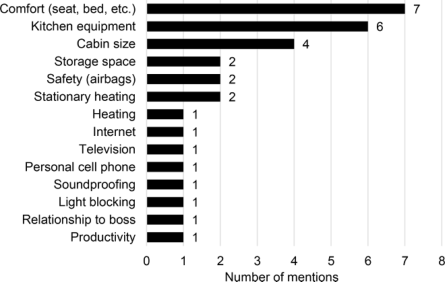
In the interviews, comfort, kitchen equipment, and cabin size were most often mentioned to contribute to well-being in the vehicle cabin (see Figure 1). Comfort, encompassing aspects such as seat and bed quality, had the highest number of mentions with seven drivers (32%) citing it as important. Kitchen equipment followed second, highlighted by six drivers (27%). Cabin size was also a significant factor, with four mentions. In addition to these, storage space, safety features like airbags, and stationary heating were each noted by two drivers, with heating being mentioned generally once as well. Single mentions were further observed for several factors: internet connectivity, television, personal cell phones, soundproofing, light blocking, relationship to the boss, and productivity. These responses reflect a broader range of factors associated with both sleep/rest environments, highlighted by soundproofing and light blocking, and work-related factors such as maintaining a positive relationship with the boss and progressing efficiently along the route.
Figure 1: Positive factors for well-being in the vehicle cabin (N = 22). Multiple responses per driver permitted.
Enhancing Trucker Well-Being: The Role of Cabin Features and Technology Acceptance 287
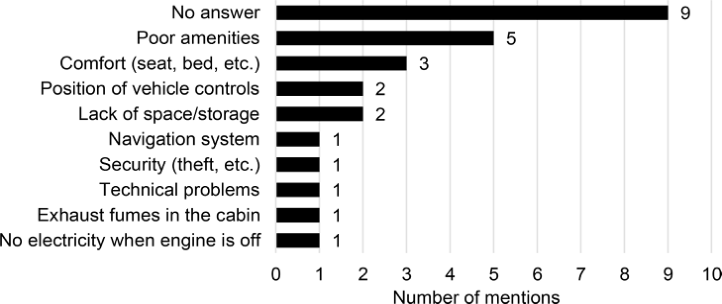
When asked about factors negatively affecting well-being in the vehicle cabin, 9 out of 24 responding drivers reported no negative cabin features (see Figure 2). Among those who did identify negative factors, poor cabin amenities were the most frequently cited, mentioned five times, accounting for 21% of the mentions. Discomfort related to seats and beds was the second most common issue, mentioned three times (13%). Additional complaints included issues related to the driving task, such as the position of vehicle controls (mentioned twice) and problems with the navigation system, noted once. Other factors were related to rest time, including lack of space/storage mentioned twice, security concerns mentioned once, technical problems cited once, exhaust fumes in the cabin noted once, and the lack of electricity when the engine is off, also mentioned once.
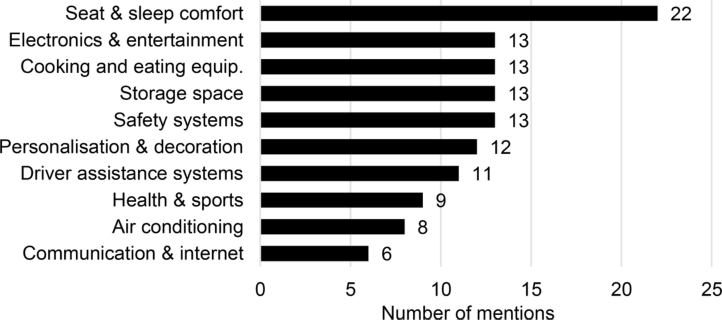
Design ideas for future vehicle cabins varied broadly (see Figure 3). Unlike factors affecting well-being, which often elicited singular responses, drivers provided several suggestions for design improvements. Enhancements to seating and sleeping comfort were the most commonly requested, with almost every driver (22 out of 24) mentioning this aspect. Over half of the drivers suggested improvements to electronics and entertainment, cooking and eating equipment, storage space, and safety systems (13 mentions each). Personalisation and decoration improvements were also highly requested, with 12 mentions. Improvements to driver-assistance systems were mentioned 11 times. Least frequently, three other aspects were noted: health and sports (9 mentions), air conditioning (8 mentions), and communication and internet (6 mentions).
Figure 2: Negative factors for well-being in the vehicle cabin (N = 24). Multiple responses per driver permitted.
When asked about the use of gadgets to improve well-being generally, a majority of drivers (75%) was in favour. One of the drivers that expressed a general favour towards using gadgets did not comment on any of the specific gadgets surveyed aside from the camera. Among the six drivers who were not in favour of using gadgets, the responses varied: one driver was against all devices when prompted, two drivers provided varying answers depending on the specific device, and three did not provide responses for the individual
devices but explicitly disapproved of the camera. These last three drivers were included in the overview in Figure 4 as disapproving, to ensure that the acceptance rate was not artificially increased.
Figure 3: Design ideas of drivers for the vehicle cabin to improve well-being (N = 24). Multiple responses per driver permitted.
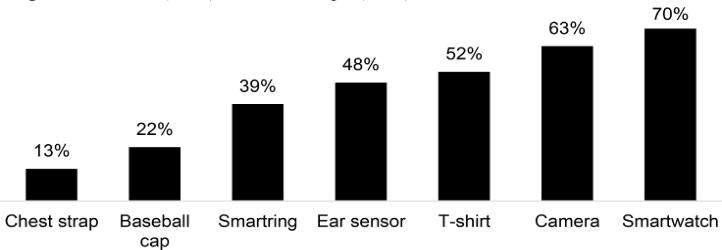
Smartwatches emerged as the clear favourite, with 70% acceptance, with almost all drivers who accepted gadgets also accepting smartwatches. The driver-facing camera was a close second with a 63% acceptance rate. T-shirts with integrated sensors and ear sensors had acceptance rates of around half of the drivers, at 52% and 48%, respectively. Smart rings were accepted by over a third of the drivers (39%). In contrast, only a minority of drivers would accept baseball caps with integrated sensors (22%) or chest straps (13%).
Figure 4: Acceptance rates of gadgets to monitor physiological properties, e.g. heart rate (n = 23, for camera n = 24).
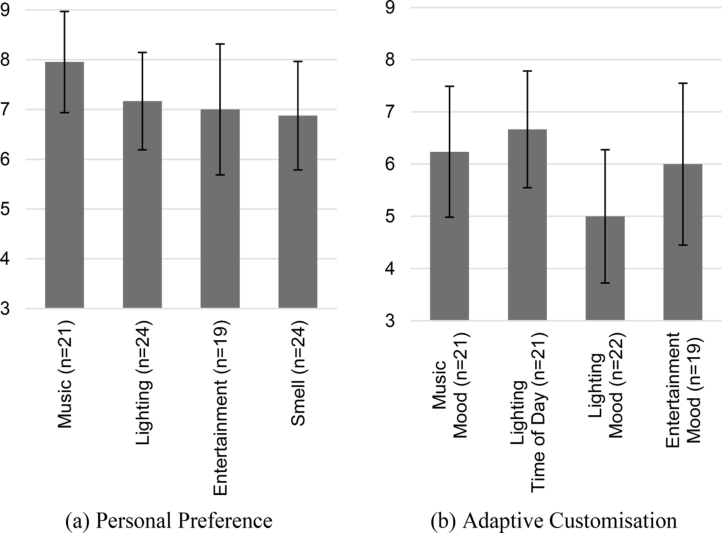
Drivers were asked to rate, on a scale from 1 (‘very bad’) to 10 (‘very good’), how they would perceive the future vehicle cabin if it were customisable to their personal preferences (see Figure 5a). Among the aspects considered, music scored the highest with an average rating of 7.9. Lighting
Enhancing Trucker Well-Being: The Role of Cabin Features and Technology Acceptance 289
received a rating of 7.2, followed closely by entertainment at 7.0, and smell at 6.9.
Subsequently, drivers rated how they would perceive these same aspects if they changed adaptively based either on mood and feeling or, in the case of lighting, also based on the time of day (see Figure 5b). All ratings were lower for adaptive customisation. Lighting based on mood experienced the highest drop, with an average rating of only 5.0. In contrast, lighting adjusted according to the time of day was rated highest among the adaptive options with 6.7. Music and entertainment, both adapted based on mood, received ratings of 6.2 and 6.0, respectively.
The 95% confidence intervals were higher for adaptive customisations, ranging from 1.1 to 1.6, compared to personal preference customisations, which ranged from 1.0 to 1.3. These intervals overlapped for all surveyed categories, both within the groups of personal preferences and adaptive customisations, as well as across the two groups for the same category.
Figure 5: Responses of drivers to the customisation of a future vehicle cabin according to personal preferences (a) and to its adaptive customisation (b) in different categories. Rated on a scale from 1 (‘very bad’) to 10 (‘very good’). Error bars indicate 95% confidence intervals.
DISCUSSION
Overall, responses highlight the multifaceted nature of factors that drivers associate with their well-being while in the vehicle cabin. However, there was a notable difference between responses to questions about the factors influencing well-being and those asking for aspects to improve: When asked
about factors influencing their current well-being, participants mentioned only a few key aspects. In contrast, there were more detailed responses when participants were prompted to suggest improvements.
A strong focus on comfort, amenities, and space emerged from the analysis of current well-being, with these elements being perceived both positively when well-designed and negatively when lacking. This is unsurprising, given that drivers spend a significant amount of time in the vehicle cabin, with many of them both driving for a full workday and often also sleeping in the cabin. The extensive array of additional suggestions for improvement further underscores the dual role the cabin must play; it needs to provide an environment that is conducive to the driving task while also serving as a restful space during downtime. The breadth of additional ideas highlights the importance of ensuring the cabin meets both functional and comfort requirements to enhance the overall well-being of drivers.
With respect to using wearables for detecting and improving well-bring, results showed a generally positive attitude among the participants, similar to the findings reported by Greenfield et al. (2016). Almost all drivers who were in favour of using gadgets also accepted the use of smartwatches. Interestingly, cameras were rated almost as highly, which could be attributed to their unobtrusive nature. Unlike other wearables, cameras do not require physical contact, thus would be less noticeable to users. On the opposite end of the spectrum were chest straps and baseball caps, both of which were less favourably received, likely due to their intrusive nature. Familiarity seemed to play a significant role in acceptance, with T-shirts being well- received and potentially also ear sensors. Smart rings, while less favourably rated, presented unique concerns; drivers noted the potential safety risks these devices entail, particularly during loading and unloading activities. This explains their lower acceptance rate despite being relatively discreet and convenient to wear.
Regarding cabin electronics, results indicate a preference among participants for manually customising music, lighting, and entertainment according to their personal preferences, rather than relying on auto-adaptive customisation. This observation might be attributed to concerns regarding the feasibility and implementation of adaptive systems, or simply a lack of clarity on how such systems would function in real-world scenarios. The ratings for personal lighting and adaptive lighting based on the time of day were the most closely aligned, with a minor difference of 0.5 points, possibly because the concept of time-based lighting adjustments is more intuitive for users. An alternative explanation for the overall preference of manual control could be that drivers prefer direct control over their environment and are potentially uncomfortable with automated adjustments. This discomfort is further reflected in the significantly lower ratings for lighting adjustments based on mood, which were on average more than two points lower than other customisation options. These findings suggest a need for more specific follow-up questions to better understand drivers’ concerns and preferences. Moreover, the high variability in the responses, as indicated by the large confidence intervals, highlights that acceptance and preferences for customisation are not universal but vary significantly among drivers.
Enhancing Trucker Well-Being: The Role of Cabin Features and Technology Acceptance 291
CONCLUSION
In our study, we conducted interviews of long-distance truck drivers on well- being in the cabin, acceptance of gadgets to monitor physiological properties, and cabin customisation to better understand drivers and generate insights for future developments. The results highlight that comfort, amenities, and space are most crucial for drivers’ well-being, given the extensive time spent in the cabin for both driving and resting purposes. The cabin must support both functional driving and restful recovery. There is a generally positive attitude towards wearables, especially non-intrusive ones like smartwatches and cameras, if these can help to improvements well-being. Intrusive wearables like chest straps and baseball caps were less accepted. Drivers also prefer personal control over environmental customisation rather than auto- adaptive systems, and time-based lighting adjustments are more intuitively accepted than mood-based adjustments. There is significant variability in customisation preferences, indicating the need for flexible, individualised solutions. In summary, the positive sentiment among drivers to some wearables and adaptions suggests that future development of solutions to enhance driver well-being could be well-received, provided they are beneficial and easy to use. Further research is needed to better understand drivers’ concerns and preferences regarding adaptive customisation in the cabin.
REFERENCES
Ahmed, S. G. et al. (2025) ‘AI Innovations in rPPG Systems for Driver Monitoring: Comprehensive Systematic Review and Future Prospects’, IEEE Access, 13, pp. 22893–22918. Available at: https://doi.org/10.1109/ACCESS.2025.3535540. Amidei, A. et al. (2025) ‘Unobtrusive Multimodal Monitoring of Physiological
Signals for Driver State Analysis’, IEEE Sensors Journal, 25(5), pp. 7809–7818. Available at: https://doi.org/10.1109/JSEN.2024.3385480. Apostolopoulos, Y. et al. (2010) ‘Worksite-Induced Morbidities among Truck Drivers in the United States’, AAOHN Journal, 58(7), pp. 285–296. Available at: https:// doi.org/10.1177/216507991005800703. Barka, R. E. and Politis, I. (2024) ‘Driving into the future: A scoping review
of smartwatch use for real-time driver monitoring’, Transportation Research Interdisciplinary Perspectives, 25, p. 101098. Available at: https://doi.org/ 10.1016/j.trip.2024.101098. Diener, E. (1984) ‘Subjective well-being’, Psychological Bulletin, 95(3), pp. 542–575.
Available at: https://doi.org/10.1037/0033-2909.95.3.542. Dodge, R. et al. (2012) ‘The challenge of defining wellbeing’, International Journal of Wellbeing, 2(3), pp. 222–235. Available at: https://doi.org/10.5502/ijw.v2i3.4. Gao, J. and Qi, X. (2021) ‘Study of Suspension Parameters Matching to Enhance
Vehicle Ride Comfort on Bump Road’, Shock and Vibration. Edited by M. A. A. Abdelkareem, 2021(1), p. 5806444. Available at: https://doi.org/10.1155/2021/ 5806444. Greenfield, R. et al. (2016) ‘Truck drivers’ perceptions on wearable devices and health promotion: A qualitative study’, BMC Public Health, 16(1), p. 677. Available at: https://doi.org/10.1186/s12889-016-3323-3. Healey, J. A. and Picard, R. W. (2005) ‘Detecting Stress During Real-World
Driving Tasks Using Physiological Sensors’, IEEE Transactions on Intelligent Transportation Systems, 6(2), pp. 156–166. Available at: https://doi.org/10.1109/ TITS.2005.848368.
Hege, A. et al. (2018) ‘Occupational health disparities among U.S. long-haul truck drivers: The influence of work organization and sleep on cardiovascular and metabolic disease risk’, PLOS ONE. Edited by S. A. Useche, 13(11), p. e0207322. Available at: https://doi.org/10.1371/journal.pone.0207322. Mayring, P. (2014) Qualitative content analysis: Theoretical foundation, basic
procedures and software solution. Klagenfurt. Available at: https://nbn- resolving.org/urn:nbn:de:0168-ssoar-395173 (Accessed: 4 July 2025). Paredes, P. E. et al. (2018) ‘Just Breathe: In-Car Interventions for Guided Slow Breathing’, Proceedings of the ACM on Interactive, Mobile, Wearable and Ubiquitous Technologies, 2(1), pp. 1–23. Available at: https://doi.org/10.1145/ 3191760. Schmitz-Hübsch, A. et al. (2024) ‘Towards enhanced performance: an integrated
framework of emotional valence, arousal, and task demand’, Ergonomics, 67(12), pp. 2082–2095. Available at: https://doi.org/10.1080/00140139.2024.2370440. Shattell, M. et al. (2010) ‘Occupational Stressors and the Mental Health of Truckers’, Issues in Mental Health Nursing, 31(9), pp. 561–568. Available at: https://doi.org/ 10.3109/01612840.2010.488783. Sieber, W. K. et al. (2014) ‘Obesity and other risk factors: The National Survey of
U.S. Long-Haul Truck Driver Health and Injury’, American Journal of Industrial Medicine, 57(6), pp. 615–626. Available at: https://doi.org/10.1002/ajim.22293. Soleimanloo, S. S. et al. (2015) ‘The effects of light on cognitive performance of partially sleep-deprived young drivers’, in. Australian Sleep Association Conference: Sleep DownUnder 2015. Available at: https://doi.org/10.1111/ sbr.12132.
LISTED IN THE AHFE DIGITAL BOOKSTORE CATALOGUE
Explore the complete digital volume
Human Interaction and Emerging Technologies (IHIET 2025)
Read this individual research paper free through the original publisher, or explore the full digital proceedings book.
ISBN 978-1-964867-73-1
Explore this ISBN in the AHFE Bookstore ↗Listed in the July 2026 bookstore catalogue; search by ISBN to confirm current availability · Digital book purchase optional