Jun Yit Ong, Aaron Y C Wong, Kenneth Y T Lim (2025). Design and development of a student-initiated automated delivery system for potential use in e-commerce. In: Human Interaction and Emerging Technologies (IHIET 2025). AHFE Open Access, vol. 197, pp. 460–468. https://doi.org/10.54941/ahfe1006739
The growth of e-commerce business – and the consequent faster delivery times – has demanded better services by overcoming problems such as high labor dependence and inefficiency at sorting and routes. This paper describes a student-initiated independent research and development project in which an automated system for the said delivery service involving a sorting mechanism enabled by Raspberry Pi and artificial intelligence-driven route optimization was designed and prototyped. The proposed system identified parcel destinations, efficiently sorted items, and calculated optimal delivery routes considering traffic, weather, and road conditions.In Singapore, e-commerce sales are expected to reach US$14 billion by 2027. This growth has increased the pressure on logistics providers to meet the rising customer expectations, especially in urban areas where same-day or next-day deliveries had been expected by the users. Late deliveries are one of the most common delivery problems. The traditional delivery services that rely on manpower slowly lose the ability to meet such criteria, causing more delay in deliveries and increase in operational costs. In manual sorting, it is exhausting and time-consuming to decode the packages and match them with information in the address database, increasing time taken in the sorting process and causing delay in deliveries.Our objective was to research and develop a prototype for an automated operations chain that spanned from inventory sorting to dispatching and final delivery. This involved:•designing an automated operations chain and evaluating the practical feasibility and logistics of achieving each stage of operation;•setting up an image-text algorithm using a web camera as an input device, capable of identifying the destination of the package and formatting it into a spreadsheet (xlsx). This allows for future reference by the management for further tracking or the product; and•comparing and evaluating wayfinding algorithms to plan an efficient route from the recorded destinations in the excel sheet.Key findings suggested that automation minimizes human error, enhances operational efficiency, and reduces environmental impact through optimized fuel consumption. Additionally, the data-driven approach taken by the system enhanced traceability and transparency, thus potentially building trust in customers. While there were still some challenges to be faced – for instance, restricted data access for validation – this project underlined the potential of AI and robotics in improving delivery logistics, hence providing a scalable and sustainable framework that might meet the increasing demands within the e-commerce landscape.
In today’s world where e-commerce has grown so much, revolutionizing the logistics industry has created an increase in demand for faster and more reliable delivery services on an almost daily basis. In Singapore, E-commerce sales in Singapore are expected to reach US$14 billion (S$19.6 billion) by 2027 (Straits Times, 2022).
Design and Development of a Student-Initiated Automated Delivery System 461
This growth has increased the pressure on logistics providers to meet the rising customer expectations, especially in urban areas where same-day or next-day deliveries had been expected by the users. Late deliveries are one of the most common delivery problems (fareye.com, 2023). The traditional delivery services that rely on manpower slowly lose the ability to meet such criteria, causing more delay in deliveries and increase in operational costs. An article had stated that manual sorting is exhausting and time-consuming to decode the packages and match them with information in the address database, increasing time taken in the sorting process and causing delay in deliveries (locus.sh, 2023).
Using robotics to replace manual labour is a solution. By integrating robotics, artificial intelligence (AI), and machine learning (ML) technologies, automated systems can optimize sorting, routing, and delivery operations. An example is Singpost has a SingPost’s Last Mile Platform (LaMP) which integrates various last-mile delivery services, such as courier services, parcel lockers and brick-and-mortar collection points, onto a single platform. This utilised artificial intelligence to optimize courier delivery routes based on various factors (digiconasia.net, 2019).
OBJECTIVES Our objective was to research and develop a prototype for an automated operations chain that spans from inventory sorting to dispatching and final delivery:
Designing an automated operations chain and evaluating the practical feasibility and logistics of achieving each stage of operation;
Setting up an image-text algorithm using a web camera as an input device, capable of identifying the destination of the package and formatting it into a spreadsheet (xlsx). This allows for future reference by the management for further tracking or the product;
Comparing and evaluating wayfinding algorithms to plan an efficient route from the recorded destinations in the excel sheet; and
Sketching a prototype and creating a process flowchart for the potential delivery robot, mainly consisting of an Arduino, raspberry-pi, lidar for navigation of mapping to the desired destination for package drop-off.
While our research will not aim to fully implement the technical aspects, we seek to assess the feasibility of such a system by creating models and outlining potential prototypes for each stage of the process. We are aware that while this may not address all the problems faced in delivery processes, we hope that this research is able to provide insights on how to increase efficiency in the delivery process and lay the foundations for automation in this field.
REVIEW OF LITERATURE Increase in workload for courier services will happen along with the increase in popularity of e-commerce in the future (tidio.com, 2024). According to report made, the global parcel delivery market will grow from $450.01 billion
( S$616.66 billion) in 2023 to $474.15 billion (S$649.74 billion) in 2024 at a compound annual growth rate (CAGR) of 5.4% (researchandmarkets.com, 2024). This has displayed the immense rate of growth in demand and improvement in parcel delivery services may not be able to catch up. Due to increase in workload, there will be higher frequency of wrong delivery and delay in delivery, causing delivery services to become more unsatisfactory.
In terms of sorting efficiency, there tends to be an increase in orders online when there are special events or offers, which demands for more delivery services. In Singapore, there are double-day sales on dates like 10.10, 11.11 and 12.12 offering shoppers unbeatable deals and discounts, making it the nation’s shopping culture to buy everything they wanted or needed at once on these dates (golocad.com, 2023). On these types of peak periods, manual sorting systems often have errors in sorting, affecting the punctuality of deliveries. For instance, Logiwa notes that manual warehouse operations often result in operational inefficiencies, increased labor costs, and numerous order management errors, especially during peak seasons (logiwa.com, 2024). This made delivery services less reliable during peak periods.
In terms of labour dependency, delivery services are heavily dependent on labour resources. A report from OPS Design discusses how labor disputes in the small parcel delivery sector can significantly disrupt supply chains, underscoring the industry’s reliance on human labor (opsdesign.com, 2023). In a country with limited human resources like Singapore, it heavily affects the maximum efficiency of delivery service in the country.
In terms of routing efficiency, finding the most efficient route to deliver all the package is not an easy task. From an operations standpoint, delivering packages entails needing to travel to more than dozens of different locations within a short amount of time. Besides that, there are various factors such as weather, traffic or events that cause blockage, which will affect the efficiency of the route taken at the time. These not only cost more time taken for delivery, but also cost as fuel consumption and operational costs will increase (aptean.com, 2020). Hence, we need to be able to effectively optimise a route that passes through multiple points on a map.
In today’s society, most delivery service users demand real-time delivery updates to make sure their goods are in safe hands. This also allows them to reduce stress knowing when their goods arrive (descartes.com, n.d.) Such updates will increase the users trust towards the delivery company too, and will lose their trust if it is unable to be achieved. Handling the vast amounts of data generated by real-time tracking requires robust data management systems. Integrating this data with existing systems, such as inventory and customer relationship management, can be complex, making real-time delivery updates a hard task to be achieved (fulfillmenthubusa.com, n.d).
AI has evolved rapidly in recent years and is capable of completing complex tasks or handling large amounts of data with no problems at current state. AI has the potential in solving problems faced in delivery with various solutions such as dynamic routing, autonomous vehicles and predicting the future with analysis. This solution with AI enables optimization in the
Design and Development of a Student-Initiated Automated Delivery System 463
entire process of delivering goods. For instance, McKinsey reports that AI-powered route optimization reduced delivery times by 25% in 2023 (seosandwitch.com, n.d.) Not only on the delivery route side, as an example DHL has implemented AI-driven sorting robots that have increased sorting capacity by over 40%, effectively reducing human error and enhancing operational efficiency (datarootlabs.com, 2024).
METHODOLOGY
Our automated delivery system begins with the sorting stage which aims to extract the destination in which the package needs to be delivered to, from the text indicated on the package. Our sorting system design consists of a conveyor belt, with a web camera at the beginning of the belt. The web camera is attached to a Raspberry Pi 5. The camera will constantly be providing input for the Raspberry Pi 5 to process.
When the camera detects the presence of a parcel, the Raspberry Pi 5 will take a picture of the package and relay it as an input to the Raspberry Pi 5. The Raspberry Pi 5 will then use Tesseract, an (Optical Character Recognition) engine to extract text from the image taken by the camera.
The Raspberry Pi 5 using the Tesseract OCR engine will then convert the extracted text into a string, and categorize them into an excel sheet with headings like “State”, “City”, “Recipient Name”, “Address” etc. Following this, the Raspberry Pi will identify an available delivery robot, from there using serial communications, the servo motors will be instructed to move in a way where the right package is delivered to the right robot.
All data will be stored as the base / raw data for different purposes including data traceability and data analysis.
Different errors sometimes happen during the sorting process. Hence by storing the delivery information of the parcel, it enables easy traceability in the event of missing goods. Filtered data will also be stored in another way so that it is accessible for workers to track the delivery status of the goods (example: sorted or sent). According to a study in human error, when humans perform data entry tasks related to spreadsheets, humans will have an average error rate of up to 5% and increase as the complexity of spreadsheets increases (conexiom.com, 2020). The name of the parcel receiver and sender will also be recorded for easier tracking of the parcels to prevent the possibility of the address being read wrongly, causing the parcel to not be detectable in the system.
Prior to correctly determining the delivery route, data sorting from base data is essential. Sorting criteria is defined based on priority and requirement:
Based on receivers; and
Based on location of receivers.
The second phase of operations is the delivery of packages to each of the respective destinations. This will require the delivery vehicle to follow a route such that it can pass through all respective destinations in the shortest point possible. To do this, we will be using algorithms like A* or Nearest Neighbour Search (NNS / NNR) to find the most optimal route. We will be comparing
and evaluating both algorithms to decide which one is best to use, and in which situations.
After obtaining the data needed from the sorting system, it will be used in two separate processes. The first process will be for mapping the route for delivery, shortening the travel time and finding the most optimal route between all the relevant points. The second process is determining the optimal time intervals to send delivery vehicles deliveries and allowing the parcels to be tracked more easily.
Relevant sorted data is cross-linked to generate optimal time for delivery to be done. It includes data and information of pre-delivery and post-delivery. Various uncertain factors are taken into consideration such as availability of the receiver and the traffic conditions at the time for data mapping.
Based on data mapping results, optimum delivery time will be determined. On the other hand, all possible routes to the location are obtained from multiple navigating apps. Comparison is made and optimum route based on shortest distance and time will be generated. The optimum route and delivery time will be integrated in order to complete the delivery in the shortest time possible using the least amount of resources.
The third phase of our automated delivery system includes a delivery robot that is able to map and navigate its surroundings to the given location. While our data collection will not focus on this aspect of our operations chain, we will still explore the theoretical implications and practicality of this robot.
The robot will have three input systems. 1. Admin instructions containing the delivery details such as postal code, route, unit number etc. to allow the robot to set a final destination in mind. 2. LIDAR; which makes use of lasers to provide data on the distance of the robot from surrounding obstacles. 3. Webcam, which will provide imagerical inputs for analysis during data processing.
Following that, the inputs will be processed using Raspberry Pi 5. The robot will be able to navigate obstacles on its path as well as to explore and map its surroundings. This process will involve the Raspberry Pi 5 to identify “frontiers”, areas of its crafted map that have yet to be explored, and by cost-analysis, determine how it should approach mapping the surroundings. The Raspberry Pi 5 will also use computer vision algorithms to analyse the imagerical inputs from the webcam, identifying crucial objects like doors, numbers and lifts to allow the robot to identify where it is, especially in high-rise buildings with multiple floors. Then, with reference to the admin instructions detailing the delivery destination, the robot can craft a route to reach its destination.
Finally, via serial communication, the Raspberry Pi 5 will relay instructions to the Arduino UNO, from which the driver motors will work to get the delivery robot to its desired location.
The camera will take a picture of the text on the delivery note and provide this input directly to the Raspberry Pi. For our data collection, we will be using the Tesseract OCR engine to extract the text from the image and convert it into string. Following that, the algorithm will create an excel sheet and append the destinations on that sheet. We will mainly be focusing on the text extraction and the algorithm’s ability to try to group the extracted text by
Design and Development of a Student-Initiated Automated Delivery System 465
headings like “address”, “city” or “postal code. This will make it useful for algorithms like geopy to create a map showing where all the destinations are during the route optimisation process. Though the actual process will require the algorithm to sort and group our destinations into clusters based on their region on the map, we decided for this research, we will first focus on the text extraction. The process mentioned can be part of our future extension.
For our data collection, we mainly used only images online as those were clearer and needed less cleaning up compared to a live webcam. This allows us to test the OCR engine, and its capability to categorise the extracted text into our desired headings.
We collated a group of ten images containing texts with similar layouts to that of the destination written on a package to be delivered. We made sure that the images contained texts of different fonts, positions on the frame as well as surrounding designs. These images were all converted into (.jpg) format and given to OCR to carry out text extraction, to compilation into a spreadsheet.
One of the methods we explored for route optimisation include the A* Algorithm, which starts from a specific starting node of a graph and aims to find a path to the given goal node while having the lowest cost (distance travelled, shortest time to complete the route etc.).
In an ideal situation, the algorithm should be able to extract the needed destinations from a spreadsheet, but for this research and for our data collection, we prepared a set of longitudinal and latitudinal coordinates, simulating the real-life scenario of package destinations. This will allow us to deepen our understanding on how we can optimise delivery routes using A*, from which we can evaluate the limitations to it too.
Another method we explored for the optimisation of delivery routes include the Nearest Neighbour Search (NNS) algorithm. This algorithm acts as a form of proximity search, and finds the point in a given set that is closest (or most similar) to a given point.
Given our list of delivery destinations, we can use NNS to figure out the closest point from the starting point, and then by repeatedly running NNS, find the next closest destination to where we are currently at, effectively giving us a route that should be most optimised to complete all deliveries within the shortest time possible.
A set of data including the name of locations, and the travel time needed to reach each of the other destinations from each respective starting points was prepared. In an ideal situation, our algorithm would need to be able to obtain real-life data. However, for the purpose of this research, the prepared set is meant to simulate the real-life scenario.
RESULTS AND DISCUSSION
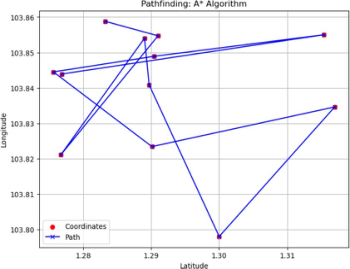
Figure 1 shows a graphical representation of pathfinding using the A* Algorithm. It can be observed that the algorithm was able to plot the data point on the map as well as, using the blue lines, map out the most optimal route from one point to the next.
Figure 1: Graphical representation showing pathfinding using A* Algorithm.
However, while it is able to map out the most optimal route, A* mainly depends on calculating the distance from point to point. This may prove to be an issue in real-world contexts, where the path from one point to another is often not in a straight line.
Nearest-Neighbour search (NNS) provides the sequence of locations we should visit as the optimal route, as well as the total travel time to complete the journey. NNS instead of using the distance from point to point, instead uses the travel time from point to point to craft its routes. In a real-world context, this will prove to be useful as it is able to take into account traffic, weather, path deviations and other external factors, adjusting travel time realtime, and providing a more effective and optimal delivery route.
WIth this research, current delivery services will be able to deliver goods more efficiently without heavily relying on human labour. This will largely decrease the cost needed for delivering and reduce the rate of late deliveries. Besides, fuel consumption will be reduced compared to current methods therefore delivery services will be more environmentally friendly by reducing the release of greenhouse gases, contributing to the SGD goals where global carbon dioxide emissions need to be reduced by 45 per cent by 2030 from 2010 levels (United Nations, n.d.). Traffic conditions will also get smoother as there will be less vehicles moving on the road for delivery purposes. Delivery companies will have lesser risk in losing goods due to mistakes in sorting or delivery.
During this research, we faced a few challenges. Limited data regarding delivery details (e.g. percentage, delivery service provider, root cause of late delivery) from delivery service company. We are unable to determine the effectiveness of our research as we do not have sufficient data to make comparison. In order to evaluate the research study result in a more effective way. We are looking forward to collaborating with a reputable delivery service provider.
After the current sorting system, our aim is to work on the autonomous delivery robot so that parcels can be delivered to each customer’s doorstep. It will work with our current work to provide a more effective solution in solving delivery problems in terms of effectiveness and reliability.
Design and Development of a Student-Initiated Automated Delivery System 467
CONCLUDING REMARKS This research focused on using Raspberry Pi 5 and various route optimisation or computer vision algorithms to solve problems met in delivery systems. It solves the problems through making a new sorting system and a better delivery system. The delivery system will consider both optimal route and time for delivery. Through this, the research will be able to address key challenges such as labor dependency, sorting inefficiencies, and routing limitations. The system enhances efficiency, reduces environmental impact, and lowers operational costs, offering a scalable and sustainable approach to meet the growing demands of e-commerce.
REFERENCES
aptean.com. (2020). How Much Is Inefficient Delivery Route Planning Really Costing You? [Online]. Available at: https://www.aptean.com/en-US/insights/ blog/inefficient-delivery-route-planning-cost/ [Accessed 11 February 2025]. conexiom.com. (2020). Data Entry: What Data Entry Error Rate is Acceptable?
[Online]. Available at: https://conexiom.com/blog/understanding-impact-100-per cent-order-accuracy/ [Accessed 11 February 2025]. datarootlabs.com. (2024). AI in Logistics: Emerging Startups, Challenges and Use Cases [Online]. Available at: https://datarootlabs.com/blog/ai-in-logistics- emerging-startups-remaining-challenges-and-new-models/ [Accessed 11 February 2025]. descartes.com. (n.d.). 5 Reasons Customers Love Real-time Order Tracking [Online].
Available at: https://www.descartes.com/resources/knowledge-center/5-reasons- customers-love-real-time-order-tracking/ [Accessed 11 February 2025]. digiconasia.net. (2019). Smart postal service for a smart nation [Online]. Available at: https://digiconasia.net/features/smart-postal-servic e-for-a-smart- nation/ [Accessed 11 February 2025]. fareye.com. (2023). What are delivery issues? [Online]. Available at: https:// fareye.com/resources/blogs/common-delivery-issues-solutions/ [Accessed 11 February 2025]. fulfillmenthubusa.com. (n.d.). Navigating the Hurdles: The Challenges of Real-Time Tracking for Customer Deliveries [Online]. Available at: https://fulfillmenthubusa.com/navigating-the-hurdle s-the-challenges- of-real-time-tracking-for-customer-deliveries/ [Accessed 11 February 2025]. golocad.com. (2023). Understanding Consumer Behaviour During Singapore’s
Double-Day Sales [Online]. Available at: https://golocad.com/blog/consumer- behaviour-during-double-day-sale-singapore/ [Accessed 11 February 2025]. locus.sh. (2023). Six Package Sorting Mistakes That Impact Your On-Time Delivery Rates [Online]. Available at: https://blog.locus.sh/six-package-sorting-mistakes- that-impact-your-on-time-delivery-rates/ [Accessed 11 February 2025]. logiwa.com. (2024). Prepare for peak season with inventory management best practices [Online]. Available at: https://www.logiwa.com/blog/peak-season- inventory-man agement-best-practices/ [Accessed 11 February 2025]. opsdesign.com. (2023). Labor Disputes May Impact Small Parcel Delivery [Online]. Available at: https://opsdesign.com/labor-disputes-may-impact-small- parcel-delivery/ [Accessed 11 February 2025].
researchandmarkets.com. (2024). Parcel Delivery Global Market Report 2024 [Online]. Available at: https://www.researchandmarkets.com/report/ global-parcel-delivery-market/ [Accessed 11 February 2025]. seosandwitch.com. (n.d.). AI in Logistics: Key Statistics and Insights [Online].
Available at: https://seosandwitch.com/ai-in-logistics-stats/ [Accessed 11 February 2025]. Straits Times. (2022). E-commerce sales in S’pore expected to reach $19.6b by 2027, despite slower growth this year. [Online]. Straits Times. Available at: https://www.straitstimes.com/business/e-commerce- sales-in-spore-expected-to-reach-196b-by-2027-des/ [Accessed 11 February 2025]. tidio.com. (2024). Online Shopping Statistics: Ecommerce Trends for 2025 [Online].
Available at: https://www.tidio.com/blog/online-shopping-statistics/ [Accessed 11 February 2025].
LISTED IN THE AHFE DIGITAL BOOKSTORE CATALOGUE
Explore the complete digital volume
Human Interaction and Emerging Technologies (IHIET 2025)
Read this individual research paper free through the original publisher, or explore the full digital proceedings book.
ISBN 978-1-964867-73-1
Explore this ISBN in the AHFE Bookstore ↗Listed in the July 2026 bookstore catalogue; search by ISBN to confirm current availability · Digital book purchase optional