Omar Mohammad, Haissam El-aawar (2026). Intelligent Lift System for Automotive Servicing: Enhancing Alignment, Safety, and Efficiency through Sensor-Based Automation. In: Human Interaction and Emerging Technologies (IHIET-AI 2026): Artificial Intelligence and Future Applications. AHFE Open Access, vol. 201, pp. 261–268. https://doi.org/10.54941/ahfe1007179
The automotive servicing industry is undergoing a significant transformation with the development of an autonomous adaptive lift system that enhances safety, precision, and efficiency. While traditional vehicle lifts demand manual adjustments, risking misalignment and workplace hazards, our enhanced system integrates advanced sensing and control mechanisms to fully automate both vehicle positioning and lifting. In addition to existing IR sensors for lifting-point detection, the new system incorporates side-distance sensors to monitor the spacing between the car and lift posts. A driver facing display provides real-time guidance during parking, ensuring optimal alignment before lifting. Once aligned, an intelligent controller manages lift movement with precise up-and-down adjustments, aided by limit switches that prevent over-extension and ensure stable positioning. An emergency stop button is also integrated to allow instant power cutoff in case of malfunction, reinforcing operational safety. These innovations sensor-based parking assistance, visual feedback for drivers, automated lift control, and enhanced failsafe features create a comprehensive system that not only improves accuracy in vehicle alignment and lifting but also raises workplace safety standards. By combining intelligent automation with user-friendly safeguards, this research demonstrates a forward-looking solution to reshape automotive servicing practices, reduce human error, and increase overall efficiency in garage operations.
In the rapidly evolving context of Industry 4.0, the integration of autonomous systems into automotive maintenance presents a transformative opportunity to enhance both operational efficiency and occupational safety. Human Factors Engineering (HFE), which studies the interplay between human capabilities and technological systems, becomes especially critical when introducing automation into traditionally manual tasks such as vehicle lifting, servicing, and repair. By carefully designing automated support systems, we can reshape garage workflows to reduce exposure to risk, optimize task allocation, and mitigate human error thereby addressing both productivity and safety priorities.
262 Mohammad and El-Aawar Occupational accidents in the automotive repair sector are not trivial. A seminal study in Spain analyzed 89,954 work-related accidents in automotive repair workshops between 2003 and 2008, revealing significant risk factors associated with firm size, worker demographics, and health and safety practices. For example, workers in smaller firms (≤ 5 employees) exhibited higher odds of certain injury types, underscoring the need for tailored preventive strategies (López-Arquillos, 2016). Workplace accidents impose major human and financial costs. In addition to injuries, they generate direct expenses (compensation, repairs) and indirect losses (reduced productivity, retraining, reputational damage). Global and regional data show that occupational injuries create a significant economic burden—for example, EU-OSHA estimates that such accidents cost the EU-28 hundreds of billions of euros annually, representing about 3.3% of GDP. From a human-factors and automation perspective, introducing autonomous systems in maintenance requires careful design. Research in safety-critical industries shows that while automation can lower workload and reduce errors, inadequate transparency or excessive automation can decrease worker trust, autonomy, and sense of control (Niehaus, 2022). In parallel, in industrial environments, studies of human–robot interaction demonstrate that factors such as robot motion, speed, and behavior significantly influence employees perceived safety and trust (Haney, 2024). In manufacturing settings, automating assembly lines has yielded meaningful reductions in risk, thanks to sensors, control systems, and real-time feedback loops (Nioata, 2025). Given this confluence of challenges and opportunities, our research aims to explore how advanced autonomous systems such as automated lifts, sensor-assisted diagnostics, and intelligent human-system interfaces can be integrated into garage car services to, reduce injury risk, improve operational efficiency, and catalyse industry transformation.
LITERATURE REVIEW
A relevant patent describes a vehicle position detection and guidance system for service lifts, which uses a LiDAR sensor mounted at the front of the lift to monitor both the wheel positions and potential obstructions under and around the vehicle. The system provides steering correction guidance and prevents lift motion if obstacles are detected while LiDAR and camera-based systems are expensive for small/medium garages. (Washington, DC: U.S. Patent and Trademark Office. Patent No. 10,556,780, 2020). Some research uses distance measurement and sensor technology like Ultrasonic sensors that are widely used in automotive control systems from long time, particularly for parking assistance. Ultrasonic distance sensing is well characterized in industrial-control applications, they measure distance by emitting sound pulses and calculating the echo delay (Gáspár, 2014).
Many alignments and automation system used vision to help in automatic alignment. In typical wheel-alignment processes in maintenance shops, computer-vision systems use IR LEDs and CCD cameras to detect alignment targets attached to wheels (Kim, 2020). These systems are analogous to your lift’s alignment mechanisms, especially where you rely on sensors to detect
Intelligent Lift System for Automotive Servicing 263 lift-points and correct placement before lifting. While this technology shows a faulty error due to environmental conditional and also require calibration often as vision systems need frequent calibration for accuracy. Moreover, poor lightning, shadow, reflective car surface, or dirt reduce detection reliability which make this system good for wheel alignment but not relevant for positioning car on lifts.
Another study converts a traditional manual scissor jack into an automated lifting device using a DC motor, lead screw, and mechanical linkages. The researchers tested the prototype with actual vehicle loads (e.g., Toyota Rav4), measuring lifting time, maximum height, and torque requirements. The work demonstrates how motorized actuation and electromechanical conversion can significantly reduce manual effort while enhancing operational safety. It provides fundamental insights into motor sizing, gear ratios, and mechanical efficiency for automated lifting mechanisms. While Limited safety features only basic motor control, no redundant sensor and Lacks automation intelligence no obstacle detection, no auto-leveling, no load monitoring (Ajayi, 2024).
Research proposes an autonomous adaptive lift system with RGX Controller that uses an Arduino-based Micro-controller, infrared sensors, ultrasonic sensors, and emergency-stop circuitry to automatically identify vehicle dimensions and engage lifting points. The system emphasizes both automation and safety through multi-sensor fusion, real-time feedback, and adaptive positioning. While that system reduced operator intervention, it still relied on manual positioning of the vehicle between the posts and lacked manual height adjustments for vehicles of varying heights. Misalignment could result in one side of the car being closer to a post, increasing the risk of contact (El-Aawar, 2024).
METHODOLOGY
The primary objective of this research was to develop and evaluate an automated alignment and lifting system for two-post automotive lifts that enhances precision, safety, and efficiency in vehicle servicing operations. The system integrates advanced sensor technologies, precise motorized actuation, microcontroller-based control, and operator feedback mechanisms to minimize human error during vehicle alignment and lifting.
The automated lift system was designed around an RGX advanced kit with Arduino microcontroller, which coordinates the movement of the lift arms, sensor inputs, motor operations, and user commands. Infrared (IR) sensors were implemented to detect the position of the lift arms beneath the vehicle, while ultrasonic sensors were employed to provide real-time feedback for the driver to centre the vehicle accurately within the lift bay. The system also includes servo motors coupled with gear lines to move the lift arms precisely, and a Gear DC motor for vertical lifting, with torque automatically adjusted according to vehicle type and weight. A 16×2 liquid-crystal display (LCD) provides visual guidance to the driver during positioning, and manual up– down buttons allow operators to fine-tune the lift height as needed. Safety
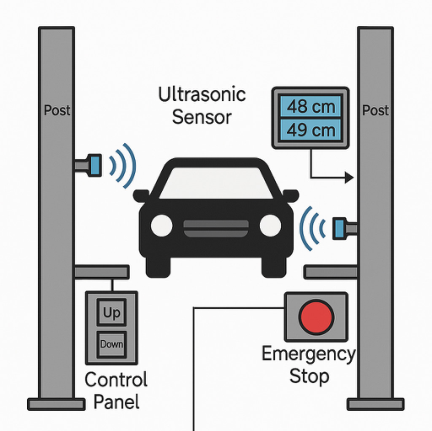
264 Mohammad and El-Aawar is reinforced through an emergency stop button, which immediately cuts power to the system in case of malfunction, and limit switches that prevent overextension of the lift arms, See Figure 1.
The control algorithms were developed in C++ using the Arduino IDE. Upon vehicle entry, the IR sensors detect the initial position of the lift arms, which then begin to move under the vehicle using the servo motors and gear system. If the predefined alignment points, indicated by colored blocks or circular markers on the vehicle, are not immediately located, the lift arms oscillate slightly forward and backward in search of the correct positions. Once alignment points are detected on both sides of the vehicle, flags in the software confirm the precise positioning of the two posts. Following this confirmation, the Gear DC motor engages to lift the vehicle vertically, adjusting torque dynamically to suit the specific vehicle. Drivers can monitor centering progress through the ultrasonic sensors displayed on the LCD, and adjust the lift height manually if necessary, ensuring precise positioning throughout the process.
A prototype two-post lift was constructed to implement this design, and functional tests were conducted within a controlled environment simulating real workshop conditions. Vehicles marked with alignment indicators were used to evaluate the system’s performance. The tests focused on the system’s ability to move lift arms under the vehicle accurately, detect alignment points via IR sensors, and adjust arm positioning as necessary until successful alignment was achieved. Additional testing verified the functionality of the ultrasonic sensor guidance, LCD feedback, manual height adjustments, and emergency stop mechanism.
The system was evaluated based on alignment accuracy, operational efficiency, safety, and user experience.
Figure 1: Illustration of the proposed prototype two-post lift system.
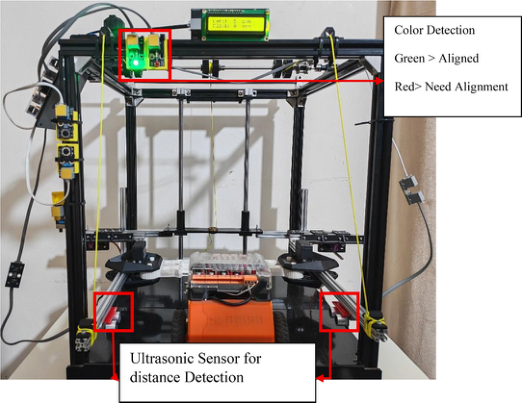
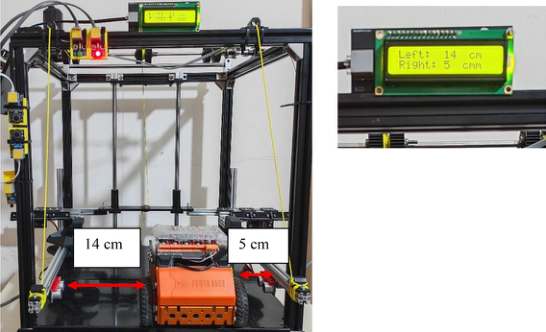
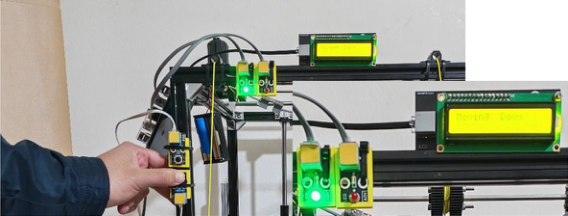
IMPLEMENTATION The implementation of the automated two-post lift system began with the careful assembly of its core hardware components, including servo motors, gear lines, and infrared (IR) sensors. Before initiating the alignment process, the system was designed to ensure that the distance between the left and right lift arms was equal or at least approximately equal guaranteeing balanced positioning under the vehicle. Only when this condition was met did the system proceed to the next stage, See Figure 2. The servo motors and gear lines were integrated to provide precise horizontal movement, allowing the lift arms to navigate accurately beneath the vehicle for optimal alignment. Simultaneously, the IR sensors were installed and calibrated to detect the exact moment the lift arms were correctly positioned under the car, marking the start of the automated alignment phase. Ultrasonic sensors were also incorporated to provide real-time distance measurements to the driver, assisting in centering the vehicle within the lift bay. A 16×2 liquid- crystal display (LCD) was employed to provide clear guidance and feedback, ensuring that the vehicle was properly aligned before lifting commenced as shown in Figure 3.
The implementation of the automated two-post lift system began with the meticulous assembly of its core hardware components, including servo motors, gear lines, and infrared sensors. A comprehensive control program was developed to manage the entire process, from the car’s entry to the precise alignment of the lift arms, ensuring a seamless and highly efficient operation. The integration of servo motors and gear lines, ingeniously designed to facilitate precise horizontal movement beneath the vehicle. This crucial step ensured the lift arms could accurately navigate and position themselves for optimal alignment as shown in Figure 2.
Figure 2: Assembly and alignment of the automated two-post lift system hardware.Figure 3: Real-time vehicle alignment and user guidance interface in the two-post lift system.
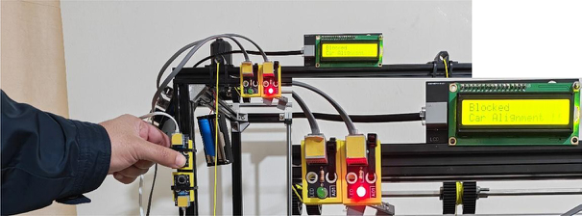
Following hardware installation, an RGX advanced kit was connected and programmed to manage the entire lifting operation. The control program activated the servo motors and gear lines for initial positioning, processed input from the IR sensors to confirm correct placement under the vehicle, and controlled the Gear DC motor to lift the vehicle, see Figure 4. Sophisticated detection and alignment algorithms processed sensor data, directing incremental movements of the lift arms until the designated alignment points on the vehicle were located. Once proper alignment was confirmed through flags in the system’s code, the lifting sequence was initiated, raising the vehicle to the desired height safely and accurately, see Figure 5.
Figure 4: Successful vehicle alignment enabling manual control of lift movement.Figure 5: Misalignment detection and safety lockout preventing lift movement.
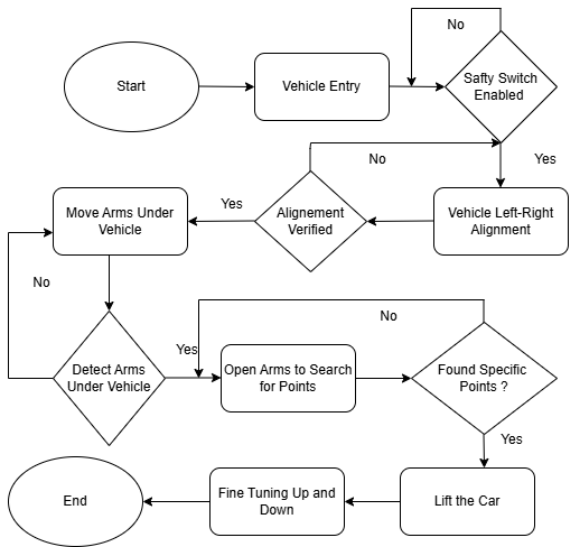
Intelligent Lift System for Automotive Servicing 267 To enhance operator flexibility, the system was designed to allow manual adjustments of the lift height using up and down buttons. This feature enables the user to fine-tune the vehicle’s elevation according to specific service requirements or personal preference. Safety was further reinforced through an emergency stop button, which immediately interrupts power to halt all movement, and limit switches, which prevent the lift arms from overextending beyond safe operational limits, as shown if Figure 6 with control logic of the whole system.
Figure 6: Control logic of the automated vehicle alignment and lifting system.
CONCLUSION
This study successfully developed an advanced automated two-post lift system for automotive servicing, integrating ultrasonic sensors, an LCD display, manual up–down controls, and robust safety features such as emergency stop. These enhancements enable precise vehicle alignment, real-time driver guidance, and flexible height adjustments, significantly reducing human error and improving operational efficiency.
This research represents a notable advancement in automotive lift technology, offering a practical and scalable solution to enhance both productivity and safety in workshop operations. With further refinement and real-world validation, the system has strong potential to set new standards for precision and reliability in automotive servicing.
ACKNOWLEDGMENT
The authors wish to express their sincere gratitude to His Excellency Abdel Rahim Mourad, President of the Lebanese International University, and to the administration of the LIU Bekaa campus for their ongoing support and encouragement of research initiatives at the university.
REFERENCES
Ajayi, A. B. (2024). Development of an Automatic Scissors Screw Car Jack. ABUAD Journal of Engineering Research and Development (AJERD), 7(2), 193–206. El-Aawar, H. a. (2024). System, Revolutionizing Automotive Industry for Servicing
An Autonomous Adaptive Lift. Human Interaction and Emerging Technologies (IHIET 2024), 1(1). Gáspár, P. a. (2014). Highly Automated Vehicle System. Retrieved from https:// scholar.googleusercontent.com/scholar?q=cache:weNGdzCHKo4J:scholar. google.com/+Highly+Automated+Vehicle+Systems&hl=en&as_sdt=0,5. Haney, J. M.-J. (2024). A literature review on safety perception and trust during
human–robot interaction with autonomous mobile robots that apply to industrial environments. IISE transactions on occupational ergonomics and human factors, 12(1-2), 6–27. Kim, S. H. (2020). Wheel alignment of a suspension module unit using a laser module. Sensors, 20(6), 1648. López-Arquillos, A. &.-R. (2016). Analysis of Workplace Accidents in Automotive
Repair Workshops in Spain. Safety and health at work, 7(3), 231–236. Retrieved from https://doi.org/10.1016/j.shaw.2016.01.004. Niehaus, S. a. (2022). An occupational safety and health perspective on human in control and AI, Frontiers in artificial intelligence, 868382. Nioata, A. a. (2025). Workplace Safety in Industry 4.0 and Beyond: A Case Study on
Risk Reduction Through Smart Manufacturing Systems in the Automotive Sector. Safety, 11(2), 50. Zecher, M. J. (2020). Washington, DC: U.S. Patent and Trademark Office. Patent No. 10,556,780.
LISTED IN THE AHFE DIGITAL BOOKSTORE CATALOGUE
Explore the complete digital volume
Human Interaction and Emerging Technologies (IHIET-AI 2026): Artificial Intelligence and Future Applications
Read this individual research paper free through the original publisher, or explore the full digital proceedings book.
ISBN 978-1-964867-77-9
Explore this ISBN in the AHFE Bookstore ↗Listed in the July 2026 bookstore catalogue; search by ISBN to confirm current availability · Digital book purchase optional