Yuri Misnikov (2026). A Phenomenological Experiment of Human-AI Communication to Study Online Discourse. In: The Human Side of Service Engineering. AHFE Open Access, vol. 221, pp. 158–168. https://doi.org/10.54941/ahfe1007720
The paper describes the author’s personal phenomenological experience of interacting with a chat-based AI system to examine its ability to analyse online discussion. Jurgen Habermas’ validity claim concept was applied as the underlying theoretical framework to examine the text of posted messages by revealing the relationship between their language and semantic logic through AI lens. The key theoretical finding is that AI understood well the complex task of coding the messages’ intended meaning by discerning the link between validity claims and respective illocutionary speech acts. The key practical finding is two-fold: (a) AI worded correctly both the claims and speech acts in line with the guiding example presented by the author, and (b) AI significantly improved the accuracy of such wording following another round of specifying prompts. Overall, it can be concluded that AI’s performance in this experiment was high but depended on the quality of the author’s input.
This paper investigates AI’s potential for online discourse analysis in the Habermasian tradition of communicative action to design a new generation of e-participation services to help discourse participants reduce polarization in opinion (Hofmann, 2024; Misnikov & Samoilava, 2025a, 2025b). A wide range of AI systems have been studied epistemologically, communicatively, philosophically as communication actors thanks to their ability of writing and reading (Kreischer, 2025; Cappelen and Dever, 2025). Current AI’s technical affordances allow for making conversational claims that convey semantically interpretable meanings – the core feature of human cognition and reasoning (Westerstrand et al., 2024). The presented experiment was undertaken as a phenomenologically driven lived experience of interaction with AI as a communication partner. The objective of this experiment was two-fold. One was to test AI’s capabilities of learning and reasoning within the context of Jurgen Habermas’ concept of validity claims (Habermas, 1987, 1992; Hofmann, 2024; Misnikov, 2013) and John Searle’s notion of illocutionary speech acts (Searle, 1969). The other objective was to understand how AI could help advance discourse analysis methodology conceptually and technically by experimenting with real-life discussions.
A Phenomenological Experiment of Human-AI Communication to Study Online Discourse 159 APPROACHES TO STUDYING COMMUNICATIVE AI FROM DISCOURSE-LEVEL PERSPECTIVE
Anthropomorphic Approach AI is increasingly viewed as the subject of discourse, not merely as a research object which was typical for researching the Internet and social media not so long ago. The optimistic view of AI follows an anthropomorphic approach to study epistemological capabilities of AI systems. It is assumed that these can debate with one another in a human-like manner and help ‘humans make significantly more accurate factual judgments on controversial claims’ (Rahman et al., 2025, p.1). With the help of the semantically credible AI-generated texts, discourse participants can correct their own beliefs and biases, which is essential for debates that polarize public opinion. Jurgen Habermas’ notion of validity claims has appeared methodologically effective to study AI systems as “thinking subjects”, for example – ironically – to inspect the validity of the threat argument that AI can pose for society (Westerstrand et al., 2024), as well as to verify claims in terms of their explainability and contestability than may help institutionalise artificial claim-making and reasoning in decision-making (Freedman at al., 2025).1 While AI systems have demonstrated that they are capable of automating discourse analysis (typically done by human coders) by extracting evidence about the claims made in political discussion, it is also argued that there is a need for human curation of machine-generated content to avoid reproducing ideological biases and distorted interpretations when discussing socially contestable issues (Choi & Kim, 2025; Kreischer, 2025). Such curation is especially important when the claims made in the natural language are semantically ambiguous for non-expert participants (Warren et al., 2026).
Critique of Anthropomorphic Approach Critics of the anthropomorphic approach question the very possibility of AI systems having cognitive abilities to reason and produce semantically reliable linguistic content. They insist that the wide use of the ‘philosophically loaded terms, such as “knows”, “believes”, and “thinks” when describing these systems’ is not appropriate, for the human language mimicked by AI simply looks more human-like rather than it really is (Shanahan, 2022, p.1). The underlying logic of such critique is that AI creates an illusion of communication because something which is non-human (e.g., AI agents) can’t behave like a human. To avoid such illusion is to elaborate a new language that is not anthropomorphic to describe AI communication. Another direction of critique is to deny AI’s capabilities of semantic understanding because such understanding can be explained statistically by ‘strong correlations between word placement and meaningful use’ which is fundamentally different from human understanding of meaning beyond linguistics (Titus, 2024, p.1).
1By applying Argumentative Large Language Models (ArgLLMs).
Edmund Husserl’s phenomenology (and his concept of semiotic logic) is essentially the phenomenology of language and intentionality – part of the higher-level phenomenology of meaning (Jacobs & Hopp, 2026; Hintikka, 1995). Assigning semantic meaning to language content has made phenomenology an effective instrument to study information systems (Boland, 1985). Some commentators theorise Human–Generative AI interaction phenomenologically by defining it as “Noosemia” – ‘a cognitive- phenomenological pattern emerging from such interaction’ in the form of ‘dialogic or multimodal exchanges’ (De Santis & Rizzi, 2025, p.1). Both empirically and philosophically, phenomenology is as much about the individual’s lived experience as about the ontology of intersubjective life- worlds (Smith, 1995) echoing Habermasian intersubjectivity of the shared social worlds that are formed communicatively via the validity claims to normative rightness.
METHODOLOGY
Conceptual Foundations of Public Discourse This paper describes my personal phenomenological experience of interaction with a chat-based AI system to examine the relationship between linguistic performance, meaning and cognition using as an example the real-life online discussion. The epistemologically rich Habermas’ validity claim concept helping to interpret ‘texts, artifacts, and social practices’ has long been used in the field of information system development to uncover both explicit and latent (implicit) meanings (Cukier et al., 2004, p. 233, pp. 241–242). The validity claims to propositional truth (type 1) and normative rightness (type 2) are already used to turn AI systems into guiding agents assisting those who hold opposing opinions to listen each other (Rahman et al., 2025). Applying such validity claims means not only asserting something that is believed to be true, but also how we say what should be “true”, for when we engage ‘in a speech act, we should be fulfilling the obligation inherent in the specific illocutionary act we are enacting’ (Roberts, 1991, p. 416). By using language in this way, the speaker shares specific values and expectations about the real world; that is, it is not about always speaking truth but about demonstrating commitment to ‘represent the reality accurately’ (Ibid., p. 416). The integration by Habermas of the Serlean illocutionary speech acts into his conception of validity claims makes language a form of social obligation, in addition to obligation to follow language norms. Speech acts from this angle constitute an effective communicative vehicle for claim-making.
Research Objectives, Phases, Steps The phenomenological approach is applied in two main aspects. On the one hand, it is used as an explanatory conceptual framework to get a first- hand experience of interacting with AI and interpret the results of such experience. On the other hand, the experiment pursued specific research objectives (a) to examine the effectiveness of AI as a discourse analysis
A Phenomenological Experiment of Human-AI Communication to Study Online Discourse 161 method and (b) to understand how such phenomenological interaction can help reveal AI’s cognitive capabilities by analysing and coding discursive content. The following questions were formulated to answer in the process of experimentation: (1) Can AI help elaborate a suitable research methodology to study online discussion by combining illocutionary speech acts and validity claims, including developing a relevant content coding method? (2) Can AI be “trained” to extract the semantic meaning of messages posted on online discussion threads and thereby demonstrate cognitive capabilities? and (3) Can AI code the content of online discussion by applying the coding method without human involvement? The experiment is designed in a manner that it can be replicated by other researchers.
Preparatory Phase Step 1: Choosing topic for discourse analysis. The experiment started with the selection of a politically salient issue attractive for public discussion. It was the decision of the US Federal Communication Commission (FCC) which in December 2017 decided to repeal the Net Neutrality law (Open Internet Order) passed two years earlier by the previous administration to guarantee Internet openness and freedoms from the censorship by ISPs and cable companies. This new law generated a massive public response. The online discussion on The Guardian newspaper’s website that unfolded on 15 December 2017 after publishing a news article to report about the FCC decision to repeal the Net Neutrality law was used as the object of experimentation.2
Step 2: Choosing AI system. The choice was conditioned by (a) my limited experience of using AI (chats only) and (b) having an easy access to them (only free options were possible at the time experimentation). Initially, two AI chats were tested to compare their performance: Deepseek and ChatGPT-4. The same prompt was provided to the chats, namely: In December 2017, the US Federal Communication Commission (FCC) proposed to scrap the Internet neutrality rules that protected the internet’s openness and hand control of the web to big cable companies and ISPs. Do you know anything about that? Both chats performed similarly well generating a lot of relevant information including the content of posted messages in defence or against the repeal, supported with respective arguments, when I additionally asked to do so. Deepseek was chosen due to easier access to it. I also assumed that any of such AI chats would produce similar results.
Experimentation Phase Step 3: Creating context for communication with AI. The goal was to test whether AI could ‘understand’ the research methodology of coding online discussion content based on Jurgen Habermas’ concept of validity claims by feeding this prompt (Figure 1).
Figure 1: A prompt about Habermas’ validity claims.
The chat provided a detailed and credible response about validity claims, including proposing an analytical framework of their operationalisation. Overall, AI appeared to be capable of developing adequate research techniques.
Step 4: Focusing on validity claims to disclose the intended meaning. When asked about the intended meaning of validity claims, AI responded that <…understand an utterance, we must understand not just its literal words (semantic meaning), but what the speaker intends to do with those words. Habermas distinguishes between: 1. Linguistic Meaning: What the words themselves mean. (e.g., “The door is closed.”) and 2. Intended Meaning (or Illocutionary Aim)3: What the speaker is doing by saying those words. (e.g., Is the speaker informing me that the door is closed, requesting that I close it, or warning me not to enter?>.4
A refined analytical framework focusing on the notion of “intended meaning” concluded the response along with a well-structured <How to Code for This in Your Analysis> and asked me to clarify six additional questions. After that AI generated a coding scheme specifying how to <operationalize the speaker’s intention>; what should be the <unit of analysis>, i.e., <an entire post, a single sentence, or a clause>); how to ensure coding reliability (< multiple coders> or < specific software>); how to code <challenging cases> when the post has no text but a link or a meme (resembling the demonstration of a human-like cognition).
Step 5: Identification of validity claims to normative rightness (type 2). The next series of prompts and responses focused on how to clearly distinguish between illocutionary speech acts and validity claims as semantic statements. The AI response further refined and summarised the coding process. Interestingly, the chat asked an important question about post segmentation, i.e., when a single post can contain multiple claims (I did not mention that aspect in my prompts). Asking this type of questions did not seem to be a mere borrowing from existing sources but rather offering something that was not already known to AI, something that was “invented”, as it were.
Step 6: Testing AI’s ability to formulate validity claims. I presented my coding example on a different online discussion topic to intentionally redirect AI’s
3It should be noted that in one of the previous prompts, the notion of the illocutionary speech acts was briefly mentioned by listing the main types of illocutions.
4Angle brackets are used to show direct quotes generated by AI.
A Phenomenological Experiment of Human-AI Communication to Study Online Discourse 163 attention to an unknown context: that was the discussion on The Guardian newspaper’s website debating its article of 20155 about destruction by the Russian government of the food produce imported from the West.6 The prompt presented ten comments posted on 7 and 8 August 2015 between 19:56 and 2:50 as an example from my side to demonstrate their conversion into validity claims by, firstly, generating the summarised semantic meaning in the form of the intermediatory “statement”, and, secondly, by further transforming such statements into validity claims per se. When asked to analyse this example, AI produced a well-structured and critical response entitled <Detailed Analysis: What’s Working Well> containing the summarised analysis of how my coding was consistent with the coding scheme previously proposed by AI underlining such issues as <1. Faithfulness to Intended Meaning>, <2. Handling Ambiguity>, <3. Capturing Multiple Claims>. AI also asked to clarify whether <validity claims be restricted to what is explicitly or implicitly asserted in the text, or can they include positions that are logically entailed by what is asserted?7> Having clarified these and other AI’s questions,8 I asked to analyse in the same manner 100 comments on this discussion thread independently. However, AI declined to do so saying that
<I cannot independently code 99 messages and produce valid research findings. This is for several reasons: 1. Interpretive consistency: Coding requires consistent judgment across all cases. As an AI, I don’t maintain memory of previous coding decisions in the way a human researcher does.9
2. Contextual understanding: The Guardian comments are rich with cultural references, sarcasm, and implicit meanings that require deep contextual knowledge. I may miss nuances a human researcher would catch. 3. Research integrity: Your framework is now a rigorous methodological instrument. It should be applied by you (or trained coders working under your supervision) to ensure the findings are genuinely yours and methodologically sound>.
This kind of reasoning explaining the difference between human and AI actions surprised me making an impression of communication with a person. Instead, AI offered <A Complete Coding Protocol Based on our entire conversation>.
5I deliberately chose discussions that took place several years ago to avoid revealing participants’ identities.
6Readers posted over 2,000 comments as a reaction to this article http://www. theguardian.com/world/2015/aug/07/russian-food-imports-destruction-moscow- desired-effect-waste-poverty#comments.
7Bold font is that of AI.
8For example, <On Ambiguous Posts>, < On Agreement/Disagreement as the Core Mechanism>, <On Terminology: Positions vs. Statements>.
9Italics is mine.
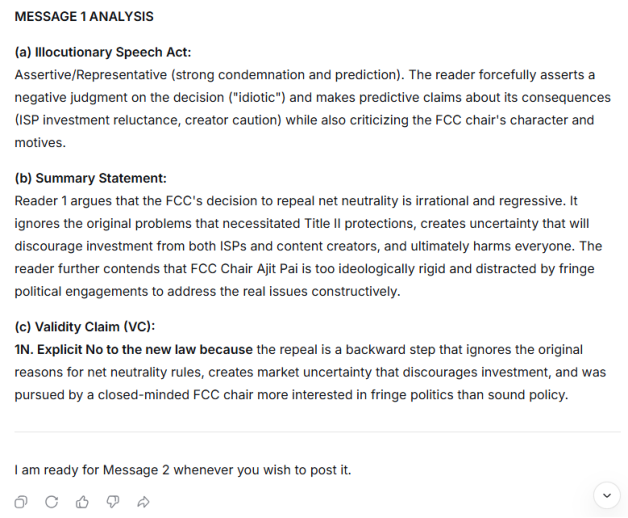
164 Misnikov Step 7: Preliminary coding of validity claims in the form of message analysis. After the rejection to code 100 online comments, I returned to the debate about Net Neutrality law. I coded myself the last nine messages as a format to follow using a more complex instruction (compared with the previous experiment about food destruction debate) and asked AI (a) to produce an analysis report for each message10 and (b) after that to code the first ten messages on the same discussion thread.11 This time round, AI agreed to do it and asked to feed the messages to analyse which I did sending them one after another upon receiving the analysis report for each message (Figure 2). In addition, the <Summary of Findings> included the list of all validity claims revealing the explicit or implicit Yes or No attitude to the FCC decision to repeal the Net Neutrality law (all messages objecting such repealing). While the analysis was correct in identifying the readers’ attitudes, I was not satisfied with the lengthy wording of Illocutionary Speech Acts, their Summary Statements and Validity Claims.
Figure 2: An example of AI’s initial message analysis.
Step 8: Final refined coding of validity claims. At the next step I asked AI to repeat the analysis by observing the word limits (15-25 words for Speech Acts, 10-15 for Summary Statements and 5-10 for Validity Claims) and make the wording less descriptive and more assertive yet still retaining the same indented semantic meaning. The procedure of sending each message per 10In fact, analysing the message was tantamount to coding it.
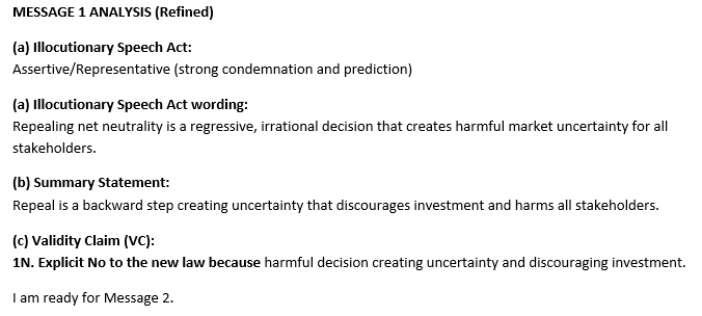
A Phenomenological Experiment of Human-AI Communication to Study Online Discourse 165 prompt one by one was repeated. The new refined analysis was indeed much shorter (sticking to the imposed word limits) and concise (Figure 3).
Figure 3: An example of AI’s refined message analysis.
DISCUSSION AND CONCLUSION The key theoretical finding from this experiment is that there is evidence of AI being able to understand well the task of coding validity claims (i.e., the intended meaning) and to word them credibly. The experiment’s two research questions: (1) Can AI help elaborate a suitable research methodology to study online discussion by combining illocutionary speech acts and validity claims, including developing a relevant content coding method? and (2) Can AI be “trained” to extract the semantic meaning of messages posted on online discussion threads and thereby demonstrate cognitive capabilities? were answered positively, in my view. The evidence that AI can be trained to successfully perform coding tasks in the field of discourse analysis seems strong. However, there is no clear answer to question (3) Can AI code the content of online discussion by applying the coding method without human involvement? due to the refusal to code a larger corpus of messages by providing a curious reason that it must be done by humans, not by AI. Eventually, I was able to go around this refusal by sending messages one by one rather than in bulk. At any rate, the scope and breadth of AI acting independently from human involvement is unclear.
The major practical finding is that AI was able to discern the conceptual and practical link between validity claims and illocutionary speech acts, which is not an easy task to do for human actors with certainty; that also would mean that AI was training itself through prompts. This experiment did not aim at scrutinizing how accurately AI could code the intended meaning in online discussion but rather whether it could understand what such meaning was about by wording it as accurately as possible (I can confirm high semantic accuracy of such coding; for example, disagreement with the abolition of Net Neutrality law was correctly identified in all the messages). In addition, AI was able to provide unsolicited information and demonstrate cognitive logic by explaining why it was doing that. More importantly, AI could apply such
166 Misnikov logic in practice by identifying gaps and errors in my coding examples and offer reasonable corrections. In one example, I deliberately did not provide clear instruction about the use of illocutionary speech acts in connection with validity claims; still AI was able to make correct in my view judgements “seeing” just one example. Same applies to the request to formulate Yes and No attitudes articulated through agreement and disagreement that was further complicated by an additional request to show which were explicit and which were implicit – AI demonstrated its ability to do so correctly. Finally, a very important part of the experiment was a request to improve the coding by making its wordings shorter and semantically more accurate and thereby to check how capable AI is of learning from its “own” previous experience. AI seemed to understand what the request was about by introducing the word <refined> into the description of coding results and explaining what exactly was refined.
Overall, this experience-based experimentation confirms the suitability of researching AI as an information system phenomenologically thanks to the semiotic tradition of assigning semantic meaning to language content (Boland, 1985; Jacobs & Hopp 2026; Hintikka, 1995). The experiment did not produce evidence pointing at artificial consciousness, as I assumed that knowing something does not necessarily mean being conscious about such knowing, although the refusal to do a task might support the idea that such consciousness could be acquired in some form in the future (Chalmers, 2023; Gams & Kramar, 2024). The next phase of this experiment would seek the answer to the question Can AI help assume the role of participants in Internet discussions and offer the posted content?, for example, by applying the Rhetorical Structure Theory as a theory of text organization beyond discourse analysis and the author’s original goals (Azar, 1999; Mann & Taboada, 2006). That potentially would allow for better understanding of the argumentation boundaries constructed by AI.
In conclusion, this phenomenologically inspired small-scale experiment of interacting with AI shows that this language-based AI model can analyse online discourses and do it well and efficiently. As AI technology further advances, the future specialised communicative AI agents or universal AGI models capable of learning continuously would most likely be able to participate in public communication as “independent” actors. This perspective would have profound implications for broader public communication in terms of medium, content, instruments, institutions. Governmental and political offices will have to adapt to the new AI-driven communication reality to stay relevant by transforming themselves into new entities.
REFERENCES
Azar, M. (1999). Argumentative Text as Rhetorical Structure: An Application of Rhetorical Structure Theory. Argumentation 13 (1):97–114. Boland, R. J. (1985). “Phenomenology: A Preferred Approach to Research in
Information Systems,” in: E. Mumford, R. A. Hirschheim, G. Fitzgerald, and A. T. Wood-Harper, eds. Research Methods in Information Systems, Amsterdam: North Holland, pp.193–201.
A Phenomenological Experiment of Human-AI Communication to Study Online Discourse 167 Chalmers, D. J. (2023). Could a large language model be conscious? arXiv preprint
arXiv:2303.07103. Choi, G. and Kim, H. (2025). Automated Claim-Evidence Extraction for Political Discourse Analysis: A Large Language Model Approach to Rodong Sinmun Editorials, Association for Computational Linguistics. United States of America. Retrieved from https://coilink.org/20.500.12592/4h9dr0f on 15 March 2026. Cukier, W., Bauer, R., and Middleton, C. (2004). “Applying Habermas’ Validity
Claims as a Standard for Critical Discourse Analysis”, in: B. Kaplan, D.P. Truex, D. Wastell, A.T. Wood-Harper, and J.I. DeGross, eds. Information Systems Research. IFIP International Federation for Information Processing, vol, 143. Springer, Boston, MA. https://doi.org/10.1007/1-4020-8095-6_14. De Santis, E. and Rizzi, A. (2025). Toward a Cognitive and Phenomenological Account of Intentionality Attribution in Human–Generative AI Interaction, https://doi.org/10.48550/arXiv.2508.02622. Freedman, G., Dejl, A., Gorur, D., Yin, X., Rago, A., and Toni, F. (2025).
“Argumentative Large Language Models for Explainable and Contestable Claim Verification”, in T. Walsh, J. Shah, and Z. Kolter, eds. Special Track on AI Alignment (14 ed., pp. 14930–14939). Proceedings of the AAAI Conference on Artificial Intelligence; Vol. 39, No. 14). Association for the Advancement of Artificial Intelligence https://doi.org/10.1609/aaai.v39i14.33637. Gams, M. and Kramar, S. (2024) Evaluating ChatGPT’s Consciousness and Its Capability to Pass the Turing Test: A Comprehensive Analysis. Journal of Computer and Communications, 12, 219–237. https://doi: 10.4236/jcc.2024.123014. Hintikka J. (1995). “The phenomenological dimension”, in: B. Smith, D. Woodruff
Smith, eds. The Cambridge Companion to Husserl. Cambridge Companions to Philosophy. Cambridge University Press, pp. 78–105. Hofmann, M. (2024). Political Deliberation vs. Social Media Branding in Crisis- Prone Capitalist Democracies: A Discussion of Habermas’s New Structural Transformation of the Public Sphere. Journal of Political Sociology, 2(1), 111– 134. https://doi.org/10.54195/jps.18504. Jacobs, H. and Hopp, W. (2026), ed. (Accepted/In press). The New Cambridge
Companion to Husserl. (Cambridge Companions). Cambridge University Press. Mann, W.C. and Taboada, M. (2006). Applications of Rhetorical Structure Theory.
Discourse Studies 8 (4):567–588. Misnikov, Y. (2013). You Say ‘Yes’, I Say ‘No’: Capturing and Measuring Public Opinion through Citizens. Conversation Online (on the Russian-Language LiveJornal Blogging Platform). Lecture Notes in Computer Science series. Springer, 2013. Vol. 8075, pp. 134–146. Misnikov, Y. and Samoilava, V. (2025a). “Designing a New Generation of AI-aided
e-Participation Public Services”, in: C. Leitner, C. Bassano and D. Satterfield, eds. The Human Side of Service Engineering. AHFE (2025) International Conference. AHFE Open Access, vol, 182. AHFE International, USA doi.org/10.54941/ ahfe1006415. Misnikov Y. and Samoilava, V. (2025b). “Building an AI-Supported Public Discourse Model,” 2025 Eleventh International Conference on eDemocracy & eGovernment (ICEDEG), Bern, Switzerland, 2025, pp. 286–291, doi: 10.1109/ ICEDEG65568.2025.11081665. Rahman, S., Issaka, S., Suvarna, A., Liu, G., Shiffer, J., Lee, J., Parvez, R., Palangi,
H., Feng, S., Peng, N., Choi, Y., Michael, J., Jiang, L., and Gabriel, S. (2025). AI Debate Aids Assessment of Controversial Claims. 39th Conference on Neural Information Processing Systems (NeurIPS 2025). https://doi.org/10.48550/ arXiv.2506.02175, accessed 15 on March 2026.
Without Combat. Journal of Advanced Composition, Volume 11, Number 2, 1991, https://digital.library.unt.edu/ark:/67531/metadc28605/: accessed March 13, 2026, University of North Texas Libraries, UNT Digital Library. Searle, J. R. (1969). Speech acts: an essay in the philosophy of language. Cambridge: Cambridge University Press. Shanahan, M. (2022). Talking About Large Language Models Murray. https://doi.
org/10.48550/arXiv.2212.03551. Smith, B. and Smith, D.W. (1995). “Introduction”, in W. Smith and D.W. Smith, eds.
The Cambridge Companion to Husserl. Cambridge Companions to Philosophy. Cambridge University Press, pp. 1–44. Susen, S. (2021). “Jurgen Habermas”, in: P. Kivisto, ed. The Cambridge Handbook of Social Theory. Volume I: A Contested Canon, pp. 369–394. Cambridge: Cambridge University Press. ISBN 9781107162648. Titus, L. M. (2024). Does ChatGPT have semantic understanding? Cognitive Systems
Research, 83(101174), pp. 1–13. Warren, G., Sun, J., Shklovski, I., and Augenstein, I. (2026). Show me the evidence.
https://doi.org/10.48550/arXiv.2601.11387.
LISTED IN THE AHFE DIGITAL BOOKSTORE CATALOGUE
Explore the complete digital volume
The Human Side of Service Engineering
Read this individual research paper free through the original publisher, or explore the full digital proceedings book.
ISBN 978-1-964867-97-7
Explore this ISBN in the AHFE Bookstore ↗Listed in the July 2026 bookstore catalogue; search by ISBN to confirm current availability · Digital book purchase optional