Takahito Horiuchi (2024). Designing an Application to Encourage Appreciation of Body’s ‘Hyoh-Joh’ in Movement: Supporting Embodied Knowledge Learning From Phenomenological View. In: Affective and Pleasurable Design. AHFE Open Access, vol. 123, pp. 207–215. https://doi.org/10.54941/ahfe1004692
Athletes and dancers, as practitioners of bodily movement, are particularly engaged in the learning of embodied knowledge, which is a flow aiming at somatic meaning-making. In the learning of embodied knowledge, 'intentionality’ such as perception and thought play an important role; however, in visual intentionality, especially, there tends to be a lack of 'soma'. To activate visual intentionality 'through and with the soma’, the author hypothesizes that it is beneficial to attempt to see the ‘Hyoh-Joh’ of the body in movement. ‘Hyoh-Joh’, as a phenomenological concept, corresponds to Ausdruck in German and Expression in English, and refers to a living Gestalt that embodies ‘emotional values’ and ‘action affordance values’ in material things. a In this study, we are designing an application that encourages the appreciation of the ‘Hyoh-Joh’ of the moving body for practitioners of body movement. This app features 'moving figures' drawn in three-dimensional space on the screen, with each joint point of body movement as a vertex. Users can 'edit and appreciate' these figures artistically on their own. Moreover, they can introspect and describe their appreciation experience, name the created figures as a ‘Hyoh-Joh’ in their own way, and save them in a database along with the figures. This specification aims to encourage practitioners to perceive ‘Hyoh-Joh’ of body and support the learning of embodied knowledge. Through the designing and practicing with this app, this study explores ‘Hyoh-Joh’ of body in movement, a crucial aspect of emobodied knowledge.
This study deals with the learning of physical movement practitioners (here- after referred to as “practitioner”) such as athletes and dancers as examples of embodied knowledge. This research defines embodied knowledge as the “meaning”being created/underway from the “soma”(a dimension that exists as an interface between bodily sensibility and the physical body) flowing between the self and the world. Given that embodied knowledge exists as
a process of meaning-making, this paper conveniently refers to it as “learn- ing of embodied knowledge.” Particularly doing proactive in the learning of embodied knowledge are practitioners. They are constantly honing and refin- ing their bodily sensibilities, striving to create more favorable meanings for themselves and attempting to express these in their performances through trial and error.
In the process of meaning-making, it is essential to engage in “intentional- ity” towards things. Intentionality refers to a phenomenon of consciousness, and consciousness is always directed towards something. Therefore, both thought and perception are types of intentionality. The experience of “see- ing” is a prime example of intentionality. In visual intentionality, we, as the seeing subjects, separate ourselves from the “object being seen,” creating dis- tance, which allows us to clearly and segmentally grasp the object. In other words, we obtain a clear, object-oriented content of intentionality.
Herein lies the problem consciousness of this study: the absence of the “body” in this mode of intentionality. The “self” here is merely a “mental subject,” and on the side of the world, there can only be a “physical body.” The content of intentionality obtained in this way becomes tasteless and dry. For practitioners, this poses a practical problem. They often observe the phys- ical movements of themselves or others (mainly through video), reflecting on them to search for various variables and to promote meaning-making. How- ever, if the content of intentionality is solely the tasteless and dry physical body, it means that the “source” of meaning-making in embodied knowledge is being overlooked. While it is undoubtedly important to analyze physical movement materially, that can only cover the “downstream” aspect.
However, intentionality should fundamentally work through and with the body, as numerous studies in cognitive science have shown, e.g. (Varela et al., 1991). Perception and action cooperate, and the senses work in interrela- tion and integration. If this is the prototype of intentionality, then even when sitting and watching a video, wouldn’t the content of visual intentionality contain the “feel of the body/body’s feeling”? When looking at something, incorporating the “body’s feeling” without overlooking it (such a way of intentionality) is crucial for “meaning-making based on own soma.” This is one of the claims of this study. But how can we do that?
Hyoh-Joh One hint lies in the concept of “Hyoh-Joh” proposed by the philosopher Wataru Hiromatsu (Hiromatsu, 1989). In Japanese, the term “Hyoh-Joh” is commonly used to mean facial expression, and it is a concept that extends the idea of facial expressions to those of all things. This is based on the concept of “Ausdruck (expression)” discussed by Cassirer (1929) and Merleau-Ponty (1945).
What is Hyoh-Joh? Hiromatsu explains it as follows: “Let’s turn our eyes to the landscape. ‘Now, the pine trees on the hill behind are sturdy, but their large branches are drooping. Towards the cliff, the pale bamboo grows vigorously, their tips taut and sharp. ...The
Designing an Application to Encourage Appreciation of Body’s ‘Hyoh-Joh’ 209
stream flows gently, and the fish swim smoothly....A gust of wind sud- denly sweeps through, scattering the snow in a burst. Yet, the pines stand stubbornly. The bamboo creaks under the weight, and as sparrows hop from branch to branch, snow falls in clumps. The setting sun lazily dips, and the moonlight stealthily creeps in…” The surrounding environment is filled with ‘Hyoh-Johness’.”(Hiromatsu, 1989, p. 9).
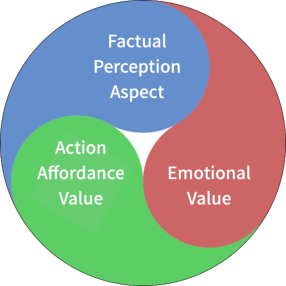
Among the quoted passages above, the parts where Hyoh-Johness is particu- larly plain have been indicated in italics. Hiromatsu states that an Hyoh-Joh is a kind of Gestalt. If we break this Gestalt down into parts darely, it would be three “moments” of “factual perception aspect,” “emotional value,” and “action affordance value”, and each of them always presents itself in a form that has constantly changing quality and quantity. In particular, what cor- responds to “action affordance value” is explained by Hiromatsu as the concept of Affordances as described by Gibson (Gibson, 1979). The theory of affordances posits that what a cognitive agent directly perceives from the environment is not so much the object itself but rather the “possibility of action.”
As can be easily understood from the example of a face, a Hyoh-Joh is a qualitative Gestalt within movement. We never recognize individual parts of a face and then add them up and infer to recognize the expression. The same applies to things other than faces. That is, the process is not (1) recognizing an “object”and then (2) representing or interpreting it. Instead, we first perceive the Gestalt of the Hyoh-Joh. It is only when we reflect on it intellectually that we “decompose” the Hyoh-Joh and portray the (1) and (2) as a two-stage process. Based on the above, I illustrate Hyoh-Joh as in Figure 1.
Figure 1: Hyoh-Joh.
When practitioners see a moving body, they should first be able to perceive its Hyoh-Joh. To engage in visual intentionality that encompasses the “feel of the body/body’s feeling,” one should simply try to see the Hyoh-Joh. There- fore, this study creates an app that facilitates the perception of the Hyoh-Joh of moving bodies.
210 Horiuchi
OBJECTIVE AND METHODOLOGY The objective of this study is to create an application that facilitates the perception of the Hyoh-Joh of the body in movement and to explore practi- cally the aspect of embodied knowledge that is Hyoh-Joh through learning in physical movement practice. Given the definition of embodied knowl- edge, exploring embodied knowledge must be done “with the body itself.” It involves vividly depicting how meaning is cultivated from experiences from the first-person perspective of practitioners (Horiuchi and Suwa, 2020). It is crucial for researchers to immerse themselves in the field, experiencing and closely accompanying practitioners in their inquiry (Horiuchi and Suwa, 2020). Shusterman (2012) argues that to study aesthetics, it is not enough to dis- cuss philosophy at a desk. Instead, researchers must go out into the field and engage in “meliorative”practices with their bodies (should be called “soma”) to gain insights, thereby pioneering a new field of study called Somaesthetics. Inspired by Shusterman’s ideas, a new approach called Somaesthetic Design has emerged in the field of human-computer interaction (Höök, 2018). In Somaesthetic Design, tools (tools for sharpening the soma) are designed to practically approach the concepts being explored. However, designers do not just create; they engage in the practices themselves, gaining insights for tool creation based on their somatic experiences. Designers then use the tools they have created, reflect on them from a practitioner’s perspective, and make improvements. This iterative design process is how Somaesthetic Design explores somaesthetic concepts.
Therefore, the goal of this study, which involves both creation and practice, can also be described as “designing” the perception of the body’s Hyoh-Joh. The author, from a practitioner’s perspective, progresses through the pro- cess of creating a tool (a web application) that facilitates the perception of the body’s Hyoh-Joh and actually using it. Although the study also involves having subjects use the tool as users, it is crucial to encourage introspec- tive descriptions from the subjects to meticulously handle the “first-person perspective experiences” of the practice participants. In this way, the study practically explores the perception of the body’s Hyoh-Johs.
Application to Encourage the Appreciation of Hyoh-Joh of Body in Movement This application is a web app. Users capture their physical movements through motion capture and get a single body movement data, referred to as “body movement data.”, consists of the three-dimensional position coor- dinates of each joint of the body * the number of frames captured over time. The captured body movement data is stored in the app’s database (hereafter referred to as DB), and users can load and play “body movement data” from the DB within the app.
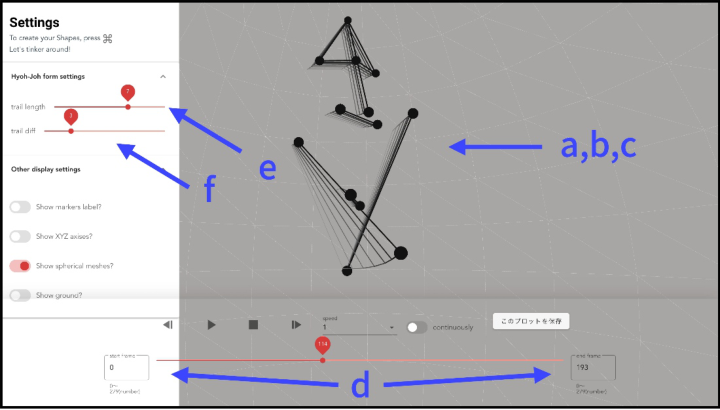
Let’s describe the play screen (Figure 2, 3). Within the three-dimensional drawing space on the screen, “moving figures” formed by the “joint points” of body movement data are drawn. Users can play and appreciate these. The most significant feature of this app, aimed at exploring Hyoh-Joh, is
Designing an Application to Encourage Appreciation of Body’s ‘Hyoh-Joh’ 211
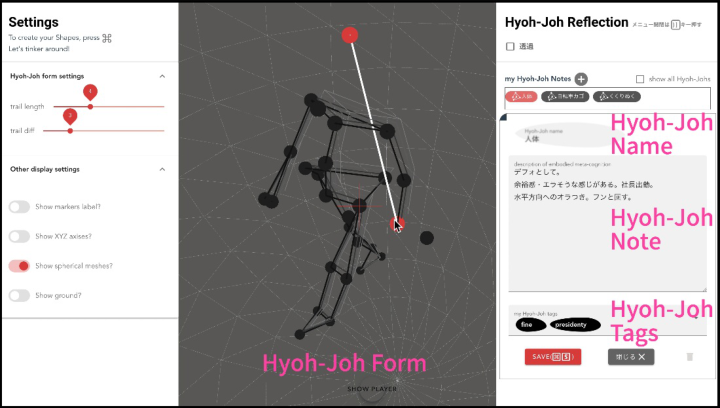
its intuitive user interface, which encourages users to “sculpturally edit” by connecting or disconnecting any vertices of this moving figure with lines. For example, Figure 2 shows a user sculpturally editing the body movement data of “walking.” It depicts a scene viewed from the “upper left front direction” relative to the observed body, walking from the top right to the bottom left of the figure, where the user is about to connect two joint points, “head” and “left wrist.” For explanatory purposes, Figure 2 shows the human skele- ton connected by lines (black lines) to indicate “walking” for readers, but in actual play, connecting lines in ways not confined to the human skeleton is also important. I will discuss the significance of this later.
Figure 2: Play screen (editting the Hyoh-Joh Form).Figure 3: Play screen (configuration of a Hyoh-Joh Form).
212 Horiuchi
Table 1. Configuration of a Hyoh-Joh Form.
Table available in the original PDF paper.
ID Element a Which points to show/hide b Which points are connected by lines c From where and centered on which point the body of interest is viewed (camera position and focus point) d Which frames of the body movement data are trimmed and played back e The length of the trajectory (how many frames are left as a trajectory) f The minimum unit of trajectory length (how many frames make up the smallest unit of the trajectory)
The figures created by the user are called “Hyoh-Joh Forms.” A sin- gle Hyoh-Joh Form is defined by the following spatiotemporal information (Table 1). For a, b, c, users can edit the Hyoh-Joh Form “directly by touch- ing” it with the mouse and keyboard in the drawing space. d, e, f are edited through the “playback menu (the bottom part of Figure 3)” and “settings menu (the left white background part in Figures 2 and 3)” GUI. Although the Hyoh-Joh Forms in the drawing space of Figures 2 and 3 are different, they are actually created from the same “walking” body movement data.
The second feature of this app is a function that encourages users to describe their viewing experience. The right white background part of Figure 2 corresponds to this function, called the “reflection menu.” This allows users to introspectively write down their feelings and thoughts through the viewing experience of this Hyoh-Joh Form. In the reflection menu of Figure 2, as explained in pink text within the figure, users are encouraged to write the “name of the Hyoh-Joh (“Hyoh-Joh Name”),” “reflective descrip- tion of the viewing experience of the Hyoh-Joh (“Hyoh-Joh Note”),” and “tags of the Hyoh-Joh (“Hyoh-Joh Tags”).” This encourages practitioners, who are users, to generate various “meanings” based on the perception of Hyoh-Johs. At the same time, as part of this study’s practice, it is also possi- ble to collect users’ introspective data, namely the “view from the first-person perspective.”
As shown in Hiromatsu’s example, when naming Hyoh-Joh, it is advis- able for users to opt for onomatopoeic or predicate-based naming rather than object-based naming. It is also recommended to name them with created words without being constrained by existing words.
Users can save these three types of reflective descriptions and the Hyoh- Joh Form as a set (the four types of data noted in pink text in Figure 2) as one “Hyoh-Joh” in the DB. Users can assign multiple Hyoh-Johs to a single body movement data. Just below “my Hyoh-Johs” written at the top inside the reflection menu of Figure 2, there are three chip-type buttons lined up. These represent a list of Hyoh-Johs that this user has assigned to this body movement data and saved in the DB (the Hyoh-Joh names are written inside the chips). The Hyoh-Joh currently being edited is the chip that is colored red among the three chip-type buttons. By pressing these chip-type buttons, users can load the relevant Hyoh-Joh at any time.
Designing an Application to Encourage Appreciation of Body’s ‘Hyoh-Joh’ 213
Through the above specifications, the app encourages practitioners, who are users, to perceive the Hyoh-Johs of moving bodies.
The development languages of this app are JavaScript, HTML, and CSS. The primary JavaScript libraries used are p5.js (for drawing figures), Vue.js (ver. 2.0.1), and Vuetify (ver. 2, for UI elements such as sliders and buttons). The hosting and DB of this app use Firebase, a cloud service by Google.
DISCUSSION
What is the significance of the app’s specifications? Hyoh-Johs are per- ceived before objects. Therefore, the default state of the video in this app omits the familiar “human skeleton” lines, displaying only “points.” From there, users create Hyoh-Joh Forms. Hyoh-Joh Forms are created by the viewer segmenting the body movement data in their own spatiotemporal way. This specification reflects the idea that Hyoh-Johs belong to the relationship between “the subject of appreciation and the object being appreciated.”
What is the best way to connect joint points? Since Hyoh-Johs arise within the relationship between the body of the appreciater, equipped with a body, and the body of the object being appreciated, I do not believe there is a universal correct way. However, there may be ways of connecting that make Hyoh-Johs “easier to perceive.” For example, connecting “shoulder to elbow” differs from connecting “sternoclavicular joint to toe.” The for- mer corresponds almost to the “humerus,” so the length of the line does not change during playback, whereas the latter may stretch or shrink to some extent (the degree of stretching or shrinking strongly depends on the type of body movement). Even with just the default state of points, or Hyoh-Joh Forms like the human skeletal one in Figure 2 that does not stretch or shrink, I feel that Hyoh-Johs are easier to perceive than in ordinary videos. This aligns with the findings of Biological Motion (Johansson, 1973).
However, in this app, which aims to discover new Hyoh-Johs, I believe we should not stop connecting points with the latter way. Lines that stretch and shrink reflect “the movement itself” strongly in the form of the figure, which can be interpreted as a phenomenon close to the “figure-ground reversal” in Gestalt psychology. If so, drawing lines that stretch and shrink could be a good way to uncover Hyoh-Johs that are usually hidden.
When drawing lines that are not part of the human skeleton, there may be ways of connecting that make the Gestalt easier to see, as suggested by Preg- nant’s law (Koffka, 1935). For example, by connecting multiple points into a single closed area (i.e., a figure) as in the “law of closure,” it becomes easier to foreground it as a single Gestalt. Conversely, we tend to see the human skeleton in the movement of point clusters without lines. This is probably because the distance between points forming both ends of a bone is invariant, meaning they share a “common fate” and tend to be grouped together.
This is similar to when we draw “auxiliary lines” while solving geomet- ric proof problems. Being able to draw one or two “appropriate” auxiliary lines can drastically change the overall figure’s appearance (i.e., the Gestalt), instantly opening up the path to proof. Taking this as a hint, drawing lines between points as “auxiliary lines” in this app could also be considered an
214 Horiuchi
effective method for revealing new Hyoh-Johs. Thinking of them as auxiliary lines for seeing Hyoh-Johs, it does not necessarily mean drawing many lines to create a figure.
From the author’s experience using this app, even after creating Hyoh-Joh Forms and returning to the default state of only points, the user can still see the Hyoh-Joh. In this sense, this app could also serve as a tool for sharpening and training the sensitivity to perceive Hyoh-Johs.
Of course, how this app is used may vary depending on the domain of physical movement. For athletes in track and field or baseball, the focus is generally on “efficient movement of the entire body,” but this may not necessarily be the case for dancers.
Through this app, flipping the paradigm from body movement to body Hyoh-Joh could encourage somaesthetical and creative recognition, such as:
- Perceiving two “walking” body movements (e.g., Person A’s walk and Person B’s walk) as “completely different” Hyoh-Johs.
- Viewing two body movements with seemingly different names of action as “exactly the same” Hyoh-Joh.
FUTURE WORK
As of the writing of this paper, the author is carrying out the practices with the five practitioners below (Table 2). Moving forward, the author will continue to explore the Hyoh-Johs of moving body while encouraging the practitioners to perceive Hyoh-Johs through their practice.
Table 2. Subjects.
Table available in the original PDF paper.
Practitioner Motion Hip hop dancer Free Dance Baseball player Batting Pole vault player Horizontal bar excersize, Walking, High knee Triple jump player Walking, High knee Decathlon Player Walking, High knee
ACKNOWLEDGMENT
I would like to extend my sincere gratitude to Dr. Kentaro Kodama for gen- erously providing the motion capturing kit, which is crucial for the going of this research.
REFERENCES
Cassirer, E. (1929). Philosophie der symbolischen Formen, 3. Teil: Phänomenologie der Erkenntnis. Bruno Cassirer Verlag. Gibson, J. J. (1979). The Ecological Approach to Visual Perception. MA: Houghton
Mifflin. Hiromatsu, W. (1989). Hyoh-Joh. Tokyo, Japan: Kobundo.
Designing an Application to Encourage Appreciation of Body’s ‘Hyoh-Joh’ 215
Horiuchi, T., Suwa, M. (2020). What is live as an athlete? A story-telling of how an athlete learns embodied skills of running in an attitude of competition and life blending each other, Cognitive Studies, Volume 27, No. 4, pp. 443–460. Höök, K. (2018) Designing with the Body: Somaesthetic Interaction Design. MA:
The MIT Press. Johansson, G. (1973). Visual perception of biological motion and a model for its analysis. perception & psycophysics. Volume 14, pp. 201–211. Koffka, K. (1935) Principles of Gestalt Psychology. London: Routledge & Kegan
Paul Ltd. Merleau-Ponty, M. (1945). Phénoménologie de la perception. PAR: Gallimard. Shusterman, R. (2012). Thinking Through the Body: Essays in Somaesthetics.
Cambridge: Cambridge University Press. Varela, J. F., Thompson, E., Rosch, E. The Embodied Mind: Cognitive Science and Human Experience, MA: The MIT Press.
LISTED IN THE AHFE DIGITAL BOOKSTORE CATALOGUE
Explore the complete digital volume
Affective and Pleasurable Design
Read this individual research paper free through the original publisher, or explore the full digital proceedings book.
ISBN 978-1-958651-99-5
Explore this ISBN in the AHFE Bookstore ↗Listed in the July 2026 bookstore catalogue; search by ISBN to confirm current availability · Digital book purchase optional