Toma Uda, Kosuke Nakayama, Haruka Ito, Sarah Tominaga, Mizuki Nakajima (2026). The Impact of Facade Design in Community Pharmacies on Conveying Operational Status and Enhancing the Ease of Entry. In: Interdisciplinary Practice in Industrial Design. AHFE Open Access, vol. 222, pp. 77–87. https://doi.org/10.54941/ahfe1007748
The influence of storefronts on customer perceptions and behaviors has been widely noted in commercial environmental design and architectural studies. However, these studies have focused on general commercial stores. There is insufficient specialized knowledge regarding pharmacies, which operate under unique constraints, such as medical-related services, including privacy considerations and a customer base consisting primarily of purpose-driven visitors. Therefore, this study examined the relationship between the exterior facade of a dispensing pharmacy and the communication of its open status, as well as the perceived “ease of entry” experienced by visitors. An evaluation experiment was conducted, and qualitative aspects were extracted from the photographs. The findings suggest that “interior visibility” and “store brightness” are important factors in the interpretation of operational status within this study. In addition, store brightness was assessed relative to the external environment, indicating the importance of presenting information in a manner that is not influenced by relative evaluation. These findings represent an initial step in identifying relevant design factors, providing a basis for future research incorporating quantitative measures and practical design evaluation.
In the fields of architecture and commercial environmental design, the influence of storefronts on store user perceptions and behaviors has been widely noted. Specifically, visual information affects users’ cognitive load and functions as a primary factor in their decisions to enter a store (Oh, 2012). Furthermore, when the clarity of a store’s open status is insufficient, users are more likely to hesitate about entering, potentially leading to lost usage opportunities (Kalantari, Xu, Govani & Mostafavi, 2022). However, previous research has focused on general commercial stores, and there is insufficient specialized knowledge regarding pharmacies, which operate under unique constraints as healthcare-related services. Regarding “ease of entry” versus “difficulty of entry,” the latter is actually perceived in real-world behavioral contexts. In this Received February 21, 2026; Revised April 3, 2026; Accepted April 17, 2026; Available online July 20, 2026
cognitive process, users predict their situation after entering a store based on the store’s exterior and atmosphere. When such prediction is difficult, the resulting anxiety and concern lead to the perception of “difficulty of entry” (Yamamoto, Itami, & Kojima, 2016). From this perspective, pharmacies, as medical facilities that prioritize privacy, tend to limit visual information, such as internal visibility, compared to general commercial stores. Consequently, it is inferred that their store environments make it difficult for users to predict the situation, thereby contributing to the perception of “difficulty of entry.” Furthermore, most dispensing pharmacy users are “purpose-driven visitors” coming specifically to pick up prescriptions from hospitals or clinics, with “impulse visitors”—typically those entering while passing by—being virtually nonexistent. Given this usage structure, users must observe and judge the store’s operational status within the limited time they spend in front of it. However, the lack of clarity in conveying opening information stemming from the aforementioned usage structure is thought to directly affect user behavior. Therefore, this study aims to clarify how specific facade elements of pharmacies communicate operational status and influence perceived ease of entry under the constraints of privacy and purpose-driven use, through the extraction of key design-related factors underlying user judgment.
PREVIOUS STUDIES Subject of the “Ease of Entry” Study
Research on “ease of entry” into commercial stores has been extensively conducted in the fields of architecture and commercial environmental design.
Kozaki et al. focused on the relationship between standalone stores and shopping districts, examining both “ease of entry” and “ease of finding.” Saito et al. addressed the psychological evaluation of “desire to enter,” developing predictive models for both concepts and investigating their interrelationships.
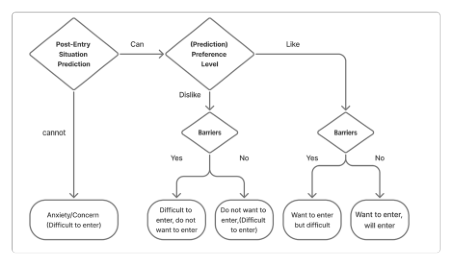
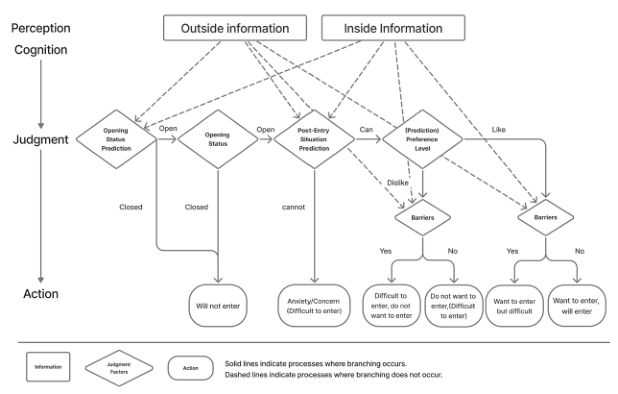
Yamamoto et al. summarized previous “ease of entry” research, organized situations in which “ease of entry” and “difficulty of entry” are perceived in real user behavior scenarios and modeled the decision-making mechanism in store selection. The model is described in Figure 1.
Figure 1: “Difficulty of entry” cognitive process (adapted from yamamoto, itami, & kojima, 2016).
The Impact of Facade Design in Community Pharmacies on Conveying Operational Status 79 “Predictability” indicates whether the situation upon entering the store can be predicted based on factors such as price, customer gender, cleanliness, and the comfort level inside the store. “(Predicted) Preference” evaluates the personal desirability of the predicted store, influenced by the physical environment inside. This study treats this as “Post-Entry Prediction.”
Regarding “ease of entry” versus “difficulty of entry,” “difficulty of entry” is actually perceived in real-world behavioral situations. In this cognitive process, users predict their situation after entering a store based on the store’s exterior and atmosphere. When such prediction is impossible, the resulting anxiety or concern leads to the perception of “difficulty of entry” or “difficulty of staying” (Yamamoto, Itami, & Kojima, 2016). In most previous studies, the assumption that a store is open to business (including cases where this is not explicitly stated) has been taken as a premise for survey analysis. Yamamoto et al. state that regarding “ease of finding,” if the store is ultimately not found, neither “ease of entry” nor “difficulty of entry” is perceived. However, it is reasonable to consider that diverse variations exist within “ease of finding.” In real life, it can be inferred that predictions and judgments about a store’s operational status, such as whether it appears to be open or closed, are made unconsciously even before predicting the situation after entering. Therefore, this study includes a prediction stage regarding whether a store is open or closed in its survey analysis.
Organization of Store Utilization Structure Yamamoto et al. point out that the quality of “ease of entry” varies depending on user demographics, usage patterns, and store type. They state that quantitative research, such as the development of predictive models, must limit these factors to some extent. While this study is qualitative and focuses on “ease of entry,” we believe this point warrants similar consideration. Takahashi et al. classify store users into “purposeful visitors (those who decide in advance to visit a specific store)” and “floating visitors (those who enter a store while passing by without a specific purpose).” They state that exterior design, including the store facade and displays, plays a crucial role in attracting “floating visitors.” The fact that much research on “ease of entry” targets “impulse shoppers” is likely based on this research significance. This study focused on dispensing pharmacies. Most dispensing pharmacy users are “purpose-driven customers” who come to pick up prescriptions from hospitals or clinics; “impulse shoppers,” who typically enter while passing by, are rarely anticipated. Furthermore, prescription drug prices in pharmacies are set according to government-regulated pricing, which makes significant price differences between stores unlikely. Additionally, the pharmaceuticals handled depend on the prescription content, limiting situations in which store selection is influenced by differences in product assortments, as seen in general retail stores. Consequently, the appeal-based expectations—such as “expectations about taste” or “expectations about products”—that influence entry decisions in restaurants or retail stores, as demonstrated by Takiguchi et al., are considered relatively less important for dispensing pharmacies. In other words, entry decisions at dispensing pharmacies can be determined
more by functional and reassurance aspects, such as whether prescription drugs can be obtained reliably and smoothly, rather than by expectations of new value.
Therefore, this study hypothesizes that the role of “anticipatory expectations” in pharmacy facades is limited. Instead, factors fostering reassurance, such as the clarity of business status and predictability of internal conditions, play a primary role in entry decisions.
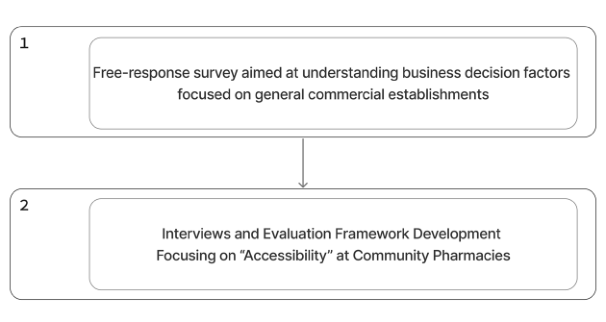
Research Method Building on these prior studies, this study aims to clarify the impact of a pharmacy’s storefront design elements on conveying its open status and perceived accessibility. Therefore, this study proceeded as follows (Figure 2):
Figure 2: Research flow.
Experiment 1: “Identifying Factors for Determining Store Opening Status on Store Facades” Overview of Experiment 1
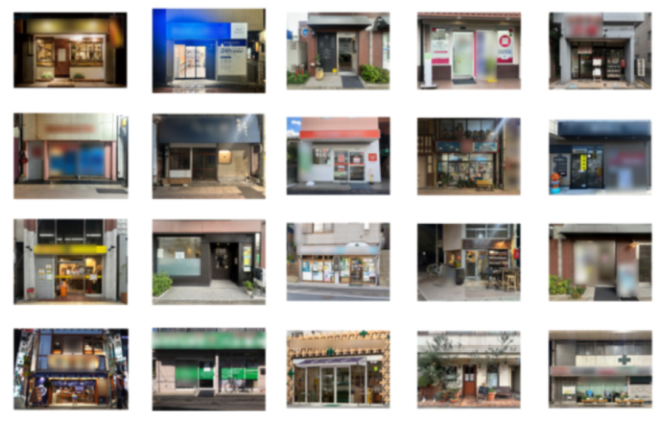
An experiment was conducted with 20 university students in their 20s to examine how they determine whether a store is open or closed based on its exterior appearance and to identify the key cues used in this judgment. The participants were shown 20 photographs of existing store exteriors. For each photograph, participants predicted whether the store was open and provided a free-form written explanation of their reasoning. In Experiment 1, we considered it necessary to examine exterior elements common to a broader range of business types to clarify the unique facade design requirements for dispensing pharmacies. Therefore, the evaluation was not limited to dispensing pharmacies but included commercial establishments such as restaurants (e.g., izakaya, coffee shops), beauty salons, and clinics (Figure 3). A qualitative approach was adopted to explore the cognitive cues that users rely on when interpreting storefront information, which are difficult to capture through predefined quantitative measures.
Figure 3: Store exterior photos used in Experiment 1.
Results and Discussion
Experiment 1 revealed that the elements users rely on to predict store opening status can be broadly categorized into two types: “exterior information,” which clearly indicates both open and closed states through elements such as entrance lighting status and the presence of menus or signs, and “interior information,” which allows users to infer the store’s condition based on signs of human presence or brightness levels. “Exterior information” includes linguistic and symbolic information that can be directly read, such as the presence of signs or menus, the lighting status of external lights, and open or closed displays, thereby explicitly conveying business status. However, the effectiveness of such information may weaken when it is permanently installed or lacks sufficient contrast with the external environment. “Interior information” consists of indirectly discernible elements such as signs of human presence or the state of interior lighting, including light spilling from openings or signs of people, which allow users to infer the store’s interior conditions. Furthermore, obtaining such information is related to “interior visibility.” These findings suggest that both “interior information” and “exterior information” function as prominent factors influencing the interpretation of operational status and perceived ease of entry within this study. In other words, a store may be perceived as easier to enter when both types of information are available. However, pharmacies may intentionally restrict internal information due to privacy considerations. Therefore, it is important to ensure that either (1) the store situation can be inferred even from limited “interior information,” or (2) the operational status can be reliably determined from “exterior information.”
Experiment 2: “Perceived Accessibility Evaluation Framework for Community Pharmacies” Overview of Experiment 2
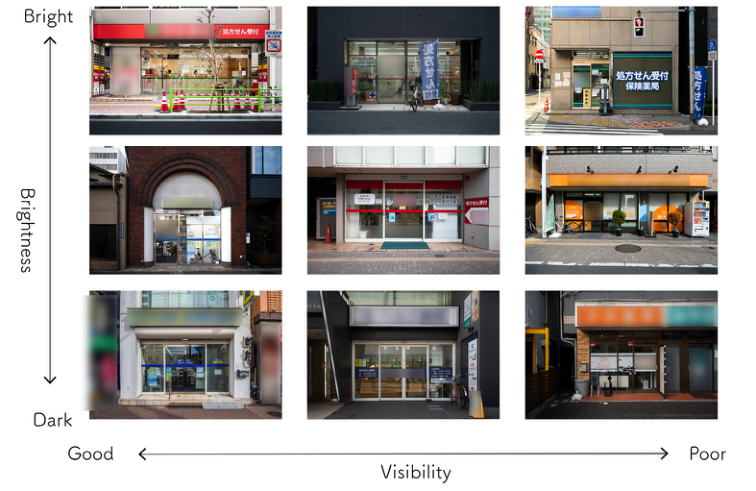
To understand how pharmacy users evaluate the “ease of entry” into dispensing pharmacies, the questionnaire content and conceptual hierarchy were refined based on the evaluation grid method, given that the stimuli were storefront exteriors observed prior to entry (Figure 4). An experiment was conducted using the laddering technique based on the evaluation grid method with 10 students in their 20s. The participants were presented with nine photographs of pharmacy exteriors, each incorporating varying degrees of “internal visibility” and “brightness,” and were asked to rank them in order of preference. This approach allowed the extraction of latent evaluation structures underlying perceived ease of entry.
Figure 4: Exterior photos of the dispensing pharmacies used in Experiment 2.
Results and Discussion
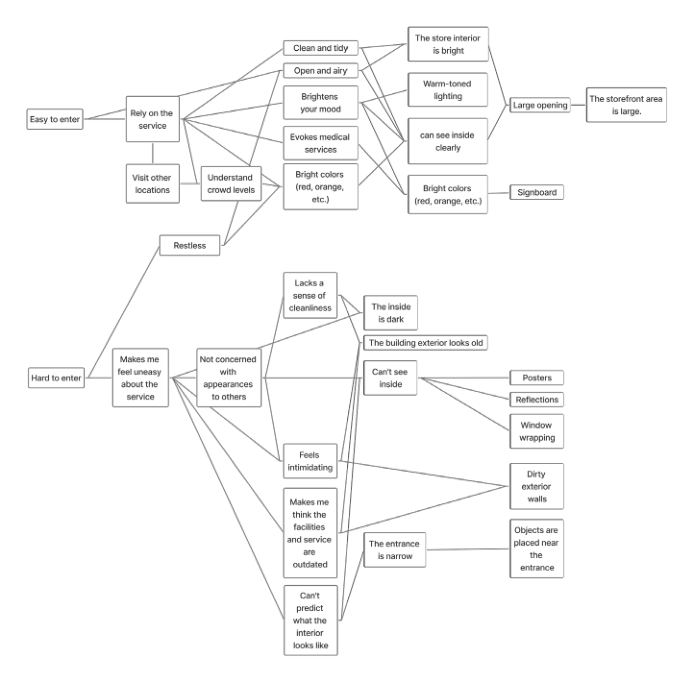
Based on the experimental results, an evaluation structure model of the “ease of entry” into dispensing pharmacies was constructed (Figure 5).
The top-level concept of “easy to enter” was associated with the evaluation of “reliability of service.” This “reliability of service” was composed of mid- level evaluation items such as “feeling open,” “feeling clean,” and “evoking medical services.” The evaluation of “cleanliness” was linked to visual
The Impact of Facade Design in Community Pharmacies on Conveying Operational Status 83 information such as a bright interior, warm-toned colors (e.g., red and orange), and an exterior free of dirt. In particular, “bright interior” and “warm- toned lighting” were associated with a sense of security as a medical facility, contributing to the perception of “reliable service.” In addition, a “sense of openness” was associated with physical and spatial elements, generating evaluations such as “evokes thoughts of medical services” and “perceives/ sees people present,” which were related to a sense of security. At the same time, “perceives/sees people present” was also linked to the evaluation of “can gauge how crowded it is,” suggesting that, depending on the situation, this may contribute to avoidance behavior, such as choosing another store. Furthermore, the “signboard” was associated with “bright colors” and “evokes thoughts of medical services,” reinforcing this evaluation. In other words, “ease of entry” appears to be formed not only by physical openness but also by the predictability of whether the medical service is perceived as reliable. Regarding the size of openings, which has been noted in prior research on “ease of entry,” a similar evaluation tendency was observed in the context of dispensing pharmacies in this study. This may be related to users’ attempts to anticipate the quality of interaction with pharmacists, as well as their emphasis on cleanliness as a medical facility. These elements were associated with the formation of a sense of security. However, high “interior visibility” was not always positively evaluated. Some participants expressed concerns about insufficient privacy considerations and discomfort with being overly aware of the people inside the store. In particular, in areas where multiple pharmacies are located nearby, high visibility of interior activity was suggested to potentially discourage entry, as customers may avoid crowded environments. The results of the preference ranking of nine exterior photographs showed a tendency for images with visible interiors and bright lighting to be ranked higher, whereas those with obscured interiors and darker entrances tended to rank lower. This tendency is consistent with the evaluation structure described above, in which physical elements such as “bright interior” and “sense of openness” are related to “ease of entry” through the mediating perception of “reliable service.” However, photographs with high interior visibility did not always receive the highest rankings, with some placed in the middle range. This finding corresponds to the evaluation structure in which “visualizing human presence” and “assessing crowd levels” are also linked to avoidance-related judgments. Therefore, “interior visibility” can be interpreted as a non-monotonic factor: rather than following a simple linear relationship in which higher visibility leads to greater ease of entry, it may, beyond a certain threshold, be associated with avoidance decisions.
Figure 5: Created “accessibility” evaluation structure diagram.
Consideration Redefining Expectations for Purpose-Driven Customers
This study initially assumed that dispensing pharmacies primarily serve “purpose-driven customers” with virtually no “casual walk-in customers,” and thus expected limited anticipation of products or experiences similar to those in general retail stores. However, the results of Experiment 2 suggest that users form expectations not about the products themselves, but about the quality of communication with pharmacists and the cleanliness and reassurance provided as a medical facility. Thus, expectations in dispensing pharmacies can be reinterpreted not as enjoyment of product selection, but as expectations regarding medical reliability, such as whether services can be received safely, whether appropriate explanations are provided, and whether the environment is clean and reassuring. This indicates that even among “purpose-driven customers,” users anticipate their in-store experience and evaluate their expectations.
The Impact of Facade Design in Community Pharmacies on Conveying Operational Status 85 Extension of Cognitive Processes Including Opening Status Prediction
This study examined cognitive processes underlying the perception of “ease of entry,” including unconscious predictions of store opening status occurring prior to the prediction of post-entry situations. Previous research has conceptualized “ease of entry” based on the predictability of post-entry situations, whereas this study addressed the preceding stage, namely the unconscious prediction of whether a store is open or closed. Results from Experiment 1 indicate that users judge operational status using cues such as interior lighting leakage and signs of human presence. Importantly, being open appears to be a necessary but not sufficient condition for “ease of entry.” Users rely on interior cues to judge whether a store is open, but clear operational status alone does not guarantee ease of entry. These findings suggest a sequential cognitive process: predicting store opening status → predicting post-entry situation → forming a sense of security → evaluating ease of entry. The contribution of this study lies in presenting a model that incorporates this preliminary stage (Figure 6).
Figure 6: Cognitive process model including opening status prediction.
Ambiguity of Internal Visibility One key finding of this study is the ambivalence inherent in interior visibility. While visibility into the interior is associated with positive evaluations such as creating an open atmosphere, evoking medical services, conveying a sense of human presence, and enhancing reassurance, it is also linked to negative evaluations, including privacy concerns, awareness of crowding, and anxiety about being seen by others. In particular, when multiple pharmacies are located nearby, the visibility of crowding may contribute to avoidance behavior. These findings suggest that interior visibility is not simply beneficial when it is high, but rather functions as a trade-off factor that simultaneously
generates reassurance and avoidance. In the design of dispensing pharmacy facades, it may be more effective to avoid both complete visibility and complete concealment, and instead consider approaches that indirectly convey human activity.
CONCLUSION
Based on the above findings, the following considerations are important for the design of dispensing pharmacy facades:
Designing dynamic exterior information that clearly communicates operational status
Developing lighting plans that convey interior brightness to the outside
Maintaining colors and a sense of cleanliness that evoke medical facilities
Adjusting visibility to avoid excessive internal exposure This study proposes an evaluation structure of “ease of entry” in dispensing pharmacies, including the stage of predicting opening status. Whereas previous research on “ease of entry” has primarily focused on the predictability of post- entry conditions, the present study indicates that predicting business status may be incorporated into the user’s cognitive process as a preliminary stage. The experimental results suggest that users judge business status based on cues related to “exterior information” and “interior conditions,” forming a sense of security through this predictability. In particular, “interior visibility” was identified as an important element associated with reassurance by promoting a sense of openness and evoking associations with medical services. However, it was also found to function as an ambivalent factor, as it may lead to avoidance behavior by making the presence of people and crowding levels visible. These findings suggest that simply increasing interior visibility is insufficient; rather, facade design should balance the enhancement of reassurance with the need to respect privacy. Therefore, in designing pharmacy facades, it is important to ensure that exterior information clearly communicates operational status while conveying appropriate cues of activity without excessive exposure. This study was based on a qualitative investigation targeting students in their 20s, and the findings should therefore be interpreted as preliminary and context- specific. Future research should expand the age range and conduct verification in real-world environments, as well as incorporate quantitative approaches to further validate and generalize the proposed model.
REFERENCES
Kalantari, S., Xu, Y., Govani, K., Mostafavi, A. (2022). Predicting Store Operational Status and Its Impact on Customer Entry Behavior Using Visual Cues, Automation in Construction, 142, p. 104512. Kozaki, M. (2017). Research on Evaluation of Exterior Impression of a Store Facade:
Exploratory Study on Evaluation of a Single Shop and Shops in a Commercial Avenue, Journal of Environmental Engineering (Transactions of AIJ), 82(738), pp. 695–704.
The Impact of Facade Design in Community Pharmacies on Conveying Operational Status 87 Oh, H. (2012). The Influence of Store Exterior Visual Information on Consumer
Cognitive Load and Entry Decision, Journal of Environmental Psychology, 32(4), pp. 347–356. Saito, K., Sano, Y., Hatayama, Y., Kikuchi, Y. (2013). Effects of architectural elements of retail store facades facing streets and surrounding conditions on pedestrians’ perceived “ease of entering” and “ease of approaching.” Summaries of Technical Papers of Annual Meeting, Architectural Institute of Japan, D-1, pp. 35–36. Takahashi, H., Oi, N. (2006). A Study on Exterior Design of Commercial Buildings
and “Ease of Entry” Part 1, Summaries of Technical Papers of Annual Meeting, Architectural Institute of Japan, D-1, pp. 773–774. Takiguchi, S., Kiyono, S. (2025). “Ease of Entry” for Privately-Owned Restaurants: Consumer Evaluation of Restaurant Exteriors Across Different Industries, Journal of Food System Research, 31(4), pp. 283–288. Yamamoto, K., Itami, H., Kojima, T. (2016). A Study on Ease and Unease of
Entering to Location of Shops Based on Recall Method, Journal of Environmental Engineering (Transactions of AIJ), 81(719), pp. 19–27.
LISTED IN THE AHFE DIGITAL BOOKSTORE CATALOGUE
Explore the complete digital volume
Interdisciplinary Practice in Industrial Design
Read this individual research paper free through the original publisher, or explore the full digital proceedings book.
ISBN 978-1-964867-98-4
Explore this ISBN in the AHFE Bookstore ↗Listed in the July 2026 bookstore catalogue; search by ISBN to confirm current availability · Digital book purchase optional