Silvia Albano, GianMarco Longo, Emanuela Corti, Ivan Parati (2026). A Hybrid Continuum: Scaffolding Design Logic from Manual Making to Digital Fabrication. In: Human-Computer Interaction & Emerging Technologies. AHFE Open Access, vol. 233, pp. 145–154. https://doi.org/10.54941/ahfe1007514
Contemporary design pedagogy faces a tension between analog-making traditions and digital technologies, often resulting in fragmented skill development. This paper examines a scaffolded pedagogical model that connects precedent analysis, hand drawing, material prototyping, digital modeling, and fabrication within a continuous learning sequence. The study is framed as a design-based qualitative workshop study conducted with 11 multidisciplinary participants. It analyses process observations, intermediate artifacts, and final outcomes across four workshop phases inspired by Giò Ponti's tile designs. Rather than claiming statistically measured improvement, the paper identifies how students' engagement with design process logic became visible through rule extraction, iterative translation, peer explanation, material testing, and digital reconstruction. The findings clarify three pedagogical thresholds: moving from visual appreciation to compositional rule recognition; from two-dimensional pattern to material relief; and from tactile form-making to digitally explicit geometry for fabrication. The paper concludes by proposing a carefully staged extension toward AI-assisted generative tools, arguing that analog and material foundations remain necessary for critically evaluating AI outputs in terms of geometric coherence, material feasibility, and fabrication readiness.
Contemporary design pedagogy is increasingly defined by a tension between the tradition of analog making and the expanding hegemony of digital technologies. While digital tools are rapidly adopted in studio education (Oxman, 2008), their integration often seems separated from traditional analog practices, resulting in a fragmented learning landscape. This divergence presents a significant pedagogical challenge: students may gain software proficiency yet lack a critical understanding of the design logic and material sensibilities (Kara, 2015). This gap frequently manifests in curricula that introduce digital tools instrumentally, prioritizing technical skills over integrative design thinking. Students often learn software through ad hoc, just-in-time tutorials or peer support, a process that can separate tool mastery from deeper conceptual and material reasoning. Consequently, learners may navigate digital environments without really understanding how Received May 17, 2026; Revised June 1, 2026; Accepted June 16, 2026; Available online July 20, 2026
computational decisions relate to physical behavior, design precedent, and compositional intent. This disconnection not only limits creative synthesis but also leaves students underprepared to engage critically with emerging technologies. Emerging research investigates new hybrid pedagogical models that intentionally converge analog and digital workflows, suggesting that such integration can enhance creativity and deepen engagement with design processes (Doyle & Senske, 2016; Salama & Patil, 2025; Al-Rqaibat et al., 2025). However, few models explicitly connect design logic with contemporary computational practice, leaving a need for structured approaches that guide students through the cognitive and creative transitions between hand- making and digital fabrication. Addressing this need, this study examines a structured workshop that progresses from the manual analysis of Giò Ponti’s tiles to digital modeling and 3D printing. By reporting on this “pedagogical journey,” the researchers explore how such a scaffolded hybrid workflow can help students to build the critical and creative foundations necessary for meaningful engagement, re-embedding computational practice within a continuum of design thinking.
LITERATURE REVIEW
Existing research frames digital design and hybrid learning as an essential pedagogical transformation in design education rather than as technical support. Four themes are particularly relevant. First, the limits of stand- alone tools: the widespread use of CAD/BIM platforms tends to privilege later-stage detailing and may offer limited support for iterative conceptual exploration, potentially constraining problem framing and spatial sensitivity. Early introduction of digital media in foundation studios can weaken tectonic awareness and embodied understanding of scale and space (Al-Rqaibat et al., 2025; Kara, 2015). Second, hybrid toolsets as design thinking: the integration of generative, performance-based, visualization, and fabrication tools with drawing and physical modeling can enable richer divergence-transformation- convergence cycles, repositioning digital media as an active partner in design cognition (Al-Rqaibat et al., 2025; Oxman, 2008; Salama & Patil, 2025). Third, manual and physical making should precede and interweave with digital production to establish phenomenological and material knowledge. Without deliberate scaffolding, competencies risk becoming shallow and tool-driven; fabrication-oriented settings therefore need structured planning to connect design reasoning, material testing, and production knowledge (Kara, 2015; Doyle & Senske, 2016; Celani, 2012). Fourth, pedagogical frameworks for hybrid courses need to be iteratively designed and tested so that technology, content, and studio learning remain integrated rather than fragmented (Doyle & Senske, 2016; Wang & Hannafin, 2005).
AIMS AND RESEARCH QUESTIONS Despite sustained advancements, the literature reveals a persistent lack of structured analog-digital workflows that use precedent analysis as a bridge to computational design. Current hybrid approaches often juxtapose tools
A Hybrid Continuum: Scaffolding Design Logic From Manual Making to Digital Fabrication 147 without making explicit how design decisions are transferred from analog to digital processes, resulting in fragmented skills and weak continuity between tradition and innovation (Al-Rqaibat et al., 2025; Kara, 2015; Oxman, 2008). This study, therefore, examines a two-day workshop on Giò Ponti’s 1960s tiles as a situated testing ground for an integrated workflow that moves from hand-drawing analysis and clay prototyping to digital modeling and 3D printing, with 11 diverse participants. The research questions are refined as follows: (RQ1) In what ways does a structured hybrid workflow support students’ engagement with design process logic? (RQ2) Which shifts in modes of thinking become visible as students move from precedent analysis to generative reinterpretation, material modeling, and digital fabrication? (RQ3) How might the framework be extended toward AI-assisted generative tools while retaining critical judgment grounded in analog and material reasoning?
METHODOLOGY
Context and Participants The paper refers to the outcomes of a two-day workshop conducted at a transnational university in China. The workshop engaged 11 participants from diverse design disciplines, including architecture, industrial design, and urban planning, as well as from varied national backgrounds encompassing both local and international students. The participants represented a broad range of academic levels, from first-year undergraduate to doctoral study. This diversity was not treated as a statistically representative sample; rather, it provided an exploratory pedagogical setting in which the same workflow could be observed across different levels of disciplinary confidence and digital competence.
Research Design and Analytical Framework The study adopts a design-based research orientation (Wang & Hannafin, 2005) and is presented as a qualitative pedagogical case rather than a controlled experiment. The workshop functioned as a deliberately designed testing ground for a proposed workflow. Evidence was collected through facilitator observation, process documentation, photographic records, intermediate design artifacts, final tile outcomes, and informal participant discussions during tutoring and peer exchange. The analysis followed two complementary strategies. First, artifact-trajectory mapping traced how each participant carried decisions from the original Ponti tile into a new matrix, a tessellation, a clay relief, and a digital model. Second, interpretive coding was used to examine four analytical categories: design process logic, mode- of-thinking shifts, engagement, and learning thresholds. In this paper, design process logic is operationalized as the ability to identify, transform, and maintain compositional rules across media, including square boundaries, diagonals or midlines, proportional subdivisions, chromatic hierarchy, edge continuity, tessellation behavior, relief translation, and fabrication constraints. Engagement is not treated as a measured psychological variable; it is inferred
cautiously from observable indicators such as time-on-task, voluntary iteration, peer explanation, problem-solving discussions, and references back to previous design decisions. Learning thresholds are identified when a change of medium forces participants to reformulate their design intention or to recognize a hidden constraint.
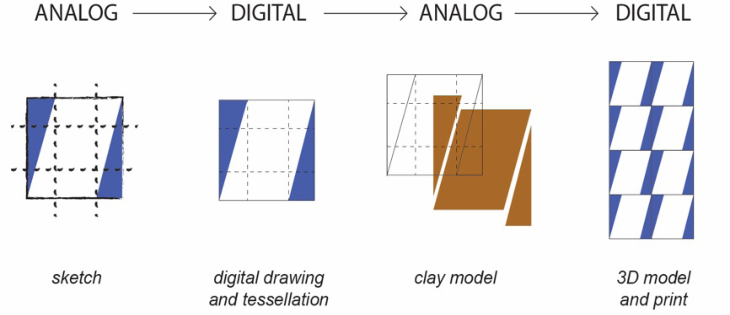
The activities were organized into four consecutive phases over two days. The sequence was designed to test whether explicit rule transfer could maintain continuity across media, while also revealing the moments where continuity became difficult or broke down.
Figure 1: A diagram that visualizes the four workshop phases.
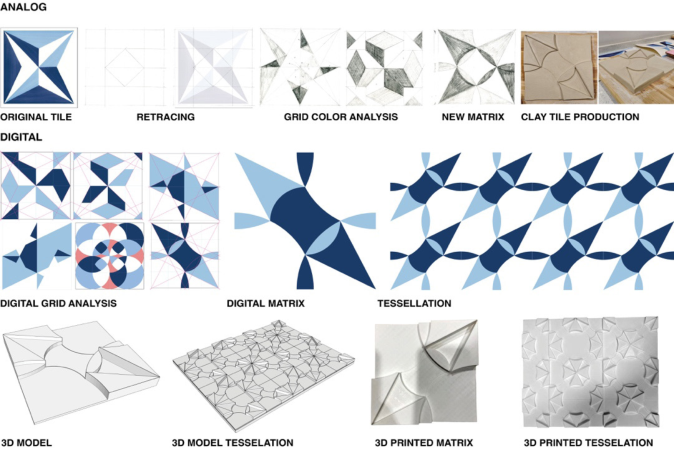
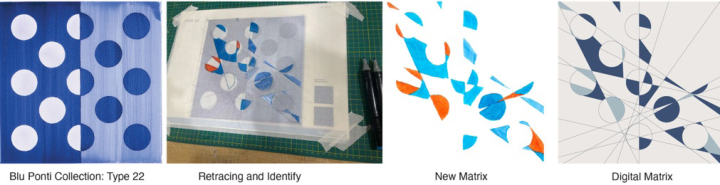
Phase 1 - Retracing and Identifying. On the first day, each student analyzed one of the thirty-three Ponti tiles using tracing paper to understand its compositional principles. The aim was not simply to copy the image, but to extract a working rule set from the precedent: square boundary, diagonal and midline structures, proportional subdivisions, chromatic hierarchy, and edge relationships. The analysis revealed a shared underlying grid emphasizing diagonals and midlines, subdividing the square into multiple sections. This process guided each participant to produce a new matrix tile and established the first analytical basis for subsequent transformations.
Phase 2 - Analog reinterpretation and 2D digital tessellation. Students reimagined tile designs through deliberate rule-making and rule-breaking in tessellation. In this context, rule-making meant selecting which extracted constraints would remain stable, such as edge continuity, symmetry operations, or chromatic balance. Rule-breaking meant intentionally altering proportion, rotation, mirroring, figure-ground relation, or density while still keeping the tile capable of repetition. Students first reviewed basic principles, symmetry transformations, and seamless edge continuity, along with references from Islamic patterns to M.C. Escher. Using vector graphics software, they translated, modified, and tested their work digitally, allowing faster experimentation with different combinations while keeping the design logic visible.
A Hybrid Continuum: Scaffolding Design Logic From Manual Making to Digital Fabrication 149 Phase 3 - Clay models / material translation. On the second day, participants transitioned from two-dimensional drawings to three-dimensional clay models. The newly created patterns were transferred onto clay using tracing paper to ensure accuracy and consistency. Participants were instructed to assign varying heights and inclinations to their design, interpreting Ponti’s color associations by linking darker and lighter blues to lower and higher relief levels. This phase tested whether visual rules could become material rules, making scale, depth, edges, junctions, and constructability visible.
Phase 4 - Digital modeling & 3D printing. Upon finalizing the physical clay models, participants were introduced to SketchUp and Rhino to create corresponding digital models. The objective was to generate accurately scaled three-dimensional prototypes and tessellating tile designs suitable for digital fabrication. This phase made explicit the geometric consequences of earlier analog decisions: curves, relief heights, surface continuity, and edge conditions had to be rebuilt as digital geometry before being prepared for 3D printing.
Figure 2: Workshop process workflow analog/digital.
FINDINGS Engagement and Process Logic
The workshop produced visible forms of process engagement, although these should be understood as qualitative observations rather than quantitative measures. Across the four phases, engagement appeared through prolonged time-on-task, voluntary redrawing, peer-to-peer explanation, requests for tutor feedback, and repeated references to previous design decisions. During Phase 1, participants concentrated on identifying hidden grids and
matrix logic rather than producing a finished image. In Phase 2, engagement became generative: students tested tessellation options and compared how small changes in rotation, symmetry, or edge continuity affected the whole field. In Phase 4, digital modeling generated frustration for less experienced participants, but this difficulty often redirected attention back to earlier analog decisions. The most relevant finding is therefore not that engagement was simply higher, but that the workflow made design process logic more observable: students increasingly treated each phase as dependent on decisions made in the previous one.
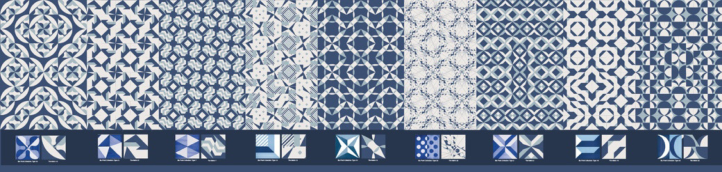
Creative Outcomes and Design Sensibilities The 11 tile reinterpretations exhibited considerable variety while remaining traceable to Ponti’s geometric and chromatic logic. The outcomes suggest different degrees of creative rule adaptation rather than a uniform level of creative achievement. Most designs preserved a recognizable matrix, color hierarchy or tessellation principle, while introducing proportional shifts, symmetry breaks, density changes or relief interpretations. For instance, one student reinterpreted the circular configuration of the assigned tile through a new system of circles and diagonal generative lines, showing a controlled tension between geometric constraint and expressive freedom. Other outcomes revealed more fragile continuity, particularly when material depth or digital reconstruction exposed unresolved edge conditions. These differences are important because they show that creativity in the workshop depended on the participant’s capacity to carry a design rule across media, not only on the visual novelty of the final tile.
Figure 3: Student geometric analysis and new matrix identification.
Learning Thresholds The iterative workflow from analog to digital revealed three recurrent cognitive and practical thresholds within a condensed experiential learning cycle (Kolb, 1984). The first threshold was the shift from visual appreciation to the recognition of compositional rules. Hand-redrawing was not mere copying but a reflective, analytical act (Schön, 1983) in which hand-eye coordination helped students deconstruct Ponti’s system of harmonious rectangles (Munari, 2005). The second threshold emerged when the two- dimensional pattern became a clay relief. At this point, color, line, and
A Hybrid Continuum: Scaffolding Design Logic From Manual Making to Digital Fabrication 151 figure-ground decisions had to be reinterpreted as height, inclination, surface continuity, and material resistance. The third threshold emerged during digital reconstruction, when intuitive clay decisions had to be made explicit as geometry suitable for modeling and fabrication. These thresholds clarify the shifts in mode of thinking identified in RQ2: from perceptual reading, to rule extraction, to generative manipulation, to material reasoning, and finally to digital-fabrication reasoning.
Challenges & Skill Gaps The intensive hybrid process also exposed discontinuities and skill gaps. The most evident difficulties occurred in digital modeling and fabrication. Students with limited prior digital competency struggled to translate their clay models into digital geometry and to adapt the design for fabrication. Rather than being treated as failures, these moments were analyzed as evidence of where the analog-digital chain became fragile. Some modeling problems can be traced back to unresolved decisions in the clay model or the initial pattern geometry, thereby making the workflow’s interconnectivity visible. The compressed two-day schedule intensified these difficulties and limited the depth of individual reflection. This confirms that continuity across media cannot be assumed; it must be pedagogically constructed through explicit rules, documentation, and guided moments of reflection.
DISCUSSION
Hybrid Workflow & Engagement In response to RQ1, the workshop indicates that a structured hybrid workflow can support engagement with design process logic when students are required to transfer explicit rules from one medium to another. The evidence does not demonstrate superiority over other hybrid workflows because no comparative baseline was used. Its value lies instead in making process logic visible: a line traced from the precedent becomes a matrix, a matrix becomes a tessellation, a tessellation becomes a relief, and a relief becomes digital geometry. This staged continuity responds to literature calling for hybrid pedagogical frameworks that avoid tool-centric fragmentation (Doyle & Senske, 2016). The workshop, therefore, contributes less as a measurement of engagement and more as a tested pedagogical sequence for observing how design decisions accumulate, transform, and sometimes break across media.
Creativity & Thresholds In response to RQ2, the workflow shows that analog-digital transitions involve shifts in modes of thinking rather than simple tool substitution. Hand-making allowed freedom of execution, tacit knowledge, and responsive iteration (Sennett, 2008), positioning making as a form of inquiry through material engagement (Ingold, 2013) in which aesthetic judgment emerges through experience (Dewey, 1934). Digital reconstruction then made geometric and fabrication constraints explicit. This representational shift
produced divergent strategies: more engineering-oriented participants tended to stabilize constraint logic, while more artistically oriented participants used software more exploratively. In threshold concept terms, the transition constituted a form of troublesome knowledge that became transformative when participants understood hand drawing, clay modeling, and digital modeling as a coupled representational-material system rather than as separate skill sets (Meyer & Land, 2003).
Extension With AI Tools In response to RQ3, the next development of the workflow could introduce AI-generative tools as a fifth phase after students have already extracted, tested, and materialized design rules. In this position, AI would not replace analog analysis or material reasoning; it would operate as a permutation engine capable of expanding alternative pattern variations. Students would then evaluate AI-generated proposals against the rule set developed in Phases 1–4: geometric coherence, edge continuity, chromatic logic, relief feasibility, and fabrication readiness. This sequencing is important because it positions students as critical editors and accountable designers rather than passive users of generative outputs.
Figure 4: Selection of students’ outcomes.
CONCLUSION AND FUTURE WORK This paper contributes a structured analog-digital workflow for multidisciplinary design education. Its contribution is not a general measurement of student creativity or engagement, but a qualitative pedagogical model that makes visible how design decisions can be transferred, transformed, and tested across media. Progressing from tactile analysis to digital synthesis enabled participants to connect structural, visual, and material dynamics while engaging critically with processes of making and representation (Kvan, 2001; Kolb & Kolb, 2005). The workshop also revealed that hybrid continuity is fragile: when design rules were not sufficiently explicit, the transition to clay or digital modeling exposed unresolved decisions. This insight is central to the study’s academic value because it reframes analog- digital integration as a sequence of guided cognitive thresholds rather than a neutral combination of tools.
A Hybrid Continuum: Scaffolding Design Logic From Manual Making to Digital Fabrication 153 For AI debates, the proposed future Phase 5 positions analog and material foundations as safeguards against uncritical adoption. Students who have already analyzed precedent rules, tested tessellation, built clay reliefs, and reconstructed digital geometry are better prepared to judge AI outputs for geometric logic, material feasibility, and fabrication readiness (Al-Rqaibat et al., 2025; Celani, 2012; Salama & Patil, 2025). Future research should strengthen the empirical basis of the framework by repeating the workshop with larger cohorts, introducing pre/post reflective prompts, design logs, participant interviews, and explicit rubrics for process logic, mode-of- thinking shifts, and engagement. A comparative study with alternative hybrid workflows would also allow stronger claims about enhancement. Within its exploratory scope, however, the study demonstrates how precedent-based making can prepare students for more critical, accountable, and materially grounded engagement with emerging digital and AI-assisted practices.
REFERENCES
Al-Rqaibat, S., Al-Nusair, S. & Bataineh, R.: Enhancing architectural education through hybrid digital tools: investigating the impact on design creativity and cognitive processes. Smart Learning Environments, 12, Article 26. https://doi. org/10.1186/s40561-025-00370-9 (2025). Celani, G.: Digital Fabrication Laboratories: pedagogy and impacts on architectural
education. Nexus Network Journal, 14(3), pp. 469–482. https://doi.org/10.1007/ s00004-012-0120-x (2012). Dewey, J.: Art as Experience. Minton, Balch & Company, New York, NY (1934). Doyle, S. & Senske, N.: Between design and digital: bridging the gaps in architectural education. In Weber, P. et al. (Eds.), Research Based Education: Proceedings of the 2016 Association of Architectural Educators International Conference, Bartlett School of Architecture, UCL, London, pp. 192–209 (2016). Ingold, T.: Making: Anthropology, Archaeology, Art and Architecture. Routledge,
London (2013). Kara, L.: A critical look at digital technologies in architectural education: when, where and how? Procedia - Social and Behavioral Sciences, 176, pp. 526–530. https://doi.org/10.1016/j.sbspro.2015.01.506 (2015). Kolb, D. A.: Experiential Learning: Experience as the Source of Learning and
Development. Prentice Hall, Englewood Cliffs, NJ (1984). Kolb, A. Y. & Kolb, D. A.: Learning styles and learning spaces: enhancing experiential learning in higher education. Academy of Management Learning & Education, 4(2), pp. 193–212. https://doi.org/10.5465/AMLE.2005.17268566 (2005). Kvan, T.: The pedagogy of virtual design studios. Automation in Construction, 10(3),
pp. 345–353. https://doi.org/10.1016/S0926-5805(00)00051-0 (2001). Meyer, J. H. F. & Land, R.: Threshold concepts and troublesome knowledge: linkages to ways of thinking and practising within the disciplines. In C. Rust (Ed.), Improving Student Learning: Theory and Practice Ten Years On, Oxford Brookes University, pp. 412–424 (2003). Munari, B.: Il quadrato. Corraini, Mantova (2005). Oxman, R.: Digital architecture as a challenge for design pedagogy: theory,
knowledge, models and medium. Design Studies, 29(2), pp. 99–120. https://doi. org/10.1016/j.destud.2007.12.003 (2008). Salama, A. M. & Patil, M. P.: The socius in architectural pedagogy: transformative design studio teaching models. Architecture, 5(3), Article 61. https://doi. org/10.3390/architecture5030061 (2025).
Schön, D. A.: The Reflective Practitioner: How Professionals Think in Action. Basic Books, New York, NY (1983). Sennett, R.: The Craftsman. Yale University Press, New Haven, CT (2008). Wang, F. & Hannafin, M. J.: Design-based research and technology-enhanced
learning environments. Educational Technology Research and Development, 53(4), pp. 5–23. https://doi.org/10.1007/BF02504682 (2005).
Read this individual research paper free through the original publisher, or explore the full digital proceedings book.
ISBN 979-8-950676-09-3
Explore this ISBN in the AHFE Bookstore ↗Listed in the July 2026 bookstore catalogue; search by ISBN to confirm current availability · Digital book purchase optional